





When “Service Air Suspension System” appears on your Audi’s dashboard, it means the suspension control module has detected a fault somewhere in the system. That fault could be as minor as a slow air-spring leak or as serious as a failed compressor or valve block. Either way, the message is not one to ignore or reset without a proper diagnosis.
Your immediate steps: get an OBD-II scan that reads the suspension control module (not just the engine module), avoid highway driving or heavy loads, and head to a certified shop if your ride height looks uneven or handling feels off. Kwik Kar Oil Change & Auto Care uses manufacturer-capable diagnostic tools to read the exact fault codes before recommending any repair.
Quick checklist:
- Safe to drive short distances at reduced speed (Audi’s own manual specifies a reduced maximum speed when a system fault is active)
- Do not tow or carry heavy cargo until the fault is diagnosed
- Book a diagnostic scan today — waiting typically expands the repair scope and cost
Table of Contents
- How Audi air suspension actually works
- The most common causes behind the warning
- What happens when you keep driving with the warning on
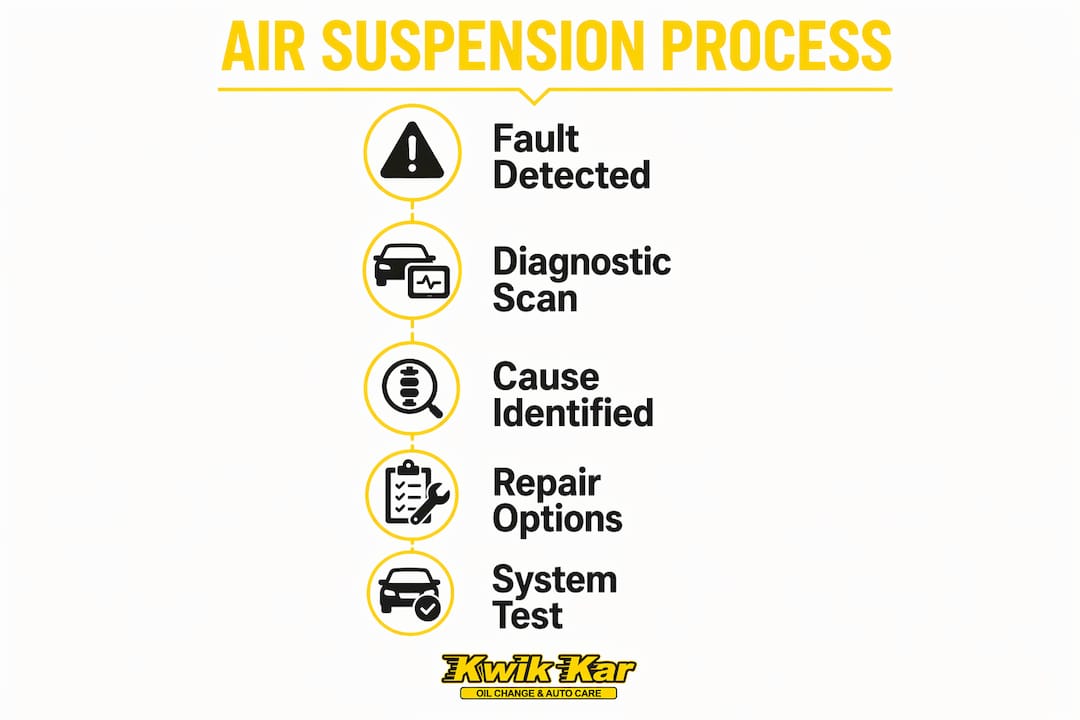
- What a technician will do to diagnose the fault
- Repair options and realistic U.S. cost ranges
- How long air suspension lasts and how to protect it
- How urgent is the warning, and what should you ask a shop?
- How Kwik Kar Oil Change & Auto Care handles air suspension faults
- Key Takeaways
- Why owners delay air suspension repairs (and why that’s a costly habit)
- Kwik Kar Oil Change & Auto Care: transparent diagnosis, fair pricing
- Useful sources
- FAQ
How Audi air suspension actually works
Audi’s air suspension replaces conventional steel coil springs with pressurized air bags, giving the car the ability to adjust ride height and damping on the fly. Five core components work together to make that happen:
- Air springs (air struts): Rubber-and-textile bladders that hold pressurized air and support the vehicle’s weight at each corner
- Compressor and desiccant dryer: An electric pump that fills the air springs; the dryer removes moisture to protect internal components
- Valve block: A solenoid-controlled manifold that routes air to individual springs and releases it when the car needs to lower
- Ride-height sensors: Linkage-mounted sensors at each corner that report actual ride height to the control module
- Suspension control module (ECU): The brain that reads sensor data, commands the compressor and valve block, and stores fault codes when something is out of range
Because every component talks to the module electronically, a fault can originate in hardware (a cracked air spring) or in wiring (a corroded sensor connector). That tight integration is exactly why a suspension module scan is the mandatory first step — visual inspection alone cannot tell you which component triggered the warning.
The most common causes behind the warning
Air-spring leaks are the most frequent trigger. The rubber bladders develop micro-cracks from road debris and repeated flexing, and even a slow leak is enough to set a fault code. Here are the causes ranked from most to least common:
- Leaking air spring or air strut — One sagging corner, especially after the car sits overnight, is the clearest symptom.
- Failed or overworked compressor — A leaking system forces the compressor to run continuously, eventually burning out the motor or piston. You may hear a loud, prolonged pump noise.
- Valve block failure — Stuck solenoids cause uneven height between corners or a car that won’t raise or lower on command.
- Ride-height sensor fault — A corroded connector or failed sensor sends implausible data to the module, triggering a code without any actual pressure loss.
- Wiring, connector, or module fault — Intermittent codes that appear and disappear often point here. Specific DTCs such as C118D01 can indicate transient electrical errors that don’t require major hardware replacement at all.
Pro Tip: The most expensive mistake Audi owners make is ignoring a slow air-spring leak. A small leak forces the compressor to run far longer than it was designed to, and compressor burnout follows. Fixing a leaking spring early typically costs a fraction of replacing both the spring and the compressor.
What happens when you keep driving with the warning on
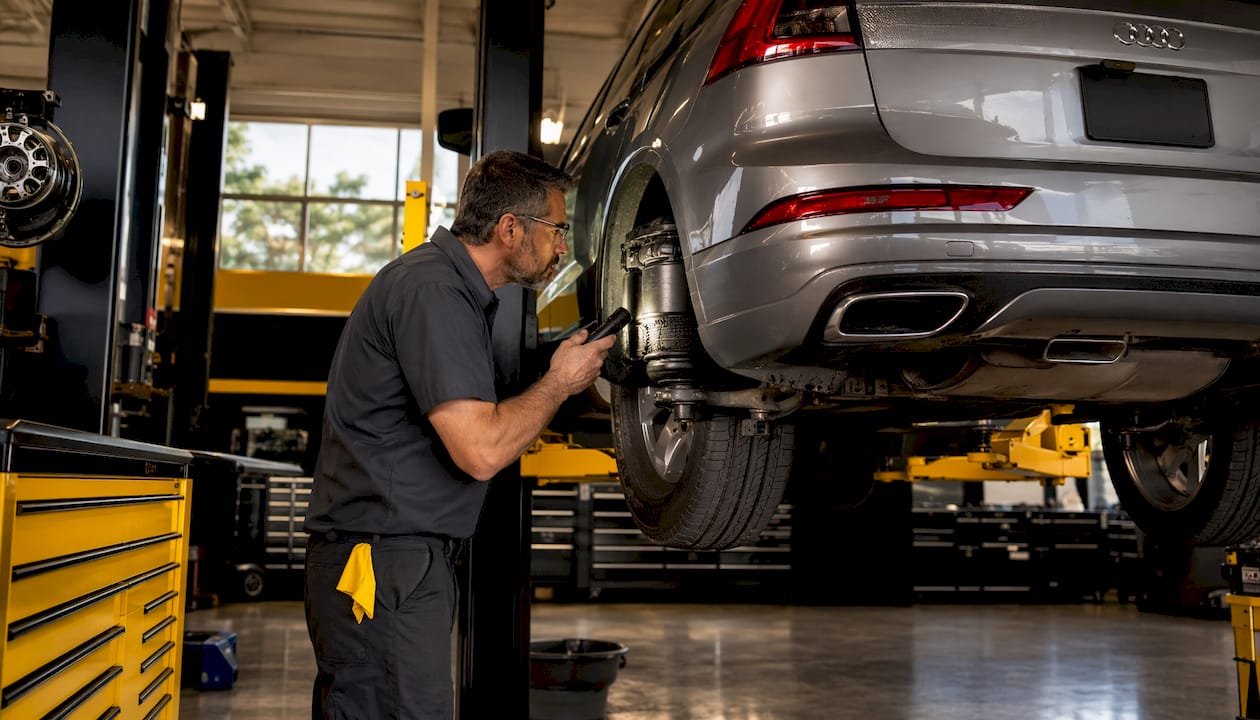
Continuing to drive without addressing the fault puts both safety and your wallet at risk. A sagging corner reduces braking stability and creates uneven tire wear that can shorten tire life significantly. The compressor, already working overtime to compensate for a leak, will eventually fail completely.
Specific impacts to expect:
- Reduced ride height at one or more corners, which lowers ground clearance and can cause undercarriage contact on dips or speed bumps
- Degraded handling, particularly during lane changes or emergency maneuvers
- Limp-home or reduced-function mode, where the system locks at a fixed height and disables automatic adjustments
- Expanded repair scope, because a failed compressor often sends debris into the valve block, requiring both components to be replaced
Stop driving and arrange a tow if: your Audi sits noticeably lower on one corner, steering feels vague or pulls to one side, or the ride height warning escalates to “vehicle too low.” The Audi S7 owner’s manual is explicit: a system fault can result in restricted driving stability, and the maximum recommended speed is 35 mph en route to a qualified workshop.
What a technician will do to diagnose the fault
A proper diagnosis starts with reading the suspension control module’s fault codes, not the generic OBD-II engine codes most basic scanners access. Shops equipped with VCDS or ODIS-capable tools can communicate directly with the suspension module, view live sensor data, and run output tests on individual solenoids.
The diagnostic sequence a qualified technician follows:
- Read DTCs and freeze-frame data from the suspension control module to identify which component or circuit flagged the fault
- Visual inspection of air springs, compressor, valve block, and wiring harnesses for obvious cracks, corrosion, or damage
- Pressure and leak test — inflate the system and monitor each corner for pressure drop over time to locate leaks
- Compressor load and run-time test — measure how long and how hard the compressor runs to reach target pressure
- Ride-height sensor plausibility check — compare live sensor readings against actual measured ride height at each corner
- Valve block output test — command individual solenoids and verify each corner responds correctly
A thorough scan and inspection typically takes about an hour at an independent shop. Diagnostic fees for a suspension-specific scan vary but can often be credited toward the repair cost if you proceed with them. Skipping the scan and replacing parts by guesswork is how owners spend $1,000 on a compressor only to find the real problem was a $40 sensor connector.

Repair options and realistic U.S. cost ranges
Cost varies widely depending on whether you need one targeted part or a full-system overhaul. The table below reflects typical U.S. independent-shop pricing; dealer rates generally run 20–40% higher.
| Repair | Typical Parts Cost | Typical Labor | Estimated Total |
|---|---|---|---|
| Single air spring replacement | $200–$600 | $200–$400 | $400–$1,000 |
| Pair of air springs (same axle) | $400–$1,200 | $300–$500 | $700–$1,700 |
| Compressor replacement only | $500–$1,000 | $200–$400 | $700–$1,400 |
| Valve block replacement | $300–$700 | $150–$300 | $450–$1,000 |
| Full 4-corner overhaul (springs + compressor + valve block) | $1,500–$3,500 | $600–$1,200 | $2,100–$4,700 |
| Coil-spring conversion | $800–$2,500 | $700–$1,200 | $1,500–$3,700 |
A few things worth knowing before you authorize any repair:
- Always replace or clean the valve block when installing a new compressor. Debris from a failed compressor can clog solenoids and cause the new unit to fail within months.
- OEM parts cost more but carry tighter tolerances. Aftermarket air springs vary significantly in quality; ask your shop which brand they use and whether it carries a warranty.
- Coil-spring conversion is worth considering after a second major failure. Conversion typically costs $1,500–$6,000 installed, eliminates future air-system risk, and suits owners who no longer need the ride-height adjustment feature. For a deeper look at suspension upgrade paths, this guide to suspension upgrades covers the trade-offs clearly.
- Request an itemized written estimate before work begins. Knowing exactly what each line item covers helps you compare quotes and spot unnecessary add-ons.
How long air suspension lasts and how to protect it
Many Audi owners encounter suspension problems after substantial mileage, though climate and usage play important roles. In well-maintained models, air struts and compressors can last for many miles before requiring attention.
Practical steps to extend system life:
- Listen for a compressor that runs longer than 20–30 seconds when the car adjusts height. Extended run time is the earliest warning of a slow leak.
- Check ride height visually after the car sits overnight. A corner that drops more than an inch is leaking.
- Replace the compressor desiccant at around 70,000 miles to prevent moisture from contaminating the valve block and air springs.
- Keep the valve block clean and flush it whenever the compressor is replaced.
- Schedule a preventive suspension inspection every 30,000 miles or any time you notice a change in ride quality.
Pro Tip: If you’re buying a used Audi with more than 80,000 miles, budget for potential air-suspension work before you commit. Use VCDS or OBDeleven to scan all modules during the pre-purchase inspection — stored suspension faults are a red flag even if the car feels fine on a test drive. A thorough pre-purchase inspection can save you thousands.
How urgent is the warning, and what should you ask a shop?
Urgency depends on what the car is doing, not just what the dashboard says. If ride height looks normal and handling feels unchanged, you can drive carefully to a shop within a day or two. If the car sits low on any corner, handling feels unstable, or the warning escalates, stop driving and arrange a tow.
When you call a shop, ask these questions directly:
- Do you have a scanner that reads the Audi suspension control module (VCDS or ODIS-capable)?
- Will you perform a pressure and leak test, not just a visual inspection?
- Do you recommend OEM or aftermarket parts, and what warranty do they carry?
- Will you clean or replace the valve block if the compressor needs to go?
- Can I get an itemized written estimate before you start?
A shop that hesitates on any of these questions is not the right shop for this repair. Understanding what a repair estimate should include before you walk in puts you in a much stronger position.
How Kwik Kar Oil Change & Auto Care handles air suspension faults
Kwik Kar Oil Change & Auto Care uses certified technicians and manufacturer-capable diagnostic equipment to find the actual root cause before recommending a single repair. The process is straightforward and transparent from the moment you arrive.
Here’s what to expect at a Kwik Kar appointment:
- Arrival inspection — a technician notes any visible ride-height differences and asks about symptoms you’ve observed
- Suspension module scan — the shop reads all DTCs and freeze-frame data from the air suspension control module using an OBD-II-compatible, Audi-capable scanner
- Pressure and leak test — the system is inflated and each corner is monitored for pressure loss
- Compressor load test — run time and current draw are measured to assess compressor health
- Repair recommendation — you receive a clear, itemized explanation of what failed, what needs to be replaced, and what it will cost before any work begins
- Recalibration and test drive — after the repair, the system is recalibrated and the car is driven to confirm the fault is resolved
Bring your VIN, the exact wording of the dashboard message, and any recent service records. A typical diagnostic appointment runs 60–90 minutes. If you’re facing a larger repair bill, auto repair financing options are available to help spread the cost.
Key Takeaways
The “Service Air Suspension System” warning on an Audi signals a real fault that requires a suspension module scan before any parts are replaced — acting early almost always costs less than waiting.
| Point | Details |
|---|---|
| What the warning means | A fault in the air suspension system, ranging from a leaking air spring to a failed compressor, sensor, or wiring issue. |
| Urgency level | Drive carefully at low speed to a shop if handling is normal; stop and tow if the car sits low or handles poorly. |
| Most common cause | Leaking air springs are the most frequent trigger; left unaddressed, they burn out the compressor. |
| Typical repair cost | Single air spring replacement and full 4-corner overhaul costs vary widely depending on parts and labor at independent shops. |
| Recommended next step | Kwik Kar Oil Change & Auto Care provides a suspension module scan, pressure test, and itemized estimate before any repair begins. |
Why owners delay air suspension repairs (and why that’s a costly habit)
The most common reason owners put off this repair is cost anxiety. The warning appears, the car still drives, and the hope is that it’s intermittent. That reasoning makes sense on the surface, but the system’s cascade failure pattern makes delay genuinely expensive. A slow air-spring leak is a $400–$700 fix at most shops. That same leak, left for another 5,000 miles, burns out the compressor and pushes the bill past $1,500. Add valve block contamination from compressor debris, and you’re looking at a full-system repair.
Getting a scan early doesn’t commit you to an expensive repair. It tells you exactly what you’re dealing with, which is the only way to make a smart decision. A complete air suspension system guide can help you understand the components involved before you walk into any shop.
Kwik Kar Oil Change & Auto Care: transparent diagnosis, fair pricing
When your Audi’s air suspension warning comes on, the last thing you need is a shop that replaces parts by guesswork and hands you a surprise bill. Kwik Kar Oil Change & Auto Care in Fort Worth offers a straightforward diagnostic appointment: a full suspension module scan, pressure and leak test, and a written itemized estimate — all before a single part is ordered.

Appointments typically run 60–90 minutes. Bring your VIN and note the exact message your dashboard displayed. Kwik Kar’s RepairPal-certified technicians will tell you exactly what failed, what it costs to fix, and whether OEM or quality aftermarket parts make more sense for your situation. For owners facing larger repairs, auto repair financing is available. If you want to get ahead of future repair costs, the 2026 car care prevention guide is a practical starting point. Call or stop by Kwik Kar Oil Change & Auto Care today to schedule your air suspension diagnostic.
Useful sources
- Biste Parts: Common Audi Air Suspension Problems — detailed breakdown of air-spring and compressor failure modes with repair guidance
- KnowsYourCar: Audi Allroad Air Suspension — mileage expectations, cascade failure explanation, and coil-conversion economics
- Meta Mechanics: Audi Suspension Fault — diagnostic tool requirements and live-data testing explained
- OEM DTC: Audi Technical Service Bulletin — example TSB showing how intermittent electrical codes can be resolved without major hardware replacement
- Vigor Air Ride: Audi Air Suspension Replacement Cost — component-level cost ranges for parts and labor
- LuxuryCarsGuide: Audi A8 Reliability and Suspension Failure Database — long-term ownership costs and mileage-onset data by component
- 24 Car Repair: Audi A6 Allroad Best and Worst Years — generation-by-generation reliability ratings and suspension failure frequency
FAQ
What does “Service Air Suspension System” mean on an Audi?
It means the suspension control module has detected a fault, which could be a leaking air spring, a failing compressor, a valve block issue, a sensor fault, or a wiring problem. A diagnostic scan of the suspension module is required to identify the specific cause.
How much does it cost to repair Audi air suspension?
Costs range from roughly $400–$1,000 for a single air spring at an independent shop to $2,100–$4,700 for a full 4-corner overhaul including compressor and valve block. Dealer rates typically run 20–40% higher than independent shops.
What is the lifespan of Audi air suspension components?
Many owners see problems between 60,000 and 100,000 miles, with climate and usage affecting the timeline. Air struts and compressors typically require attention somewhere within that range in most Audi models.
Is it safe to drive with the air suspension warning on?
You can drive carefully at reduced speeds to reach a shop if handling feels normal. Stop driving and arrange a tow if the car sits visibly low on any corner, handling is unstable, or the warning escalates to “vehicle too low.”
How expensive is a coil-spring conversion compared to repairing air suspension?
A coil-spring conversion typically costs $1,500–$6,000 installed, depending on vehicle and labor, and eliminates future air-system failures entirely. It eliminates future air-system failures entirely and typically makes financial sense after a second major failure or on high-mileage vehicles.