

An unexpected repair bill lands on your dashboard and your stomach drops. Whether it’s a transmission rebuild or a failing alternator, knowing what auto repair financing options mean is the difference between making a calm, informed decision and signing whatever paper the service desk puts in front of you. This guide breaks down every major financing type available in 2026, explains the real costs behind each one, and gives you the tools to choose what actually works for your budget. No confusing jargon, no filler — just clear, practical guidance.
Table of Contents
- Key takeaways
- What auto repair financing options mean for your wallet
- Understanding the real costs of auto repair financing
- How financing approvals and funding actually work
- Choosing the right financing option for your situation
- My take on auto repair financing after years in the shop
- Get trustworthy repairs and clear pricing in Fort Worth
- FAQ
Key takeaways
| Point | Details |
|---|---|
| Multiple financing types exist | Options range from Buy Now, Pay Later services to personal loans and in-house shop payment plans. |
| Interest rates vary widely | Rates span from 0% promotional offers to over 50% APR on no-credit-check loans. |
| Approval speed differs by type | BNPL and shop cards approve near-instantly; personal loans typically fund within 1 to 3 business days. |
| Total cost matters most | Compare total borrowing cost, not just monthly payment size, before signing any agreement. |
| Match the option to your repair | Small to mid-range repairs suit BNPL; major repairs over $2,000 usually call for a personal loan. |
What auto repair financing options mean for your wallet
Understanding auto repair financing explained simply means knowing which tools exist to pay for repairs over time instead of all at once. There are three primary financing methods you will encounter, and each one works differently depending on the size of the repair, your credit profile, and how fast you need the work done.
The three primary auto repair financing methods include Buy Now, Pay Later services for repairs in the $500 to $2,000 range, shop-branded or third-party credit cards, and unsecured personal loans for larger repairs ranging from $1,000 to $50,000. Here is how each one stacks up:
| Financing Type | Typical Repair Size | Credit Check | Speed of Approval | Common APR Range |
|---|---|---|---|---|
| BNPL (Affirm, Sunbit, Klarna) | $500 to $2,000 | Soft pull only | Near-instant | 0% to 35% |
| Shop-branded credit card | $300 to $5,000 | Soft or hard pull | Near-instant | 0% promo, then 26%+ |
| Unsecured personal loan | $1,000 to $50,000 | Hard pull required | 1 to 3 business days | 8% to 36% |
| In-house shop payment plan | Varies by shop | Often none | Immediate | 0% to varies |
Buy Now, Pay Later (BNPL) apps like Affirm, Sunbit, and Klarna are now common at larger repair shops and dealerships. They break your bill into equal installments, often over 3, 6, or 12 months. Many BNPL services use soft credit checks, so your score is not affected just by applying. That accessibility makes them useful when an unexpected repair catches you off guard.
Shop-branded credit cards work like a standard credit card but are tied to a specific automotive retailer or repair network. They typically offer a 0% promotional APR for 6 to 18 months. The catch is that if you carry a balance past the promotional period, the rate jumps sharply. These cards work well when you are confident you can pay off the balance before the promo ends.
Unsecured personal loans are the most flexible option for major repairs. Personal loans do not require collateral and give you the freedom to use any repair shop you trust. The trade-off is a hard credit inquiry and a longer approval process, though many online lenders now offer same-day decisions.

In-house shop financing is worth knowing about too. Repair shops often offer in-house payment plans, sometimes with 0% interest for a promotional period. These are convenient, but terms vary widely from shop to shop, so always read the details before committing.
Understanding the real costs of auto repair financing
Knowing the types is only half the picture. Auto repair financing explained fully has to include what each option actually costs you over time, not just what your monthly payment looks like.
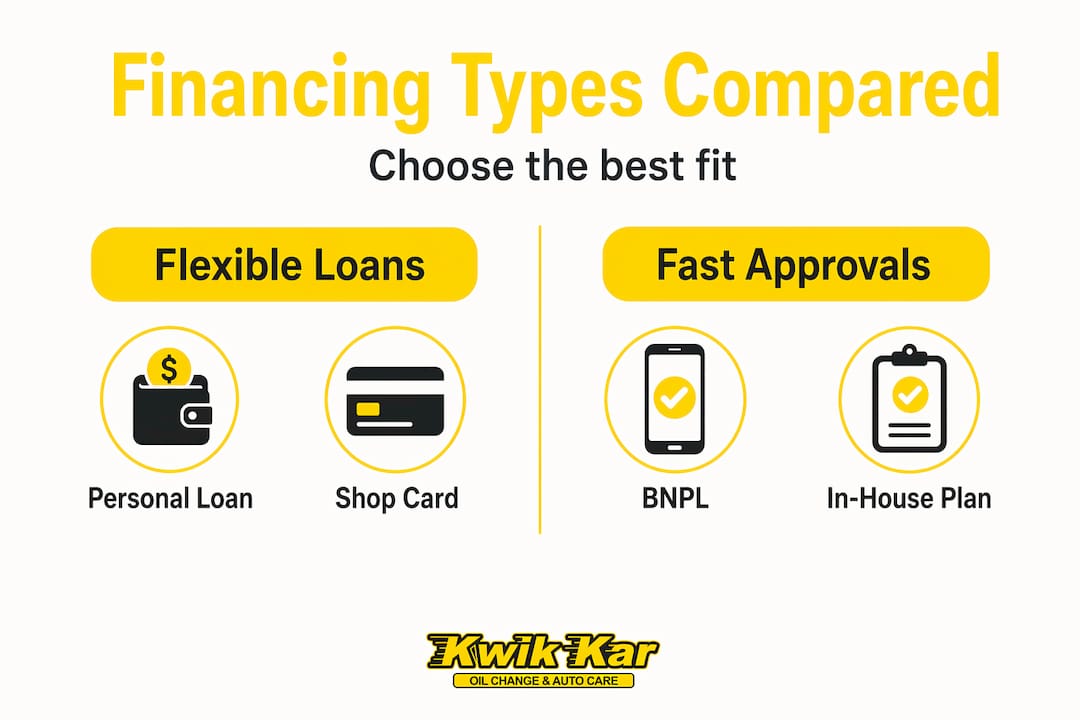
Interest rates across financing types vary dramatically: BNPL runs from 0% to 35% APR, credit card promotional rates start at 0% but can rise past 29% after the intro period, and personal loans land between 8% and 36% depending on your credit score. The most dangerous category is no-credit-check loans, which can easily exceed 50% APR. That rate turns a $1,200 repair into a $1,800 or $2,000 obligation by the time you finish paying.
Here is a practical order for evaluating financing costs before you sign:
- Calculate total repayment, not monthly payment. A $200 monthly payment sounds manageable, but stretched over 24 months at 28% APR, a $3,000 repair ends up costing closer to $4,200.
- Check for origination fees. Origination fees typically range from 1% to 8% and are added to your loan balance at the start, increasing what you owe before you make a single payment.
- Ask about prepayment penalties. Some lenders charge a fee if you pay off the loan early. This is worth asking about upfront, especially if your financial situation might improve.
- Watch the term length. Long repayment terms reduce monthly payments but increase the total interest you pay, sometimes substantially over 60 to 84 months.
- Avoid 0% BNPL traps. Read the fine print. Some BNPL plans charge deferred interest, meaning if you miss the payoff deadline, you owe interest on the original full balance retroactively.
Pro Tip: Before you accept any financing offer, ask the lender or shop to give you the total amount repaid figure, not just the monthly amount. This single number tells you the real price of borrowing.
How financing approvals and funding actually work
Speed matters when your car is sitting at the shop and you need transportation. Understanding auto repair loans means knowing not just what each option costs, but how quickly it can actually put your car back on the road.
BNPL services and shop-branded credit cards typically approve near-instantly at the point of sale. You apply on a tablet or phone at the service counter, and within minutes you have an answer. Personal loans usually take one to three business days for funds to arrive, though some online lenders advertise same-day funding for well-qualified applicants.
Here is what lenders and shops typically require during the application process:
- A valid government-issued ID and Social Security number for identity verification
- Proof of income, such as recent pay stubs or bank statements for personal loans
- A detailed repair estimate or invoice from the shop for loan-specific products
- Bank account information for direct deposit of loan funds or automatic payments
Pro Tip: Have your repair estimate ready before you apply for any financing. Lenders who specialize in auto repair loans often require this document, and having it on hand can cut your approval time significantly.
One detail many car owners miss is the difference between a pre-approval and a final approval. A pre-approval tells you the maximum amount you qualify for, but the final loan amount may depend on the actual repair invoice. If the shop’s estimate increases after they open up the vehicle, you may need to revisit your financing agreement. Staying in close communication with both the lender and the shop prevents delays in getting your car back.
Choosing the right financing option for your situation
This is where auto repair payment plans and loan types stop being abstract and start being personal. The right choice depends on the size of your repair, your credit profile, and how quickly you need to act.
Matching the loan type to the repair size and urgency is the clearest decision rule you can follow. BNPL works well for mid-range repairs where you can pay off the balance in a few months. Personal loans make more sense for anything above $2,000, especially when you need a longer repayment period.
Consider these factors before you commit:
- Your credit score. Scores above 670 open up better personal loan rates. Below that, BNPL or in-house shop financing may be more accessible, but examine the rates carefully.
- Your income stability. Fixed monthly payments require reliable income. If your income fluctuates, a shorter-term BNPL plan may carry less risk than a multi-year loan.
- The vehicle’s market value. Avoid financing repairs that cost more than your car is worth. If your vehicle has a resale value of $4,000 and the repair is $5,000, you may be better off considering replacement.
- Whether you want flexibility in shop choice. Personal loans give you the most freedom. Shop-specific financing ties you to one location.
“The best financing option is the one with the lowest total cost you can realistically manage on your current income — not the one with the lowest monthly payment.”
Shopping around is worth the effort. Getting two or three quotes on financing options for vehicle repairs, even if it takes an extra hour, can save you hundreds of dollars in interest. Many online lenders allow you to prequalify with a soft credit check, so you can compare offers without affecting your score. You can also learn more about why mechanics charge what they do to better understand how repair costs and financing needs connect.
My take on auto repair financing after years in the shop
I have seen car owners come in stressed, hand over a credit card with a 27% APR, and walk away without realizing they just turned a $900 repair into a $1,300 problem. That pattern shows up more often than it should, and it almost always comes down to one thing: they focused on whether they could afford the monthly payment, not the total cost.
What I have learned is that the financing options for vehicle repairs are genuinely useful tools when you understand them. BNPL can get your car back on the road today without touching your credit score, but only if you treat it like a short-term obligation, not a long-term crutch. Personal loans offer real flexibility, especially if your credit is solid enough to qualify for rates below 15%.
The trap I see most often is borrowing more than necessary because the lender approved a higher amount. Just because you qualify for a $5,000 loan does not mean you should take $5,000. Borrow exactly what the repair costs, nothing more.
My honest advice: approach financing the same way you would approach buying tires. Compare the total value, not just the upfront price. And always know the value of your vehicle before you authorize any major repair investment.
— Kwik Kar
Get trustworthy repairs and clear pricing in Fort Worth
At Kwik Kar Oil Change & Auto Care, we believe that knowing your repair cost upfront is just as important as the repair itself. Our RepairPal-certified technicians provide transparent estimates before any work begins, so you are never caught off guard by the final bill. Whether you are dealing with a routine oil change or a more significant repair, we make it straightforward.
If you are working through your financing options for vehicle repairs, start by finding a shop you can trust. Our Fort Worth repair guide covers cost-effective service options in the area, and our page on finding a trustworthy mechanic helps you ask the right questions before committing to any shop or financing plan. Dependable service and honest pricing are the foundation of every interaction at Kwik Kar Oil Change & Auto Care.
FAQ
What does auto repair financing actually mean?
Auto repair financing means using a loan, payment plan, or credit product to pay for vehicle repairs over time rather than all at once. Options include BNPL services, shop credit cards, personal loans, and in-house shop payment plans.
Which financing option is best for a small repair under $1,000?
BNPL services like Affirm or Sunbit are typically the best fit for repairs under $1,000 because they offer fast approval, soft credit checks, and short repayment terms that keep total interest costs low.
Will applying for auto repair financing hurt my credit score?
It depends on the type. BNPL services and many shop credit cards use soft credit pulls that do not affect your score, while personal loans require a hard credit inquiry that may cause a small, temporary dip.
How quickly can I get funds through auto repair financing?
BNPL and shop-branded cards approve near-instantly at the point of sale. Personal loans typically fund within 1 to 3 business days, though some lenders offer same-day funding for qualified borrowers.
What hidden costs should I watch for in auto repair loans?
Watch for origination fees between 1% and 8%, prepayment penalties, and deferred interest clauses in BNPL agreements. Always ask for the total repayment amount before you sign.