You are heading west on I-30, traffic is moving, and then the TPMS light comes on. Your first thought is usually simple. Not now.
If your vehicle has run-flat tires, the second thought is relief. You may not be stranded on the shoulder. But the third question is the one that costs people money and creates real safety problems later. Can you repair run flat tires, or do you have to replace them?
As an ASE-certified technician, the honest answer is not a clean yes or no. Some run-flat tires can be repaired under strict conditions. Many should not be. The difference comes down to where the puncture is, how long the tire was driven with low or no pressure, and what the manufacturer allows for that specific tire.
Big-box counters often reduce this to a script. Replace it, or patch it. Real life is tighter than that. On Fort Worth roads, where people keep driving to get off the freeway, the tire’s internal condition matters more than the hole you can see from the outside.
That Dreaded Light on Your Dashboard
A lot of drivers only learn what run-flat tires really do when that warning appears and the car still feels drivable.
That is the trap. The vehicle may not pull hard. The tire may not look flat from the outside. You may even think you got lucky and caught it early. Then you get to the shop and hear two completely different opinions from two different places.
Relief first, then uncertainty
Run-flat tires were built for this moment. They let you keep moving long enough to get somewhere safer. That is a real benefit, especially on a busy stretch of freeway or at night.
But that convenience creates confusion. Drivers assume “still drivable” means “still repairable.” It does not.
A warning light also gets mixed up with other alerts. If you are sorting out whether the issue is tire pressure, engine trouble, or something else on the dash, this guide on my engine light is on helps separate one warning from another before you make the wrong call.
The question customers ask at the counter
Customers frequently ask the same thing in slightly different words.
- Can you patch it like a normal tire
- Can I drive on it a little longer
- Is a repair safe
- Am I about to buy a whole new tire
Those are the right questions.
Key takeaway: A run-flat tire gives you time to reach help. It does not guarantee the tire will qualify for repair once you get there.
What matters next is the tire’s construction and what happened between the moment pressure dropped and the moment the wheel came off the car. That is where repair decisions are made.
What Makes a Run Flat Tire Different
A run-flat tire is built to keep supporting the vehicle after it loses air. That sounds like a simple benefit. In the shop, it changes the repair decision, the inspection process, and often the final bill.
The biggest difference is in the sidewall. A conventional tire needs air pressure to carry the vehicle normally. A run-flat uses reinforced sidewalls and internal structure to hold the car up for a limited distance after a puncture or sudden pressure loss.
That extra support helps a driver get off I-30, out of traffic, or home without stopping on the shoulder. For Fort Worth drivers, that can be a real safety advantage in summer heat, construction zones, and fast-moving freeway traffic.
It also comes with trade-offs.
A run-flat sidewall is stiffer than a standard tire, so the tire can continue rolling after pressure drops. That same stiffness can mask internal damage. From the outside, the tire may look usable. Inside, the sidewall may have been flexed and overheated while carrying the full weight of the vehicle with little or no air.
That is why two tires with the same nail in the tread may get two different answers at the counter. A standard tire that was caught quickly often has a straightforward repair path. A run-flat may have hidden structural damage from the distance driven after the warning came on.
Why the design changes the cost equation
Big-box stores often reduce this to a yes-or-no answer. The fundamental question is more specific: How far was it driven low, how hot did it get, and does the manufacturer allow repair after that kind of event?
Those details matter because run-flat technology buys you mobility up front, but it can reduce repair options later. In plain terms, the feature that helped you avoid a tow may also be the reason a replacement becomes the safer choice.
What a technician is checking
A proper inspection goes beyond finding the puncture.
- Sidewall condition: signs of internal stress, wrinkling, or heat damage
- Tread injury location: whether the puncture sits in an area that can even qualify for repair
- Evidence of low-pressure operation: clues that the tire carried the vehicle too long after losing air
- Brand rules: whether that specific manufacturer permits repair under those conditions
That is the part many drivers never hear. With run-flats, the hole is only one piece of the decision. The tire’s service history after the pressure loss often matters just as much.
The Official Rules for Repairing Run Flat Tires
A run-flat tire is repairable only if two things line up. The manufacturer has to allow it, and the tire has to pass a full internal inspection after it is removed from the wheel.
That sounds simple, but it is where Fort Worth drivers can make an expensive mistake. One shop may quote a repair based on the visible puncture. A careful shop will stop and verify the brand policy, the puncture location, and whether the tire shows signs of low-pressure operation. That extra inspection can save money if the tire qualifies. It also prevents paying for a repair on a tire that should have been replaced for safety.
Manufacturer policy decides the starting point
Run-flat repair rules are not universal. Some brands allow one repair under strict conditions. Others recommend replacement once the tire has been driven with little or no air pressure.
In the bay, that means the brand name on the sidewall matters before the plug-patch kit ever comes out.
A manufacturer that allows repair still limits where the puncture can be, how large it is, and whether the tire was driven too long while underinflated. Some manufacturers permit one repair, but that can still potentially affect broader road hazard coverage or warranty treatment. That is one of the financial trade-offs big-box stores often skip over at the counter.
What usually qualifies, and what does not
A repairable run-flat generally needs all of the following:
- Puncture in the center tread area
- Small, clean injury
- No puncture in the shoulder or sidewall
- No signs of internal heat or structural damage
- No evidence the tire was run too long at very low pressure
- Enough remaining tread to justify the repair, which you can compare against these tire tread depth safety guidelines
If any one of those items fails, replacement is usually the safer and cheaper call long term. Paying for a repair on a marginal run-flat, then replacing it weeks later, is how a low-cost fix turns into wasted money.
Run-Flat Tire Repair Policies by Manufacturer 2026
| Manufacturer | Repair Permitted? | Key Conditions / Notes |
|---|---|---|
| Bridgestone | Yes, conditionally | May allow repair under strict standards. Low-pressure operation can disqualify the tire |
| Hankook | Yes, conditionally | May allow repair under strict standards. Low-pressure operation can disqualify the tire |
| Goodyear | Yes, conditionally | May allow a limited repair after inspection by a qualified professional |
| Michelin | Yes, conditionally | Repair may be allowed only if inspection confirms no internal damage |
| Pirelli | Generally no after zero-pressure use | Replacement is commonly recommended after zero-pressure operation |
| Yokohama | Generally no after zero-pressure use | Replacement is commonly recommended after zero-pressure operation |
| Continental | Generally no after zero-pressure use | Replacement is commonly recommended after zero-pressure operation |
Shop-floor rule. If the tire maker says no repair, a responsible shop should not override that to make a sale.
Why drivers hear different answers
The conflict usually comes from process, not guesswork. One store may inspect only the puncture area and give a quick yes. Another will dismount the tire, inspect the inner liner, check the service history, and decline the job if anything looks questionable.
That stricter answer can feel frustrating in the moment. It is often the answer that protects you from a highway failure later.
And if the tire shows visible structural problems, such as a bubble on your tire, repair is off the table. At that point, the question is no longer how to save the tire. The question is how quickly to replace it before the damage gets worse.
Signs Your Run Flat Tire Must Be Replaced
A run-flat tire can fail the inspection even when the hole itself looks minor.
That frustrates drivers because the tire may look fine mounted on the wheel. But the disqualifying damage is often inside, not outside.
Internal damage is the deciding factor
Bridgestone prohibits repairs if the inner liner shows “creasing,” “cracking,” or rubber “crumb/dust” deposits”, signs that the run-flat was operated at low pressure too long and the sidewall support ring may have developed micro-fractures that can fail under load, according to Bush Tyres’ summary of run-flat inspection standards.
Those signs do not show up in a parking lot glance. A technician has to remove the tire and inspect the inside.
What usually forces replacement
Some disqualifiers are immediate.
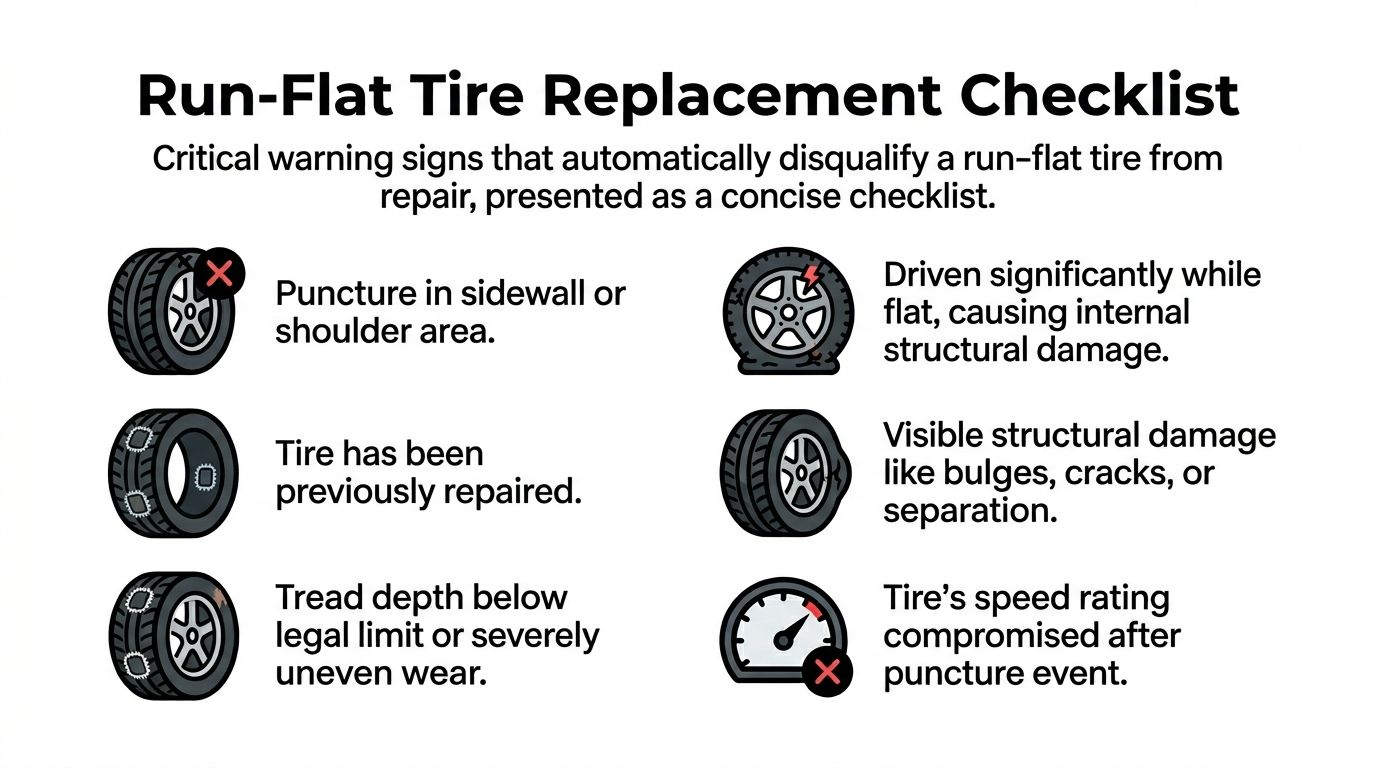
- Sidewall or shoulder damage: These zones are not repair territory.
- Evidence of low-pressure operation: Internal liner marks, cracking, or rubber debris end the discussion.
- Bulges, splits, or separation: If you notice a bubble on your tire, the structure has already been compromised.
- Severe or uneven tread wear: A puncture is not the only problem if the tire is already worn out.
- Previous repair history: Many run-flat policies allow only one conditional repair, if any.
Tread condition matters too. If you are not sure whether the tire is already near the end of service life, this guide on tire tread depth safety is worth checking before you spend money on a repair that does not make sense.
What drivers often misunderstand
The most common misunderstanding is this. “I only drove a little bit on it.”
That may be true. But “a little bit” on a loaded freeway shoulder, a frontage road, or a hot Texas afternoon can still be enough to leave inspection marks inside the tire.
Replace, do not repair, when internal support damage is suspected. A successful air seal does not restore a damaged support structure.
That is why a responsible technician may reject a patch on a tire that looks fixable from the outside. They are not upselling the job. They are refusing a future failure.
The Safe Way to Repair a Run Flat Tire
If a run-flat passes inspection and the manufacturer allows repair, the repair method is not optional.
A proper repair demands a patch-plug combination from the interior under Tire Industry Association protocols. External plugs are not enough, and punctures must be in the center tread and no larger than 1/4 inch, as explained by Scott’s U-Save in its run-flat repair guidance.
What the correct process looks like
The tire must come off the wheel. That is step one, not an upsell.
Once dismounted, the technician inspects the inner liner and sidewall area for signs that the tire ran too long with low pressure. If it passes, the puncture channel is prepared and repaired with a combination unit that seals the injury path and the inner liner together.
That matters because a run-flat has a unique structure. An outside-only plug can block obvious leakage, but it does not let anyone verify internal damage and it does not restore the liner the right way.
What does not work
Be cautious if a shop offers a shortcut.
- External string plug only: Fast, cheap, and not the approved fix for a run-flat.
- No dismount inspection: If the tire never leaves the wheel, nobody has checked the damage that matters most.
- Repairing shoulder or sidewall damage: That is not a close call. It is a no.
- Repairing oversized punctures: Once the injury exceeds the allowed size, replacement is the safe path.
Questions worth asking the shop
You do not need to be a tire engineer to protect yourself. Ask simple questions.
- Did you dismount the tire?
- Did you inspect the inside?
- Is the puncture in the center tread?
- Is the repair method an internal patch-plug combination?
- Does the manufacturer allow this repair?
A shop that performs safe run-flat repairs should answer those clearly.
Costs Alternatives and Hidden Considerations
A lot of Fort Worth drivers get to this point and ask the same question. Is it smarter to pay for a repair, or cut losses and replace the tire now?
That depends on more than the puncture itself.
Run-flat tires cost more than standard tires, so the temptation to save one is real. I understand that. But with run-flats, the cheapest invoice is not always the lowest total cost. A repair that meets the tire maker's rules can be a good value. A repair forced onto a tire that should have been replaced usually turns into extra expense, extra downtime, and more risk than the original puncture.
The cost question big-box stores often skip
The first number on the estimate does not tell the whole story.
If the tire qualifies, a proper repair can buy useful service life at a much lower cost than replacement. If it does not qualify, trying to squeeze more miles out of it can lead to uneven wear, noise, repeat air loss, or replacement shortly after you already paid for a repair. That is money spent twice.
There is also the vehicle side of the decision. Some cars are tuned around run-flat construction, especially for load support and handling response. Switching tire types can change ride quality, steering feel, and what you need to carry for a roadside emergency. Before making that change, it helps to get a professional recommendation from a shop that handles tire repair and replacement services on these vehicles regularly.
Hidden considerations after the repair
The tire itself is only part of the decision.
- Warranty limits: Some manufacturers permit a repair but still limit other warranty benefits afterward.
- Documentation: If there is ever a later claim involving the tire, the repair method and service record matter.
- TPMS reset and verification: A repaired tire still needs correct pressure monitoring system operation. If the warning stays on or the sensor data is off, you have another problem to address.
- Tread match: If replacement is required, the remaining tread depth on the opposite tire matters on many vehicles. One tire may not always be the right answer.
The alternatives
Drivers usually have three practical choices.
Replace the run-flat with the same type and keep the vehicle set up as designed. That usually preserves the handling and roadside mobility the car was built around, but it often costs more.
Convert to conventional tires and add a spare, inflator kit, or roadside assistance plan. That can reduce future tire costs and sometimes improve ride comfort, but it gives up the run-flat's ability to keep moving after a puncture.
Consider self-sealing tires if the vehicle and tire size support that option. They can help with certain tread punctures, but they are not a substitute for every run-flat feature and they do not erase the need for proper inspection.
For a driver who spends most of the week on Fort Worth streets and highways, the right choice usually comes down to two priorities. How much roadside convenience do you want, and how much are you willing to spend to keep it?
Saving a run-flat makes sense only when the tire qualifies, the repair is done correctly, and the remaining service life justifies the cost.
Your Decision and When to Call Kwik Kar
By this point, the answer to can you repair run flat tires should feel clearer. The answer is maybe, and that maybe has strict boundaries.
A run-flat repair is only worth considering when all of the following line up:
The quick decision framework
- The puncture is in the center tread
- The puncture is small enough to qualify for repair
- The manufacturer allows repair for that tire
- The tire was not driven too long while underinflated
- The internal inspection shows no disqualifying damage
Miss one of those, and replacement is usually the responsible recommendation.
When not to guess
This is not a driveway judgment call.
You cannot confirm inner-liner creasing, cracking, or support-ring damage with the tire still mounted. You also cannot safely assume that a tire that still holds air after a puncture is structurally sound enough to stay in service.
That is why the final answer should come from a certified inspection, not a visual guess or a quick plug kit.
If you need a professional tire evaluation, repair, or replacement decision, the tire service team can be found at Kwik Kar tire services.
The bottom line for Fort Worth drivers
On local roads, the dangerous mistake is trying to save a repairable-looking tire that has already failed internally. The expensive mistake is replacing a tire that met the manufacturer’s repair rules and passed inspection.
A good technician protects you from both.
If the tire qualifies, a proper repair can be the smart move. If it does not, replacement is not bad news. It is how you avoid a much worse failure later.
If your run-flat tire has a puncture and you want an honest answer based on safety, manufacturer rules, and real inspection standards, schedule an evaluation with Kwik Kar Oil Change and Auto Care. The team can inspect the tire, explain whether repair is on the table, and help you make the most cost-effective decision that still protects your vehicle and everyone riding in it.