That gut-wrenching feeling when your check engine light pops on? It's usually followed by an even bigger worry: finding a mechanic who won’t take you for a ride. The secret to finding a trustworthy mechanic is actually pretty straightforward. It starts with good old-fashioned local recommendations, followed by a bit of digital legwork to check their reputation and credentials before you ever hand over your keys.
Finding a Mechanic You Can Trust Starts Here
Let's be honest, navigating the world of auto repair can feel like a maze. But with a clear plan, you can confidently find a shop you can stick with for the long haul. This guide is your roadmap—it cuts through the noise and gives you a practical, step-by-step approach to finding a technician who values honesty and expertise as much as you do.
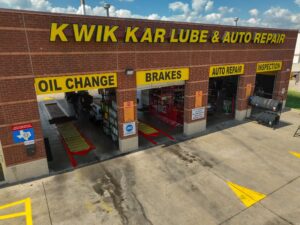
The goal isn't just to get a one-and-done fix. It's about building a relationship with a professional who will help you keep your vehicle running smoothly for years, whether it's a stellar independent shop like Kwik Kar here in Fort Worth or a local dealership you trust.
Why Independent Shops Are a Great Place to Start
Many people assume dealerships are the only option for quality service, but the numbers tell a different story. The U.S. auto repair market is massive—a $413.7 billion industry—and a staggering 75% of all repair work is done at independent shops, not dealerships. This tells you that smart drivers looking for a great mechanic often find the best service and value at local, owner-operated businesses.
This is a huge advantage for car owners. Independent shops, like Kwik Kar Oil Change & Auto Care in Fort Worth, are where you’ll often find:
- More personalized service: You're way more likely to talk directly with the person actually working on your car.
- Competitive pricing: Without the massive overhead of a big dealership, independent shops can usually offer more reasonable labor rates.
- A commitment to the community: A local shop lives and dies by its reputation, which is a powerful motivator to do honest, reliable work.
Your Initial Search Strategy
The first thing you need to do is build a shortlist of potential shops. The best way to start? Tap into your local network. Ask friends, family, and coworkers who they trust with their cars. A personal referral is gold because it comes with a built-in layer of trust.
Once you have a few names, it's time to do a quick digital background check. Look up their website, read through customer reviews, and see if they list any professional affiliations. This initial screening helps you weed out any shops that don't meet a basic level of professionalism right off the bat. A truly trustworthy mechanic will also have a broad knowledge of a vehicle's needs, including recommending various automotive services that contribute to your car's health and performance over time.
How to Vet Credentials and Read Online Reviews
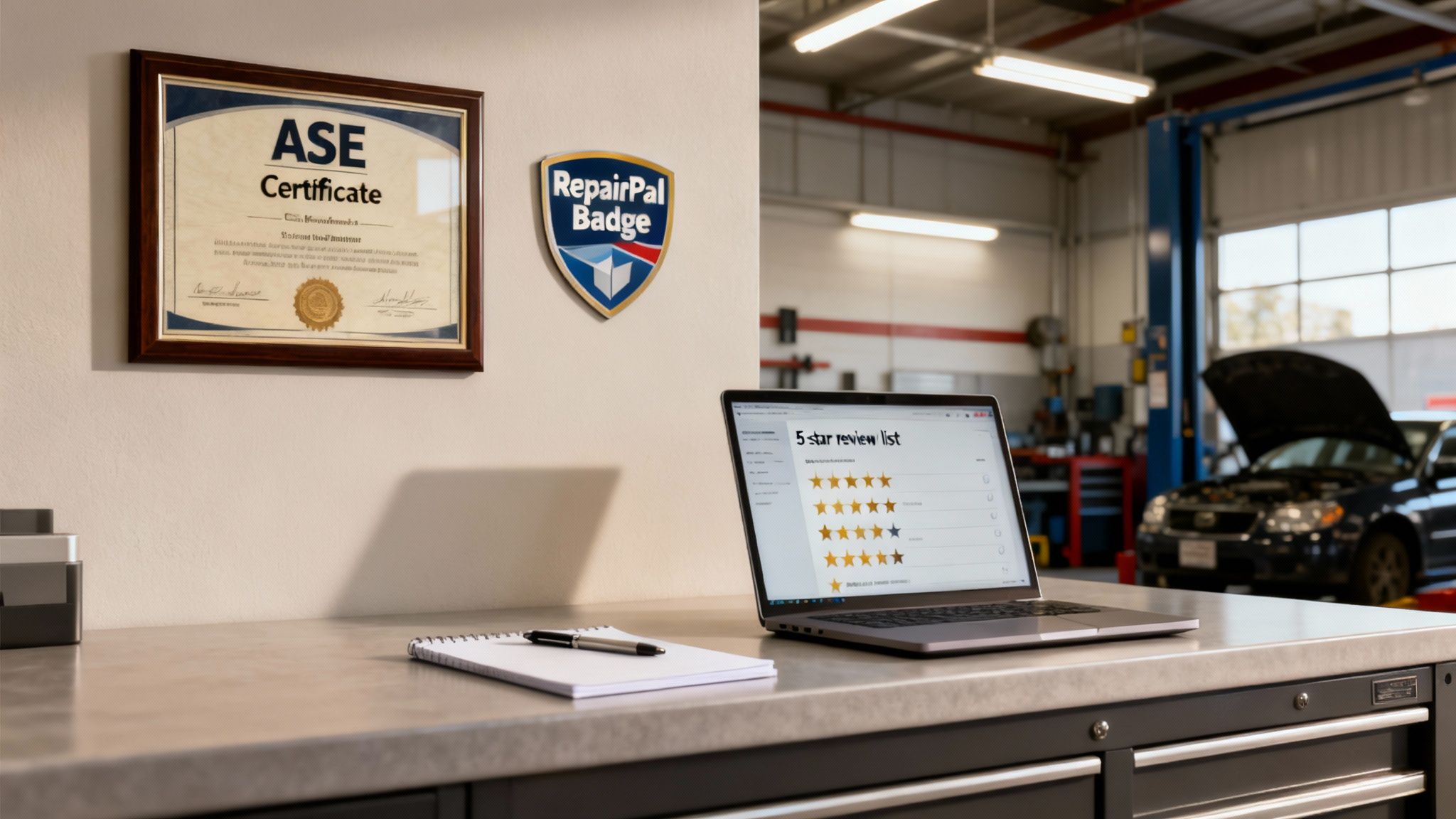
Alright, you’ve got a short list of potential mechanics. Now comes the most important part: doing your homework. Anyone can talk a good game, but genuine expertise and a solid reputation are things that have to be earned. This is where you separate the real pros from the rest before you even pick up the phone.
Think of it as a background check for your car. You’re digging for proof that a shop has the training, the right tools, and a customer-first attitude to take care of your vehicle properly.
Decoding Industry Certifications
Certifications aren’t just framed paper on a wall; they’re proof of a shop's commitment to staying current and investing in their team. It’s one of the clearest signals you're dealing with professionals who take their craft seriously.
The auto repair industry is actually facing a major skills gap. A recent report found that 31% of U.S. auto repair shops say a shortage of qualified technicians is their biggest hurdle. When a shop like Kwik Kar goes the extra mile to get and maintain certifications, it shows they’re dedicated to a level of quality that others might skip. That investment in their team pays off directly in the reliable service you receive. You can read more about these industry trends in this detailed auto repair report.
Here are the big ones to watch for:
- ASE (Automotive Service Excellence) Certification: This is the gold standard. To get ASE-certified, technicians have to pass tough exams and have real, hands-on work experience. Seeing that classic blue and white ASE sign is a very good sign.
- RepairPal Certification: This one is a huge win for car owners. A RepairPal Certified shop has passed a rigorous technical inspection, promises fair pricing within an established range, and backs their work with at least a 12-month/12,000-mile warranty. Finding a shop with this seal of approval, like Kwik Kar here in Fort Worth, gives you incredible peace of mind.
The Power of Online Reviews
While certifications prove a mechanic knows their stuff, online reviews tell you about the experience. They give you a real window into how a shop communicates, how honest they are, and what it’s actually like to be their customer. But you have to know how to read them.
Don't get fixated on a perfect 5.0-star rating. A shop with a 4.8-star average across 500 reviews is almost always a safer bet than one with a perfect score from only 15 reviews. Volume and consistency over time are what you’re looking for.
Pro Tip: Look for negative reviews and, more importantly, see how the shop responds. A calm, professional reply that offers to solve the problem is a massive green flag. It shows they value their reputation and aren't afraid to take responsibility.
How to Read Between the Lines of Customer Feedback
As you scroll through reviews on Google, Yelp, or the Better Business Bureau (BBB), you’re looking for patterns. One person’s bad day isn’t a trend, but if you see the same comments over and over, pay attention.
Positive Patterns to Look For:
- Specifics are good: "Mike explained exactly why my alternator failed" is way more valuable than "Great service." Details suggest a genuine experience.
- Honesty is mentioned: Look for phrases like "they saved me money" or "told me I didn't need a repair I thought I did."
- Communication is praised: If multiple people say the shop kept them updated throughout the repair, that’s a huge plus.
Negative Patterns to Watch For:
- The same complaints: If you see multiple reviews mentioning surprise fees, busted deadlines, or rude staff, believe them.
- Pressure and upselling: Comments about feeling pushed into expensive, unplanned services are a serious warning.
- The problem isn't fixed: The biggest red flag of all? Reviews from people who had to bring their car back because the initial issue wasn't resolved, or worse, a new one popped up.
By looking at a shop’s official credentials and its real-world reputation, you get the full picture. This two-step process ensures you’re choosing a mechanic who’s not only a skilled technician but also someone you can trust. For a closer look, see our guide on what to expect from a certified mechanic near you.
Asking the Right Questions Before Handing Over Your Keys
Walking into a potential auto shop isn't just a quick visit; it's more like an interview, and you're the one in the hiring manager's seat. The conversation you have before agreeing to any work is your single best tool for gauging their expertise, honesty, and overall vibe.
The right questions cut right through a sales pitch and show you how a shop really operates. This initial chat sets the tone for your entire relationship. A trustworthy mechanic will welcome your questions, give you clear answers, and make you feel confident. Anyone who gets defensive, buries you in confusing jargon, or tries to rush you is waving a massive red flag.
Questions About Their Expertise and Process
Before you even think about costs, you need to be sure they know what they’re doing, especially with your specific car. Modern vehicles are incredibly complex, and a one-size-fits-all approach just doesn't cut it anymore.
Start with the fundamentals of their experience:
- “Do you specialize in my vehicle’s make?” A shop that mostly works on domestic trucks might not be the best fit for your German sedan. While many mechanics are versatile, a specialist will know the common quirks and already have the right diagnostic tools for your car.
- “Are your technicians ASE Certified?” We've talked about certifications, but asking them directly shows it’s a priority for you. A confident "yes" from the service advisor is exactly what you want to hear.
- “Can you walk me through your diagnostic process?” This is a fantastic question to test their transparency. A good mechanic will explain how they’ll use scan tools, conduct visual inspections, or run specific tests to pinpoint the problem instead of just guessing.
Their answers should be direct and easy to understand. If they can’t clearly outline how they'll figure out what's wrong, it could signal a lack of a systematic, professional approach.
A mechanic’s willingness to explain a complex repair in simple terms is a direct reflection of their confidence and honesty. If they make you feel confused, it might be intentional. A real pro wants you to understand the value of their work.
Discussing Parts, Warranties, and Communication
Once you feel good about their technical skills, the next set of questions should focus on the business side of the repair. This is where hidden costs and future frustrations often pop up, so getting clarity now prevents major surprises later.
A shop's policy on parts and warranties says a lot about the quality of their work. A solid warranty means they use reliable parts and trust their technicians to install them correctly.
Be sure to ask these crucial questions:
- “What kind of warranty do you offer on parts and labor?” A minimum 12-month/12,000-mile warranty is the industry standard. Top-tier shops, like Kwik Kar here in Fort Worth, often stand by their work with robust guarantees that give you real peace of mind.
- “Do you use OEM, OEM-equivalent, or aftermarket parts?” There’s a time and place for each. A trustworthy mechanic will explain the pros and cons—like cost versus longevity—and recommend the best option for your specific repair and budget.
- “How will you communicate with me during the repair?” Will they call or text with updates? Most importantly, will they get your explicit approval before doing any work that goes beyond the initial written estimate? The answer to this has to be a firm "yes."
Understanding how a shop operates behind the scenes is just as important as knowing they can fix your car. For instance, knowing what's involved in routine services helps you gauge their thoroughness; you can learn more by checking out this overview of what a car tune-up includes. By asking these questions, you’re setting clear expectations and making sure you find a trustworthy partner who respects both your time and your budget.
Spotting Red Flags Before They Cost You Money
Knowing what to look for in a great mechanic is only half the battle. You also have to know how to spot the warning signs of a bad one. Your gut instinct is a powerful tool here, but backing it up with a few key things to watch for can save you a world of headaches and money.
Think of it as your field guide to sniffing out trouble before you hand over the keys.
High-Pressure Tactics Are a No-Go
A trustworthy mechanic wants you to feel confident and informed, not backed into a corner. One of the biggest red flags is high-pressure sales tactics. If a service advisor is telling you a repair must be done this very second or your car will be unsafe, it's time to pause.
While some issues are genuinely urgent, a real professional will calmly explain the problem, outline the risks, and give you the space to make a decision or get a second opinion. They should never use fear to rush you into an expensive repair. That kind of urgency is often just a trick to keep you from comparing prices.
The Paper Trail of Trust
Clear, professional communication is everything, and in the auto repair world, that starts with a written estimate. A huge warning sign is any hesitation—or outright refusal—to provide a detailed, written estimate before any work begins. This document is your protection.
A proper estimate isn't just a number scribbled on a notepad. It should clearly break down:
- The cost of all parts
- Estimated labor hours and the shop's hourly rate
- Any additional shop fees or taxes
If all you get is a vague verbal guess, you can bet the final bill will be full of surprises. An honest shop, like Kwik Kar, operates with total transparency and makes sure you understand every cost upfront.
Communication and Shop Environment
Pay close attention to how they talk to you. If a mechanic hits you with a wall of confusing technical jargon and gets visibly annoyed when you ask for a simpler explanation, that's a problem. They might be trying to confuse you or make you feel too intimidated to ask questions. A great mechanic can explain a complex transmission issue in a way anyone can understand.
A mechanic's willingness to educate you is a sign of respect. They should be your partner in maintaining your vehicle, not a gatekeeper of secret knowledge. If they make you feel small for asking questions, it’s time to walk away.
Don't forget to look around, either. Sure, a repair shop isn't going to be spotless, but there's a huge difference between a busy, well-run garage and a place that's just plain filthy and disorganized. A chaotic workspace often reflects a chaotic work process. You don't want that lack of attention to detail when someone's working on your brakes.
To help you get the right information, here are some of the most important questions you should be asking any potential mechanic.
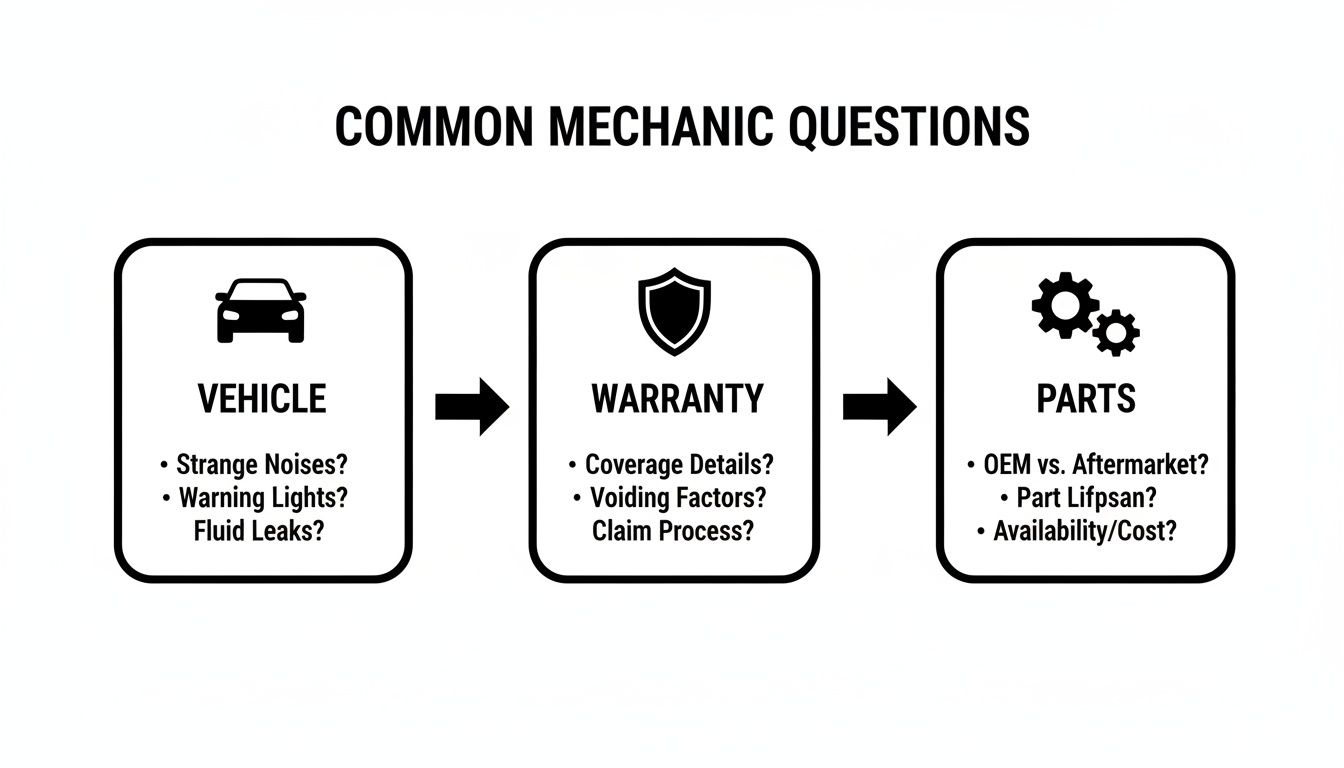
A good shop will have no problem answering questions about their experience with your car's make, what their warranty covers, and where they source their parts.
To make it even clearer, here’s a quick comparison of what you want to see versus what should make you walk away.
Trustworthy Mechanic vs. Red Flag Behavior
| Positive Sign (Green Flag) | Warning Sign (Red Flag) |
|---|---|
| Provides a detailed, written estimate upfront. | Gives a vague verbal quote or is hesitant to write it down. |
| Clearly explains the problem and answers all your questions. | Uses confusing jargon and seems annoyed by questions. |
| Recommends services but gives you space to decide. | Uses high-pressure tactics to force an immediate decision. |
| Has a clean, organized waiting area and a tidy shop floor. | The shop is disorganized, dirty, and chaotic. |
| Offers a clear warranty on both parts and labor. | Offers no warranty or has vague, confusing warranty terms. |
| Has positive online reviews and industry certifications (like ASE). | Has mostly negative reviews or no online presence at all. |
Watching for these signs can quickly help you sort the good shops from the ones you'll regret visiting.
Beware of the "Too Good to Be True" Quote
Finally, if a quote seems unbelievably low, you should be suspicious. It’s a classic bait-and-switch. A shop might offer a rock-bottom price to get your car on the lift, only to "discover" a dozen other "urgent" problems that send the final bill skyrocketing.
This is exactly why comparing detailed, written estimates is so critical. A slightly higher price from a certified, reputable shop that uses quality parts and offers a solid warranty is always a better deal than a lowball offer that ends in shoddy work or a surprise invoice.
Getting familiar with your car's needs before you even go to the shop can also be a huge help. Using a good car inspection checklist can give you a baseline so you know what to expect. By spotting these red flags early, you can avoid a bad experience and find a mechanic who will keep your car running safely for years to come.
Making Your Final Decision with Confidence
You've done the homework, asked the tough questions, and narrowed down your list. Now comes the moment of truth: picking the shop you'll stick with for the long haul. This isn't just about picking a name off a list; it's about making a final, confident choice that will save you headaches for years to come.
Think of this last step as turning your research into a real-world relationship. It's time to confirm your gut feeling and find a partner you can truly trust with your vehicle.
Why a Second Opinion Is Smart for Major Repairs
Let's say a shop tells you it's time for a transmission rebuild or a new head gasket. Before you commit to a repair that expensive, getting a second opinion isn't a sign of distrust—it’s just plain smart.
If another reputable mechanic independently comes to the same conclusion and gives you a similar quote, you can move forward feeling 100% certain. But what if the second diagnosis is totally different? You might have just saved yourself hundreds, or even thousands, on a misdiagnosis. A genuinely honest mechanic will understand and even encourage you to get another quote; they won't pressure you into a decision.
Compare Written Estimates Beyond the Bottom Line
By now, you should have written estimates from your top two or three choices. It's so tempting to just glance at the final number at the bottom of the page, but the real story is always in the details. A cheaper quote often means you're giving something up.
Lay the estimates out side-by-side and look closer:
- Labor Rates: Is the hourly rate clearly stated? An unusually low rate might be a red flag for an inexperienced technician.
- Parts Quality: Does the quote specify OEM (Original Equipment Manufacturer), aftermarket, or used parts? This is a huge factor in how long the repair will last.
- Warranty Terms: A shop offering a solid 24-month/24,000-mile warranty clearly stands behind its work. One offering just 90 days? Not so much.
Comparing these details helps you see the true value you're getting, not just the upfront cost. A slightly more expensive repair that uses better parts and comes with a strong warranty is almost always the smarter investment.
The Power of the "Test Drive" Repair
One of the best ways to lock in your decision is to start small. Don't bring your car in for a major overhaul right away. Instead, book a simple, low-stakes service like a routine oil change or a state inspection. This is your "test drive" of the shop itself.
This is your final interview with them. You get to experience their customer service firsthand, see how clean and organized the shop is, and judge the quality of their work on a simple task—all without a big financial commitment. It’s a low-risk way to confirm you’ve made the right call.
This strategy is more relevant than ever. Recent studies show that U.S. dealership service visits have dropped from 33% to 29% of the market, while independent shops have grown from 9% to 12%. People are actively choosing independent shops like Kwik Kar because they often deliver better value and a more personal touch. You can read more about this shift in the service industry and see why drivers are making the switch.
During that oil change, pay close attention. Are the staff friendly and professional? Did they finish the work when they said they would? Does the final bill match the quote they gave you? A smooth, hassle-free experience on a small job is a great sign that you've found a reliable mechanic for the bigger things down the road. Once you feel confident, you can easily book your next appointment online and start building that lasting relationship.
Got Questions? We’ve Got Answers.
Even after doing your homework, a few questions might still be bouncing around in your head. That’s completely normal. Let's tackle some of the most common ones that car owners ask when they're on the hunt for a mechanic they can trust.
Should I Go to a Dealership or an Independent Shop?
This is a classic dilemma, and the right answer really comes down to your car and what you value most. Dealerships are the specialists—they live and breathe your specific brand and only use original manufacturer parts. This makes them a great option for newer cars still under warranty or for those really tricky, model-specific problems. The trade-off? That specialized service usually comes with a much higher price tag.
On the other hand, you have independent mechanics. They typically offer more budget-friendly pricing and a more personal touch. They're the go-to for most post-warranty repairs and all the routine maintenance that keeps your car happy. When you consider that independent shops handle a whopping 75% of all auto repair work in the U.S., it's clear they're a reliable and often more sensible choice for the average driver.
What’s the Big Deal with OEM vs. Aftermarket Parts?
Understanding the parts going into your car is a big deal because it directly affects the repair's cost, quality, and how long it's going to last.
- OEM (Original Equipment Manufacturer) Parts: Think of these as factory-direct parts. They're made by your car's manufacturer and are an exact match for what was in your car when it rolled off the assembly line. You get a guaranteed fit and performance, but they're almost always the priciest option.
- Aftermarket Parts: These are made by other companies, not the car manufacturer. The quality can be all over the map—some are just as good (or even better) than OEM, while others are… not. The secret is to use parts from a well-respected brand.
A good mechanic won't just slap a part in; they'll walk you through the pros and cons for your specific repair. They should be able to explain why they recommend one over the other for your car and budget, and it should all be spelled out clearly on the estimate.
Don't be shy about asking, "Why this particular brand of aftermarket part?" A mechanic who knows their stuff will have a solid reason, like a great track record for reliability or a better warranty, and they’ll be happy to tell you.
What if I Have a Problem with a Repair After the Fact?
It’s a situation no one wants to be in, but there’s a right way to handle it. The first step is to stay calm and professional. Go back to the shop with your original invoice and any other paperwork and ask to speak with the manager. Reputable shops, like us here at Kwik Kar, care deeply about their reputation and will almost always work with you to make things right.
If you can't get a fair resolution by talking to them directly, your next move is to check the repair warranty you were given. If the shop won't honor it, you can file a complaint with the Better Business Bureau (BBB) or your state's consumer protection agency. This is where choosing a RepairPal Certified shop gives you a huge advantage—RepairPal often steps in to help mediate and resolve disputes.
Should I Just Pick the Cheapest Quote?
In a word: no. While we all love to save a buck, the cheapest quote in auto repair is rarely the best value. An unusually low price is often a massive red flag that could mean a few things are happening behind the scenes:
- Cheap, Low-Quality Parts: They might be using subpar parts that are destined to fail way sooner than they should.
- Inexperienced Techs: A rock-bottom labor rate could mean the person working on your car lacks proper training.
- A "Bait-and-Switch" Diagnosis: The quote might only cover a tiny piece of the real problem, leaving you on the hook for a much bigger, "surprise" bill later.
Instead of just looking at the bottom line, compare the details of each written estimate. Look at the labor rates, the specific brands of parts they plan to use, and—most importantly—the warranty they offer on both parts and labor. A slightly higher price from a certified, reputable shop with a solid warranty will almost always save you money and a ton of headaches down the road.
Your vehicle is a major investment, and it deserves top-tier care from technicians you can count on. At Kwik Kar Oil Change and Auto Care, we bring together ASE and RepairPal certifications with transparent, honest communication and fair pricing. We're here to deliver service you can finally feel good about. Schedule your appointment today and feel the difference a truly trustworthy mechanic makes.