





BMW Condition-Based Service (CBS) is a sensor-and-algorithm system that calculates actual component condition and tells you exactly when specific parts need service, rather than defaulting to a fixed mileage schedule. When a CBS alert appears on your dashboard, follow it for the items it monitors, and schedule a professional inspection for everything else. The system is designed to replace arbitrary intervals with maintenance timed to real wear, which means you avoid both premature replacements and overdue service.
CBS status colors at a glance:
- Green: Component is within normal range. No action needed yet.
- Yellow: Service is approaching. Schedule within the next few weeks.
- Red: Service is overdue or immediately required. Book an appointment now.
Table of Contents
- How does BMW Condition-Based Service actually work?
- What does CBS actually monitor on your BMW?
- How does BMW calculate oil life without using mileage?
- What CBS does not monitor — and why that matters
- How to read CBS messages and what to do next
- Typical CBS intervals and what services cost in the U.S.
- How a trustworthy shop uses CBS data during your service visit
- Key Takeaways
- The part most BMW owners get wrong about CBS
- CBS-driven service for your BMW in Fort Worth
- Useful sources and further reading
- FAQ
How does BMW Condition-Based Service actually work?
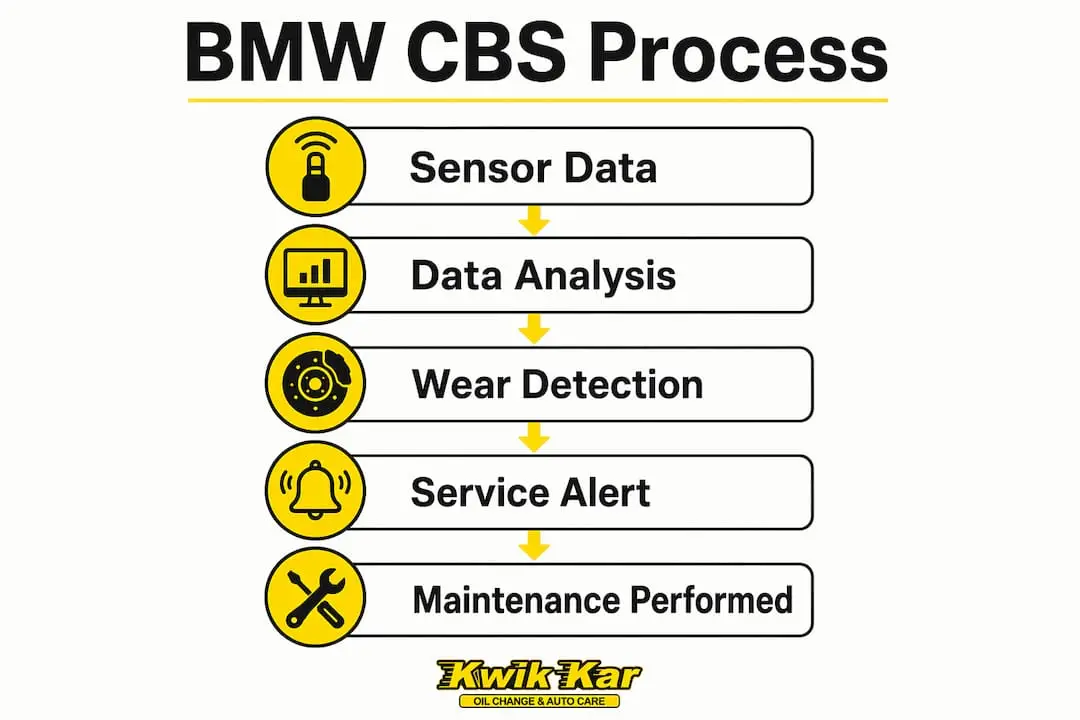
CBS runs on a layered architecture: sensors collect raw data, control modules process it, and onboard algorithms translate the results into service counters your instrument cluster and iDrive display can show you. The primary inputs are fuel consumption, engine temperature, cold-start frequency, drive-cycle patterns, wheel and brake sensor data, and an oil conductivity sensor that measures additive depletion directly.
The Digital Motor Electronics module (DME on gasoline engines, DDE on diesel) handles the heavy calculation. It continuously models how quickly each monitored component is wearing under your specific driving conditions. That processed data is then written to your vehicle’s service history.pdf) and, critically, stored in your vehicle key every time you drive.
CBS is the electronic equivalent of having a service advisor along for every drive. It monitors operating data continuously and alerts you approximately four weeks before service is actually due, giving you a real scheduling window rather than a surprise.
Pro Tip: CBS capability varies meaningfully by generation. E-series BMWs (pre-2013) have fewer sensors and simpler algorithms than F-series and G-series vehicles. If you own an older E90 or E60, your CBS tracks fewer metrics than a current 3 Series or 5 Series does.
What does CBS actually monitor on your BMW?
CBS analyzes operating data including engine oil condition, brake wear, fluid health, and filter life. Here is exactly what it tracks and how:
- Engine oil and oil filter: Calculated from fuel consumption patterns plus an oil conductivity sensor that detects when additives are depleted. This is the most sophisticated CBS calculation.
- Front and rear brake pads: Monitored via dedicated wear sensors on equipped models, or through a residual-wear algorithm on models without physical sensors.
- Cabin microfilter (air filter): Tied to the oil-service counter. On many models, replacement is triggered after a set number of oil services rather than a fixed calendar date.
- Brake fluid: Calendar-based. BMW recommends replacement after the first three years, then every two years regardless of condition readings.
- Spark plugs: Model-dependent. Tracked on applicable gasoline engines and linked to the oil-service counter on some configurations.
- Vehicle inspection items: A general inspection reminder that covers a broader checklist of safety and mechanical checks.
- Diesel particulate filter (diesel models only): Tracks usage and regeneration cycles on diesel-equipped BMWs.
| CBS Item | Detection Method | Trigger Type |
|---|---|---|
| Engine oil | Fuel consumption + conductivity sensor | Condition-based |
| Brake pads | Wear sensor or algorithm | Condition-based |
| Cabin microfilter | Oil-service counter | Counter-based |
| Brake fluid | Calendar | Time-based |
| Spark plugs | Oil-service counter | Counter-based |
| Vehicle inspection | Combined algorithm | Time/condition |
Pro Tip: Some maintenance items are grouped to the oil-service counter, so when your oil service comes due, multiple CBS items may appear together. Always ask your technician to review the full CBS list, not just the item that triggered the visit.
How does BMW calculate oil life without using mileage?
The DME/DDE module uses fuel consumption as its primary oil-life metric because fuel burned correlates directly with engine stress, heat cycles, and combustion byproducts entering the oil. Mileage alone misses all of that context. A car that idles for 30 minutes in traffic burns fuel and degrades oil without adding a single mile to the odometer.

Layered on top of the fuel-consumption model is the oil conductivity sensor which measures the electrical properties of the oil itself. As additives break down, conductivity changes, and the DME registers that shift as accelerated oil aging. Engine load, idle time, temperature extremes, and the number of cold starts all feed into the same adaptive calculation.
What this means in practice:
- A BMW driven mostly on the highway at steady speeds may go the full 15,000-mile range before CBS calls for an oil change.
- The same model driven on short city trips with frequent cold starts may see a CBS oil alert at 7,500 miles or fewer.
- Two identical BMWs bought the same week can reach their first oil service at completely different times, and both CBS readings are correct.
Frequent short trips and cold starts are the fastest way to shorten your oil interval. If your commute is mostly under 10 miles, expect CBS to call for service earlier than the maximum interval suggests.
What CBS does not monitor — and why that matters
CBS is precise for the items it tracks, but its coverage has real limits. Relying on a green dashboard status as a full bill of health is a mistake.
Items outside CBS coverage:
- Cooling system leaks and hose condition
- General fluid leaks (power steering, differential, transfer case)
- Suspension wear: ball joints, control arm bushings, sway bar links
- Tire condition, tread depth, and uneven wear patterns
- Many electrical faults and sensor degradation
- Exhaust system deterioration
- Some transmission and drivetrain wear
Beyond what CBS simply doesn’t track, some CBS-monitored metrics are not shown to you on the driver display at all. Items like automatic transmission fluid life and oxygen sensor condition may be tracked internally but only appear to a technician reading the vehicle with a scan tool. Your dashboard can show green while hidden counters are approaching their limits.
Brake fluid is a useful example of how CBS handles exceptions: even though it is a CBS-monitored item, it follows a fixed calendar schedule (first 3 years, then every 2 years) rather than a pure condition reading. CBS enforces this calendar trigger regardless of what the fluid looks like.
Pro Tip: Pair CBS guidance with a preventive visual inspection at least once a year. Sensors cannot see a cracked coolant hose, a leaking axle boot, or a tire with internal belt separation.
How to read CBS messages and what to do next
CBS notifies you approximately four weeks before a service is actually due. That window is intentional. Use it.
Step-by-step owner response:
- Check the details. Press the CBS button or navigate to the service menu in iDrive. The display lists each due item by name and shows its status color.
- Identify the urgency. Yellow means schedule soon. Red means schedule now. Multiple yellow items appearing together often signals a grouped service is due.
- Call your shop with specifics. Tell them which CBS item triggered and ask for an itemized estimate covering that item plus a visual inspection of the surrounding system.
- Ask the right questions. Which item triggered? What were the measured values? Was a visual confirmation performed alongside the sensor reading?
- Confirm the reset. After service, the shop should reset the CBS counter using a proper scan tool or BMW-compatible key reader. An owner-initiated reset without completing the repair hides the issue without fixing it.
What to watch for:
- A CBS message that reappears shortly after a reset may indicate the repair was incomplete or the reset was done incorrectly.
- If your dashboard shows no CBS alerts but you haven’t had service in over a year, ask a qualified shop to read your vehicle’s service reminders with a scan tool. Hidden counters may be due.
Pro Tip: Never reset CBS yourself without completing the service. The system is designed to track cumulative wear, and a manual reset without repair simply restarts the counter from zero while the underlying wear remains.
Typical CBS intervals and what services cost in the U.S.
CBS intervals are not fixed, but real-world patterns give you a useful planning range. Oil service typically falls somewhere between 7,500 and 15,000 miles depending on driving style. Short-trip city drivers tend toward the lower end; steady highway drivers can reach the upper end.
Calendar-based items to plan for regardless of mileage:
- Brake fluid: first change at 3 years, then every 2 years
- Microfilter: often every second oil service (roughly every 2 oil changes)
| Service | Typical U.S. Cost Range | Notes |
|---|---|---|
| Oil + filter change | $120–$220 | BMW-spec synthetic required; varies by model |
| Brake pad replacement (per axle) | $250–$500 | Includes wear sensor replacement on equipped models |
| Cabin microfilter | $100–$120 | Often bundled with oil service |
| Brake fluid flush | $100–$180 | Calendar-based; due every 2 years after year 3 |
| Annual vehicle inspection (labor) | $100–$150 | Visual check of items CBS doesn’t monitor |
Cost ranges are estimates for the U.S. market and vary by model year, engine, and shop. Always request an itemized estimate before authorizing work.
Two identical 2022 BMW 330i sedans can illustrate the variability clearly. One driven 12,000 miles per year mostly on the highway may not see a CBS oil alert until month 14. The other, driven the same 12,000 miles in stop-and-go city traffic with frequent cold starts, may see the alert at month 9. Both cars are following CBS correctly; the difference is entirely driving style.
How a trustworthy shop uses CBS data during your service visit
A qualified shop does not just read the CBS alert and replace the flagged part. The CBS code is the starting point, not the whole story.
What a thorough CBS service visit includes:
- Retrieve CBS status from the vehicle key using a KeyReader or compatible scan tool
- Verify the CBS alert against a visual inspection of the flagged component
- Check brake pad thickness physically, not just by sensor reading
- Inspect cooling system, tires, and suspension for items outside CBS coverage
- Perform an oil condition check and compare to CBS oil-life reading
- Conduct a short test drive if brake or drivetrain items are involved
- Write technician notes to the vehicle history and reset the CBS counter after repair
CBS data stored in the vehicle key gives a qualified technician a complete maintenance picture before the car even goes on the lift. A shop using a proper key reader can see every service counter, including hidden metrics the driver display never shows, and build a service checklist tailored to your specific vehicle history.
European vehicles require specialized diagnostic tools to read CBS data accurately. A generic OBD-II scanner will not access BMW’s proprietary CBS counters. Make sure your shop has BMW-compatible equipment before authorizing any CBS-related work.
Pro Tip: Ask your technician to show you the CBS readout before and after service. A before-and-after comparison confirms the counter was reset correctly and gives you a baseline for the next interval.

Key Takeaways
BMW Condition-Based Service reliably monitors specific components using real sensor data, but it works best when paired with an annual visual inspection that covers what sensors cannot detect.
| Point | Details |
|---|---|
| CBS replaces fixed mileage | The system calculates actual wear from fuel use, sensor data, and drive patterns, not odometer readings. |
| Oil intervals vary widely | Driving style shifts CBS oil alerts anywhere from 7,500 to 15,000 miles between services. |
| CBS has real blind spots | Cooling leaks, suspension wear, tires, and many electrical faults fall outside CBS coverage entirely. |
| Hidden counters exist | Some CBS metrics only appear to technicians via scan tools, not on your driver display. |
| Kwik Kar Oil Change & Auto Care reads CBS codes | Certified technicians use BMW-compatible tools to pull full CBS data and pair it with a visual inspection. |
The part most BMW owners get wrong about CBS
Most owners treat CBS as a pass/fail system: green means fine, red means act. That framing misses the most useful thing CBS actually does, which is give you a four-week window to schedule service before anything becomes urgent. The owners who get the most value from CBS are the ones who respond to yellow, not red.
There is also a persistent misconception that CBS eliminates the need for regular shop visits. It does not. CBS is genuinely excellent at what it measures. But a sensor cannot see a coolant hose that is soft and about to fail, a tire with a bubble in the sidewall, or a ball joint that is loose but not yet generating a code. Those failures show up on a lift, not on a dashboard.
The driving-style impact on intervals surprises people too. Owners who commute short distances in Fort Worth traffic often assume their low mileage means their car is “barely used.” CBS disagrees. Short trips with cold starts are harder on oil than long highway runs, and the system knows it. Trusting CBS means accepting that your car’s actual condition, not your intuition about how gently you drive, sets the schedule.
CBS-driven service for your BMW in Fort Worth
When your BMW shows a CBS alert, Kwik Kar Oil Change & Auto Care handles the full scope of what that message actually requires. Certified technicians read your CBS codes with BMW-compatible diagnostic tools, perform a visual inspection alongside the sensor data, and reset service counters correctly after every job.

Services relevant to CBS alerts include BMW-spec oil and filter changes, brake pad inspection and replacement, cabin microfilter swaps, brake fluid flushes, and multi-point vehicle inspections that cover the items CBS cannot. Bring your vehicle key and any recent service notes; the team pulls your full CBS history before the car goes on the lift.
If your CBS light is yellow or you haven’t had a professional inspection in over a year, now is the right time to act. Check signs your car needs an oil change or download a maintenance checklist to track your CBS items between visits. Book your service online or call the shop directly at 2840 White Settlement Road, Fort Worth.
Useful sources and further reading
The following sources back the factual claims in this article and give you direct access to official BMW documentation and technical training material.
- BMW Technical Training Document: CBS System Diagnosis — BMW manufacturer training document covering CBS architecture, key-stored data, and shop diagnostic procedures. Primary technical reference for how CBS stores and retrieves service status.
- BMW USA MY 2023 All Models Maintenance Booklet.pdf) — Official BMW USA owner documentation explaining CBS status displays, iDrive integration, and service history access. Use your model-year-specific booklet for exact procedures.
- ALLDATA Repair: CBS In-Vehicle Maintenance Reminder System — Technical service bulletin covering CBS-monitored items, calendar-based exceptions, and oil-service counter groupings. Authoritative reference for shop technicians.
- TechShopMag: Troubleshooting BMW’s CBS System — Technician-focused article on CBS diagnostics, hidden counters, and oil-life calculation inputs. Useful for understanding what scan tools reveal beyond the driver display.
- AA1Car: BMW Condition Based Service System — Independent technical overview of CBS alert timing and the four-week advance notification design.
Always consult your model-year-specific owner’s manual or a qualified BMW technician for exact service procedures. CBS configurations differ between E-series, F-series, and G-series vehicles, and the intervals and monitored items in this article are representative, not universal.
This article is general information for educational purposes. Confirm service intervals, costs, and procedures with your owner’s manual or a qualified technician for your specific vehicle.
FAQ
How does BMW Condition-Based Service work?
CBS uses sensors and onboard algorithms to monitor component wear in real time, factoring in fuel consumption, engine load, cold starts, and oil conductivity to calculate when each item actually needs service rather than following a fixed mileage schedule.
How much does a typical BMW CBS service cost in the U.S.?
Common CBS-triggered services range from roughly $120–$220 for an oil and filter change to $250–$500 per axle for brake pads, with brake fluid flushes typically running $100–$180. Costs vary by model, engine, and shop.
Why does BMW recommend oil changes at different mileage intervals?
Because CBS calculates oil life from fuel consumption and an oil conductivity sensor rather than mileage alone. A car driven on short city trips with frequent cold starts will trigger an oil alert much sooner than the same model driven primarily on the highway.
What happens if you ignore a CBS red alert?
Continuing to drive past a red CBS alert means the flagged component is overdue for service, which can accelerate wear, reduce safety margins (especially for brake-related alerts), and potentially void coverage under BMW’s maintenance program if applicable.
Can any shop reset BMW CBS, or does it require a dealer?
Any shop with BMW-compatible diagnostic equipment can reset CBS counters correctly. A generic OBD-II scanner will not access BMW’s proprietary CBS system, so confirm your shop has the right tools before authorizing a reset.