




Most car owners assume service intervals are either arbitrary numbers printed in a manual or a dealership tactic to get you in the shop more often. Neither is true. Understanding how auto service intervals are determined reveals a precise engineering process built around your engine’s chemistry, your driving habits, and how components wear over time. Get this right, and you protect your vehicle’s reliability while avoiding the kind of repair bills that blindside people who thought they were “fine.” Get it wrong, and skipping routine maintenance can increase your ownership costs by up to 75% over five years.
Table of Contents
- Key takeaways
- How manufacturers determine baseline service intervals
- Normal vs. severe service conditions
- How modern technology adjusts intervals dynamically
- Vehicle type, age, and usage as interval factors
- Applying interval knowledge to your maintenance plan
- My honest take on why people get this wrong
- Ready to put your maintenance plan into action?
- FAQ
Key takeaways
| Point | Details |
|---|---|
| OEM manuals set the baseline | Your Owner’s Manual defines legally binding service intervals tied to warranty compliance. |
| Driving conditions change everything | Severe service conditions can cut recommended oil change intervals roughly in half. |
| Modern monitors adjust dynamically | Oil Life Monitoring Systems calculate real-time degradation, not just mileage. |
| Vehicle type and age matter | Trucks, high-mileage cars, and aging components all shift when service is needed. |
| Documentation protects you | Keeping a service log guards your warranty and helps technicians spot patterns early. |
How manufacturers determine baseline service intervals
The starting point for any auto maintenance schedule is the original equipment manufacturer, or OEM. Engineers at every major automaker spend thousands of hours testing components under controlled and real-world conditions before they publish a single number in your Owner’s Manual. Those numbers are not guesses. They reflect material science, lubrication chemistry, and mechanical wear data gathered across millions of test miles.
Your Owner’s Manual and the accompanying scheduled maintenance guide are the two documents that define your vehicle’s service framework. Under the Magnuson-Moss Warranty Act, these intervals are binding for warranty compliance, meaning if you skip a documented service and a related component fails, your warranty claim can be denied. That alone makes the manual worth reading.
OEMs use three primary metrics to set intervals:
- Mileage: The most familiar trigger. Oil changes for modern vehicles typically fall between 7,500 and 10,000 miles under normal conditions.
- Time: Even if you drive very little, fluids degrade and seals dry out. Most manufacturers set a time limit alongside mileage, often 12 months, whichever comes first.
- Engine hours: Less common in passenger cars but standard for heavy-duty and commercial vehicles where idle time is significant.
Typical interval ranges give you a useful reference point. Engine oil changes run 5,000 to 10,000 miles for conventional oil and up to 15,000 miles for full synthetic. Coolant flushes land around 30,000 to 50,000 miles. Transmission fluid service ranges from 30,000 to 60,000 miles depending on vehicle type and use.
Pro Tip: Never rely on the sticker your last shop put on your windshield as your sole interval guide. Cross-reference it with your Owner’s Manual every time.
Normal vs. severe service conditions
This is where most drivers get into trouble. Manufacturer interval schedules classify operation into two categories: normal service and severe service. The distinction matters more than most people realize because many drivers unknowingly qualify for severe service schedules but follow normal intervals, effectively deferring maintenance and increasing risk.
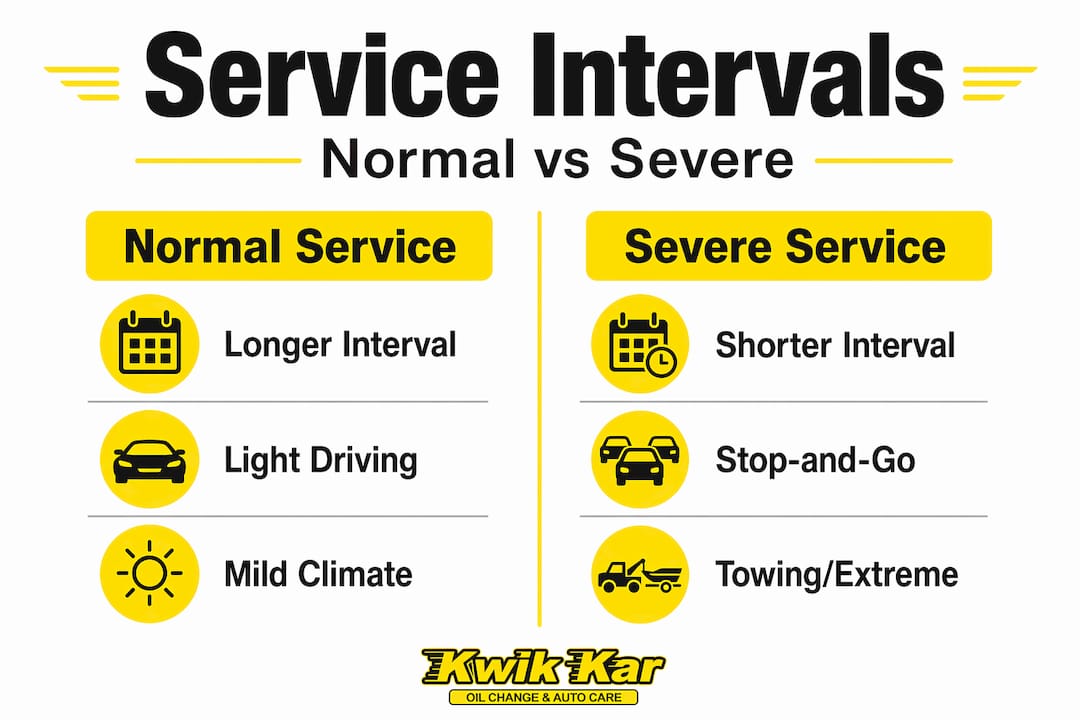
Normal service applies when you drive mostly on highways, in moderate temperatures, with consistent trip lengths above 10 miles. Think a daily commute on an interstate in a mild climate.
Severe service covers a wide range of conditions that most American drivers actually experience on a regular basis:
- Frequent short trips under 5 miles, especially in cold weather
- Stop-and-go traffic for extended periods
- Towing, hauling heavy loads, or using a roof rack regularly
- Driving in extreme heat or extreme cold
- Operating on dusty, unpaved, or salted roads
The practical impact is significant. Severe conditions reduce oil change intervals to roughly 3,000 to 5,000 miles compared to 7,500 to 10,000 miles for normal service. That is not a minor adjustment. It is a fundamental shift in how often your car needs attention.
| Service Type | Oil Change Interval | Transmission Fluid | Brake Inspection |
|---|---|---|---|
| Normal service | 7,500 to 10,000 miles | 60,000 miles | Every 12 months |
| Severe service | 3,000 to 5,000 miles | 30,000 miles | Every 6 months |
Short trips are particularly hard on engines because the oil never fully reaches operating temperature, which means moisture and combustion byproducts accumulate in the crankcase instead of burning off. Over time, this degrades oil far faster than highway miles do.
Pro Tip: If you make at least three of the severe service conditions your regular reality, switch to the severe schedule immediately. Do not wait for a symptom to appear.
How modern technology adjusts intervals dynamically
Fixed mileage rules made sense when the only data available was an odometer reading. Modern vehicles have moved beyond that. Oil Life Monitoring Systems (OLMS) compute oil degradation in real time based on actual engine conditions, not just distance traveled.
Here is what an OLMS actually measures:
- Engine revolutions: More revolutions mean more mechanical stress on oil molecules.
- Temperature cycles: Repeated heating and cooling breaks down oil’s viscosity and additive package faster.
- Engine load: Towing or climbing grades puts more strain on oil than flat highway cruising.
- Cold starts: Each cold start is harder on oil than a warm restart, and the system accounts for frequency.
General Motors introduced one of the first widely adopted OLMS systems in the 1980s, and today most major manufacturers include some version of it. When the system calculates that your oil has degraded to a threshold percentage, it triggers a maintenance reminder light on your dashboard.
The limitation worth knowing: OLMS only monitors oil life. It does not track brake pad wear, tire rotation needs, air filter condition, or dozens of other service items. Relying solely on the dashboard light means you could miss critical services that run on their own separate schedules. A thorough auto maintenance schedule still requires manual tracking or a professional inspection alongside the OLMS data.

Vehicle type, age, and usage as interval factors
Selecting appropriate service interval guidelines requires integrating vehicle architecture, use patterns, and aging component data rather than relying solely on mileage. This is where determining vehicle service frequency gets genuinely nuanced.
Vehicle type creates meaningful differences in service needs:
- Passenger cars with unibody construction generally follow lighter-duty schedules than body-on-frame trucks.
- Light-duty trucks and SUVs used for towing or payload work shift quickly into severe service territory.
- Heavy-duty vehicles operate on duty-hour and load-cycle schedules rather than simple mileage.
- Hybrids and electric vehicles have unique considerations. Hybrids still require traditional engine service, but regenerative braking reduces brake wear significantly. EVs eliminate oil changes entirely but add battery coolant and high-voltage system checks.
Vehicle age reshapes the interval picture in a specific way. Reliability follows a wear-out curve, and failure probability rises exponentially after a critical mileage or duty-hour threshold. A 10-year-old vehicle with 120,000 miles is not just an older version of the same car you bought new. Its seals, gaskets, and bearings have accumulated fatigue that makes timely service more urgent, not less.
Here is a practical approach to aligning your schedule with your vehicle’s actual condition:
- Pull your Owner’s Manual and locate both the normal and severe service schedules side by side.
- Honestly assess your typical driving conditions against the severe service criteria listed above.
- Check your vehicle’s age and mileage against its published wear thresholds for major components like brakes and suspension.
- Note that brake system intervals typically reach a critical point between 40,000 and 60,000 km, and wheel bearings between 80,000 and 120,000 km.
- Build a service log, either in a notebook or a maintenance app, and record every service with date, mileage, and technician notes.
That service log is more valuable than most people think. It protects your warranty, helps a technician spot developing patterns, and gives you concrete data when buying or selling the vehicle.
Applying interval knowledge to your maintenance plan
Knowing how auto service intervals are determined is only useful if you translate it into a schedule you actually follow. Here is how to make that happen without overcomplicating it.
Start by being honest about your driving conditions. Most people who commute in urban traffic, run short errands, or live in climates with temperature extremes qualify for severe service. Acknowledging that upfront saves you money and prevents the kind of deferred maintenance that turns a $60 oil change into a $2,000 engine repair.
Use your onboard maintenance reminder as a prompt, not a final authority. When the light comes on, treat it as a signal to schedule a full inspection, not just the single service it references. A certified technician can assess items the OLMS cannot see, including air filter condition, belt wear, and fluid contamination levels.
Key habits that protect your vehicle long-term:
- Schedule a professional inspection at least once a year regardless of mileage.
- Follow car maintenance by mileage guidelines as a structured reference alongside your OEM schedule.
- Never skip a service because the car “seems fine.” Components degrade silently until they do not.
- Keep receipts and service records organized. They matter for warranty claims and resale value.
The importance of regular car servicing comes down to one principle: preventive maintenance prevents 70 to 80% of major vehicle breakdowns. That statistic is not a marketing claim. It reflects decades of fleet data and engineering research.
Pro Tip: Download a maintenance checklist and review it at every oil change. It takes five minutes and keeps you ahead of every service item on your schedule.
My honest take on why people get this wrong
I’ve worked with enough car owners to know that the gap between knowing and doing is wide. People understand they should follow their maintenance schedule. They just underestimate how much their specific driving conditions change what that schedule actually looks like.
What changed my own approach was understanding the wear-out curve. Once you see that failure risk does not climb gradually but spikes sharply after a threshold, the logic of strict interval adherence becomes obvious. It is not about being cautious. It is about staying on the safe side of an exponential curve.
I’ve also seen how the “my car feels fine” mindset costs people thousands of dollars. Oil does not turn black and chunky overnight. Brake pads do not squeal from day one. Degradation is quiet and cumulative, which is exactly why the schedule exists.
My advice: treat your OEM schedule as the floor, not the ceiling. If your conditions are severe, move to the shorter interval without hesitation. And find a certified shop you trust, one that will tell you what you actually need rather than what generates the most revenue. That relationship is worth more than any single service.
— Kwik Kar
Ready to put your maintenance plan into action?
At Kwik Kar Oil Change & Auto Care, we work with Fort Worth drivers every day who are unsure whether they are on the right schedule for their vehicle and driving conditions. Our RepairPal-certified technicians assess both normal and severe service needs with transparency and no upselling.
If you are not sure when your last oil change was or whether your current schedule fits your driving habits, start with our guide to signs your car needs an oil change. From there, explore our oil change types guide to understand how your oil choice affects your interval. When you are ready for a thorough inspection from a team that treats your vehicle like their own, Kwik Kar Oil Change & Auto Care is here.
FAQ
How are auto service intervals determined?
Service intervals are set by manufacturers through engineering tests, material science data, and real-world wear analysis. They factor in mileage, time, engine load, and operating conditions to define when each component needs attention.
What qualifies as severe driving conditions?
Severe conditions include frequent short trips under 5 miles, stop-and-go traffic, towing, extreme temperatures, and dusty or unpaved roads. If you regularly experience any three of these, you likely need the severe service schedule.
How often should I change my oil under normal conditions?
Most modern vehicles require an oil change every 7,500 to 10,000 miles under normal service, or every 12 months, whichever comes first. Full synthetic oil can extend that range, but always verify with your Owner’s Manual.
Does an Oil Life Monitoring System replace my maintenance schedule?
No. An OLMS tracks oil degradation only. It does not monitor brakes, filters, fluids, or other components that have their own separate intervals. Use it as one input alongside a full scheduled maintenance review.
Can skipping a service interval void my warranty?
Yes. Under the Magnuson-Moss Warranty Act, the intervals documented in your Owner’s Manual are binding for warranty compliance. Skipping a required service and then filing a related warranty claim can result in denial of coverage.
Recommended
- Car Maintenance by Mileage: 7 Essential Tips for 2025
- Download Your Car Maintenance Checklist PDF Today
- How Long Do Car Engines Last? Your 2026 Guide
- Oil Change and Tire Rotation Tips for Your Car