You are stopped on Camp Bowie in late-afternoon traffic, the engine feels rough, and the question shows up at the worst time. How long has it been since your last oil change?
That is not a minor maintenance detail. Engine oil lubricates internal parts, pulls heat away from high-friction areas, and carries dirt and combustion byproducts to the filter. Once the oil is worn out, low, or contaminated, the engine loses protection fast. Heat builds. Friction rises. Wear speeds up.
Fort Worth driving makes this problem show up sooner. Long idle time, summer heat, stop-and-go traffic, construction dust, and highway commutes all shorten the useful life of oil, especially in older vehicles, work trucks, and high-mileage daily drivers.
Your car usually warns you before real damage starts. Some warnings mean schedule service this week. Others mean stop driving and check the vehicle now. That distinction matters, and many drivers miss it. If you have recently cleared a maintenance reminder without service, review how the maintenance required light reset process works so you do not mistake a reset light for healthy oil.
This guide is built for Fort Worth drivers who need more than generic advice. You will see which signs point to overdue service, which ones signal possible engine risk, and how urgent each one is so you can act before a basic oil change turns into a repair bill.
1. Dashboard Oil Change Light Illumination
You are halfway down I-30 in Fort Worth traffic, the oil change light comes on, and now you have to decide whether this is a quick scheduling issue or a stop-driving warning. Make the right call fast.
If the dashboard shows an oil change light, maintenance reminder, or service message, book an oil change now. Do not wait for the weekend. These systems track driving conditions, mileage, and engine operation, then flag service when the oil is near the end of its useful life.
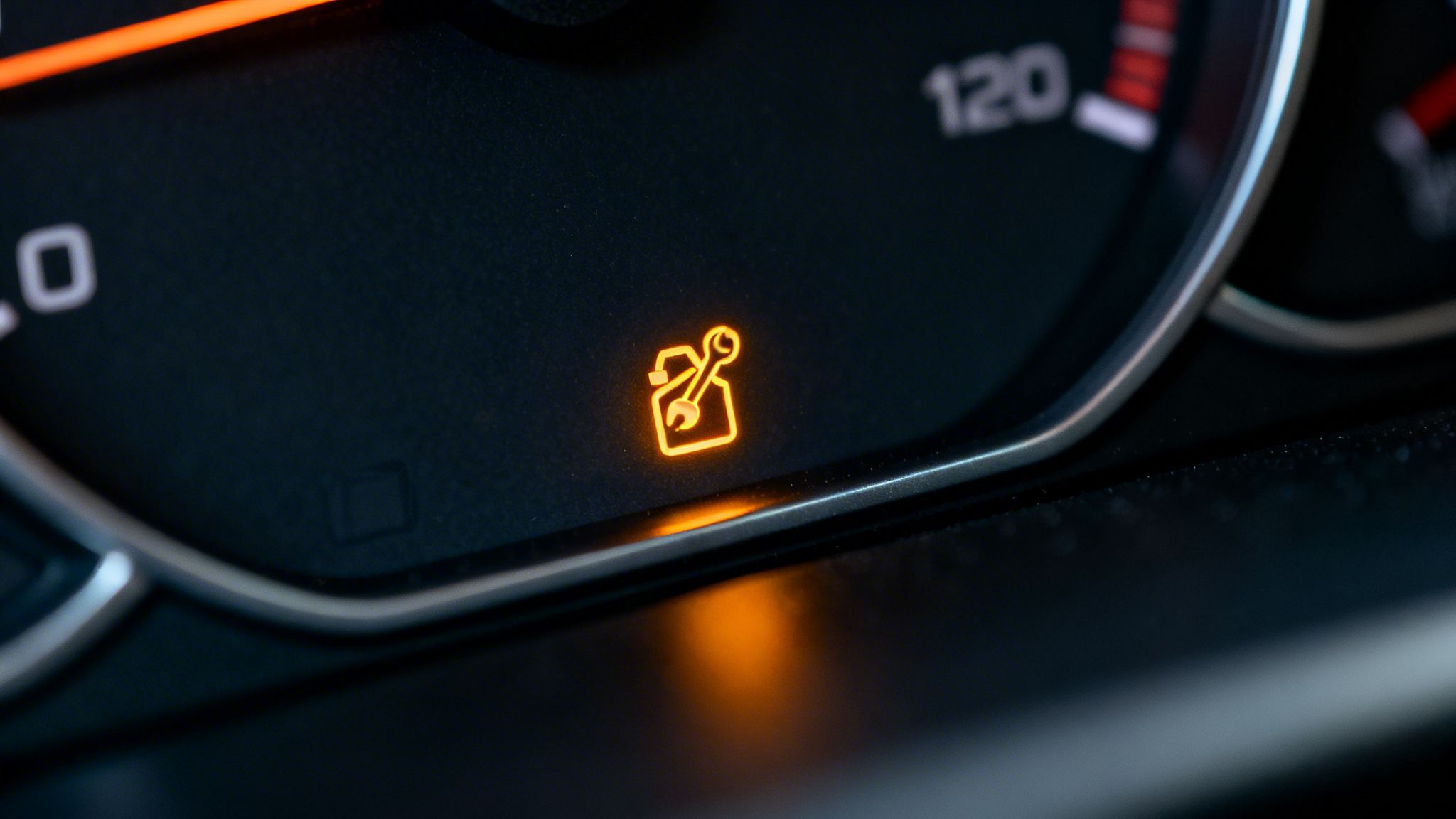
Do not confuse a maintenance reminder with the red oil-pressure warning. A maintenance light means service is due. A low-oil-pressure light means oil may not be circulating correctly, and continued driving can damage the engine within minutes.
How urgent it is
Treat this sign as high urgency.
If the reminder comes on but the engine still runs smoothly, schedule service within the next few days. If the light appears with knocking, rough idle, overheating, or a burning smell, stop driving and have the vehicle checked the same day. That is no longer routine maintenance. That is possible engine risk.
Fort Worth drivers need to be stricter here than the average maintenance article suggests. Long idle time, triple-digit summer heat, jobsite dust, and short-trip driving all push oil harder. If your vehicle sees that kind of use, the warning light should move your oil change to the top of your list, not somewhere after errands and work.
If you want to understand what dirty oil looks like after the monitor turns on, this explanation of what causes engine oil to turn black adds useful context.
If your warning light turns on repeatedly after service, have the system checked. A reset issue, sensor problem, or underlying engine condition can keep the reminder active.
If you recently had service and the light is still on, this guide to a maintenance required light reset can help you understand what may be happening before you bring the vehicle in.
2. Dark or Discolored Oil on Dipstick
You check the dipstick before heading across Fort Worth, and the oil looks closer to black syrup than clean lubricant. That is your warning.
Fresh oil usually starts out amber or honey-colored. As it ages, it collects soot, fuel residue, and other contaminants. Darker oil is common over time, but color is only the first clue. What matters is whether the oil still looks clean, wipes smoothly, and moves like oil instead of sludge.
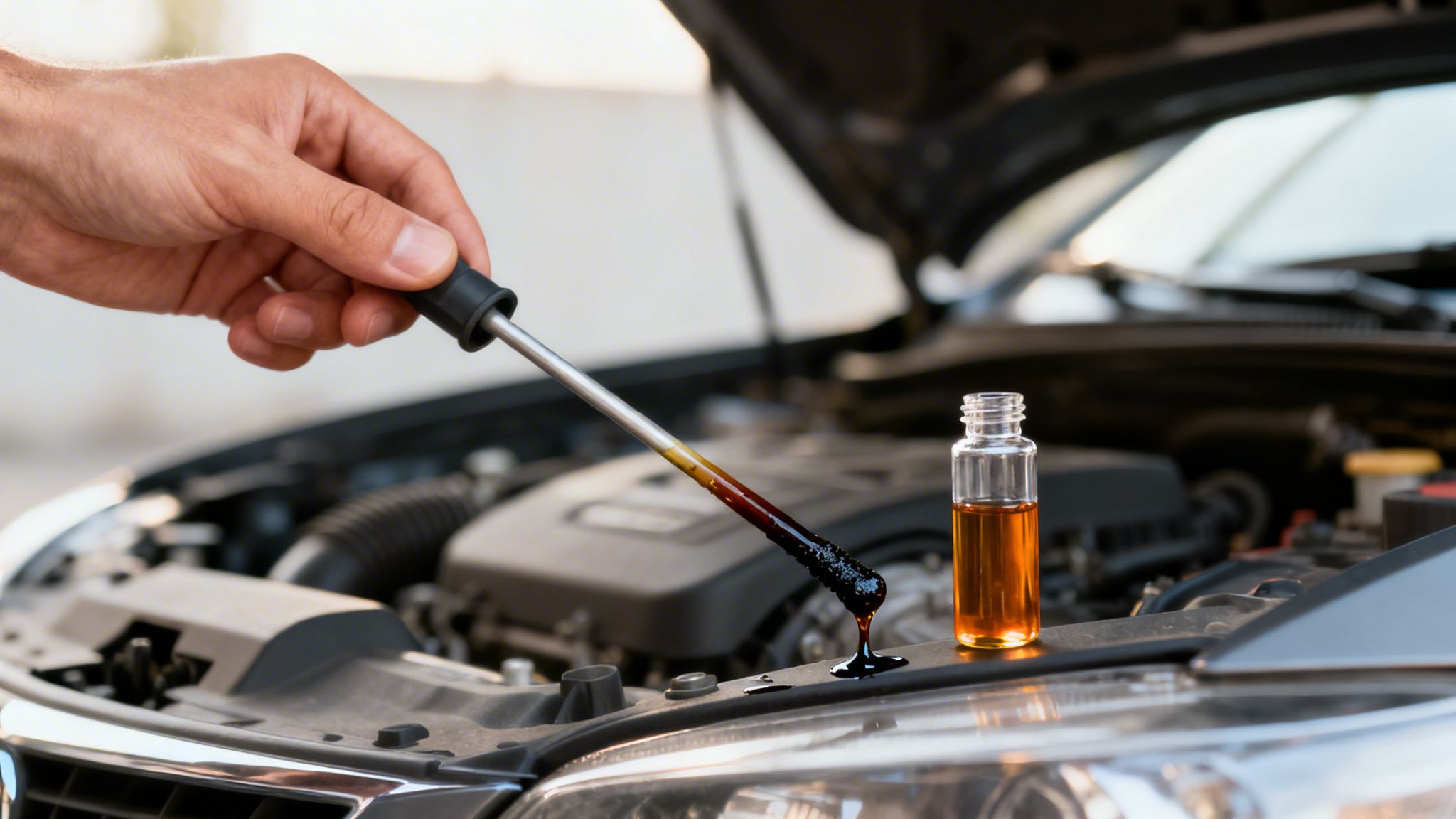
Check it the right way. Park on level ground, shut the engine off, let it cool, wipe the dipstick clean, reinsert it fully, then pull it again to get the reading.
Here is what deserves attention:
- Very dark brown or black oil: This usually means the oil has been working hard for too long, especially in stop and go traffic, summer heat, or dusty jobsite conditions common around Fort Worth.
- Gritty feel: Rub a small amount between your fingers. If it feels dirty or abrasive, contamination is building up and the oil is no longer protecting the engine well.
- Thick, slow-moving oil: If it clings heavily to the dipstick or looks unusually sticky, schedule service soon. Oil needs to flow quickly to protect internal parts.
- Low level plus dark color: That combination raises the risk. You may be dealing with overdue service and oil consumption at the same time.
Do not rely on color alone. Some engines darken oil faster than others, and synthetic oil can still look dark before it completely loses effectiveness. Texture, thickness, and level give you a more useful diagnosis than color by itself.
For local drivers, urgency depends on the full picture. Dark but smooth oil with no other symptoms is a soon issue. Dark, gritty, or low oil is a same-week issue. If the oil is dirty and the engine also sounds louder, runs hotter, or feels sluggish, stop putting it off and get it serviced right away.
If you want a clearer visual on discoloration, this guide on what causes engine oil to turn black helps you judge what you are seeing on the dipstick.
A quick visual helps if you have never checked your oil before:
Urgency level
Medium to high. Dark oil alone means schedule an oil change soon. Dark, gritty, thick, or low oil means move faster, especially if your Fort Worth driving includes heat, heavy traffic, towing, short trips, or dusty roads.
3. Unusual Engine Noise or Knocking Sounds
You pull away from a Fort Worth stoplight, press the gas, and the engine answers with a tick, a knock, or a dry clatter you have never heard before. Treat that as a lubrication warning until proven otherwise.
Clean oil forms a protective film between moving parts. Old, thinned-out, or low oil cannot keep that film intact. Metal parts start making contact, and the sound changes fast. Ticking at startup often points to delayed oil flow to the top end. Knocking under load is more serious because cylinder pressure and engine load expose weak lubrication right away.
This matters even more for local drivers who deal with long idle time, heavy traffic, summer heat, towing, and dusty roads. A work truck that sounds acceptable on side streets can get much louder when it climbs speed on Loop 820 or I-35W. That change under load is a red flag, not background wear.
How to judge the noise
Listen for when it happens, not just how loud it is.
- Brief ticking at startup: Often tied to oil that is dirty, too thin, or slow to reach upper engine components.
- Knock during acceleration: High urgency. Reduce driving and get the oil level and condition checked immediately.
- Steady clatter at idle and while driving: This suggests ongoing internal friction or a lubrication problem that is no longer occasional.
- Noise that gets worse as the engine warms up: Old oil may be losing viscosity and protection as heat builds.
A phone recording helps. Capture the sound at cold start, at idle, and during light acceleration if it can be done safely. That gives the shop a clearer starting point and helps separate an oil-related noise from spark knock, valvetrain wear, or another mechanical fault.
What to do next
High urgency.
Do not keep driving it normally. Skip hard acceleration, towing, long highway runs, and high RPM driving until the oil is checked. If the oil is low, very dirty, or overdue by a wide margin, same-day service is the right call. If the noise is sharp, heavy, or suddenly much worse, stop driving and have the vehicle inspected before you risk bearing or valvetrain damage.
Do not assume a fresh oil change will fix everything. Sometimes overdue oil service causes noise. Sometimes the noise is the sign that wear has already started. For Fort Worth drivers, the smart move is simple: treat new engine noise as urgent, check the oil immediately, and get a professional inspection if the sound does not disappear quickly after service.
4. Engine Oil Odor Inside the Vehicle
You pull up to a long light on I-35W, the A/C is running, and a burnt oil smell slips into the cabin. Treat that as a warning, not an annoyance.
Oil smell inside the vehicle usually points to one of two problems. Oil is leaking onto hot engine parts, or the oil is running too hot because it is old and breaking down. Both need prompt attention. In Fort Worth heat, this sign deserves even more urgency because high under-hood temperatures push weak oil and small leaks into a bigger problem faster. As Veenstra’s Garage explains in its oil change warning guide, heat stress in hot climates can speed oil breakdown, especially during repeated high-temperature driving.
Why you smell it inside
Your HVAC system pulls air from the cowl area at the base of the windshield. If oil fumes are hanging in the engine bay, the ventilation system can carry that smell straight into the cabin. That is why drivers often notice it most at idle, in traffic, in drive-thru lines, or right after parking.
On many vehicles, the usual source is a small leak around the valve cover gasket, oil fill cap, or another upper-engine seal. Those leaks may not leave a large puddle, but they can drip onto hot metal and create a clear burnt-oil smell before the leak looks dramatic.
Urgency level for Fort Worth drivers
Medium-high to high urgency.
If you smell oil once for a second after a recent spill during a top-off, clean it up and monitor it. If the smell returns, gets stronger with the A/C on, or shows up after every commute, book service soon. If you also see smoke from under the hood, notice a hot engine, or smell burning every time you stop, stop driving and have it inspected the same day.
What to check now
- Check the oil level on level ground: Low oil raises risk fast.
- Look around the valve cover and oil cap: Fresh wetness matters.
- Check for residue on hot components: Burn marks or oily grime near the exhaust side of the engine are a strong clue.
- Notice when the smell appears: Only at idle, only after highway driving, or all the time. That pattern helps a shop find the leak faster.
For Fort Worth drivers, this is one of the most useful signs to document. Note the outside temperature, whether the A/C was on, and whether the smell showed up after short city driving or a longer highway run. That gives your local shop a better starting point and helps separate an overdue oil issue from an active leak that needs repair.
5. Reduced Engine Performance or Power Loss
You are merging onto Loop 820, you press the gas, and the car hesitates longer than it should. That sluggish response can point to overdue oil, especially if the vehicle also feels rough under load with the A/C running in Fort Worth heat.
As engine oil breaks down, it loses its ability to reduce friction and help moving parts operate smoothly. The result is simple. The engine has to work harder, and you feel it through weaker acceleration, slower throttle response, and less confidence when you need power quickly.
This sign is easy to miss because it usually shows up in specific situations first, not all the time. Pay attention if your vehicle feels noticeably weaker when:
- pulling into fast traffic on I-20 or I-35W
- climbing an overpass or grade with passengers or cargo
- towing even a light trailer
- accelerating from a stop with the A/C on
- passing at highway speed and getting a delayed response
Fuel economy can slip at the same time. The U.S. Department of Energy explains at FuelEconomy.gov that poor vehicle maintenance, including neglected oil service, can reduce fuel economy. If you are filling up more often and the engine feels flat, check the oil before you chase more expensive causes.
Urgency level for Fort Worth drivers
Medium-high urgency.
If the car only feels a little less responsive, schedule an oil service within the next few days and check the oil level today. If power loss is obvious, gets worse in hot stop-and-go traffic, or shows up with engine noise, high temperature, or a warning light, stop driving and get it inspected the same day.
What to check now
Start with the basics. They tell you a lot.
- Check the oil level on level ground: Low oil can cause sluggish performance and raises engine risk fast.
- Look at the oil condition on the dipstick: Very dark, gritty, or unusually thin oil supports the case for immediate service.
- Notice when the power loss happens: Only during hard acceleration, only with the A/C on, or all the time. That pattern helps separate an oil problem from ignition, fuel, or transmission trouble.
- Track fuel use for the next few fill-ups: A sudden drop in miles per tank paired with weak acceleration is a strong clue.
- Listen during acceleration: If sluggish performance comes with ticking, knocking, or harsh engine sound, treat it as urgent.
For Fort Worth drivers, this is one of the most useful signs to document before visiting a shop. Note the outside temperature, whether the engine felt weak only after a long commute, and whether the problem was worse in city traffic or at highway speed. That gives a local technician a faster path to the right diagnosis and helps determine whether the issue is overdue oil alone or a larger engine problem.
6. Oil Leaks or Puddles Under the Vehicle
A stain on the driveway is not just messy. It is a warning.
If you find dark spots under the engine area after parking overnight, the engine may be losing oil through a gasket, seal, drain plug, oil pan, or filter area. That means the oil level can drop below safe operating range even if the oil itself is not severely overdue.
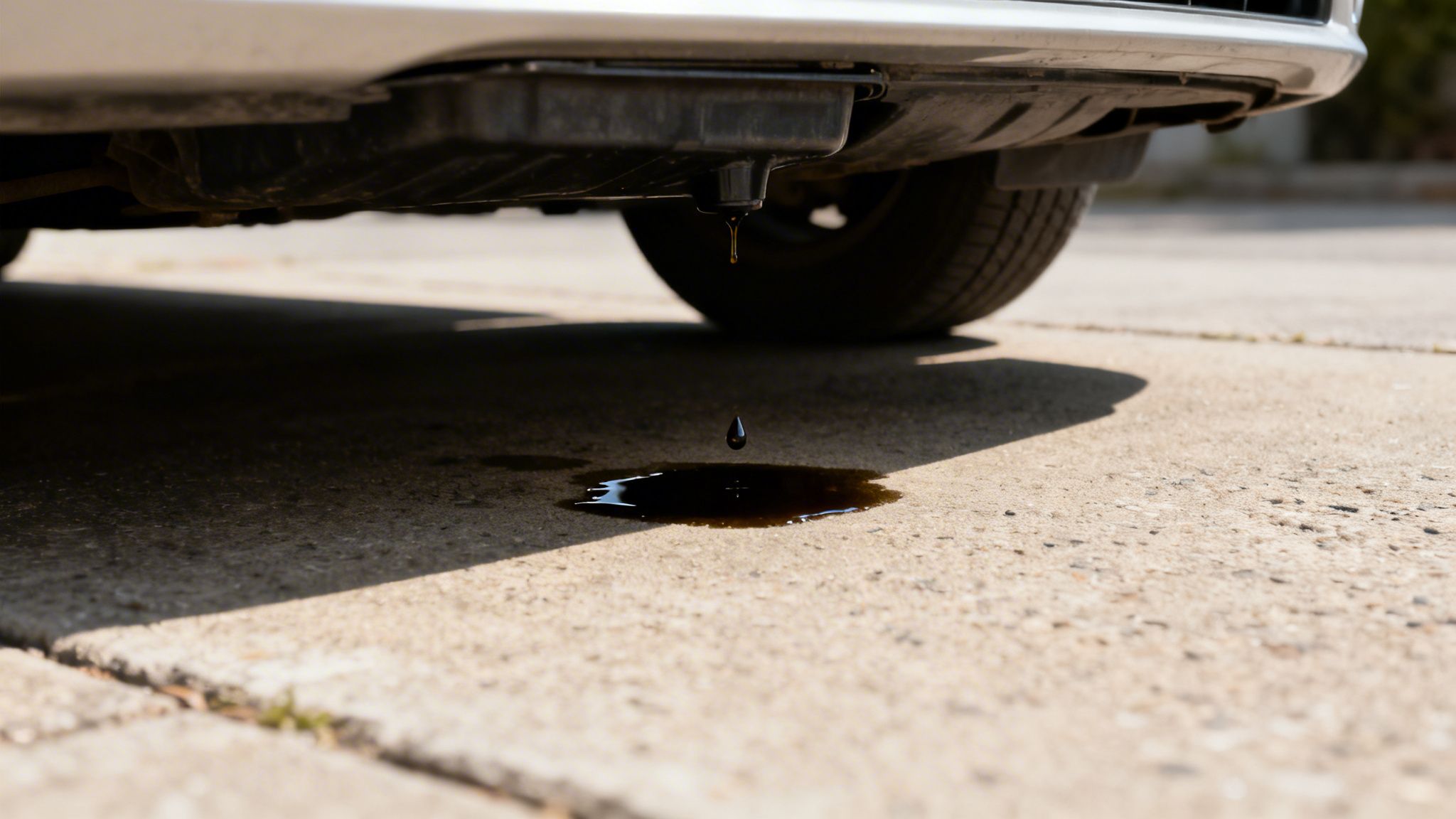
Leaks matter for two reasons. First, they reduce the amount of oil available to protect the engine. Second, they often get worse with time, heat, and pressure. A small seep can become a serious loss quickly.
What to check at home
Use simple observation before you head in for service.
- Location: Oil near the center-front of the car often points to the engine area.
- Color: Dark brown or black fluid is often engine oil, especially in a higher-mileage vehicle.
- Pattern: A few drops may suggest a seep. A growing puddle means fast action is needed.
A Fort Worth example is a family SUV parked in the same garage spot every night. If a driver sees fresh dark spots on Monday, more on Tuesday, and a larger stain by Friday, the leak is active and getting worse under daily heat cycles.
When it becomes urgent
High urgency. Check the dipstick before driving any distance. If the level is low, top it up only enough to protect the engine and get the leak diagnosed. Do not treat top-offs as a long-term fix.
Leaks become especially risky when paired with any of these:
- oil smell
- smoke
- warning lights
- louder engine noise
If you see fresh puddles, schedule an inspection with the oil service. The goal is not just to replace oil. The goal is to keep the new oil from leaving the engine.
7. Milage-Based Maintenance Schedule Expiration
You pull out of your Fort Worth neighborhood for the morning commute, the car sounds normal, and nothing looks wrong. Then you glance at the sticker on the windshield or the service record on your phone and realize you passed the oil interval weeks ago. That alone is enough reason to schedule service.
Mileage deadlines exist because oil wears out before many drivers notice a symptom. Add North Texas heat, stop-and-go traffic, short trips, dust, and long idle time, and the oil breaks down faster than the brochure version of your driving routine suggests.
Follow the manual, then adjust for real Fort Worth driving
Your owner’s manual sets the baseline. A manufacturer service guide for many Ford models, for example, separates normal driving from severe duty. Severe duty includes repeated short trips, extended idling, towing, and dusty conditions. That describes a lot of local driving around Fort Worth.
If your vehicle uses an oil life monitor, do not treat it as permission to ignore time and mileage completely. Use it with your service history, not instead of it.
A simple rule works well here. If you reached the listed interval, book the oil change. If you passed it, treat the service as overdue.
What to track
Keep three things written down every time the oil is changed:
- Current mileage: This tells you when the next service is due.
- Service date: Some cars need oil changed by time even if miles stay low.
- Oil type used: Conventional, synthetic blend, and full synthetic can have different schedules.
For a stronger long-term schedule, use this guide to car maintenance by mileage.
Urgency level
Moderate urgency if you just hit the interval. High urgency if you are well past it, drive in heavy traffic, make frequent short trips, or use the vehicle for work, towing, or school runs across town.
Do not wait for noise, smoke, or a warning light to confirm what the mileage already told you. An on-time oil change is cheap. An overdue engine repair is not.
8. Excessive Exhaust Smoke or Burning Oil Smell During Driving
You merge onto I-30, press the gas, and see blue-gray smoke in the mirror. A few minutes later, a hot burning-oil smell comes through the vents. Treat that as a same-day problem.
Blue-gray exhaust usually means oil is getting into the combustion chamber and burning with the fuel. In real Fort Worth driving, you may notice it after a cold start, during hard acceleration, after a long stretch at highway speed, or while idling in heavy traffic with the A/C running. Common causes include worn valve seals, piston ring wear, an overfilled crankcase, or oil dripping onto hot exhaust components.
Why this is serious
This sign points to active oil loss, not old oil that is overdue for replacement.
As the engine burns or leaks oil, the level can drop faster than many drivers expect. That leaves internal parts with less lubrication and more heat. Keep driving in that condition and a repair that starts as a seal, gasket, or PCV issue can turn into major engine wear.
Smoke color matters here. Blue or blue-gray points to burning oil. White smoke usually points somewhere else, often coolant. Black smoke usually means a fuel mixture problem. If you smell burning oil and see blue-gray smoke at the same time, put oil-related diagnosis at the top of the list.
What Fort Worth drivers should do immediately
Heavy smoke or a strong burning-oil smell calls for high urgency. Pull over when it is safe, shut the engine off, and check the oil level before you keep driving.
Then do three things:
- Check the dipstick: If the level is low or barely registers, do not continue normal driving.
- Note the pattern: Smoke at startup often points to valve seal wear. Smoke during acceleration can point to ring wear or crankcase ventilation problems.
- Pay attention to location: A smell strongest at stoplights or after parking can mean oil is leaking onto hot engine or exhaust parts.
A common local example is a high-mileage commuter car that looks fine on short trips in White Settlement, then starts smoking when the driver accelerates onto Loop 820 or Highway 183. That vehicle needs inspection before the next workday.
Blue-gray exhaust plus a burning oil smell means the problem is active now. In Fort Worth heat and traffic, waiting usually makes it more expensive.
8-Point Comparison of Oil-Change Warning Signs
| Indicator | 🔄 Implementation Complexity | ⚡ Resource Requirements | ⭐ Expected Outcomes | 📊 Ideal Use Cases | 💡 Key Advantages / Tips |
|---|---|---|---|---|---|
| Dashboard Oil Change Light Illumination | Low: built-in system; sensor/config dependent | Minimal: no owner tools; technician if sensor fault | High ⭐⭐⭐: accurate timing in newer vehicles | Everyday drivers; vehicles with oil-life monitors; fleet alerts | Immediate alert; follow manual; diagnose if erratic |
| Dark or Discolored Oil on Dipstick | Very low: manual visual check | Minimal: dipstick and good lighting | Moderate ⭐⭐: early degradation indicator but subjective | Older/high‑mileage cars; DIY owners; interim checks between services | Cost‑free check; compare to fresh oil; take photos for techs |
| Unusual Engine Noise or Knocking Sounds | Moderate: easy to detect, diagnosis may be complex | Low immediate; requires technician diagnostics | High ⭐⭐⭐: urgent sign; can prevent major damage if addressed | High‑mileage, heavy‑load, or neglected vehicles | Record audio; avoid high RPMs; schedule immediate inspection |
| Engine Oil Odor Inside the Vehicle | Low: smell detection; locating source needs inspection | Low immediate; professional leak/thermal inspection advised | High ⭐⭐: indicates overheating or leak; prompt service needed | Vehicles with aging seals; hot climates; cab occupants sensitive to fumes | Check oil level; avoid extended driving; priority diagnostic |
| Reduced Engine Performance or Power Loss | Moderate: gradual onset; may require diagnostics | Low owner monitoring; possible diagnostic tests | Moderate ⭐⭐: often improves after change but may have other causes | Commuters, towing vehicles, drivers tracking MPG | Track fuel economy; change oil promptly; inspect air/fuel systems |
| Oil Leaks or Puddles Under the Vehicle | Low to detect; repair complexity can be high | Low to detect; repair may need parts and labor | High ⭐⭐⭐: visible sign that prevents rapid oil loss if fixed | Parked vehicles, older cars, high‑mileage fleets | Inspect parking area monthly; use cardboard to trace; repair seals/gaskets |
| Mileage-Based Maintenance Schedule Expiration | Very low: manual tracking or reminder systems | Minimal: tracking tools or apps; service appointment | Moderate‑High ⭐⭐: predictable and warranty‑aligned | Fleet management; owners preferring scheduled maintenance | Follow owner manual; set reminders; document each service |
| Excessive Exhaust Smoke or Burning Oil Smell During Driving | Low to notice; diagnosis is complex and urgent | Immediate stop and professional diagnostics; possible major repair | Very High ⭐⭐⭐: indicates oil burning/internal failure; urgent action required | High‑mileage engines; vehicles showing sudden smoke after long drives | Stop driving; check oil level; seek emergency service and compression testing |
Don't Delay Trust Kwik Kar for Your Next Oil Change
Recognizing the signs your car needs an oil change is only useful if you act on them. The biggest mistake drivers make is waiting for the problem to become obvious. By the time the oil is badly degraded, the engine has already been running hotter, dirtier, and with more friction than it should.
That is why oil service should never be treated as a basic fluid swap. A proper oil change is also a chance to catch trouble early. When a technician checks the old oil, filter condition, fluid level, leaks, warning indicators, and visible engine bay issues, you get a much clearer picture of your vehicle’s health. That matters even more if you drive an older car, a high-mileage truck, a work van, or a family vehicle that sees hard use in Fort Worth traffic and summer heat.
The warning signs in this guide all point to the same core issue. Your engine oil has a service life, and once it moves past that point, protection drops. Sometimes the signs are obvious, like smoke, odor, or a dashboard light. Sometimes they build slowly, like darker oil, weaker fuel economy, or reduced power. In both cases, the right move is the same. Get the car checked before more wear occurs.
Fort Worth drivers also need a local mindset about maintenance. Heat, dust, stop-and-go traffic, short trips, and long idling all put extra stress on oil. If your driving pattern matches any of that, do not rely on generic internet advice or stretch intervals because the car still starts and runs. A vehicle can keep moving while its oil is already doing a poor job.
At Kwik Kar Oil Change & Auto Care on White Settlement Road, the goal is not to rush you through a quick service and send you away guessing. The team checks what matters, explains what they find, and helps you make a smart decision based on your vehicle, your mileage, and how you drive. That kind of direct, transparent service is what keeps small maintenance from turning into large repairs.
If your car is showing any of these signs, do not wait for a breakdown, a no-start morning, or a repair bill that could have been avoided. Bring it in, get the oil checked, and get clear answers. Your engine will run better, last longer, and give you fewer surprises.
If your vehicle is showing any signs your car needs an oil change, schedule service with Kwik Kar Oil Change and Auto Care. The team on White Settlement Road in Fort Worth can inspect your oil condition, check for leaks or warning signs, and get your car back on the road with the right service for your engine.