


European vehicles require specialized automotive tools because their proprietary engineering, diagnostic protocols, and fastener systems are fundamentally incompatible with generic repair equipment. A standard OBD-II scanner cannot access the module-level fault memory in a BMW or Mercedes-Benz. A common socket set will strip the triple-square fasteners found throughout Audi and Volkswagen drivetrains. Understanding why european vehicles need specialized tools is not just a technical curiosity. It directly determines whether your repair holds, your warning lights stay off, and your car performs the way it was built to.
Why do generic diagnostic tools fail on European cars?
Generic OBD-II scanners fall short on European vehicles because they cannot access proprietary diagnostic protocols. Platforms like BMW ISTA, Mercedes XENTRY, and Audi ODIS go far beyond reading basic fault codes. They reach deep into individual control modules, perform software adaptations, and run system calibrations that a generic scanner simply cannot execute. When you learn to diagnose problems with your car at a basic level, you quickly realize how much deeper European systems go.
Generic OBD-II scanners miss critical module-level faults on European vehicles entirely. That gap means a technician replacing a steering angle sensor without the correct software cannot complete the calibration the system requires. The result is a persistent warning light, a car that enters limp mode, or a safety system that behaves unpredictably.
The primary cause of repeat repairs on European vehicles is not mechanic incompetence. It is the absence of OEM-level diagnostic software. After replacing a part, many European vehicles require a digital “handshake,” where the software codes the new component to the car’s network. Without that step, the repair is incomplete regardless of how well the physical work was done.
- Module-level access: OEM software reads faults from ABS, airbag, transmission, and body control modules that generic tools ignore.
- Adaptation and coding: Replacing a battery, throttle body, or injector on a BMW or Audi requires software adaptation to reset learned values.
- System calibration: Steering, suspension, and camera systems need recalibration after replacement, a function only available through manufacturer platforms.
- Condition-based resets: European luxury vehicles use integrated sensors for condition-based maintenance, and failure to reset these systems after service accelerates costly failures.
Pro Tip: Ask any shop working on your European vehicle whether they have access to the OEM diagnostic platform for your brand. If they only use a generic scanner, your repair may be incomplete before the technician even touches a wrench.
How do European fasteners and torque requirements differ?
European vehicles use fastener types that do not exist in standard domestic tool sets. Triple-square sockets, also called XZN, and external or inverted Torx bits are common throughout BMW, Volkswagen, Audi, and Mercedes drivetrains. Using conventional sockets on these fasteners strips them immediately, turning a routine job into a complex and expensive extraction.
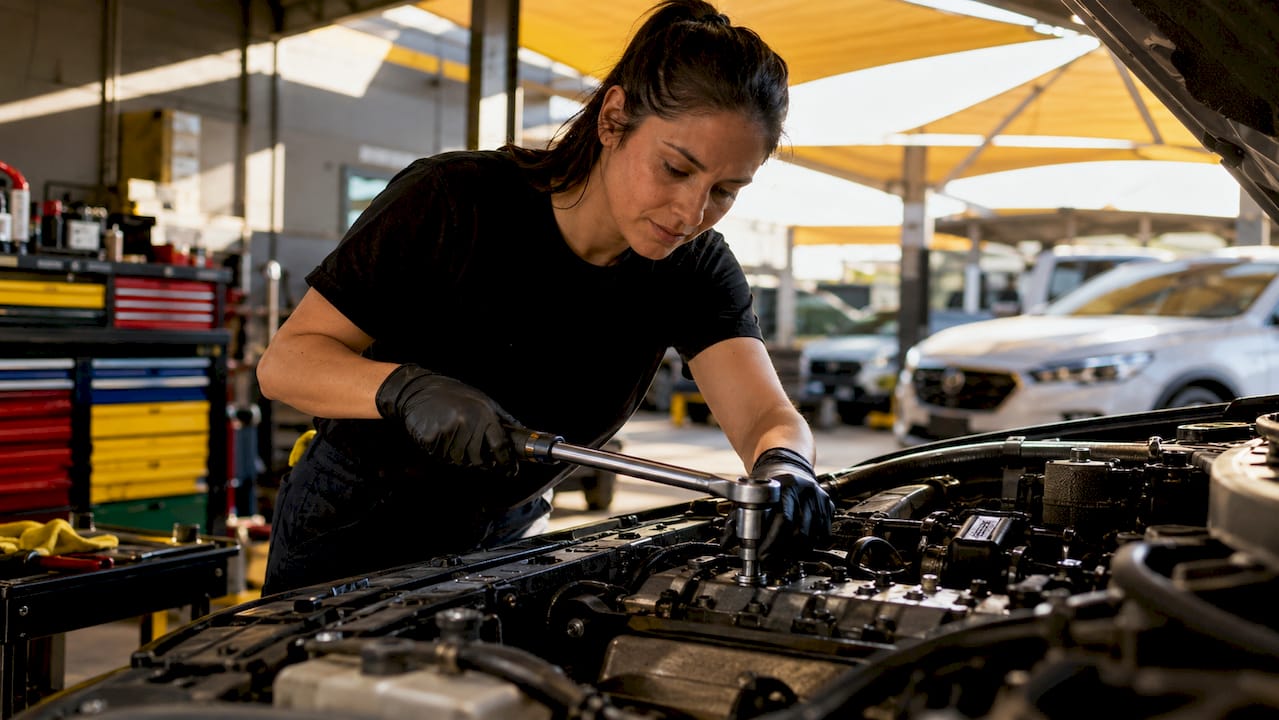
The consequences go beyond a stripped bolt. Damaged fasteners on aluminum suspension components or engine covers can compromise the structural integrity of the part itself. European manufacturers build to tight tolerances, and a fastener torqued incorrectly or with the wrong tool degrades both handling and long-term reliability.
European vehicles require metric-only tooling per ISO 898-1 property classes to protect fasteners and maintain correct assembly. That standard defines the mechanical properties of fasteners by grade, and matching the tool to the fastener grade is not optional. Using a “close enough” size causes hardware damage that compounds over time.
Here is the correct sequence for working with European fasteners and torque procedures:
- Identify the fastener type before selecting any tool. Confirm whether the application calls for triple-square, inverted Torx, or a standard metric hex.
- Match the tool grade to the fastener grade. ISO 898-1 property classes define the strength of the fastener. Your tool must match or exceed that rating.
- Use a calibrated torque wrench. Torque-to-yield bolts, common on European cylinder heads and suspension components, stretch to a specific value and cannot be reused or guessed.
- Follow the torque sequence. Many European assemblies require a specific tightening pattern, not just a final torque value.
- Use press-fit adapters for aluminum components. Incorrect pressing of aluminum knuckles causes cracks, and specific press adapters are required for BMW suspension and VW/Audi transmission services.
Pro Tip: Torque-to-yield bolts are single-use. If a shop reuses them to save cost, the joint will not hold to spec. Always confirm that new fasteners are used when the manufacturer specifies torque-to-yield hardware.
What physical tools does tight European packaging demand?
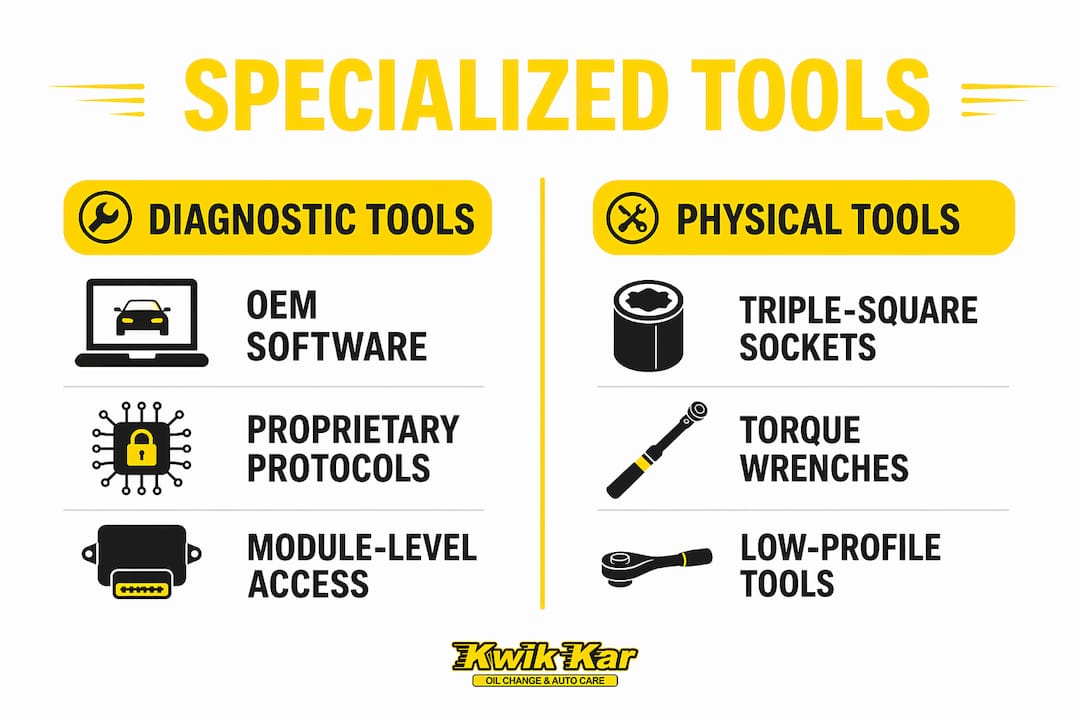
European vehicles pack more components into less space than most domestic designs. That density is a deliberate engineering choice, prioritizing weight distribution and handling. The trade-off is that standard tools physically cannot reach many service points. Tightly packaged components require specialized low-profile or bent tools for tasks like timing chain service, suspension bushing replacement, and diesel injector extraction.
Consider a few real examples of where generic tools fail:
- BMW timing chain service requires a dedicated locking tool set that holds the camshafts and crankshaft in precise alignment. Without it, the chain cannot be installed to the correct tension, and engine timing will be off.
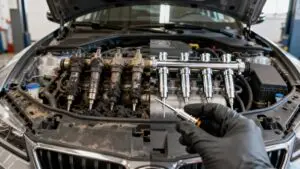
- Diesel injector extraction kits use a slide hammer and thread adapter specific to the injector seat. Attempting extraction with a generic puller risks breaking the injector body in the bore, a repair that can cost thousands of dollars.
- Multi-link suspension press tools for vehicles like the Audi A4 or BMW 3 Series use brand-specific adapters to press bushings without damaging the aluminum control arm. A generic press with the wrong adapter crushes the arm.
- Low-profile ratchets and offset wrenches are required to reach fasteners behind engine mounts and subframe brackets that a standard ratchet cannot access at any angle.
Physical tools and diagnostic software work together in a complete repair workflow. A technician might use a low-profile socket to remove a sensor, then switch to OEM software to recode the replacement. Skipping either step produces an incomplete repair. For owners interested in how specialized suspension components interact with these service requirements, the connection between tool precision and component integrity is direct.
What does tool quality mean for your long-term repair costs?
The right tools reduce repeat visits. Specialist workshops using correct specialized tools and factory procedures build reputations for accuracy and deliver better long-term reliability. That outcome is not accidental. It follows directly from having the equipment to complete every step of a repair, not just the visible ones.
“Higher costs in European vehicle maintenance reflect the need for specialized tools, premium parts, and exacting standards. Owners who understand this choose shops that invest in the right equipment and avoid the cycle of recurring faults and return visits.”
When a generic shop attempts a European repair without the correct tools, several failure patterns emerge:
- Recurring fault codes that return within days or weeks because the software adaptation was never completed.
- Premature component failure caused by incorrect torque or improper press-fit installation.
- Warranty complications when repairs do not follow manufacturer procedures, voiding coverage on related systems.
- Misdiagnosis leading to unnecessary parts replacement because the scanner could not read the actual fault source.
Choosing a qualified specialist means verifying that the shop holds brand-specific training, owns the OEM diagnostic platforms for your vehicle, and stocks the physical tool sets required for your model. You can also review affordable maintenance service options to understand what thorough service should include and what fair pricing looks like. The premium labor rate at a specialist shop reflects the investment in tools and training, and that investment pays off in repairs that hold.
Key Takeaways
European vehicles demand specialized tools at every level, from diagnostic software to physical fastener sets, because their engineering leaves no room for approximation.
| Point | Details |
|---|---|
| OEM software is non-negotiable | Generic OBD-II scanners miss module-level faults and cannot perform coding or calibration after repairs. |
| Proprietary fasteners require matched tools | Triple-square and inverted Torx fasteners strip instantly with standard sockets, turning routine jobs into costly extractions. |
| Tight packaging demands dedicated physical tools | Low-profile, bent, and brand-specific tools are the only way to safely access timing, suspension, and injector components. |
| Correct tools reduce long-term costs | Shops with proper equipment complete repairs fully, eliminating recurring faults and premature failures. |
| Specialist selection matters | Verify OEM diagnostic access, brand-specific training, and physical tool inventory before authorizing any European vehicle repair. |
Why I believe tool investment is the real dividing line in European repair
At Kwik Kar Oil Change & Auto Care, we have seen the same pattern repeat itself. A customer brings in a European vehicle after a repair elsewhere, and the fault light is back within a week. Nine times out of ten, the physical part was replaced correctly. The problem is that nobody completed the software adaptation afterward. The car’s network never accepted the new component.
The uncomfortable truth is that a technically skilled mechanic without the right tools is still working at a disadvantage on a European vehicle. The engineering does not forgive improvisation. An aluminum knuckle pressed with the wrong adapter cracks. A torque-to-yield bolt reused to save $8 fails under load. A battery replaced without a coding reset causes the alternator to overcharge and shorten its own life.
What I want enthusiasts and owners to take away is this: understanding why specialists use unique tools changes how you evaluate a shop. You stop asking “can they fix it?” and start asking “do they have what it takes to fix it correctly?” Those are very different questions, and the second one protects your vehicle.
— Kwik Kar
European vehicle care at Kwik Kar Oil Change & Auto Care
Kwik Kar Oil Change & Auto Care brings certified technicians and a commitment to thorough, transparent service to every vehicle that comes through the door. For European vehicle owners, that means working with professionals who understand the difference between a completed repair and a partial one.
Whether you need to understand signs your car needs an oil change or want to discuss a more involved service, Kwik Kar Oil Change & Auto Care is built around getting the job done right the first time. You can also review fair auto repair pricing to know exactly what quality service should cost before you schedule. European vehicles deserve the right tools and the right team. That is what you get here.
FAQ
Why can’t a regular mechanic fix a European car?
Generic tools cannot access proprietary diagnostic protocols or perform the software coding European vehicles require after repairs. Without OEM-level platforms like BMW ISTA or Audi ODIS, repairs remain incomplete even when the physical work is correct.
What are triple-square fasteners and why do they matter?
Triple-square, or XZN, fasteners are a proprietary design common on European drivetrains that standard sockets cannot grip without slipping. Using conventional sockets strips these fasteners immediately, converting a simple removal into a costly extraction job.
Do European cars need special tools for oil changes?
Many European vehicles require a specific oil drain plug socket, a filter housing tool, and a software reset for the condition-based service indicator after an oil change. Skipping the reset causes the system to flag a service warning prematurely or fail to alert you when service is actually due.
Why do European vehicle repairs cost more than domestic repairs?
Higher costs reflect specialized tools, premium parts, and exacting standards, not inflated pricing. OEM diagnostic software licenses, brand-specific tool sets, and manufacturer training all represent real investments that shops pass through to the repair cost.
How do I know if a shop is qualified to work on my European vehicle?
Ask whether the shop has OEM diagnostic software for your specific brand, owns the physical tool sets for your model’s known service requirements, and employs technicians with brand-specific training. A shop that answers all three confidently is equipped to complete the repair correctly.