


Fair auto repair pricing is defined by a clear, itemized estimate that separates labor hours, parts types, fees, and taxes so you can make an informed decision before any work begins. Most car owners feel uneasy at the service counter not because repairs are expensive, but because the bill is hard to read. Understanding what fair pricing for car repairs actually looks like puts you in control of that conversation. This guide breaks down every line of a typical estimate, from flat-rate labor to parts markup to mandatory fees, using 2026 FTC guidance and real industry benchmarks.
What fair auto repair pricing looks like: the core components
Fair pricing in auto repair rests on one principle: every cost must be visible before you approve the work. A well-structured estimate clearly shows the repair scope, labor and parts breakdown, warranties offered, and any potential changes during the job. That clarity is not a courtesy. It is the standard you should expect.
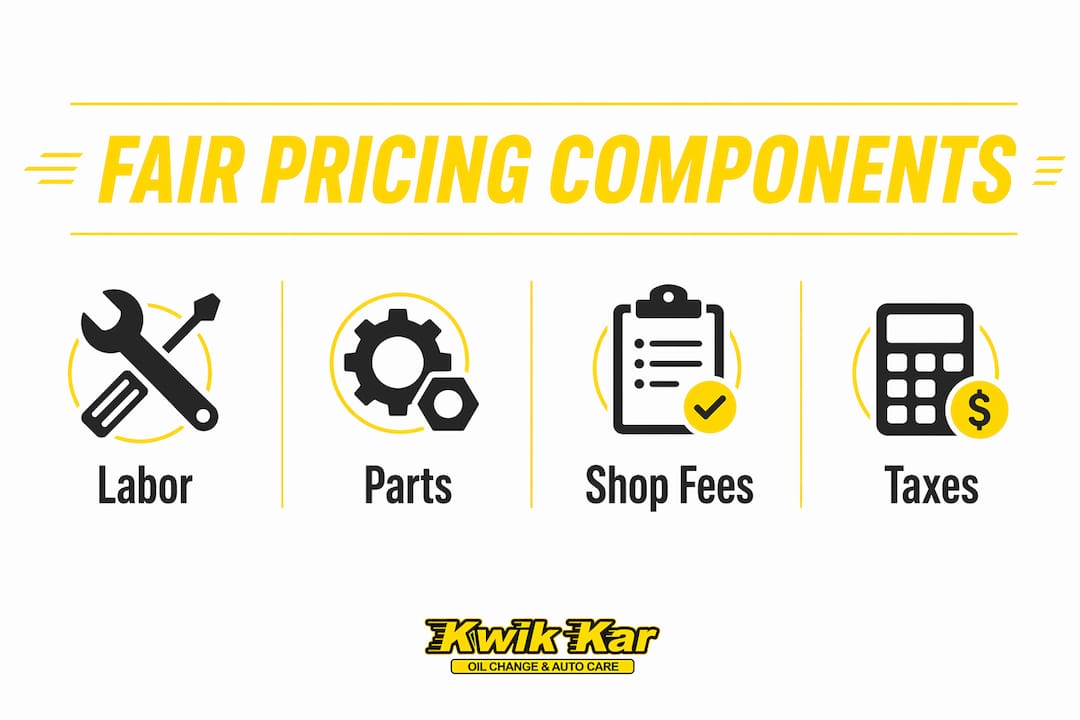
The four core components of any fair estimate are labor charges, parts costs, shop supply fees, and applicable taxes. Each one follows its own pricing logic, and each one can be evaluated independently. When a shop bundles these into a single total without itemizing them, that is a red flag worth questioning. Kwik Kar Oil Change & Auto Care builds every estimate around this itemized structure because it removes confusion and builds the kind of trust that keeps customers coming back.
How does labor pricing work at a repair shop?
Labor is typically the largest line item on any repair bill, and it is billed in one of two ways: flat-rate or hourly.
Flat-rate labor means you pay the standard published labor time for a specific job, regardless of how quickly the technician actually finishes. This time is drawn from industry labor guides such as Mitchell or Chilton, which assign a fixed number of hours to each repair type. If the guide says a brake job takes 1.5 hours and the technician finishes in 45 minutes, you still pay for 1.5 hours. The upside is predictability: you know the labor cost before the wrench turns.
Hourly billing is more common for diagnostics or jobs with uncertain scope, where the technician cannot predict how long the work will take. In those cases, shops should quote an estimated range and get your approval before exceeding it. Without that cap, an open-ended hourly job can produce a surprise bill.
Here is what to look for when evaluating labor charges:
- Labor rate posted visibly: Shops are required to display their hourly rate. In 2026, independent shops in most U.S. markets charge between $90 and $130 per hour. Dealerships typically run $130 to $180 per hour, and chain service centers often fall between $80 and $110.
- Labor hours match industry book time: If a shop charges 3 hours for a job the labor guide lists at 1.5 hours, ask for the source.
- Flat-rate scope is clearly defined: Flat-rate fairness depends on whether the estimate clarifies the repair scope and whether the shop communicates about extra work that falls outside the included scope.
- Diagnostic fees disclosed upfront: Some shops credit the diagnostic fee toward the repair cost if you approve the work. Others do not. Either policy is acceptable, but you need to know which one applies before you authorize anything.
Pro Tip: Ask the service advisor to show you the labor guide time for your specific repair. Any reputable shop will pull it up without hesitation. If they cannot or will not, treat that as a signal to get a second opinion.
OEM vs. aftermarket vs. remanufactured: how parts cost affects your bill
Parts pricing is where auto repair cost analysis gets complicated, because not all parts are created equal and the price difference between types can be significant.
Here are the four main categories you will see on an estimate:
- OEM (Original Equipment Manufacturer) parts are made by or for your vehicle’s manufacturer. They carry the highest price and are typically backed by a manufacturer warranty. For newer vehicles still under warranty, OEM parts are often required.
- Aftermarket parts are produced by third-party manufacturers and are designed to fit your vehicle. Quality varies widely across brands. Reputable aftermarket parts from companies like Bosch, Denso, or Monroe often match OEM performance at a lower cost.
- Remanufactured or rebuilt parts are used components that have been restored to factory specifications. Alternators, starters, and brake calipers are commonly available in this form. They are a cost-effective option when the remanufacturing process is certified.
- Used parts carry the lowest price and the highest risk. They are appropriate for some repairs but should come with a clear disclosure of condition and any available warranty.
Parts markup often ranges roughly 20% to 50% above the shop’s cost, covering sourcing, warranty administration, inventory risk, and the labor of ordering and receiving the part. That markup is legitimate. What is not legitimate is a shop charging OEM prices while installing an unbranded aftermarket part without telling you.
A key insight worth remembering: a part with warranty and verified fitment justifies a higher cost compared to a cheap, no-warranty alternative. Markup percentages alone do not tell the full story. A $40 markup on a warranted Bosch oxygen sensor is fairer than a $15 markup on an unbranded part that fails in six months.
Pro Tip: Ask the estimate to list the part brand, part number, and warranty term for every component. That one request separates shops that stand behind their parts from those that do not.
What are mandatory fees, and which ones are legitimate?
Beyond labor and parts, most repair estimates include additional charges that catch car owners off guard. Understanding which fees are standard and which ones are excessive is a core part of knowing how to price auto repairs fairly.
The most common additional charges include:
- Shop supply fees: These cover consumables like rags, cleaning solvents, lubricants, and small hardware used during the repair. A fee of 5% to 10% of the labor total is typical. A flat $50 shop supply charge on a $200 oil change is worth questioning.
- Environmental and disposal fees: Shops pay to dispose of used oil, coolant, and brake fluid legally. A fee of $3 to $10 per service is standard. Fees above $25 on routine maintenance deserve an explanation.
- Sales tax: Tax applies to parts in most states and sometimes to labor, depending on local law. The rate and application should be clearly stated on the estimate.
- Diagnostic fees: As noted above, these are legitimate charges for the technician’s time spent identifying the problem. They typically range from $75 to $150 depending on the shop and the complexity of the diagnosis.
The 2026 FTC guidance requires that advertised and quoted prices include all mandatory fees so consumers are not surprised by add-ons at pickup. This rule applies to dealerships and is increasingly the standard consumers should hold all shops to. If a shop cannot tell you the total cost including all fees before you approve the work, that is a transparency problem.
Watch for duplicate fee lines, such as a “hazardous waste fee” and a separate “fluid disposal fee” that cover the same service. Also watch for vague line items like “miscellaneous supplies” with no description. Both are signs of padding.
Regional and shop-type pricing: why fair prices vary by location
A fair price in Dallas is not the same as a fair price in rural Kansas, and that difference is not a sign of overcharging. Local market conditions affect what is considered fair, and comparing a rural shop to an urban one using only national averages can mislead you.
| Shop type | Typical labor rate | Best suited for |
|---|---|---|
| Dealership | $130 to $180/hr | Warranty work, brand-specific diagnostics, newer vehicles |
| Independent shop | $90 to $130/hr | Routine repairs, older vehicles, established relationships |
| Chain service center | $80 to $110/hr | Oil changes, tires, basic maintenance |
| RepairPal-certified shop | Varies by market | Verified fair pricing, consumer-backed accountability |
Urban shops carry higher overhead costs including rent, utilities, and wages, which is reflected in their rates. That does not make them unfair. What makes pricing unfair is when rates exceed local market norms without a corresponding difference in service quality, warranty, or expertise.
To benchmark fair pricing in your area, use tools like RepairPal or Kelley Blue Book’s repair cost estimator to generate a local price range for your specific repair. Then compare at least two estimates on an identical scope: same parts type, same labor hours, same fee structure. Comparing a quote that uses OEM parts to one that uses aftermarket parts is not an apples-to-apples comparison. Understanding why mechanics charge what they do in your specific market gives you a much clearer baseline than national averages alone.
How to read and evaluate an auto repair estimate line by line
Reading an estimate correctly is the single most practical skill you can develop as a car owner. Comparing estimates itemized by labor rate, parts type, and fees rather than relying on the total price alone is the method that actually reveals fair or unfair charges.
Work through these steps before signing anything:
- Verify labor hours against book time. Ask the service advisor which labor guide they use and what time it assigns to your repair. A 20% variance is common. A 100% variance needs an explanation.
- Confirm parts type and brand. Every part should be labeled as OEM, aftermarket, or remanufactured, along with the brand name and warranty term.
- Check the diagnostic fee policy. Ask directly: “Will this fee be credited if I approve the repair?” Get the answer in writing on the estimate.
- Review shop supply and disposal fees. Calculate them as a percentage of the labor total. Anything above 15% is worth a conversation.
- Confirm the total includes all fees and taxes. The number you approve should be the number you pay, barring any changes discovered during the repair that require a new authorization.
Pro Tip: If a shop discovers additional problems during the repair, they must contact you for approval before proceeding. Any shop that completes unauthorized work and then adds it to your bill is violating standard consumer protection practices in most states.
The fastest way to spot unfair charges is to look at how labor hours, diagnostic fees, and parts types are disclosed and credited. Shops that hide these details are not necessarily dishonest, but they are making it harder for you to verify that you are being treated fairly.
Key takeaways
Fair auto repair pricing requires a fully itemized estimate that discloses labor billing method, parts type and warranty, all mandatory fees, and applicable taxes before any work is approved.
| Point | Details |
|---|---|
| Itemized estimates are the standard | Every fair estimate separates labor, parts, fees, and taxes into distinct line items. |
| Labor billing method matters | Flat-rate uses industry guide times; hourly requires a cap and prior approval to be fair. |
| Parts type affects total value | OEM, aftermarket, and remanufactured parts differ in cost and warranty; always ask which type is used. |
| Mandatory fees must be disclosed upfront | Per 2026 FTC guidance, all fees must be included in the quoted price before you authorize work. |
| Benchmark locally, not nationally | Use RepairPal or Kelley Blue Book to compare estimates against your specific regional market. |
Fair pricing is about clarity, not just cost
Here is what years of working in auto care have taught us at Kwik Kar Oil Change & Auto Care: the customers who feel burned after a repair are rarely upset about the price itself. They are upset because the final bill did not match what they expected when they dropped off the car. That gap between expectation and reality is almost always a transparency failure, not a pricing failure.
We have seen customers accept a $1,200 repair without complaint because every line was explained clearly. We have also seen customers dispute a $150 oil change because the shop supply fee appeared without warning. The dollar amount matters less than the trust built or broken by how the estimate was presented.
Our honest advice: do not let a shop rush you through the approval process. A fair shop welcomes your questions because they have nothing to hide. If a service advisor becomes impatient when you ask about a specific line item, that reaction tells you something important. Build a relationship with a local shop that posts its labor rate, explains its parts sourcing, and calls you before doing any work outside the original scope. That relationship is worth more than saving $30 on a single repair.
Neighborhood auto care done right is not just about convenience. It is about having a shop that knows your vehicle and treats your budget with respect.
— Kwik Kar Oil Change & Auto Care
Get transparent pricing and dependable service at Kwik Kar
Kwik Kar Oil Change & Auto Care serves Fort Worth drivers with RepairPal-certified technicians, clearly itemized estimates, and a no-surprise pricing policy on every service from oil changes to complex repairs. Every estimate you receive at Kwik Kar Oil Change & Auto Care separates labor, parts, and fees so you know exactly what you are paying for and why. If cost is a concern, explore auto repair financing options that make it easier to handle larger repairs without delay. You can also review the 2026 maintenance services list to plan ahead and budget for routine care before small issues become expensive ones.
FAQ
What does a fair auto repair estimate include?
A fair estimate itemizes labor hours and rate, parts type and brand, shop supply fees, disposal fees, and applicable taxes before you approve any work. The total on the estimate should match the total on your final bill, unless you authorized additional repairs during the job.
How much should labor cost at an auto repair shop?
Independent shops typically charge $90 to $130 per hour in most U.S. markets in 2026, while dealerships run $130 to $180 per hour. The rate alone does not determine fairness. The number of hours charged and whether they match industry book time matters just as much.
Is a parts markup of 20% to 50% normal?
Yes. Parts markup in that range is standard practice and covers sourcing, warranty administration, and inventory costs. Markups above 50% on common parts are worth questioning, especially if the shop cannot confirm the part brand or warranty term.
What are shop supply fees and are they required?
Shop supply fees cover consumables like rags, lubricants, and small hardware used during the repair. They are a legitimate charge, typically 5% to 10% of the labor total. They are not legally required to be itemized separately in every state, but a fair shop will explain them if you ask.
How do I know if a mechanic is overcharging me?
Compare estimates on the same scope, parts type, and labor hours across at least two shops, and check the labor time against a tool like RepairPal or Kelley Blue Book. Overcharging most often shows up in inflated labor hours, vague parts descriptions, or fee lines that duplicate each other.