


The five preventive services that deliver the biggest long-term savings are oil and filter changes, scheduled fluid replacements (transmission, coolant, and brake fluid), tire care (pressure, rotation, and alignment), brake inspections and pad service, and belts and hoses checks before failure. Start this week: check your oil level and tire pressure, then schedule an oil change if you’re within 1,000 miles of your interval. According to Consumer Reports, staying on top of regular maintenance and getting repairs done before they create other problems will save you money in the long run. Kwik Kar Oil Change & Auto Care, a RepairPal-certified shop in Fort Worth staffed by certified technicians, offers every one of these services with transparent pricing and no surprises.
- Oil and filter changes (depending on oil type)
- Transmission, coolant, and brake fluid replacement on schedule
- Tire pressure checks monthly, rotation every 5,000–7,500 miles, alignment annually
- Brake pad inspection every 12,000 miles or at each oil change
- Belt and hose inspection every 30,000 miles, replacement before failure
Table of Contents
- Why does preventive maintenance cut your lifetime vehicle costs?
- Which preventive tasks save the most money?
- How do you build a maintenance schedule you’ll actually follow?
- What preventive care won’t guarantee
- Key Takeaways
- A Fort Worth perspective on what actually saves the most
- Kwik Kar Oil Change & Auto Care keeps Fort Worth drivers ahead of repairs
- Useful sources and further reading
- FAQ
- Our take on what actually matters
Why does preventive maintenance cut your lifetime vehicle costs?
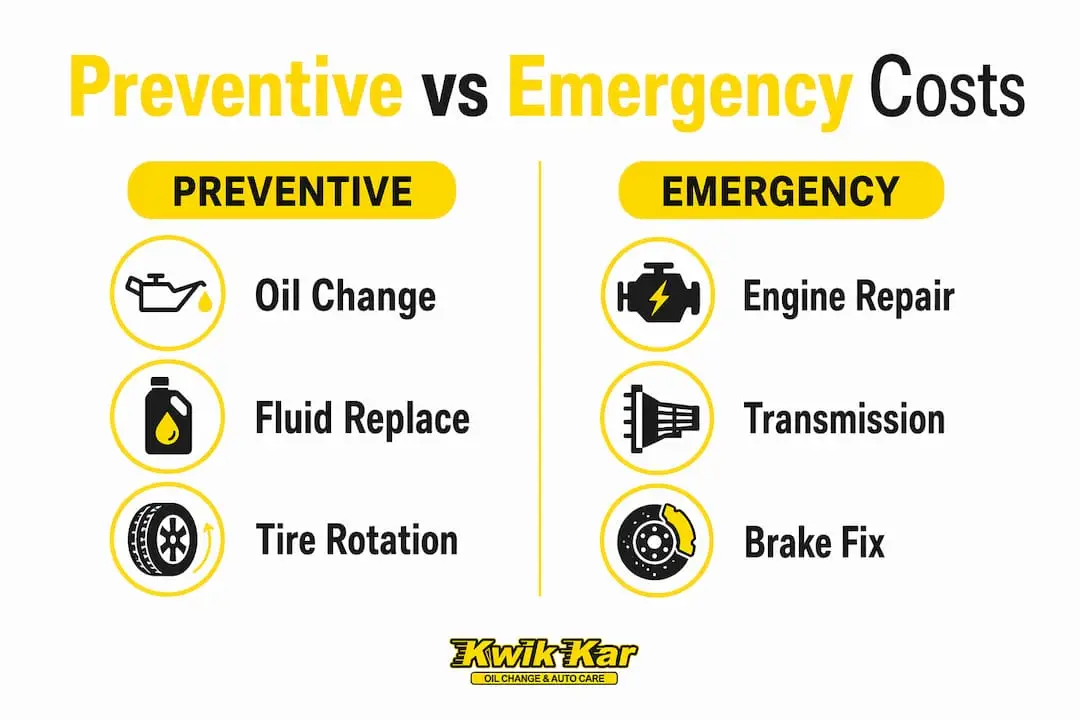
Neglecting one small item rarely stays small. A low coolant level leads to overheating; overheating warps a cylinder head; a warped head means a $2,000–$4,000 repair that a $25 coolant top-off could have prevented. Routine maintenance often costs 10 to 50 times less than the emergency repair it prevents. That ratio is the core argument for preventive care.
Annual proactive maintenance typically runs $500–$1,000, while major emergency repairs frequently exceed $4,000–$7,000. Skipping scheduled service also creates secondary costs: towing fees, rental cars, and missed work days that never show up in a simple repair estimate.
Mercury Insurance echoes that point directly. Regular service reduces cascading failures and extends the life of the engine, transmission, and brakes. Justin Yoshizawa of Mercury Insurance emphasizes that following the factory maintenance schedule is the most reliable way to avoid the kind of multi-system failures that turn a $300 service into a $5,000 repair.
| Service | Typical Preventive Cost | Emergency Repair If Ignored |
|---|---|---|
| Oil and filter change | $50–$100 | Engine rebuild: $3,000–$7,000+ |
| Accessory/serpentine belt | — | Engine damage/overheating: $1,200+ |
| Brake pads | $150–$300 per axle | Rotor replacement + pads: $600–$1,200 |
| Transmission fluid service | — | Transmission rebuild: $2,500–$5,000 |
| Coolant flush | $150 | Head gasket repair: $2,000–$4,000 |
Well-documented vehicles also sell for 15%–20% more than those without service records, so the savings extend beyond the repair shop.
Which preventive tasks save the most money?
Here are the eight highest-impact services, ranked by the cost gap between prevention and failure:
-
Oil and filter change. Every 3,000–7,500 miles (check your owner’s manual). Skipping oil changes lets sludge build up, increasing friction until the engine sustains permanent damage. Five quick monthly checks — oil level, tire pressure, coolant, air filter, and battery terminals — catch problems before they compound.
-
Tire pressure, rotation, and alignment. Check pressure monthly; rotate every 5,000–7,500 miles. Planned tire rotations and alignment prevent uneven wear and premature replacement. A $25 rotation protects a $600–$1,200 set of tires.
-
Brake inspection and pad service. Inspect every 12,000 miles or at each oil change. Worn pads left too long score the rotors, turning a $200 pad job into a $600 pad-and-rotor replacement. Consumer Reports’ John Ibbotson recommends using the best available pad and rotor parts to protect braking performance.
-
Cooling system and coolant flush. Every 30,000–50,000 miles. Overheating is one of the fastest paths to catastrophic engine damage. A coolant flush at the right interval is one of the most cost-effective services on this list.
-
Transmission fluid service. Every 30,000–60,000 miles depending on driving conditions. Dirty transmission fluid causes heat buildup that leads to slipping gears, and eventually a rebuild that can cost $2,500–$5,000.
-
Belts and hoses inspection and replacement. Serpentine and timing belts should be inspected every 30,000 miles and replaced per manufacturer spec (often 60,000–100,000 miles). A snapped timing belt can destroy an engine in seconds.
-
Battery and terminal check. Every 12 months or at each seasonal service. Most batteries last 3–5 years; a $150 replacement beats a dead battery and a tow.
-
Air filter, fuel filter, and spark plugs at mileage milestones. Air filters every 15,000–30,000 miles; spark plugs at 30,000–100,000 miles depending on type. Dirty filters and worn plugs reduce fuel efficiency and strain the engine.
Pro Tip: When your shop replaces the timing belt, have the water pump and tensioners done at the same time. The labor overlap means you pay for one job instead of two, and the water pump is already accessible. This is one of the most reliable ways to avoid paying double labor on a single repair.
You can find a full preventive maintenance checklist that maps these services to mileage milestones.
How do you build a maintenance schedule you’ll actually follow?
The single most effective strategy is simple: open your owner’s manual, find the maintenance schedule, and treat it as a fixed calendar. Following the factory-recommended schedule is the primary way to maximize vehicle lifespan. If your car is older or you tow, haul, or drive in stop-and-go traffic regularly, switch to the “severe duty” schedule listed in the same manual.
Here’s how to turn that schedule into a plan you’ll keep:
- Pull the owner’s manual and list every mileage-based service (oil, rotation, fluids, belts).
- Set phone reminders tied to your current odometer reading, not just calendar dates.
- Use a service sticker on your windshield as a quick visual cue for your next oil change.
- Keep a paper or digital log of every service, including the shop name, date, mileage, and work performed.
- Download Kwik Kar’s free car maintenance checklist PDF to track services in one place.
Consumer Reports recommends budgeting $50–$100 per month as a household rule of thumb for routine maintenance, with a higher set-aside if you plan to keep the car past 100,000 miles. Spreading costs monthly prevents the sticker shock of a single large service visit.
A simple annual rhythm for most Fort Worth drivers: oil change every 3–4 months, tire rotation at every other oil change, brake inspection twice a year, and one fluid service (coolant or transmission) per year on a rotating basis. That schedule keeps you ahead of every major failure category without requiring a large single outlay.
Understanding how service intervals are determined for your specific vehicle makes it easier to push back when a shop suggests more frequent service than your manual requires.
What preventive care won’t guarantee
Preventive maintenance reduces the risk and frequency of major failures. It does not make parts immortal. Rubber degrades, metal fatigues, and electronics fail regardless of how diligent you are. Managing that reality is part of smart ownership.
At high mileage, inspections should expand to include emissions components, driveline, and suspension. These checks materially affect whether a vehicle reaches 200,000 miles.
Common repairs that appear even on well-maintained vehicles in the 100,000–150,000 mile range:
- Timing belt or chain replacement (if not already done)
- Water pump replacement
- Suspension components (struts, control arm bushings)
- Oxygen sensors and catalytic converter
- Thermostat and radiator hoses
When to consider replacement instead of repair:
- The estimated repair cost approaches or exceeds the vehicle’s current market value.
- The same system has failed more than once within 12 months.
- Multiple major systems need attention simultaneously.
- Reliability has become unpredictable despite consistent maintenance.
Preventive care extends the window before these decisions arrive. It does not eliminate them.
Key Takeaways
Consistent preventive maintenance is the most reliable way to reduce lifetime vehicle costs, protect resale value, and avoid emergency repairs that cost significantly more than the services that prevent them.
| Point | Details |
|---|---|
| Prioritize five core services | Oil changes, fluid replacement, tire care, brake inspections, and belt/hose checks deliver the highest long-term savings. |
| Annual maintenance budget | Plan for $50–$100 per month; major emergency repairs frequently cost several thousand dollars. |
| Resale value impact | Documented service history improves resale value by 15%–20% compared to vehicles without records. |
| Follow the owner’s manual | The factory schedule (or severe-duty schedule for older/hard-used vehicles) is the most effective single strategy. |
| Kwik Kar Oil Change & Auto Care | Fort Worth’s RepairPal-certified shop offers transparent preventive services and a free maintenance checklist to keep you on schedule. |
A Fort Worth perspective on what actually saves the most
What Kwik Kar Oil Change & Auto Care sees most often in Fort Worth is this: the vehicles that arrive with the biggest repair bills are almost never the oldest ones. They’re the ones where oil changes were skipped for 10,000 miles, or where a slow coolant leak was ignored through two Texas summers. Fort Worth heat is genuinely hard on cooling systems and rubber components. Stop-and-go traffic on I-30 and Loop 820 accelerates brake pad wear faster than highway driving. Drivers who tow trailers or haul equipment regularly should be on the severe-duty schedule without question.
The RepairPal certification at Kwik Kar Oil Change & Auto Care means pricing is benchmarked against fair-market rates, and every technician on staff is certified. Bring your service records to your first appointment. That history lets the team identify what’s coming due and what can wait, so you’re spending on what your car actually needs.
For Fort Worth drivers, the easiest next step is a walk-in oil check or a scheduled alignment. Both take less than an hour and give the shop a chance to catch anything developing before it becomes a problem.
Kwik Kar Oil Change & Auto Care keeps Fort Worth drivers ahead of repairs
Spending $500–$1,000 a year on planned maintenance beats a single $5,000 emergency repair. Kwik Kar Oil Change & Auto Care makes that math work for Fort Worth drivers by offering the full range of high-impact preventive services under one roof: oil changes, fluid services, tire rotations and alignments, brake inspections, belt and hose checks, and multi-point inspections. Every service is performed by certified technicians, priced transparently, and backed by RepairPal certification.
If a larger repair does come up, flexible financing options are available so cost doesn’t force you into delaying work that affects safety. Busy schedule? Kwik Kar offers maintenance without an appointment for most routine services. Download the free maintenance checklist PDF to track your intervals, then stop by or book online to get your next service scheduled.
Useful sources and further reading
- Consumer Reports Car Maintenance Guide — General maintenance intervals, expert quotes from John Ibbotson, and guidance on when to use severe-duty schedules.
- Consumer Reports: Make Your Car Last 200,000 Miles — Factory schedule adherence, high-mileage inspection guidance, and monthly budgeting rules.
- Mercury Insurance: Car Maintenance Schedule Explained — Domino-effect failure risk and the cost case for following manufacturer intervals.
- Mission Autos: Preventive Maintenance vs Emergency Repairs — Real-world cost comparisons and the cascading value of early intervention.
- Owl-Let: Is It Cheaper to Maintain or Fix? — Annual maintenance cost ranges, emergency repair ranges, and resale value data.
- Motor1: Mechanic Car Maintenance Advice — Five monthly checks recommended by a practicing mechanic.
- Kwik Kar Preventive Maintenance Checklist PDF — Free downloadable checklist to track your service intervals.
- Liberty CDJR: Preventive Vehicle Maintenance Owner’s Guide — Manufacturer-focused guidance on recommended service intervals and owner’s manual use.
FAQ
What preventive car services save the most money long-term?
Oil and filter changes, tire rotations and alignment, brake inspections, scheduled fluid replacement, and belt/hose checks deliver the highest savings by preventing failures that are far more costly than the services themselves.
How much should I budget for preventive car maintenance each year?
Consumer Reports recommends setting aside $50–$100 per month, which covers most routine services and builds a buffer for larger interval items like timing belts or fluid flushes.
Does preventive maintenance improve my car’s resale value?
Yes. Vehicles with documented service histories sell for 15%–20% more than comparable vehicles without records, making record-keeping one of the easiest ways to protect your investment.
How do I know if I need the severe-duty maintenance schedule?
Check your owner’s manual. If you regularly drive in stop-and-go traffic, tow or haul loads, operate in extreme heat, or have a high-mileage vehicle, the severe-duty schedule applies and shortens most service intervals.
Where can Fort Worth drivers get preventive maintenance done reliably?
Kwik Kar Oil Change & Auto Care is a RepairPal-certified shop in Fort Worth with certified technicians, transparent pricing, and no-appointment options for most routine services.
Our take on what actually matters
Most drivers think about car maintenance the wrong way. They treat it as an expense to minimize rather than a system to manage. The real cost of a vehicle isn’t the purchase price. It’s the total of every repair, every tow, every rental car, and every resale dollar lost because the service history was spotty. Preventive care is the only lever that controls all of those variables at once.
The conventional wisdom says “just follow the schedule.” That’s correct but incomplete. The schedule only works if you actually know what’s in your owner’s manual, understand which conditions trigger the severe-duty intervals, and have a shop that will tell you honestly what’s due versus what can wait. That last part matters more than most drivers realize. A shop that recommends every flush and filter at every visit isn’t serving your interests. The right shop helps you prioritize.
Fort Worth’s heat and traffic patterns make cooling system and brake maintenance more urgent than the national averages suggest. That’s not a sales pitch. It’s what the cars coming through the door tell us every week.