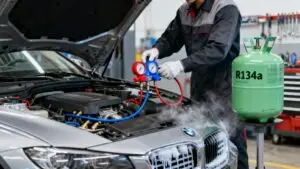





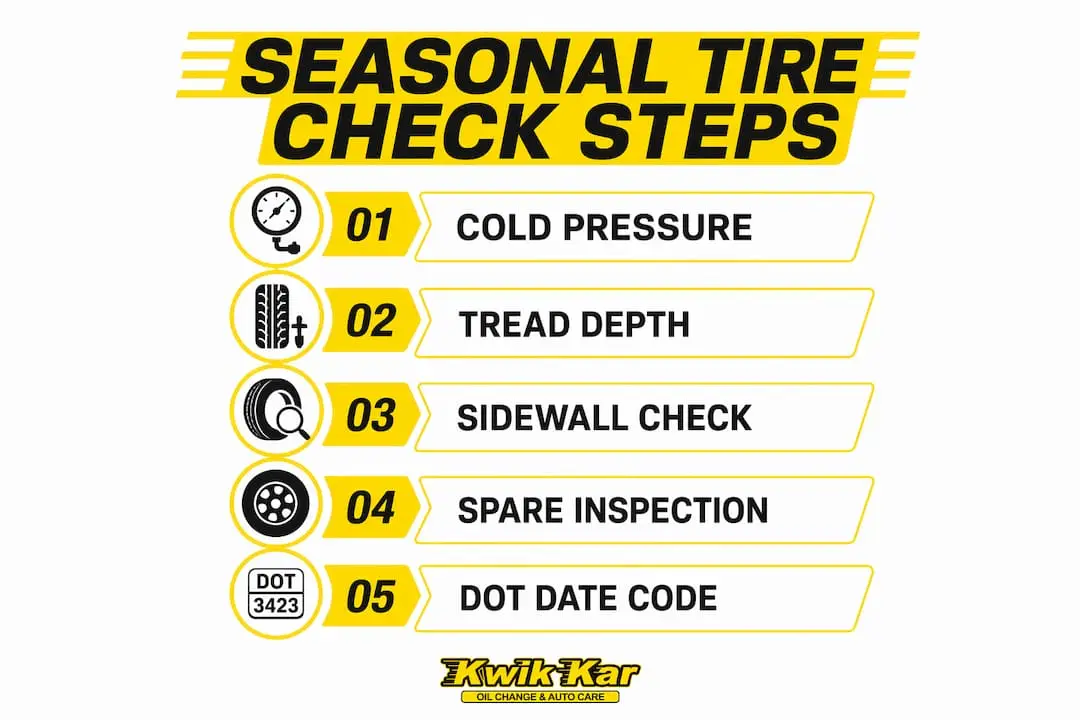
A seasonal tire check in Texas covers core items including cold inflation pressure, tread depth at multiple grooves, sidewall condition, valve stem and TPMS sensor status, wheel balance and rotation, and any visible damage that makes a tire unsafe to drive. Run this check before the summer heat peaks and again before the first cold front of fall. Those two windows catch the conditions most likely to cause a blowout or a roadside citation in Texas.
Since House Bill 3297 took effect on January 1, 2025, most non-commercial vehicles no longer need a mandatory annual safety inspection. That does not mean your tires are off the hook. Texas DPS is clear: drivers remain legally responsible for maintaining safe tires, and officers can still cite you for visibly unsafe ones. A voluntary seasonal check is now your primary safety net.
Quick seasonal tire checklist — scan before your next service visit:
- Cold tire pressure (check manufacturer spec on door jamb, not the tire sidewall)
- Tread depth at two adjacent major grooves (minimum 2/32" for passenger vehicles)
- Sidewall inspection for bulges, cuts, cracks, or exposed cords
- Valve stems and caps (cracked stems leak pressure silently)
- TPMS warning light status and sensor function
- Wheel balance and rotation interval
- Puncture repairability (center tread vs. sidewall location)
- Spare tire pressure and jack condition
Table of Contents
- What Texas law actually requires for tire safety now
- Why Texas seasonal checks are heat-first, with winter as a secondary concern
- The full seasonal tire inspection checklist — what technicians check and what you can do at home
- When to replace your tires — thresholds and Texas-specific examples
- What a professional seasonal tire check looks like at a shop
- What Kwik Kar Oil Change & Auto Care technicians check and why it matters
- Key Takeaways
- The one thing most Texas drivers overlook before summer
- Kwik Kar Oil Change & Auto Care seasonal tire service in Fort Worth
- Useful sources and further reading
- FAQ
What Texas law actually requires for tire safety now
HB 3297 eliminated the mandatory annual safety inspection for most non-commercial vehicles starting January 1, 2025. You still pay an inspection program replacement fee at registration, but no technician is required to sign off on your tires before you renew your plates.
Commercial vehicles are a different story. They still require a passing safety inspection in every county, and the $7.50 fee does not apply to them since they pay for the full inspection.
Texas DPS guidance states: Even though vehicle safety inspections are being eliminated for most vehicles, driving without properly working safety features — including tires — is against the law and puts everyone at risk. Officers can stop and cite vehicles for unsafe tire conditions regardless of inspection status.
The DPS enforcement threshold for passenger tires is 2/32" of tread depth. A tire measuring below that in two adjacent major grooves is classified as unsafe. Commercial vehicles face a stricter standard: steering-axle tires must have at least 4/32" of tread. Beyond tread, officers look for exposed cords, sidewall bulges, severe cracking, and tires that are clearly mismatched or improperly mounted.
The practical takeaway: the annual certificate is gone, but the legal obligation to run safe tires has not changed. A vehicle safety inspection used to catch these issues automatically. Now that safety net is yours to maintain.
Why Texas seasonal checks are heat-first, with winter as a secondary concern
Most tire guides are written for four-season climates. Texas is not one. Summer heat management is the primary seasonal concern for the vast majority of Texas drivers, not winter traction. Pavement surface temperatures in Texas regularly exceed 100°F during summer months, and that heat accelerates sidewall rubber degradation, increases blowout risk, and causes pressure to rise beyond the manufacturer’s recommended range.
When to run your checks:
- Pre-summer (April–May): Before sustained high temperatures arrive. This is the highest-priority window for most Texas drivers. Check pressure, sidewall condition, and tread depth before the heat compounds any existing wear.
- Pre-first cold front (October–November): Pressure drops roughly 1 PSI for every 10°F drop in temperature, so a tire that was fine in August may be underinflated by November.
- Mid-summer: Add a quick pressure and sidewall check if you’re logging high mileage, hauling loads, or driving regularly on hot highway stretches.
Regional nuance matters here. Drivers in the Texas Panhandle, the Davis Mountains area, or along high-elevation routes may encounter genuine winter conditions and should consider tires carrying the 3PMSF (Three-Peak Mountain Snowflake) symbol, which indicates industry-tested winter capability. For central and southern Texas, quality all-season tires handle the occasional freeze without the trade-offs of a dedicated winter tire. If you want guidance on cold-weather prep specific to North Texas, the Tarrant County winter prep guide covers the regional specifics.
Pro Tip: Store any spare or off-season tires away from direct sunlight and heat sources. UV exposure and ozone from electric motors accelerate sidewall cracking even on tires that never touch the road. A cool, dark storage spot can add years to a tire’s usable life in the Texas climate.
The full seasonal tire inspection checklist — what technicians check and what you can do at home
A thorough seasonal check covers more than a quick glance at the tread. Here is what a trained technician works through, and which steps you can reasonably handle in your driveway.
What technicians inspect
- Cold inflation pressure: Measured before the vehicle has been driven (or at least three hours after). The target is the PSI listed on the driver’s door jamb sticker, not the maximum PSI molded into the tire sidewall.
- Tread depth: Using a calibrated gauge at the lowest points in two adjacent major grooves. Per DPS technical guidance, a tire is rejected when tread falls below 2/32" in those two grooves, or when the built-in wear indicators make contact across two adjacent grooves.
- Sidewall inspection: A 360° visual check for cuts, bulges, cracks, or any sign of cord exposure. Heat-related cracking often starts as fine lines near the bead area before becoming structurally dangerous.
- Valve stems and caps: Cracked or corroded stems are a common source of slow leaks. Caps keep moisture and debris out of the valve core.
- TPMS sensor scan: A scan tool reads each sensor’s status and battery level. Temperature swings can trigger false warnings, so TPMS sensors should be checked and updated during seasonal services.
- Wheel balance: Checked with a spin balancer; imbalance shows up as vibration at highway speeds and accelerates uneven wear.
- Alignment indicators: Technicians look for uneven wear patterns across the tread face (feathering, one-sided wear) that suggest an alignment issue. A full alignment check requires a rack, but visual wear patterns flag the need.
- Puncture and repairability assessment: Location and size determine whether a repair is safe. Repairs are generally permitted in the center tread area within certain diameter limits. Sidewall and shoulder punctures are not safely repairable and call for replacement.
- Spare tire and jack: Spare pressure and jack condition are easy to overlook until you need them. A proper car jack and a properly inflated spare are part of a complete seasonal check.
What you can do at home
A five-minute DIY check covers the basics between professional visits:
- Check cold pressure with a quality gauge before your first drive of the day.
- Use a tread depth gauge or the quarter/penny test at multiple points across each tire.
- Walk around the vehicle and visually inspect each sidewall for bulges or cracking.
- Note whether the TPMS warning light is on or flashing — a solid light means low pressure, a flashing light often means a sensor fault.
Pro Tip: For the penny test, insert a penny into the tread groove with Lincoln’s head pointing down. If you can see the top of Lincoln’s head, you’re at or below 2/32" and the tire needs replacing. A quarter gives you a 4/32" warning margin — useful if you want earlier notice before hitting the legal threshold.
Tread depth should be checked at the lowest points in two adjacent major grooves for an accurate reading. Checking only the center of a single groove can miss shoulder wear that a technician would catch on a lift.
When to replace your tires — thresholds and Texas-specific examples
The legal minimum tread depth is the enforceable floor for passenger vehicles in Texas, but waiting until that point to replace tires may not be safest, as stopping distances increase with lower tread depth. For Texas drivers who deal with sudden heavy rainstorms, that margin matters.
Age guidance: Heat accelerates rubber oxidation. A tire that has been parked in a hot Texas driveway for years may look fine but have brittle sidewall rubber that cracks under load. Most manufacturers and industry guidance suggest considering replacement after 6–10 years regardless of tread depth, with the lower end of that range applying to tires stored in high-heat, high-UV conditions. Check the four-digit DOT date code on the sidewall: the last four digits indicate the week and year of manufacture (e.g., “2319” means the 23rd week of 2019).
Practical examples:
- A tire at 3/32" on a high-mileage Fort Worth commute with daily highway driving in summer heat: replace it now rather than waiting for the final 1/32". The combination of heat, speed, and load accelerates wear faster than the number alone suggests.
- A 3PMSF-rated all-weather tire approaching low tread before an expected Panhandle freeze: replace before the weather event, not after. Traction on snow and ice degrades sharply below 4/32" even on winter-capable tires.
| Threshold | Passenger vehicles | Commercial (steering axle) |
|---|---|---|
| Legal minimum tread depth | 2/32" | 4/32" |
| Recommended replacement warning | 4/32" | 6/32" |
| Repairable puncture zone | Center tread only | Center tread only |
| Age guidance (heat-exposed) | Consider replacement at 6–10 years | Per fleet/DOT schedule |
For a deeper look at tread depth measurement and what the numbers mean for your driving conditions, the Kwik Kar tread depth guide walks through each scenario.
What a professional seasonal tire check looks like at a shop
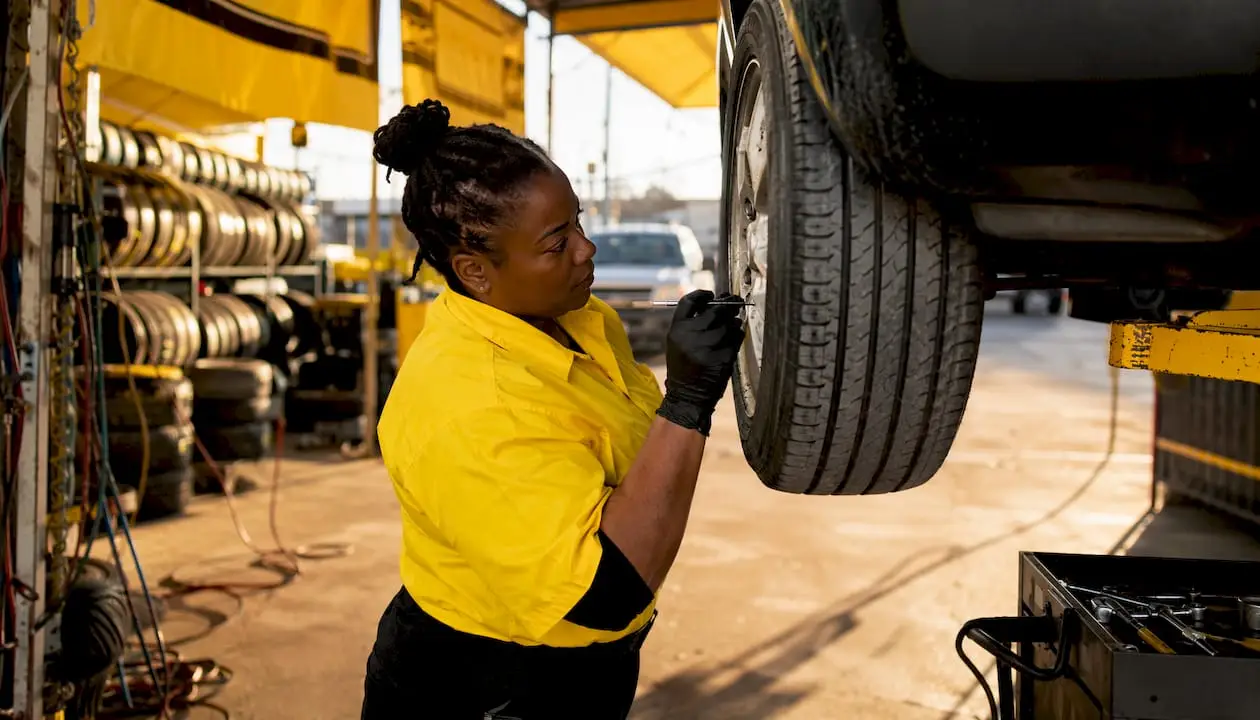
Knowing the checklist is one thing. Understanding what actually happens during a shop visit helps you confirm the work was done right and ask the right questions.
Typical shop workflow:
- Initial visual walk-around before the vehicle goes on the lift
- Vehicle raised; wheels inspected on and off the vehicle depending on service scope
- Pressure adjusted to door-jamb spec; TPMS scan completed
- Tread depth measured with a calibrated gauge at multiple points per tire
- Valve stems inspected; stems replaced if cracked or corroded
- Rotation performed if mileage or wear pattern warrants it
- Balance check and correction if vibration or uneven wear is present
- Written inspection report provided to the customer
Time estimates: A seasonal check with rotation typically runs 45–60 minutes. Adding a mount and balance for new tires extends that to 60–90 minutes. A plug or patch repair on a repairable puncture usually adds 20–30 minutes. Alignment diagnosis adds time and, if correction is needed, a separate appointment may be required.
Cost ranges in Texas: A tire rotation and inspection at most shops runs $20–$50. Mounting and balancing per tire typically falls in the $15–$30 range depending on wheel size and labor rates. Plug or patch repairs generally run $15–$30 per tire. These ranges vary by market, wheel type, and shop. Always ask for an itemized estimate before work begins. If you want to understand how to evaluate those estimates fairly, the guide on comparing auto repair prices covers what to look for. Pairing a seasonal tire check with your oil change and tire rotation appointment is an efficient way to cover both in one visit.
What Kwik Kar Oil Change & Auto Care technicians check and why it matters
Kwik Kar Oil Change & Auto Care’s certified technicians follow a structured seasonal tire inspection that covers every item on the checklist above. That means cold-pressure adjustment to door-jamb spec, a calibrated tread depth reading at two adjacent grooves per tire, a full sidewall inspection, valve stem check, and a TPMS sensor scan with a dedicated scan tool. If rotation or balancing is needed, it is performed on the same visit with written documentation of the findings.
RepairPal-certified shops meet verified standards for pricing transparency and technician competence. Kwik Kar Oil Change & Auto Care holds RepairPal certification, which means customers receive honest, itemized estimates before any work is approved — no surprises on the final invoice.
The team at Kwik Kar Oil Change & Auto Care has served Fort Worth and the surrounding Tarrant County area for years, building a track record on straightforward communication and thorough service. When you bring your vehicle in, let the service advisor know about any recent TPMS warnings, vibration at highway speeds, or visible sidewall concerns. That context helps technicians prioritize the inspection and catch issues that a standard visual might not flag immediately.
To schedule your seasonal tire check, visit the Kwik Kar Oil Change & Auto Care website or call the shop directly. Bring your vehicle’s recent mileage and any warning light history if you have it.
Key Takeaways
A seasonal tire check in Texas is your primary safety net now that most non-commercial vehicles no longer require a mandatory annual inspection under HB 3297.
| Point | Details |
|---|---|
| Two check windows per year | Run a full check before summer heat peaks (April–May) and before the first cold front (October–November). |
| Legal tread minimums | Passenger tires must meet 2/32" tread depth; commercial steering-axle tires require 4/32" per Texas DPS. |
| HB 3297 shifts responsibility to you | The $7.50 fee replaced the annual inspection for most vehicles, but unsafe tires remain citable by law. |
| Heat is the primary Texas risk | Sidewall degradation, pressure spikes, and blowout risk peak in summer — pre-summer checks are the priority. |
| Kwik Kar Oil Change & Auto Care | RepairPal-certified technicians in Fort Worth provide itemized seasonal tire checks with TPMS scanning and written reports. |
The one thing most Texas drivers overlook before summer
Most drivers who come in with a tire problem in July had the warning signs in May. A sidewall crack that looked minor in spring becomes a blowout risk once pavement temperatures climb past 100°F and the tire is running at highway speed under a full load. The heat does not create the problem — it accelerates one that was already there.
What technicians see most often in Texas seasonal checks is not catastrophic damage. It is tires that are 5–8 years old with acceptable tread depth but sidewalls that have gone brittle from years of UV and heat exposure. The tread gauge passes. The sidewall fails. Owners are surprised because the number looked fine.
The practical recommendation: do not let tread depth be your only metric. Check the DOT date code on each tire. If any tire is approaching eight years old and has spent most of its life in a Texas driveway, schedule a professional inspection before the summer heat wave, not after. A quick sidewall check twice a year, as industry guidance recommends, takes about five minutes and catches the kind of aging that a pressure gauge will never show you.
Kwik Kar Oil Change & Auto Care seasonal tire service in Fort Worth
Certified technicians, transparent pricing, and no appointment required for most services — that is the practical advantage Kwik Kar Oil Change & Auto Care offers Texas drivers who want a professional seasonal tire check without the wait or the guesswork of a dealership service lane.
A seasonal tire check at Kwik Kar Oil Change & Auto Care covers cold-pressure adjustment, calibrated tread depth measurement, sidewall and valve inspection, TPMS scan, and a written report of findings. Most visits run under an hour. If rotation or balancing is needed, it is handled the same day with no separate scheduling. For drivers who prefer to skip the appointment and walk in, the shop accommodates that. If cost is a concern, auto repair financing options are available for larger services. Schedule your seasonal tire check at Kwik Kar Oil Change & Auto Care online or by phone, and bring your vehicle in before the Texas heat makes the decision for you.
Useful sources and further reading
The sources below are the primary references for the legal thresholds, measurement methods, and seasonal guidance in this article.
Texas DPS is the authoritative source for tire safety enforcement in Texas. The inspection criteria pages and the tire measurement annex are the documents technicians use during commercial inspections — they are publicly available and worth bookmarking for reference.
Official Texas DPS resources:
- Vehicle Safety Inspection Program Changes (HB 3297) — the official announcement explaining what changed January 1, 2025, and what drivers are still responsible for.
- Inspection Criteria for Items of Inspection — the DPS page listing tread depth thresholds and other enforceable tire standards.
- Ch. 3 Station Operation Annex 1 — Tire Measurements (PDF) — the technical manual showing exactly how tread depth is measured and when a tire is rejected.
Kwik Kar Oil Change & Auto Care guides for next steps:
- Tire tread depth safety guide — how to measure tread and what the numbers mean for Texas driving conditions.
- Fort Worth summer car care tips — heat-specific inflation and inspection guidance for local drivers.
- Pre-trip vehicle inspection checklist — a printable checklist covering tires and other safety items before long trips.
- Car maintenance checklist PDF — a downloadable maintenance tracker to pair with your seasonal tire check routine.
FAQ
What inspection is no longer required in Texas?
As of January 1, 2025, Texas eliminated the mandatory annual safety inspection for most non-commercial vehicles under House Bill 3297. Owners still pay a $7.50 inspection program replacement fee at registration, but no safety certificate is required.
Can you use summer tires all year in Texas?
Most Texas drivers do not need dedicated summer or winter tires. Quality all-season tires handle the full range of Texas conditions for central and southern regions; drivers in the Panhandle or high-elevation areas should look for the 3PMSF symbol if winter traction is a genuine concern.
How far can tires stick out past fenders in Texas?
Texas law requires that tires not extend beyond the fender line without appropriate mudflaps or fender extensions. Trucks and vehicles with lifted suspensions or wider tires should verify compliance with Texas Transportation Code requirements, as protruding tires can result in a citation.
What tread depth will fail a tire inspection in Texas?
A passenger tire measuring below 2/32" tread depth in two adjacent major grooves is classified as unsafe under Texas DPS standards. Commercial steering-axle tires must meet a 4/32" minimum. Both thresholds remain enforceable even without a mandatory annual inspection for most vehicles.