



What a service checklist includes at a glance
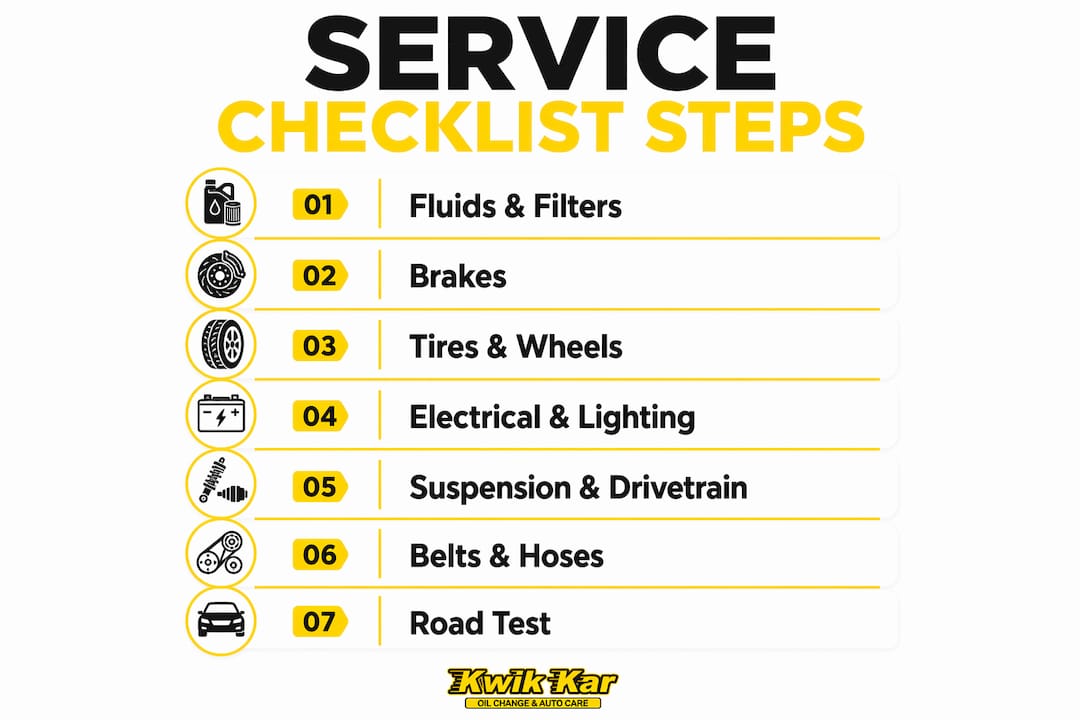
A complete vehicle service checklist covers 30–80 inspection points across six core categories: fluids and filters, brakes, tires and wheels, electrical and lighting, suspension and steering, and belts and hoses. Think of it as a structured diagnostic workflow, not just a to-do list. Every item on the checklist exists because something can fail silently until it doesn’t.
Here is what a thorough service checklist covers at minimum:
- Fluids: Engine oil, coolant, brake fluid, transmission fluid, power steering fluid, and windshield washer fluid
- Filters: Engine air filter, cabin air filter, and fuel filter (especially on diesel engines)
- Brakes: Pad thickness, disc condition, brake lines, calipers, and parking brake function
- Tires: Tread depth, pressure, wear patterns, and wheel nut torque
- Electrical and lighting: Battery condition, all exterior lights, horn, and alternator output
- Suspension and steering: Shocks, struts, bushings, ball joints, and tie rod ends
- Belts and hoses: Timing belt or chain condition, auxiliary belt, and all coolant hoses
- Diagnostics: OBD-II fault code scan and a road test before and after service
Preventive maintenance schedules tie these checks to specific mileage and time intervals, which is what separates a real service from a quick once-over.
Detailed breakdown of every major service category
Experienced technicians treat a service checklist as a diagnostic workflow, checking factors like brake fluid moisture content and tire wear patterns as early warnings of deeper problems. Each category below reflects that approach.
Fluids and filters
Engine oil is the most frequently replaced item, but it is far from the only fluid that matters. Coolant protects against both overheating and freezing, brake fluid absorbs moisture over time and loses effectiveness, and transmission fluid degrades under heat. A thorough checklist measures fluid condition, not just level. The air filter and cabin filter get inspected at every full service and replaced when clogged, since a dirty air filter measurably reduces fuel economy.

Brakes
Brake pad thickness is measured in millimeters, and legal tread limits apply to pads just as they do to tires. Technicians also inspect disc surfaces for scoring and lipping, check calipers for free movement, and examine brake lines for corrosion or leaks. The parking brake, whether mechanical or electronic, gets tested for proper engagement.
Tires and wheels
Tread depth measurement tells you how much life remains, but wear patterns tell you why the tire is wearing that way. Uneven wear across the shoulder often points to an inflation problem; diagonal wear suggests an alignment or suspension issue. Tire pressure gets set to the manufacturer’s specification, not the maximum printed on the sidewall.
Electrical and lighting
Battery condition testing goes beyond a simple voltage check. A load test or conductance test reveals whether the battery can still deliver adequate cranking amps under real-world conditions. Every exterior light gets verified, including brake lights and reverse lights that drivers rarely see themselves. The alternator’s charging output is checked to confirm it is keeping the battery topped up while the engine runs.
Suspension, steering, and drivetrain
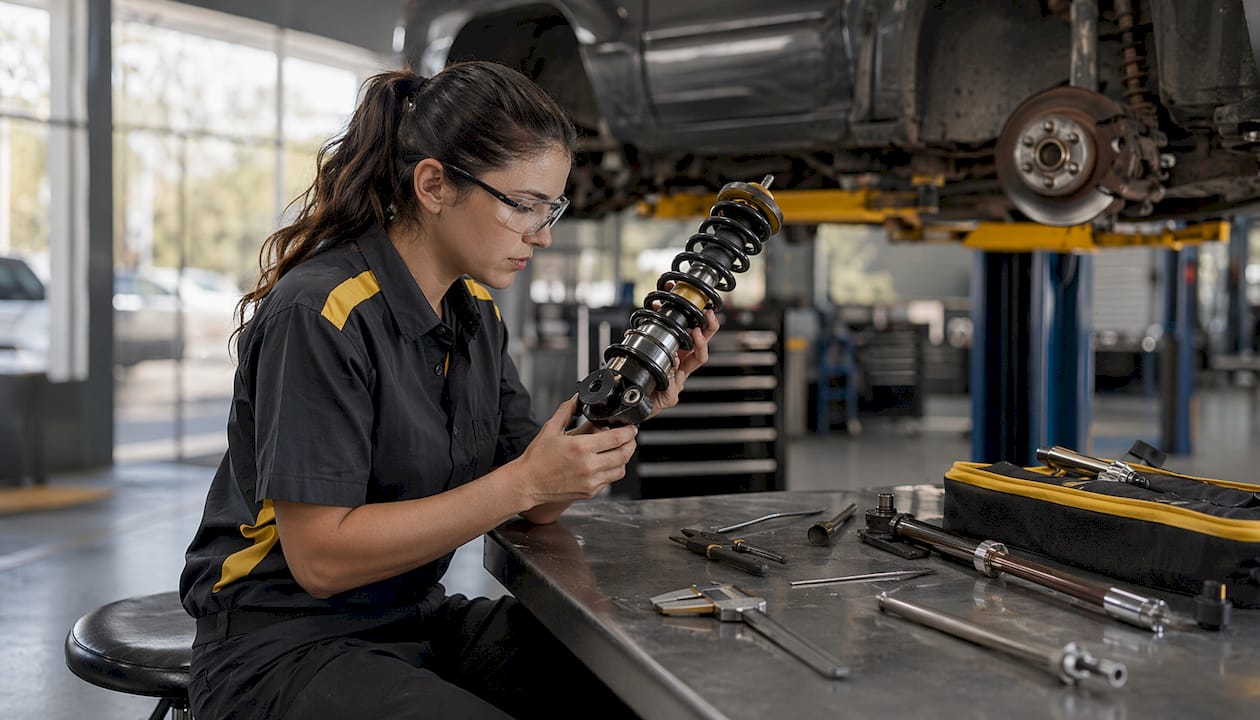
Shocks and struts get inspected for fluid leaks, and suspension bushings are checked for cracking or play. Worn tie rod ends and ball joints affect both steering precision and tire wear. CV joint boots, driveshaft condition, and gearbox seals round out the drivetrain portion of the checklist.
Belts, hoses, and under-hood items
The timing belt is the component technicians watch most carefully. Delaying its replacement risks catastrophic engine failure, and the service interval is a safety threshold, not a suggestion. Auxiliary belts, coolant hoses, and radiator condition are all part of this category. A visual scan for oil leaks and seepage completes the under-hood inspection.
Road test and diagnostics
A quality checklist includes road tests before and after service to catch issues like suspension rattles and steering play that static inspections miss. An OBD-II scan retrieves any stored fault codes, which can surface problems in emissions, transmission, or ABS systems before they trigger a warning light.
How preventive maintenance schedules work
Preventive maintenance follows a tiered schedule built around time and mileage. The seven core elements of a preventive maintenance program are oil and filter management, fluid monitoring, brake health, tire maintenance, lighting and electrical, suspension and steering assessment, and belts and hoses inspection. Each element has its own interval.
| Interval | Typical tasks |
|---|---|
| Monthly | Check tire pressure, inspect all fluid levels visually, test exterior lights |
| Every 3 months / 3,000–5,000 miles | Oil and filter change (conventional oil), inspect wiper blades and belts |
| Every few months | Tire rotation, battery load test, brake inspection, cabin air filter check |
| Annually / 12,000 miles | Full brake system inspection, air filter replacement, coolant system check |
| Every 2 years | Brake fluid flush, transmission fluid inspection, spark plug check |
| Every recommended mileage interval | Timing belt replacement (check manufacturer spec), fuel filter, major tune-up |
Seasonal adjustments matter too. Before winter, verify antifreeze concentration and battery cold-cranking amps. Before summer, check the cooling system and air conditioning refrigerant level. Following the manufacturer’s recommended intervals keeps your warranty intact and prevents the kind of compounding failures that turn a $40 fluid flush into a $1,200 repair.
Pro Tip: Keep a small notebook or use a free app like the one built into your vehicle’s infotainment system to log every service date and mileage. That record becomes your vehicle’s maintenance history and is worth real money at resale.
Basic vs. full service: what each checklist actually covers
Not every service is the same depth, and knowing the difference helps you ask the right questions at the shop.
| Checklist item | Basic / interim service | Full / major service |
|---|---|---|
| Engine oil and filter | ✓ Replaced | ✓ Replaced |
| Fluid level top-up | ✓ Checked | ✓ Checked and condition tested |
| Brake inspection | Visual check only | Full measurement and caliper check |
| Tire pressure and condition | ✓ Checked | ✓ Checked, rotated if due |
| Air and cabin filters | Inspected | Replaced if needed |
| Spark plugs | Not included | Inspected or replaced |
| Belts and hoses | Visual only | Full condition assessment |
| Electronic diagnostics | Not standard | OBD-II fault code scan |
| Road test | Not standard | Before and after service |
| Suspension and steering | Not standard | Full inspection |
An interim service mostly covers an oil change and essential safety checks, while a full service includes comprehensive inspections such as cabin air filters, the fuel system, and electronic diagnostics. The gap between the two is significant. If your vehicle is due for a full service and you only book a basic one, you are leaving brake wear measurements, belt condition, and fault code checks undone.
For fleet managers, understanding this distinction is especially useful. A fleet maintenance checklist built around full-service intervals keeps vehicles in compliance and reduces unplanned downtime across the whole operation.
Why consistent checklist-driven maintenance protects your vehicle and your wallet
Reactive maintenance, fixing things after they break, costs far more than preventive care. A timing belt that fails on the highway can destroy an engine. A brake caliper that seizes from neglected fluid can warp a rotor and turn a $30 fluid flush into a $400 rotor replacement.
Treating service intervals as safety thresholds, not suggestions, is the single most important mindset shift a vehicle owner can make. A technician who flags a worn belt at 55,000 miles is not upselling. They are preventing a breakdown that will cost ten times more to fix roadside.
Consistent documentation of preventive maintenance creates a reliable vehicle history, which matters both for resale value and for fleet compliance. A buyer or fleet auditor can see exactly what was done and when. Gaps in the record raise red flags. A complete service log, tied to a structured checklist, is one of the most practical things you can do for long-term vehicle value.
The benefits of staying on schedule are straightforward:
- Fewer unexpected breakdowns and roadside emergencies
- Lower cumulative repair costs over the vehicle’s life
- Maintained manufacturer warranty coverage
- Higher resale or trade-in value
- Compliance with fleet safety and insurance requirements
Scheduled maintenance significantly reduces the risk of unexpected breakdowns and helps maintain vehicle safety and performance over time.
Safety checks and legal compliance items on a service checklist
Some checklist items exist not just for reliability but for legal compliance. In most U.S. states, vehicles must pass periodic safety inspections that mirror what a thorough service checklist already covers.
Lighting is the most visible compliance category. All headlights, taillights, brake lights, turn signals, and reverse lights must function correctly. A burned-out brake light is a moving violation in every state and a genuine safety hazard. Horn function is also a required check in most state inspections.
Emissions testing is mandatory in many states, including Texas, California, and New York. An OBD-II scan during a service appointment will catch stored emissions-related fault codes before your vehicle fails a state test. Addressing those codes proactively saves you the cost and hassle of a retest.
Tire tread depth has a legal minimum of 2/32 of an inch in the U.S., though most technicians recommend replacement at 4/32 for wet-weather safety. Windshield condition matters too. Cracks in the driver’s line of sight can fail a state inspection and impair visibility in ways that are easy to underestimate.
How to customize your service checklist for your specific vehicle
A generic checklist is a starting point, not a final answer. A major service covers up to 80 points and should adapt to the manufacturer’s recommendations and the vehicle’s technology. Here is how to tailor yours.
Start with your owner’s manual. The manufacturer’s maintenance schedule lists every service interval specific to your engine, transmission, and drivetrain. A turbocharged engine may need oil changes more frequently than a naturally aspirated one. A CVT transmission has different fluid requirements than a traditional automatic.
Account for vehicle age. Older vehicles need more attention to rubber components like hoses, belts, and seals, which degrade over time regardless of mileage. A 12-year-old vehicle with 60,000 miles still needs timing belt and coolant hose inspections that a newer vehicle at the same mileage might not.
Factor in modern technology. Hybrid and electric vehicles require battery health checks, high-voltage system inspections, and regenerative brake assessments that do not appear on a standard checklist. Vehicles with electronic parking brakes need a technician with the right software to retract the caliper during pad replacement. Adaptive cruise control sensors and cameras may need recalibration after suspension or alignment work.
Adjust for driving conditions. Towing, off-road driving, and stop-and-go city traffic all accelerate wear on brakes, transmission fluid, and cooling systems. If your driving profile is harder than average, shorten your service intervals accordingly. You can find a detailed car maintenance by mileage breakdown that accounts for these variables.
What diagnostic tools technicians use during a service inspection
Modern service inspections rely on a combination of hands-on measurement and electronic diagnostics. Knowing what tools are involved helps you understand what you are paying for.
OBD-II scanner: Every vehicle built after 1996 has an OBD-II port. A scanner reads stored and pending fault codes across all vehicle systems, including engine, transmission, ABS, and emissions. Some scanners also display live sensor data, letting technicians watch oxygen sensor readings or fuel trim values in real time.
Battery tester: A conductance tester measures the battery’s internal resistance and estimates remaining capacity in cold-cranking amps. This is more accurate than a simple voltage check, which can show a healthy reading on a battery that will fail in cold weather.
Brake pad gauge and disc micrometer: Pad thickness is measured in millimeters with a dedicated gauge. Disc thickness is measured with a micrometer to confirm it is still above the minimum safe specification. Both measurements get recorded on the service report.
Tire tread depth gauge: A simple but critical tool. Technicians measure tread depth at multiple points across each tire to detect uneven wear that a visual inspection might miss.
Torque wrench: Wheel nuts must be tightened to the manufacturer’s specified torque. Over-tightening warps brake rotors; under-tightening risks a wheel coming loose. A calibrated torque wrench is the only way to confirm correct installation.
Coolant tester and brake fluid test strips: Coolant concentration is checked with a refractometer or test strips to verify freeze protection. Brake fluid moisture content is tested with electronic strips or a dedicated meter, since moisture above a certain threshold lowers the fluid’s boiling point and increases brake fade risk.
Kwik Kar Oil Change & Auto Care keeps your checklist covered
At Kwik Kar Oil Change & Auto Care in Fort Worth, certified technicians work through a thorough service checklist on every visit, from oil changes to full inspections. There are no surprises on the invoice and no pressure to approve work you did not ask about. If you want to know exactly what your vehicle needs and what it will cost before any work begins, that is exactly how every appointment runs.
You can bring your vehicle in for maintenance without an appointment and get a transparent, itemized review of your vehicle’s condition. Kwik Kar Oil Change & Auto Care’s RepairPal certification means pricing is fair and the work is done right.
Key Takeaways
A complete vehicle service checklist covers fluids, brakes, tires, electrical systems, suspension, belts, and diagnostics across 30–80 inspection points, with intervals ranging from monthly checks to major services at manufacturer-specified mileage intervals.
| Point | Details |
|---|---|
| Checklist scope | A comprehensive checklist covers 30–80 inspection points across fluids, brakes, tires, electrical, suspension, and belts. |
| Service intervals | Tasks range from periodic fluid checks to timing belt replacement at the manufacturer’s recommended interval. |
| Basic vs. full service | A basic service covers oil and safety checks; a full service adds diagnostics, belt inspection, and a road test. |
| Documentation matters | Consistent service records create a vehicle history that supports resale value and fleet compliance. |
| Customize by vehicle | Tailor your checklist to your vehicle’s make, model, age, and technology for accurate, effective maintenance. |
FAQ
What are five items that regularly scheduled maintenance will check?
Engine oil level and condition, tire pressure and tread depth, brake pad thickness, battery health, and all exterior lighting are five items covered at virtually every scheduled service.
What does a vehicle service checklist consist of?
A service checklist consists of inspection and maintenance tasks grouped by system, covering fluids, filters, brakes, tires, electrical components, suspension, belts, and a diagnostic scan, totaling 30–80 individual points depending on the service level.
What should be included in a full service plan?
A full service plan should include oil and filter replacement, fluid condition checks, brake measurements, tire rotation, air and cabin filter replacement, belt and hose inspection, an OBD-II fault code scan, and a road test before and after service.
What are the seven basic preventive maintenance elements?
The seven core elements are oil and filter management, fluid monitoring, brake health, tire maintenance, lighting and electrical checks, suspension and steering assessment, and belts and hoses inspection.
How often should a full vehicle service be performed?
Most manufacturers recommend a full service every 12 months or every 12,000 miles, whichever comes first, though manufacturer-specific intervals in your owner’s manual take priority over general guidelines.