

If your vehicle is registered in Fort Worth or anywhere in Tarrant County and is more than two model years old, you are required to pass an annual Texas emissions inspection before renewing your registration. Texas eliminated the statewide safety inspection for most non-commercial vehicles on January 1, 2025, but emissions testing remains fully in effect for Tarrant County drivers. Many people confuse the two and skip the emissions test entirely, then hit a registration renewal block. Don’t let that happen to you.
Here’s your quick-action checklist before you head to a station:
- Confirm your vehicle is not exempt (check model year and powertrain type)
- Make sure no Check Engine light is on
- Inspect your gas cap for cracks or a loose seal
- Keep your fuel tank at a moderate level between roughly one-quarter and three-quarters full
- Drive a substantial distance of mixed city and highway driving if you recently cleared codes or disconnected the battery
- Bring your registration renewal notice, proof of insurance, and a valid ID
Start preparing one to two weeks before your registration expires. That buffer gives you time to complete a drive cycle, schedule a diagnostic, and handle any repairs without rushing into a failed test and a registration block.
Table of Contents
- Which Fort Worth vehicles actually need an emissions test?
- What do you need to bring, and where do you get tested?
- Your step-by-step pre-test checklist
- Why do cars fail Texas emissions tests?
- What happens if your vehicle fails the emissions test?
- When should you start preparing to avoid a registration block?
- How Kwik Kar Oil Change & Auto Care helps you prepare
- Key Takeaways
- Why a pre-test shop visit is worth your time
- Ready for your emissions test? Kwik Kar can help
- Useful sources for Fort Worth emissions rules
- FAQ
Which Fort Worth vehicles actually need an emissions test?
Tarrant County is one of the Texas counties where emissions testing is currently required, placing Fort Worth drivers squarely in the program. The full county list includes Brazoria, Collin, Dallas, Denton, El Paso, Ellis, Fort Bend, Galveston, Harris, Johnson, Kaufman, Montgomery, Parker, Rockwall, Tarrant, Travis, and Williamson. Bexar County joins the list on November 1, 2026.
The Texas Commission on Environmental Quality (TCEQ) administers the Inspection and Maintenance (I/M) program, targeting nitrogen oxides, volatile organic compounds, and carbon monoxide. The Texas Department of Public Safety (DPS) and Texas Department of Motor Vehicles (TxDMV) handle the inspection certification and registration enforcement sides, respectively.
Common exemptions to know:
- Vehicles within the first two model years of manufacture (a 2025 or 2026 model year vehicle is currently exempt)
- Battery-electric vehicles (no tailpipe, no emissions test required)
- Certain diesel-powered vehicles and farm-use vehicles (check DPS for your specific category)
- Vehicles registered outside an emissions county, even if driven in Fort Worth regularly
If you are unsure whether your specific vehicle or registration county qualifies, the DPS Inspection Criteria page lists every covered category with clear definitions. Confirming this before you book an appointment saves a wasted trip.
What do you need to bring, and where do you get tested?
Showing up prepared makes the appointment faster and avoids any last-minute scrambles at the counter. Inspectors will verify your vehicle identification number (VIN) against your registration and check that your insurance is current before the test begins.
Bring these items to every emissions appointment:
- Current vehicle registration or renewal notice
- Valid proof of liability insurance (a digital copy on your phone is accepted at most stations)
- A valid government-issued ID
- Your vehicle keys (including any fob needed to start the car)
On the vehicle side, keep the fuel tank between roughly 25–75% full. A nearly empty tank can trigger EVAP system errors that cause a preventable failure. Avoid clearing any diagnostic trouble codes (DTCs) or disconnecting the battery in the days immediately before your appointment.
To find a certified emissions station in Fort Worth, use the DPS station locator on the official DPS website. Filter by county and test type to find stations near you. Local certified shops, including Kwik Kar Oil Change & Auto Care, also appear in the locator and can perform the OBD-II emissions test alongside a pre-test diagnostic if you want both done in one visit.
Pro Tip: Book your appointment early in the week. If the test reveals a problem, you have several business days to get repairs done and retest before the weekend, rather than scrambling on a Friday afternoon.
Your step-by-step pre-test checklist
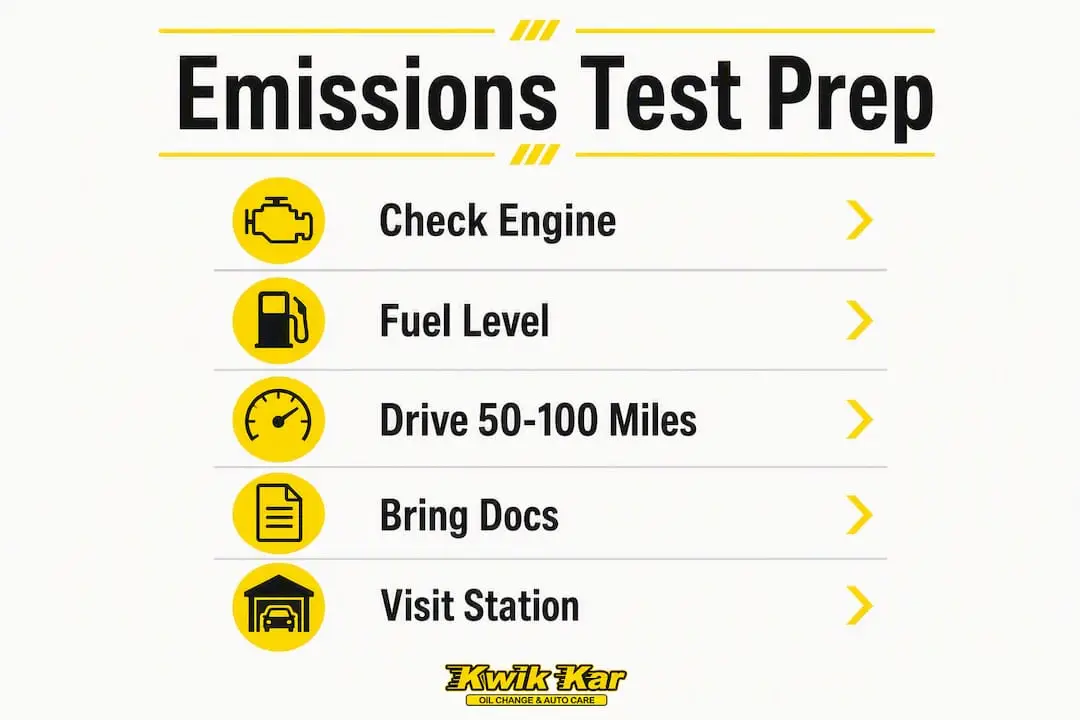
Follow these steps in order during the 1–2 weeks before your test. The items at the top have the biggest impact on whether you pass.
- Check for any illuminated MIL (Check Engine light). A lit Check Engine light is an automatic failure under OBD-II testing standards. If the light is on, read the stored DTCs with a scan tool before you do anything else. Clearing codes without fixing the underlying fault just delays the problem and triggers a “Not Ready” monitor failure.
- Inspect and replace the gas cap if needed. A cracked or loose gas cap is one of the most common causes of EVAP pressure test failures. Replace it with an OEM-spec cap. This is a low-cost fix that often prevents a failed test when no other faults exist.
- Check your readiness monitors. If you recently disconnected the battery or cleared codes, your OBD-II monitors will show “Not Ready.” Drive 50–100 miles of mixed city and highway driving to allow non-continuous monitors to reset before you test.
- Warm up the engine fully before arriving. Drive at least 15–20 minutes at normal operating temperature. Testing a cold engine increases the chance of borderline readings on oxygen sensor and catalytic converter monitors.
- Keep the fuel tank at 25–75% capacity. Too little fuel can interfere with EVAP system testing. Fill up or burn down to the right range the day before.
- Check basic maintenance items. Look at your air filter, spark plugs (if they are due by mileage), and oil level. Visible blue or black exhaust smoke is a red flag that warrants a shop visit before testing. A car maintenance checklist can help you track what is current and what is overdue.
- Decide: DIY or shop visit? If your Check Engine light is on, you see unusual exhaust smoke, or you are unsure about your readiness monitor status, schedule a pre-test diagnostic at a certified shop. Guessing on a complex DTC and then paying for a retest costs more than a single diagnostic appointment.
The two highest-impact, lowest-cost steps are replacing a worn gas cap and completing the drive cycle after any code clear. Both are free or nearly free, and both are disproportionately responsible for pass/fail outcomes on otherwise healthy vehicles.
Why do cars fail Texas emissions tests?
Most failures fall into a short list of causes, and several of them are fixable before you ever pull into a testing lane.
Top failure causes:
- “Not Ready” readiness monitors. The most common non-pass result. After a battery disconnect or code clear, OBD-II monitors need 50–100 miles of mixed driving to reset. Testing too soon guarantees a fail.
- Illuminated MIL (Check Engine light). Any active fault code that triggers the MIL is an automatic failure. Fix the underlying cause, not just the light.
- EVAP system leaks or a faulty gas cap. A loose, cracked, or wrong-spec gas cap fails the EVAP pressure check. Replace it with an OEM-spec cap as a first step.
- Oxygen sensor faults. Failing O2 sensors throw specific DTCs and cause the MIL to illuminate. Replacement is straightforward at a certified shop.
- Catalytic converter issues. A degraded or missing catalytic converter causes elevated emissions readings and a direct fail. This repair is not inexpensive, but it is unavoidable.
- Engine misfires. Misfires dump unburned fuel into the exhaust stream, overwhelming the catalytic converter and triggering multiple DTCs. Spark plugs and ignition coils are the usual culprits.
Quick fixes to try first:
- Replace the gas cap (under $20 at most auto parts stores for an OEM-spec cap)
- Complete the full drive cycle before retesting after any code clear
- Confirm oil level and look for obvious vacuum leaks before booking a retest
When the fault is an O2 sensor, catalytic converter, or persistent misfire, you need a certified mechanic to diagnose and repair it properly. Avoid clearing codes and immediately retesting. The monitors will show “Not Ready,” and you will pay the retest fee without any chance of passing.
Pro Tip: If your Check Engine light came on recently, read the check engine light repair guide before your appointment. Understanding the specific DTC helps you ask the right questions at the shop and avoid unnecessary repairs.
What happens if your vehicle fails the emissions test?
Failing is not the end of the road, but the steps you take immediately after matter for both your registration and your waiver eligibility.
After a failed test:
- Get a copy of the inspection report. It lists every failed item and the specific DTCs.
- Take the vehicle to a certified emissions repair facility (RERF) or a recognized dealer. Keep all repair receipts. Documentation from a recognized repair facility is required for waiver applications.
- After repairs are complete, return to a certified station for a retest. Retest fees vary by county and station.
Registration consequences:
If you do not have a passing emissions test on file, TxDMV will block your registration renewal. Driving with an expired registration in Texas carries fines. The block lifts as soon as a passing test result is recorded in the state system, so the fastest path is always to repair and retest promptly.
TCEQ waivers and time extensions:
The TCEQ Vehicle Inspection and Maintenance Program offers two main relief options when a vehicle cannot pass after documented repair attempts:
- Individual Vehicle Waiver: Available when you have made documented good-faith repair attempts and the vehicle still cannot pass. Eligibility requires receipts showing a minimum repair expenditure (the threshold is set by TCEQ and can change, so confirm the current amount directly with TCEQ).
- Low-Income Time Extension: Available to qualifying low-income vehicle owners who need additional time to complete repairs. Documentation of income eligibility and repair attempts is required.
Neither waiver is automatic. You must apply with supporting documentation, and approval is not guaranteed. The safest path is always to repair the vehicle and pass the test outright.
When should you start preparing to avoid a registration block?
Tarrant County Motor Vehicle recommends starting preparations at least one to two weeks before your registration expiration date. That window accounts for the most common delays: drive-cycle completion, parts availability, and shop scheduling.
Realistic time estimates for common prep items:
- OBD-II diagnostic scan at a shop: typically same-day, often under an hour
- Gas cap replacement: 5 minutes, parts available same day at most auto parts stores
- Drive-cycle completion after a code clear: 2–5 days of normal driving, covering 50–100 miles of mixed conditions
- Oxygen sensor replacement: usually same-day at a certified shop if the part is in stock
- Catalytic converter replacement: 1–3 days depending on parts availability and shop schedule
Scheduling tips:
- Book a pre-test diagnostic early in the week so repairs can be completed before the weekend
- Allow at least 3–5 days after any repair that required a code clear before retesting
- If your registration expires at the end of the month, aim to test by the 15th at the latest
For drivers who want to handle multiple maintenance items before the test, vehicle maintenance without an appointment is available at Kwik Kar Oil Change & Auto Care for straightforward services like oil changes and basic inspections.
How Kwik Kar Oil Change & Auto Care helps you prepare
Kwik Kar Oil Change & Auto Care, located in Fort Worth, offers the specific services that address the most common emissions prep needs. Certified technicians handle everything from a quick OBD-II scan to full diagnostic and repair work, with transparent pricing so you know what you are paying before any work begins.
Services relevant to emissions prep:
- OBD-II diagnostic scan to read stored DTCs and check readiness monitor status
- MIL (Check Engine light) diagnosis and repair
- Gas cap inspection and OEM-spec replacement
- Oxygen sensor replacement
- Tune-up services (spark plugs, air filter, ignition components)
- Pre-test multi-point inspection covering fuel system, exhaust, and electrical
Kwik Kar Oil Change & Auto Care holds a RepairPal certification, which means pricing and repair quality meet independently verified standards. That matters when you are choosing where to take your vehicle after a failed test and need confidence that the repair will actually resolve the DTC, not just clear the code.
A pre-test inspection at Kwik Kar Oil Change & Auto Care typically takes less time than a failed test and a second trip to the emissions station. Catching a loose gas cap or a “Not Ready” monitor status before you test saves the retest fee and the frustration of an avoidable failure.
When you come in, bring your registration renewal notice and proof of insurance. The technician will pull your DTCs, check monitor readiness, and walk you through exactly what needs to be addressed before you head to the testing station. For a full overview of what the Kwik Kar state inspection process covers, that guide explains each step in plain terms.
Key Takeaways
Fort Worth drivers registered in Tarrant County must pass an annual emissions test, and the most effective preparation combines a pre-test OBD-II scan, a fresh gas cap, and a completed drive cycle before arriving at the station.
| Point | Details |
|---|---|
| Tarrant County requires testing | All non-exempt vehicles registered in Tarrant County must pass an annual emissions inspection to renew registration. |
| Drive cycle matters most | After any code clear or battery disconnect, drive 50–100 miles of mixed city and highway before testing to reset readiness monitors. |
| Gas cap is a quick win | Replacing a worn or loose gas cap with an OEM-spec cap is inexpensive and prevents one of the most common EVAP failures. |
| Start 1–2 weeks early | Beginning prep at least 1–2 weeks before registration expiry gives you time for repairs, drive cycles, and rescheduling if needed. |
| Kwik Kar pre-test inspection | Kwik Kar Oil Change & Auto Care offers OBD-II scans, MIL diagnosis, and gas cap replacement to catch issues before you test. |
Why a pre-test shop visit is worth your time
Rushing straight to an emissions station without checking your vehicle first is the most common mistake Fort Worth drivers make. The retest fee is real, the registration block is real, and the frustration of failing on something as simple as a loose gas cap is entirely avoidable.
At Kwik Kar Oil Change & Auto Care, the approach is straightforward: read the codes, check the monitors, fix what needs fixing, and send you to the station with confidence. Certified technicians, clear pricing, and no pressure to approve repairs you don’t need. That transparency is the reason drivers come back year after year rather than guessing on their own.
If your registration is coming up and you have any doubt about your vehicle’s readiness, a pre-test diagnostic is the calm, scheduled alternative to a surprise failure. It costs less than a retest, and it gives you a clear picture of exactly where your vehicle stands.
Ready for your emissions test? Kwik Kar can help
Failing an emissions test because of a missed readiness monitor or a $15 gas cap is the kind of problem a quick shop visit prevents entirely.
Kwik Kar Oil Change & Auto Care offers walk-in and scheduled pre-test inspections that cover OBD-II diagnostics, gas cap checks, MIL diagnosis, and basic tune-up items, all with upfront pricing and certified technicians. Most diagnostic appointments are completed the same day. If repairs are needed and cost is a concern, auto repair financing options are available to help spread the cost of larger fixes.
Call or stop by Kwik Kar Oil Change & Auto Care in Fort Worth to schedule your pre-test inspection. Bring your registration renewal notice and proof of insurance, and the team will handle the rest.
Useful sources for Fort Worth emissions rules
Regulations and county lists can change. Always verify current requirements directly with the official state agencies before your test.
Official sources to bookmark:
- DPS Emissions Testing FAQ: explains OBD-II testing, readiness monitors, and what causes a fail
- DPS Inspection Criteria for Emission Inspection: full list of covered counties and vehicle categories
- TCEQ Vehicle I/M Program: waiver eligibility, program background, and air quality targets
- TxDMV Registration Rules: registration renewal requirements and how a passing emissions test connects to your sticker
Choosing a repair facility:
When selecting a shop after a failed test, confirm it is listed as a Recognized Emissions Repair Facility (RERF) if you plan to pursue a TCEQ waiver. The DPS station locator identifies certified testing stations; for repair facilities, ask the shop directly whether they can provide RERF documentation. A vehicle inspection overview from a shop perspective can also help you understand what inspectors look for and how to evaluate a repair estimate.
OBD-II testing is the standard for 1996 and newer gasoline vehicles. Older pre-1996 vehicles may require a two-speed idle test instead. Fees vary by county and test type, so confirm the current rate with your chosen station before arriving.
FAQ
Does Fort Worth require emissions testing in 2026?
Yes. Vehicles registered in Tarrant County, which includes Fort Worth, must pass an annual emissions inspection. Texas eliminated the general safety inspection in January 2025, but emissions testing remains required in Tarrant County and several other designated counties.
How do you prepare for a Texas emissions test?
Confirm no Check Engine light is on, inspect your gas cap, keep the fuel tank at 25–75%, and drive 50–100 miles of mixed city and highway if you recently cleared codes or disconnected the battery. A pre-test OBD-II scan at a certified shop like Kwik Kar Oil Change & Auto Care catches issues before they become a failed test.
What do you need to bring to a Texas emissions inspection?
Bring your current vehicle registration or renewal notice, valid proof of liability insurance, and a government-issued ID. Your vehicle should be warmed up and have a fuel level between 25–75% before you arrive.
How do you pass a Texas emissions inspection?
Fix any active DTCs before testing, replace a worn gas cap, complete the drive cycle after any code clear, and arrive with a fully warmed engine. Vehicles with a lit MIL or “Not Ready” readiness monitors will not pass, so addressing those two issues first gives you the best odds.