




Most car batteries need replacing every three to five years, according to AAA. There is no single date that fits every car. Heat, vibration, short trips and the electronics in your vehicle all move the number. In North Texas, where summer afternoons are hard on anything under the hood, plan on the shorter end of that range and test the battery once it passes the three-year mark.
This guide explains how long a battery typically lasts, what shortens it, the warning signs that matter, and how a shop tests a battery before you spend money on a new one. We wrote it from our bay at 9613 White Settlement Rd, Fort Worth, TX 76108, for drivers in White Settlement, West Fort Worth, Westworth Village, Westover Hills, River Oaks, Lake Worth and Benbrook.
TL;DR
- The common rule of thumb is three to five years. Treat the three-year anniversary as your cue to get the battery tested, not to replace it automatically.
- Heat is the main enemy. Long Fort Worth summers, stop-and-go traffic and a hot engine bay can age a battery faster than the calendar suggests.
- Slow cranking, dim lights, a battery warning light, corrosion on the terminals and a swollen case all point toward testing.
- A proper load test tells you more than the age on the label. A battery can look fine and still fail on the next hot start.
- Replacing a weak battery on your schedule costs less in time and stress than a tow on the day it quits.
Table of Contents
- How often should you replace a car battery?
- Why Fort Worth drivers may see shorter battery life
- Signs you need a new battery
- How a shop tests a battery
- Should you replace a battery before it fails?
- How to make a battery last longer
- Our perspective: test first, replace only what needs replacing
- Get your battery tested at Kwik Kar
- Does Texas inspection law affect battery replacement?
- FAQ
- Sources
How often should you replace a car battery?
The widely repeated answer is every three to five years. AAA says that general rule holds, but time, heat and vibration all influence where your battery lands inside it. Interstate Batteries gives the same three-to-five-year range and notes that several factors affect it.
Here is how we suggest reading that range:
| Battery age | What to do |
|---|---|
| Under 3 years | Nothing routine. Keep terminals clean and watch for symptoms. |
| 3 to 4 years | Have it tested at least once a year, ideally before summer. |
| 4 to 5 years | Test twice a year and budget for a replacement. |
| Over 5 years | Expect it to be near the end. Replace it if it tests weak. |
These are planning guidelines, not guarantees. A battery that tests strong at four years can keep going. One that fails at two years is not unheard of in hot climates. The test result beats the calendar every time.
Check your battery’s age first
Most batteries carry a date code on a sticker or stamped into the case. Formats vary by brand, so if the code is unclear, ask us to read it when you stop in. If you bought the car used and have no receipt, the date code is often the only record you have.
Why Fort Worth drivers may see shorter battery life
AAA names three factors that decide how long a battery lasts: time, heat and vibration. Two of the three are part of daily life here.
Heat. Consumer Reports notes that batteries typically last three to five years, with heat-driven wear a major reason owners are advised to be proactive about servicing and replacing them. Heat damage builds quietly. A battery can get through a July heat wave and then fail on the first cool morning in November because the weakened internals could no longer deliver enough current.
Stop-and-go driving. Traffic on I-30, Loop 820 and White Settlement Road means a lot of idling and short hops. Short trips do not give the alternator much time to put back what the engine used to start. If you mostly drive a few miles at a time, the battery may sit partly discharged more often than you would expect.
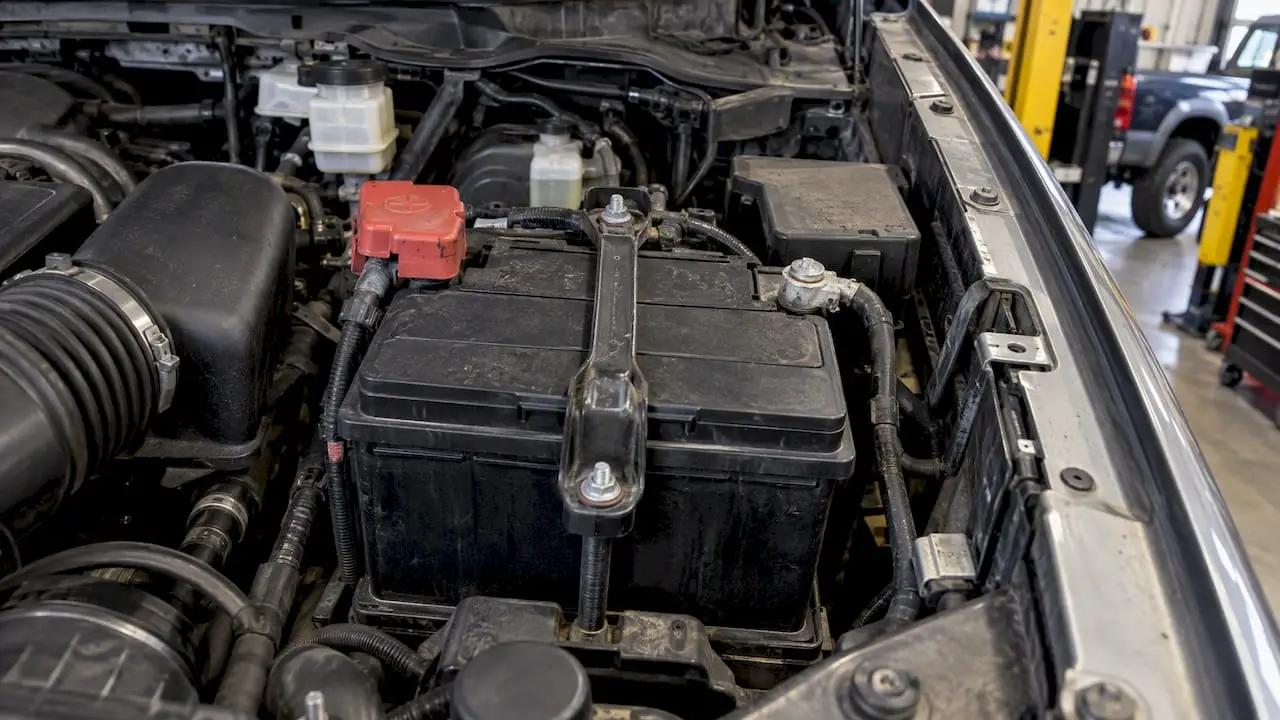
Vibration and mounting. A loose hold-down bracket lets the battery shake, which can damage the plates inside. If you drive a pickup on rough job-site roads or tow regularly, check that the battery is firmly secured.
Electrical load. Newer vehicles carry more electronics that draw power even when parked. If your car is a heavy-electronics model, or you have added accessories like a dash camera or a sound system, the battery works harder over its life.
We have not seen a reliable published figure for the average battery life in Fort Worth specifically, so we will not give you one. What we can say is that heat is a documented factor and a shop test will show how your battery is actually holding up.
Signs you need a new battery
Batteries often give notice before they fail. Watch for these:
- Slow cranking. The engine turns over lazily, like it is working through syrup, especially on a hot restart after a short stop.
- Dim headlights or flickering interior lights at idle.
- A battery or charging warning light on the dash. If it flickers on and off, our guide to a battery light that comes on and off explains what the pattern can mean.
- Clicking when you turn the key, with no engine start.
- Corrosion on the terminals, usually a white or blue-green crust.
- A swollen or cracked case, which is a sign of heat damage. Have it checked promptly.
- Needing jump-starts more than once. One jump can be an accident. Repeated jumps mean something is wrong.
- Age past four years with any of the above.
Is it the battery, the starter or the alternator?
These three parts share symptoms, and replacing the wrong one wastes money. Interstate Batteries suggests charging the battery for 4 to 8 hours and trying again. If the car starts and runs well for a day but dies again within 24 hours, the battery is the likely culprit. If the car starts fine but dies while running, or the warning light stays on while driving, the alternator becomes the prime suspect.
A single click or a grinding noise with a healthy battery can point to the starter. We covered what shops check in our starter failure guide. If the battery keeps going flat while the car sits, a parasitic drain may be the cause, and what causes a car battery to drain walks through the common ones.
How a shop tests a battery
A visual check and a guess are not a test. A proper battery inspection usually covers:
- Visual inspection of the case, terminals, cables and hold-down.
- State of charge measured at the terminals. Resting voltage gives a rough picture: a fully charged 12-volt battery reads about 12.6 volts, and a reading well below that means it is partly discharged.
- Load or conductance test with a professional tester, which shows whether the battery can still deliver the current your engine needs for a start.
- Charging system check, because a weak alternator can kill a brand-new battery.
- Parasitic draw check if the battery has been going flat for no clear reason.
The load test is the step that separates a battery that only needs a charge from one that is finished. Battery testers can also report temperature-corrected results, which matters in a hot bay or a cold morning. If you test at home with a multimeter, treat the reading as a clue only. Surface charge can make a tired battery look healthy.

Should you replace a battery before it fails?
Often, yes. Consumer Reports found that the day the car will not start is when most people shop for a battery, which is the worst time to compare options. You will probably replace a battery once or twice during the life of a vehicle, so it helps to treat it as planned maintenance.
When it makes sense to replace now:
- The battery is past four years and tests marginal.
- You are about to take a long drive, such as a road trip with the family, where a breakdown would be costly.
- You drive for a living, including rideshare and delivery, and a dead battery means lost income.
- You manage several vehicles and want to avoid unscheduled downtime. Our fleet maintenance program is built for that.
When it may make sense to wait:
- The battery is under three years old and passes a load test.
- Symptoms trace back to a loose cable, corroded terminal or failing alternator. Fix the cause first.
What about battery reconditioning?
You may see claims that old batteries can be revived. Our explainer on battery reconditioning covers what it is and why it is rarely a dependable fix for a battery with heat-damaged plates. For a car you rely on every day, a tested replacement is the safer path.
How to make a battery last longer
AAA’s battery maintenance guidance says regular care lets most batteries reach three to five years, while neglect leads to surprise breakdowns. Here is what that looks like in practice:
- Keep terminals clean and tight. Corrosion raises resistance and makes starting harder.
- Make sure the battery is secured so it does not vibrate.
- Take a longer drive now and then, so the alternator can recharge the battery fully.
- Park in shade or a garage when you can. It lowers underhood temperatures during summer.
- Turn off lights and accessories before shutting down the engine.
- Test it before summer and before winter. Both temperature extremes expose a weak battery.
- Plan ahead if the car will sit. If you leave a vehicle parked for weeks, for example during a long trip, these car battery storage tips cover how to prepare a battery for time away.
If you ever need a jump, do it correctly. Our guide to jumping a battery safely covers the cable order and what to do afterward. A jump gets you moving, but it does not tell you why the battery went flat, so get it tested soon after.
Our perspective: test first, replace only what needs replacing
We are a full-service repair shop, not only an oil change stop, and that shapes how we handle battery questions. A no-start complaint can come from the battery, the alternator, the starter, a cable or something in the wiring. Selling a battery to a customer whose real problem is a failing alternator helps no one, and the new battery will be dead again in a few weeks.
So we start with testing. Our ASE-certified technicians use professional diagnostic equipment to check the battery and the charging system together, and our digital vehicle inspections let you see what we see instead of taking our word for it. We are RepairPal certified and CARFAX Top-Rated, and qualifying repairs carry our 24-month/24,000-mile warranty.
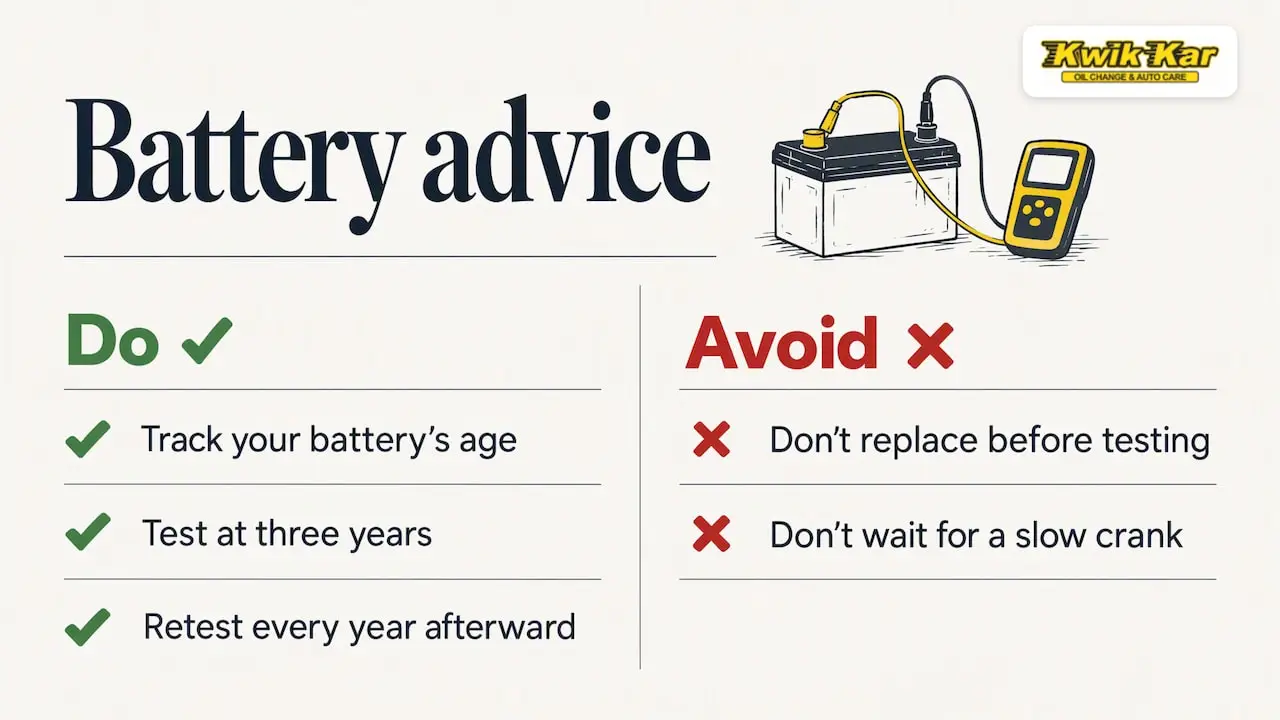
Our advice to a Fort Worth driver is simple. Learn your battery’s age. Get it tested at the three-year mark and every year after. Do not wait for a slow crank to turn into a dead one in a parking lot on a 100-degree afternoon. If the battery is fine, we will say so.
— Kwik Kar
Get your battery tested at Kwik Kar
If your battery is past three years, you have noticed slow starts, or you want to be sure before a road trip, we can test it and the charging system at our shop on White Settlement Road. We handle battery testing and replacement along with alternators, starters and electrical repair, so you get an answer and a fix in one visit. You can book a visit online or see the full list at kwikkarwhitesettlement.com.
If you bundle it with other upkeep, our preventative maintenance services can cover fluids, filters and a general inspection while the car is here. Your owner’s manual and the manufacturer’s maintenance schedule remain the reference for what your specific vehicle needs.
Does Texas inspection law affect battery replacement?
Not directly, but the rules changed recently, so it is worth getting them right. According to the Texas Department of Public Safety, the vehicle safety inspection program changed on January 1, 2025, and most non-commercial vehicles no longer need an annual safety inspection. Qualifying commercial vehicles remain subject to safety inspection requirements, so fleet owners should confirm their obligations.
Emissions testing is a separate matter. The DPS emissions criteria list Tarrant County among the affected counties, and gasoline vehicles from 2 through 24 years old registered there are subject to the On-Board Diagnostics test. A weak battery can matter here in an indirect way: electrical trouble can trigger warning lights, and a disconnected or newly replaced battery can reset the vehicle’s readiness monitors. If your car has just had a battery swap and you are heading to an emissions test, ask us how long the car may need to drive before it is ready.
FAQ
How long does a car battery replacement take?
For many vehicles, swapping the battery itself is a short job, though testing the charging system adds time. Some cars need the vehicle’s electronics reset or the battery registered after installation, which can take longer. Call ahead or schedule a visit and we will tell you what to expect for your model.
How many years should a car battery last?
Three to five years is the standard range cited by AAA and others. In hot climates like North Texas, expect your battery to land toward the shorter end. Testing it each year after year three is the most reliable way to know.
Can a battery fail without warning?
Yes. Heat damage builds inside the battery, and the first sign can be a car that will not start. That is why a load test is better than waiting for symptoms. If your battery is past four years old, testing it before summer and before winter is a sensible habit.
Is a dead battery always a bad battery?
No. Leaving the lights on, a loose cable, a failing alternator or a parasitic drain can all leave you with a flat battery that is otherwise healthy. A test after recharging tells you whether the battery can hold a charge or whether something else is the real cause.
Sources
- Know When to Replace the Car Battery: 8 Key Warning Signs, AAA
- How Long Do Car Batteries Last, AAA
- Car Battery Maintenance: 9 Expert Tips, AAA
- FAQs, Interstate Batteries
- Why My Car Won’t Start If the Battery’s Still Good, Interstate Batteries
- How Hot Weather Affects Your Car Battery, Consumer Reports
- Best Car Battery Buying Guide, Consumer Reports
- Vehicle Safety Inspection Program Changes Now in Effect, Texas DPS
- Inspection Criteria for Emission Inspection, Texas DPS