




If your car won’t crank but the dash lights stay bright, you hear a single solenoid click, or you hear grinding when you turn the key, you’re likely looking at starter failure rather than a dead battery. These are the clearest starter-specific signals among the common starter symptoms. Run through the quick checklist below, and if you smell smoke or the starter keeps spinning after the engine fires, stop and call for professional help right away.
TL;DR:
- A single click without engine turnover and grinding noises are key indicators of starter issues, often caused by worn brushes, gears, or solenoid faults.
- Jump-start tests help distinguish between starter, battery, and alternator problems by observing if the vehicle maintains operation after initial start.
- Checking for corrosion, loose connections, and faulty relays before calling a shop can provide a clearer picture of starter health without risky attempts.
- Proper diagnosis involves voltage-drop and current-draw tests, not just voltage checks, to identify wiring issues or motor failures accurately.
- Regular maintenance of the charging system and battery can extend starter lifespan and prevent unexpected failures.
Table of Contents
- 1. What do common starter failure symptoms sound like?
- 2. Starter vs battery vs alternator: how to tell them apart
- 3. A quick diagnostic checklist before you call a shop
- 4. When to call a professional and what shop testing involves
- 5. How technicians diagnose starter problems at an automotive repair shop
- 6. How long does a starter typically last?
- 7. Why starter failure is more than an inconvenience
- 8. A safety-first rule worth remembering
- Schedule a starter or charging system check
- FAQ
- Sources
1. What do common starter failure symptoms sound like?
Each symptom points to a different mechanical problem inside the starter system, and knowing which one you’re hearing narrows down the fix before you ever open the hood.
- Single click, no crank: Usually means the solenoid is engaging but the starter motor itself isn’t turning, often from worn brushes or a failed motor winding.
- Rapid, repeated clicking: Points more toward a weak battery than the starter, since the solenoid keeps trying and failing to pull enough current.
- Grinding or whirring at startup: Suggests the pinion gear isn’t meshing properly with the flywheel, which can wear both parts down over time.
- Slow, labored cranking with bright dash lights: Often means the starter is drawing too much current under load, even though the battery is supplying enough voltage.
- Starter sticking or spinning after the engine starts: A stuck solenoid or bad ignition switch signal, and it risks overheating the starter fast.
- Smoke or a burning smell near the starter: An immediate safety concern that calls for shutting the engine off and seeking help.
Mechanical wear inside the starter, including pitted solenoid contacts and worn pinion teeth, explains a lot of these symptoms and why they tend to get worse gradually rather than appearing all at once, according to a technical review of starting system faults. Intermittent starting, where the car cranks fine when cold but struggles after a short drive, often points to heat-soak affecting worn internal components.
Pro Tip: Note exactly what you heard and when (cold start, after a short trip, every time) before you call a shop. That detail speeds up diagnosis considerably.
2. Starter vs battery vs alternator: how to tell them apart
Starter, battery, and alternator problems often look alike from the driver’s seat, but the patterns differ enough that you can usually narrow things down before you pick up the phone.
- Dim lights with rapid clicking typically means a weak or dying battery, while a single click paired with a bright dash points toward the starter itself.
- Jump-start the vehicle and watch what happens next: if it starts and keeps running normally, the battery was likely the problem; if it starts, then stalls again shortly after, the alternator is a likely suspect; if nothing changes at all, suspect the starter or a bad connection, according to AAA’s jump-start guidance.
- Rule out simpler mimics first: corroded battery terminals, a blown fuse, a failed starter relay, or even a faulty neutral safety switch can all produce a no-start that looks like a bad starter but isn’t.
Avoid cranking the engine over and over while you troubleshoot. Give the battery a brief rest between attempts and interpret your results calmly rather than repeating the same test five times in a row. Technicians generally recommend ruling out the battery and charging system first, since those failures are more common and cheaper to resolve than a starter replacement.
3. A quick diagnostic checklist before you call a shop
This sequence helps you gather useful information without attempting anything risky, and it gives a technician a head start if you do need professional help.
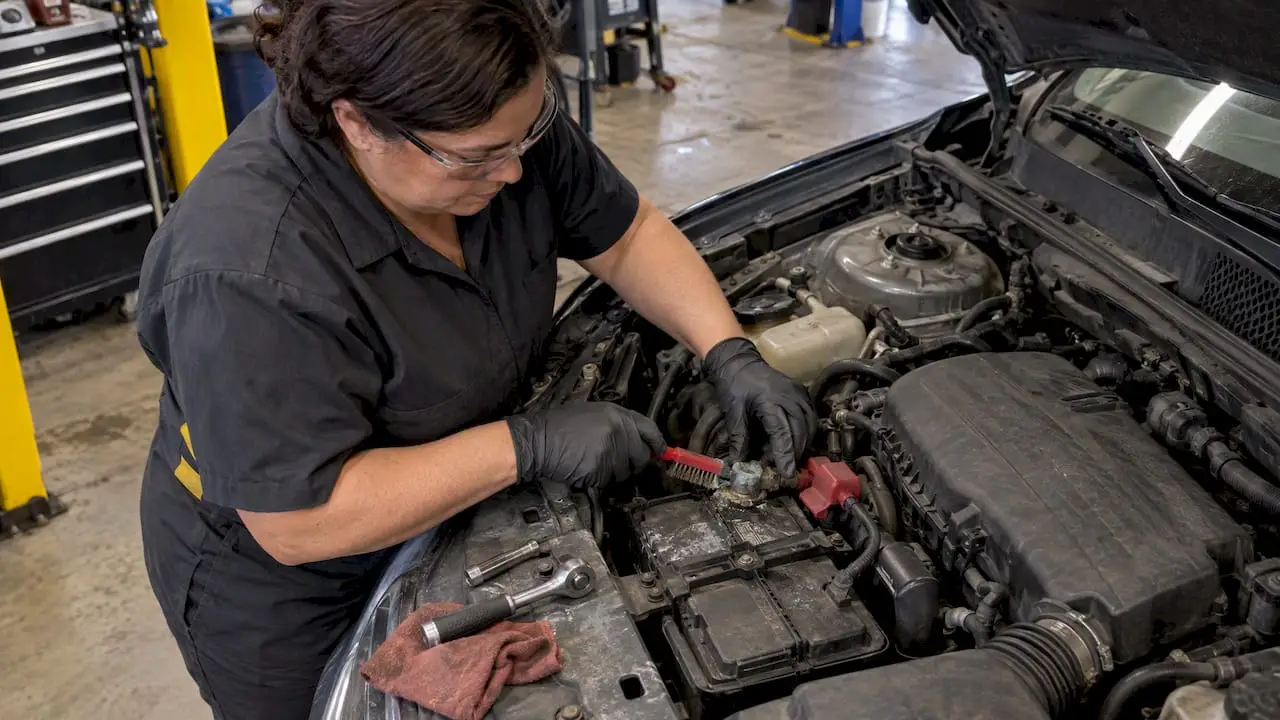
- Look at the battery terminals for corrosion, a loose cable, or any visible oil or smoke around the starter itself.
- Have a helper turn the key while you listen from under the hood, and note whether interior lights stay bright or dim during the attempt.
- Jump-start the vehicle following proper procedure, connecting cables in the correct order, and watch for one of the three outcomes described above. Our step-by-step jump-start guide walks through the safe order to connect and remove cables.
- Check accessible fuses and the starter relay, and confirm the shifter is fully in Park or Neutral, since a misaligned shifter or faulty safety switch can mimic starter failure.
- Stop immediately if you see smoke, smell burning, or the starter keeps spinning after the engine catches. Those are signs that call for professional diagnosis, not more cranking.
A failing starter can drain a battery fast if you keep cranking it, since the starter motor pulls heavy current every time it engages, according to AAA’s starter replacement guidance. Repeated attempts can leave you with two problems instead of one.
4. When to call a professional and what shop testing involves
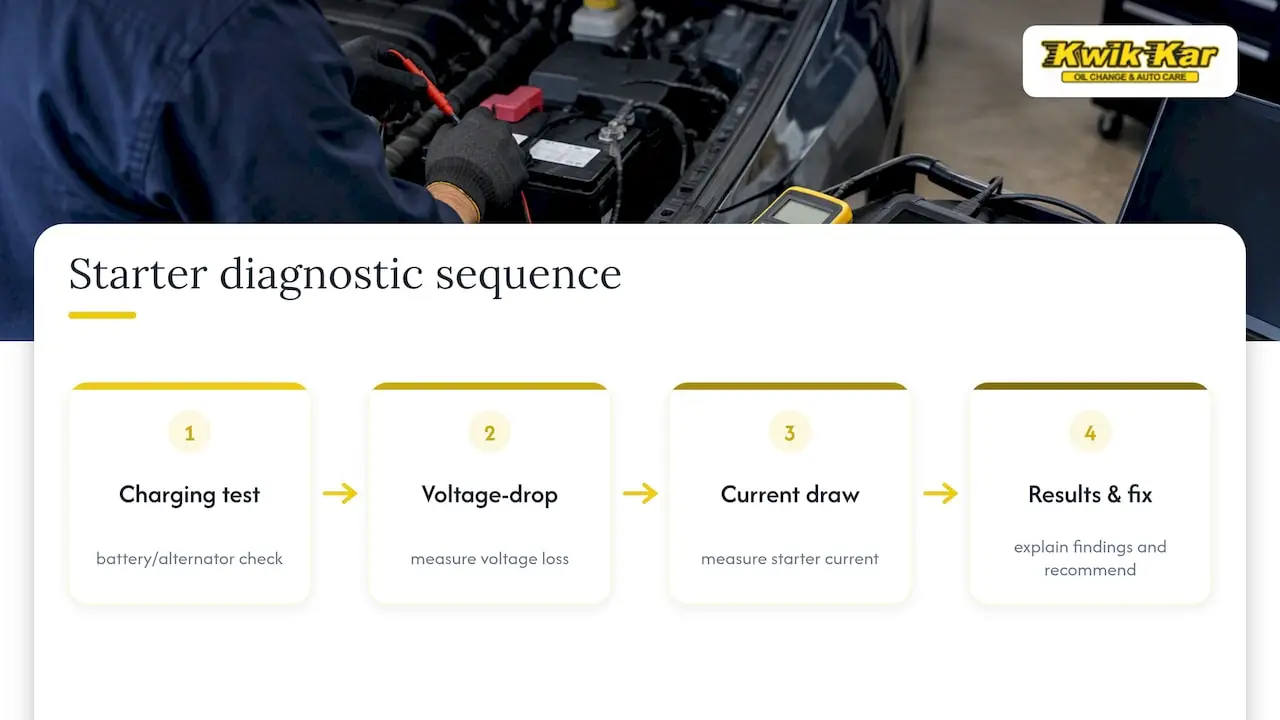
A simple test light or basic multimeter check can tell you whether voltage is present at the starter, but it can’t tell you whether the circuit can actually deliver the high current needed to crank the engine. That distinction matters, and it’s why a proper diagnosis goes further than a quick voltage check.
- Voltage-drop testing measures resistance across connections and cables under load, catching corrosion or wiring problems that a simple voltage check misses, a method confirmed in technical diagnostics research on automotive electrical systems.
- Starter current-draw testing measures how much amperage the starter pulls while cranking, revealing whether the motor, solenoid, or wiring is struggling under real load.
- Bench-testing a removed starter lets a technician confirm engagement strength and current draw directly, which many shops use when in-vehicle tests are inconclusive, according to RepairPal’s diagnostic process.
- Bring notes on what you heard and when, since that context helps a technician narrow the diagnostic path faster.
Repair paths vary depending on what testing finds; if repair is uneconomical, consider options detailed in Failed NY Inspection? Why Your Sitting Car Is Costing You Money. Sometimes it’s a corroded terminal or damaged wire, and sometimes the starter itself needs replacement. Ask for documented test results and a clear explanation of parts and labor before any work begins.
5. How technicians diagnose starter problems at an automotive repair shop
As a RepairPal certified shop, we rely on ASE certified technicians and documented testing rather than guesswork. Our battery testing and replacement, alternator and starter repair, and engine diagnostic services follow the same rule-out sequence: charging system first, then voltage drop and current draw testing on the starter circuit. We walk you through the results and the recommended fix before any repair starts.
6. How long does a starter typically last?
Starters are built to handle thousands of engagement cycles, and most last for many years of normal driving before wear catches up with them. Heat, frequent short trips, and a habit of leaving accessories running while the engine is off all add stress to the starter and the battery that feeds it.
A few habits help extend starter life. Keeping battery terminals clean and tight reduces the resistance the starter has to fight through on every start. Addressing a weak battery promptly matters too, since a starter that has to work against low voltage pulls more current and wears out its internal components faster. Routine preventative maintenance visits are a good time to have your battery and charging system checked, since catching a marginal battery early can spare the starter unnecessary strain. There’s no fixed mileage or year interval where a starter is guaranteed to fail. It’s a wear part that depends on driving habits, climate, and the health of the rest of the electrical system around it.
7. Why starter failure is more than an inconvenience
A failing starter doesn’t just delay your morning. It can leave you stranded somewhere inconvenient or unsafe, particularly if the symptoms show up unpredictably rather than every time you turn the key. Intermittent starting is often the hardest to plan around, since the car might start fine three times in a row and then leave you stuck the fourth.
There’s also a safety dimension beyond simply not starting. A starter that sticks and keeps spinning after the engine catches can overheat quickly, and in some cases that heat can affect nearby wiring or components under the hood. Grinding noises point to gear wear that, left unaddressed, can eventually damage the flywheel itself, turning a starter repair into a more involved job. Treating early symptoms, like a single click or occasional slow crank, as a signal worth checking out rather than an annoyance you wait out tends to keep a small problem from becoming a bigger one.
8. A safety-first rule worth remembering
Don’t keep cranking a struggling engine. Repeated attempts overheat the starter and drain the battery fast. If you smell burning or the starter won’t stop spinning, shut it down and call for help.
— Kwik Kar
Schedule a starter or charging system check
Guessing at a no-start problem wastes time and risks turning a simple fix into a bigger repair. As a RepairPal certified shop with ASE certified technicians, we test your battery, charging system, and starter circuit and walk you through exactly what we find before any work begins.

- Book a starter and charging system diagnostic with our team.
- Browse our full list of services to see what else we handle in one visit.
FAQ
How do you know if a starter is going bad?
The clearest signs are a single click with no crank, grinding or whirring when you turn the key, or the engine failing to crank while the dash lights and accessories stay normal. Slow, labored cranking or a starter that keeps running after the engine starts are also common warning signs.
What can mimic a bad starter?
A weak battery, corroded terminals, a blown fuse, a failed starter relay, or a faulty neutral safety switch can all produce a no-start that looks like starter failure. Jump-starting the car and watching how it behaves afterward, along with checking these simpler parts first, helps rule these out before assuming the starter is at fault.
How do I know my starter needs to be replaced?
A professional diagnosis using voltage-drop and starter current-draw testing confirms whether the starter circuit can deliver the amperage needed to crank the engine, which a simple test light cannot show, according to technical diagnostics research. Many shops also bench-test a removed starter to confirm failure before replacing it, as outlined in RepairPal’s diagnostic process.
Sources
- 14 Reasons Why Your Car Won’t Start | AAA Automotive
- Undercar electrical diagnostics (technical paper)
- Starter replacement cost and diagnostic steps | RepairPal