




A popping or clicking noise when you turn most often comes from a worn CV joint on a front-wheel-drive or all-wheel-drive vehicle. Worn tie rods, ball joints and suspension bushings can make a similar sound. The pattern of the noise tells you a lot: a rhythmic click that speeds up as you turn tighter points to a CV joint, while a single knock or clunk as you change direction points to steering or suspension parts. Our technicians at 9613 White Settlement Rd in Fort Worth can find the exact source with a lift inspection, and this guide shows you what to listen for first.
TL;DR
- A rhythmic click or pop that gets faster in tight turns usually means a worn outer CV joint, often after a torn boot let the grease out.
- A single pop, knock or clunk when the steering changes direction more often points to a tie rod, ball joint or bushing.
- AAA says a failing CV joint is not an emergency, but it can stress other steering parts and lead to costlier repairs, so book an inspection early.
- Grinding, vibration, a clunk under acceleration or a sudden loss of drive means stop driving and get the vehicle checked.
- A technician confirms the cause on a lift by checking boots, joint play and wheel bearings. The noise alone cannot name the part.
Table of Contents
- What does a popping noise when turning actually mean?
- Which noise points to which part?
- Why do CV joints start popping?
- What else can pop when you turn?
- How can you check before you come in?
- Is it safe to drive with a popping noise when turning?
- What does a technician inspect?
- What are the repair options?
- How to keep joints and steering parts lasting longer
- Perspective
- Get the noise diagnosed at our White Settlement Road shop
- A note on Texas inspections
- FAQ
- Sources
What does a popping noise when turning actually mean?
Your front wheels have to do two jobs at once: steer and receive power from the engine. On most modern cars, SUVs and crossovers, a CV axle (constant-velocity axle) handles the power part. It is a shaft with a flexible joint at each end, so the wheel can turn and move over bumps while still being driven. The joint at the wheel is the outer joint. The joint at the transmission is the inner joint.
The outer joint flexes the most when you turn. Once it wears, the steel balls inside rattle and click as the joint bends at tight angles, which is why the sound grows louder and quicker the harder you turn the wheel. A parking-lot U-turn is where most drivers notice it first.
A CV joint is not the only possibility. The steering linkage and the suspension also move when you turn, and they can pop when a part has play in it. Sorting out which one you have is the whole job of diagnosis.
Which noise points to which part?
Use the sound, the speed and the type of turn to narrow things down before you book. This table is a starting point for a conversation with a technician, not a final diagnosis.
| What you hear | When it happens | Most likely area |
|---|---|---|
| Rhythmic clicking or popping, faster as you turn tighter | Moving through a turn, especially full-lock turns | Outer CV joint |
| Clunk when you get on or off the gas | Straight line, moderate speed | Inner CV joint |
| Single pop or knock | As the steering changes direction, even at low speed | Tie rod end, ball joint or control arm bushing |
| Pop over bumps while turning | Driveway entrances, dips, uneven pavement | Suspension: strut mount, ball joint, bushing |
| Humming or growling that changes with turns | Steady highway speeds | Wheel bearing |
| Vibration that rises with speed | Highway driving | Usually tires or wheels, rarely a CV joint |
The outer and inner joint distinction matters. Motor’s driveline guide describes popping or clicking in turns as an outer joint symptom and clunking when accelerating or decelerating at highway speeds as an inner joint symptom. So if you searched for CV axle clicking when accelerating, the click you hear under power may be the same family of problem, just on a different joint.
Why do CV joints start popping?
The usual start is a torn rubber boot. The boot holds in the grease that lubricates the joint and keeps dirt out. According to the same Motor guide, faulty boots are the most common cause of CV joint failure, because centrifugal force flings grease out through even small cracks. Once the grease is gone and grit gets in, the joint tracks wear, and the click begins.
A few things make boots age faster:
- Heat and time. Rubber gets brittle. Fort Worth summers are hard on it, and so is the heat soak from long highway runs on I-30 or Loop 820.
- Road debris and curbs. A nick from a rock or a scrape on a driveway edge can open a boot.
- Loose clamps. The boot can slip off its seat and leak even if the rubber looks fine.
- Heavy use. Trucks, SUVs and rideshare or delivery vehicles that turn constantly and carry weight put more cycles on the joints.
One thing worth knowing: wear inside the joint, such as pitting or grooves in the ball tracks, cannot be seen without taking the joint apart. That is why the sound you hear matters so much. By the time it clicks, the damage is already inside.
What else can pop when you turn?
If the noise does not behave like a CV joint, these are the usual suspects.
Tie rod ends and ball joints
Both are ball-and-socket joints. When one wears, the socket has room to knock against the ball every time the wheel changes direction. You tend to feel it as a pop or clunk at low speed, sometimes with looseness or wandering in the steering. A badly worn one is a steering-control problem, not just a noise. If you suspect a ball joint, our guide to ball joint replacement cost explains what the job involves.
Struts, strut mounts and bushings
The top of a strut rotates with the wheel when you steer. A worn mount or a dry bearing can pop as the strut turns, particularly with the vehicle stopped or rolling slowly. Control arm bushings can add a clunk over bumps. Our article on suspension noise over bumps covers that side of the problem.
Wheel bearings and hubs
A bad bearing usually hums or growls rather than pops, but it can also leave play at the wheel. A technician checks it any time an axle is out. See our page on confirming wheel bearing noise for how that test works.
Not every click under power is a worn joint
Sometimes a click is a known quirk, not a failure. A manufacturer service bulletin on 2009 to 2023 Infiniti models, for example, documents a clicking noise during take-off that is cured with grease on the hub bearing surfaces, with no axle replacement. This is one reason a hands-on inspection beats guessing from a forum post.
How can you check before you come in?
These two checks take a few minutes in an empty lot and give a technician a better starting point. Do them only in a clear, open space at walking speed.
- Turn hard in both directions at low speed. A constant, rhythmic noise while the car moves through the turn points to the outer CV joint binding under load. Single pops, snaps or clunks suggest other components.
- Try the reverse circle. A tech bulletin from a driveline manufacturer says to put the vehicle in reverse, turn the wheel to one side and drive backward in a circle. If the noise gets louder, the CV shaft is the likely culprit.
Note which direction makes the noise worse. A noise only in left turns often implicates the right-side joint, because that side is the outside wheel carrying the load. Tell the technician what you found. Our page on five field tests for CV axle noise lays out the full set.
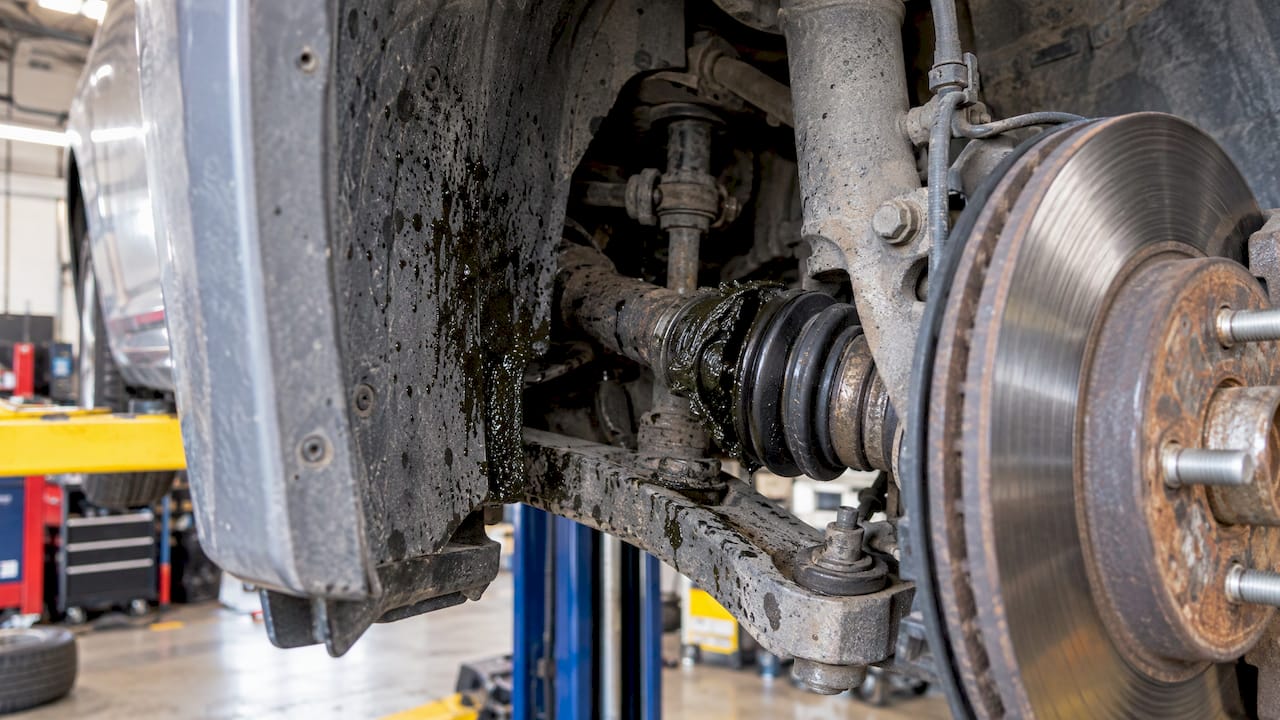
Then look at the boots if you can see them with a flashlight through the wheel opening. A shiny spray of dark grease on the inside of the wheel or the suspension parts is a strong sign of a torn boot. Whatever you see, the next step is the same: a proper inspection on a lift.
Is it safe to drive with a popping noise when turning?
The answer depends on what the noise is doing.
A light, occasional click on full-lock turns. AAA describes a worn CV joint as not an emergency that needs immediate action, but worn joints can stress other steering assembly parts and run up the repair bill. Schedule the inspection soon and avoid sharp turns under hard acceleration in the meantime.
Stop driving and have the vehicle inspected right away if you notice any of these:
- Grinding, or a click at gentle turns, not only at full lock
- Vibration or a clunk when you accelerate or let off the gas
- A sudden loss of power to one front wheel
- Looseness, wandering or a loose feel in the steering
- Grease thrown across the inside of the wheel along with any new noise
A completely failed CV joint can cut power to a front wheel or even separate from the axle, and a broken tie rod can mean losing steering control. Neither is something to find out about on the freeway. If steering feels loose or the vehicle will not move, a tow is the safer choice.
What does a technician inspect?
A good diagnosis starts by reproducing the symptom, then moves to the lift. The steps below are what a thorough inspection covers:
- Road test and turning test to hear the noise in the same conditions you do.
- Boots and clamps: tears, cracks, brittle rubber, grease on nearby parts, loose clamps.
- Joint play: gripping the outer joint housing and checking for movement in every direction, and rotating the shaft to feel for lash in the inner joint.
- Steering and suspension: tie rod ends, ball joints, control arm bushings, strut mounts, checked for play.
- Wheel bearings and hub: checked for roughness and looseness.
- Left-to-right comparison, because the good side is the best reference for the suspect one.
At our shop, ASE-certified technicians do this work with professional diagnostic equipment, and we use digital vehicle inspections so you can see what we see on your own vehicle. Kwik Kar in Fort Worth is also RepairPal certified.
What are the repair options?
The fix depends on the finding.
- Boot replacement. This only makes sense if the boot has just torn and the joint still turns smoothly, with no play or grit. If the joint already clicks, the boot is not the whole story.
- CV axle replacement. This is the most common repair once a joint has started to click. Shops generally replace the whole shaft rather than rebuild a joint, because the labor to take a joint apart, clean it, repack it and reassemble it often costs close to a complete preassembled axle, and a joint that passes a hand test can still fail within a few thousand miles.
- Tie rod, ball joint or bushing replacement. These are fixed one part at a time, usually followed by a wheel alignment because the geometry changes.
- Hub or wheel bearing replacement, if the bearing is rough or loose.
Cost varies with the vehicle, which side and joint failed, how hard the part is to reach, and the quality of the replacement part. European vehicles and some trucks can need more labor or specific parts. We do not publish a flat price for these jobs, because the real number comes from the inspection. Our guide on what a car repair estimate should include shows what to look for in line items so you can compare like with like.
How to keep joints and steering parts lasting longer
You cannot stop wear, but you can catch it early.
- Ask for a boot check at oil changes and tire rotations. A torn boot caught before the joint clicks is the cheapest version of this repair.
- Follow your manufacturer’s maintenance schedule rather than a generic interval. Your owner’s manual lists what your vehicle needs and when.
- Get an alignment after steering or suspension work, and any time the vehicle pulls or the tires wear unevenly.
- Avoid curbs and potholes when you can. Stop-and-go driving on West Fort Worth roads and rough pavement are hard on steering parts.
- Do not ignore a new sound. Early diagnosis keeps a small repair small.
Perspective
When someone calls about a popping noise in a turn, the first thing we want is the full picture: which direction, what speed, whether it happens under power. That is how a technician decides whether to start with the axle boots or the steering linkage.
What we have learned to avoid is guessing. A click is a symptom, not a part number. Our approach is to put the vehicle on the lift, check the boots, joints, tie rods, bearings and mounts, and show you the findings through a digital vehicle inspection so the repair you approve matches what is actually worn.
We would rather you come in when the noise is still occasional. It gives you more options, and it often keeps one worn part from taking others with it. Our qualifying repairs carry a 24-month/24,000-mile warranty, so you are covered after the work as well.
Kwik Kar
Get the noise diagnosed at our White Settlement Road shop
We are a full-service repair center, not just an oil change stop. Our technicians handle CV axles, steering, suspension, wheel bearings, alignment, brakes and engine diagnostics under one roof, so the cause of your noise and the fix can happen in the same visit. Drivers from White Settlement, Westworth Village, Westover Hills, River Oaks, Lake Worth and Benbrook come to us at 9613 White Settlement Rd, Fort Worth, TX 76108. We have one location, and it is here.
See everything we do on our services page or schedule a visit. If you run a rideshare, delivery or work vehicle, our fleet service page covers multi-vehicle accounts. You can also start at kwikkarwhitesettlement.com.
A note on Texas inspections
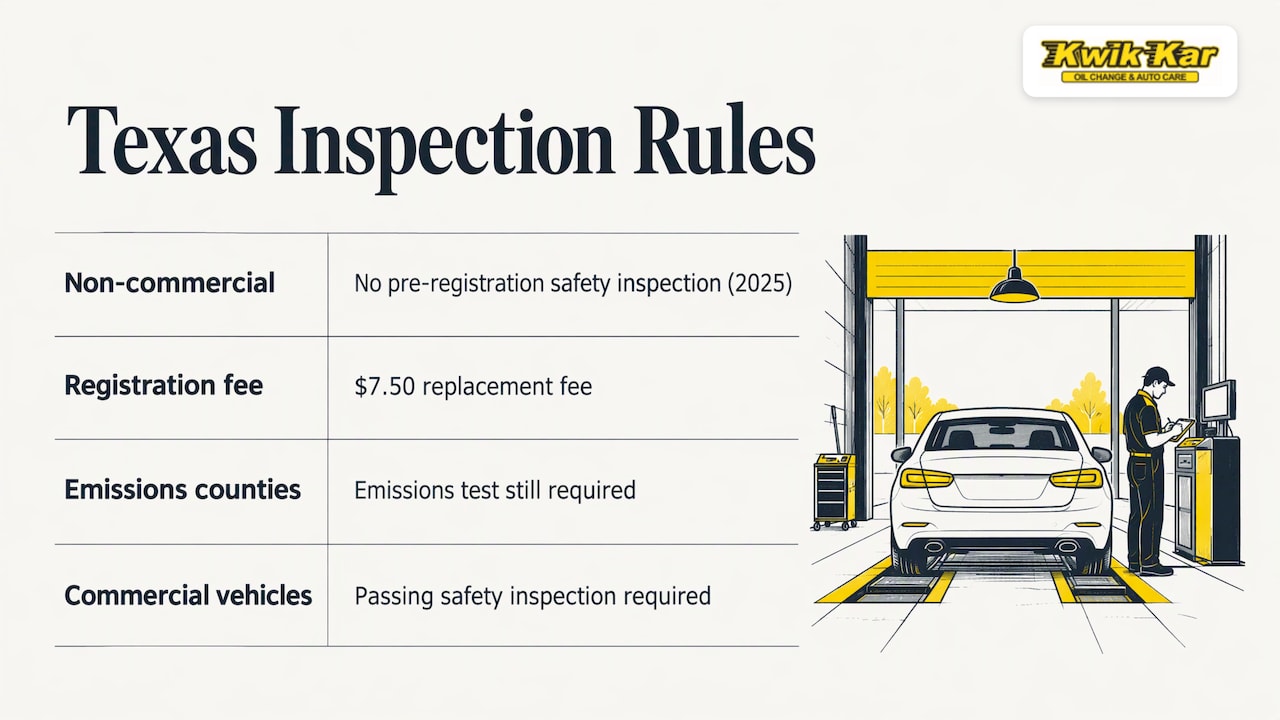
Some drivers ask whether a noise like this affects inspection. Since January 1, 2025, non-commercial vehicles no longer need a safety inspection before registration, though they still pay a $7.50 inspection program replacement fee when registering. Vehicles registered in emissions counties, which include Tarrant County, still need an emissions test, and all commercial vehicles still need a passing safety inspection. The state’s own advice is to keep servicing your vehicle regularly. A noise in the steering is a good reason to do that, whether or not a sticker is involved.
FAQ
Why does my car pop when I turn the steering wheel while parked?
A pop with the car stopped usually is not a CV joint, because the axle is barely moving. Look at strut mounts, tie rod ends, ball joints and steering components. A technician can check each for play on the lift.
Is a clicking noise when turning always a CV joint?
No. A rhythmic click that speeds up in tight turns is the classic CV joint sign, but a worn tie rod, ball joint or suspension part can also pop. A lift inspection separates them.
Why does my CV axle click when I accelerate?
A clunk or click under acceleration can mean play in the inner joint, particularly on front-wheel-drive vehicles. It can also come from the outer joint when you accelerate through a turn. Because some clicks have other causes, have the axle, hub and bearings inspected before replacing anything.
Can I keep driving until the noise gets worse?
A light click on full-lock turns is not usually an emergency, but it does not heal itself. Book an inspection soon. If you get grinding, vibration, a clunk under power or loose steering, stop driving and arrange a tow.
Does the popping noise mean I need an alignment?
Not by itself. An alignment corrects tire angles and does not fix a worn part. If a steering or suspension part is replaced, an alignment is usually the right follow-up.
Sources
- Vehicle Noises You Should Never Ignore, AAA
- Signs Your CV Joint Is Failing, PartCatalog
- SurTrack Replacement Driveline & Axles Tech Bulletin
- CV Joint Symptoms/Diagnosis, Counterman
- OE Driveline CV, Motor
- Infiniti Service Bulletin, NHTSA
- CV Joint Diagnosis, Apex Technation
- Vehicle Safety Inspection Program Changes Now in Effect, Texas DPS