


Clicking during turns points to a worn outer CV joint. Clunking under acceleration signals a more serious inner joint or shaft problem. If you hear either, check the CV boot for grease or tears right away, and avoid long highway drives until a certified technician inspects the axle. A trained eye can usually confirm the diagnosis in minutes.
TL;DR:
- Clicking during sharp turns indicates early outer CV joint wear, which is still often drivable but requires inspection soon.
- Clunking noises under acceleration suggest more serious inner joint or shaft damage, necessitating immediate repairs.
- Grease splatter on the wheel or brake components confirms a torn CV boot and high contamination risk.
- Simple tests like full-lock turns and swerve maneuvers can differentiate CV joint issues from wheel bearing problems.
- Early detection and addressing torn boots prevent costly axle replacements caused by dirt and moisture ingress.
Table of Contents
- What Does CV Axle Noise Actually Sound Like?
- How Can You Tell CV Joint Noise From a Bad Wheel Bearing?
- What Causes CV Axles to Fail Early?
- What Repairs Fix CV Axle Noise, and What Should You Expect?
- When Should You Stop Driving on a Noisy CV Axle?
- How Does a Certified Shop Diagnose CV Axle Noise?
- Get Your CV Axle Checked Before It Gets Worse
- Sources
- FAQ
What Does CV Axle Noise Actually Sound Like?
The sound tells you almost everything before a technician ever touches a wrench. Clicking or popping when you turn sharply, especially in a parking lot at low speed, is the textbook symptom of a failing outer CV joint. It happens because the joint has lost lubrication or developed internal wear, and the clicking gets louder the tighter you turn.
A clunking noise when you accelerate or shift into drive is a different animal. This usually comes from the inner CV joint or the axle shaft itself, and it tends to show up later in the failure process than outer joint clicking. Clunking is your car telling you the problem has moved past “annoying” and into “urgent.”
Vibration or shudder that gets worse as you press the gas often means the joint has progressed to advanced wear, or the axle is out of balance entirely. This one deserves attention fast, since it frequently precedes total joint failure. If the shaking feels more like a wheel-balance issue than a drivetrain shudder, it’s worth comparing your symptoms against our guide on why your car shakes when driving before assuming it’s the axle.
Then there’s the visual clue that confirms almost everything: grease flung across the inside of the wheel, the brake caliper, or the steering knuckle. That’s a torn CV boot, and it’s a bigger deal than it looks.
Symptoms and what they usually mean:
- Clicking on sharp turns: early outer CV joint wear, common and often still driveable short distances
- Clunking on acceleration or shifting: inner CV joint or shaft damage, more urgent
- Vibration that worsens with throttle: imbalance or advanced joint failure
- Grease on the wheel, rotor, or knuckle: torn boot, contamination risk rising fast
Pro Tip: A torn boot doesn’t always make noise right away. If you spot grease during a routine tire check, treat it as an early warning even if the car still sounds quiet.
Contamination is the real accelerant here. Once dirt and moisture get past a torn boot, they act like sandpaper inside the joint, and what might have been a simple boot replacement often turns into a full axle job within a matter of weeks.
How Can You Tell CV Joint Noise From a Bad Wheel Bearing?
Two low-effort tests, done back to back, separate CV joint failure from a failing wheel bearing in most cases, without needing a lift or a scan tool.
- Run the tight-turn test. Find an empty lot, turn the steering wheel to full lock, and drive slowly in a tight circle in both directions. A clicking or popping sound that only appears at full lock strongly points to an outer CV joint problem rather than a bearing.
- Do the swerve test on a quiet road. At a safe, low speed, gently swerve left and right. Wheel bearing noise tends to change as weight shifts from one side to the other, while CV joint noise typically stays tied to turning angle rather than load.
- Jack up the front end and spin each wheel by hand. Feel for roughness, listen for clicking, and check for any side-to-side play in the hub. Note exactly what you feel, since this detail helps a technician diagnose faster.
- Inspect the boot visually. Look for splatter patterns on the inside of the wheel, cracks in the rubber bellows, or a boot that’s clearly loose at one clamp. Grease flung outward in a ring pattern is a near-certain sign of a split boot.
- Write down what you find before your appointment. Which turn direction was louder, whether the swerve test changed anything, and whether the wheel spun rough all matter to whoever inspects the car next.
One caution worth repeating: a badly worn outer joint can sometimes produce a rumble at highway speed that mimics a bad bearing, so don’t treat any single test as the final word. If the car vibrates severely or you feel the wheel losing stability, skip the road tests entirely. Get it towed instead of driving it to confirm a suspicion.
What Causes CV Axles to Fail Early?
Every CV axle problem traces back to one of a handful of root causes, and most of them are preventable if you catch them early.
- A torn boot is the most common trigger. Once the rubber bellows splits, grease escapes and dirt gets in, and the joint starts grinding itself apart from the inside.
- Mileage and age matter, but unevenly. Some axles run well past 100,000 miles because the boot stayed intact, while others fail at half that mileage because of one small tear nobody noticed.
- Lift kits and suspension modifications change the geometry. Raising a vehicle increases the operating angle of the CV joint, and that added stress shortens joint life noticeably compared to a stock ride height.
- Impact damage from potholes or curb strikes can bend a shaft instantly, causing sudden vibration or noise with no gradual warning period.
- Catching a torn boot early is the cheapest possible outcome. A boot replaced before contamination sets in can save the whole axle; one caught late usually can’t.
What Repairs Fix CV Axle Noise, and What Should You Expect?
The repair path depends almost entirely on how early the problem was caught. A torn boot discovered before any dirt or moisture reaches the joint can sometimes be fixed with a boot replacement and fresh grease, which is the least invasive and least expensive route.
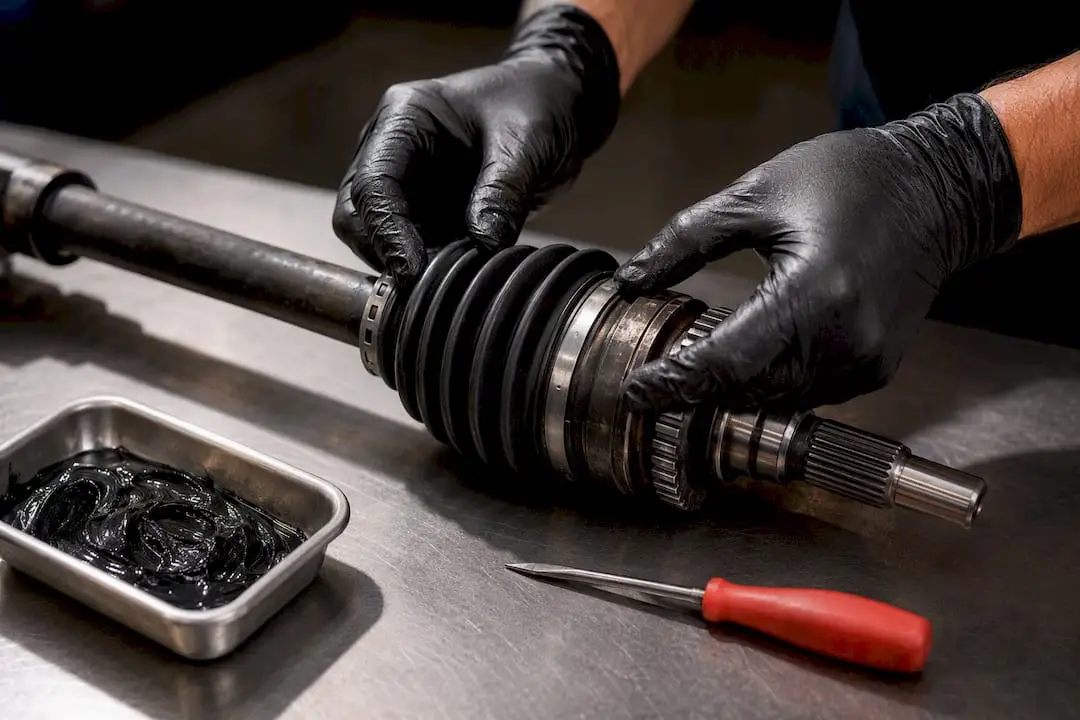
Once contamination has entered the joint, though, that option closes. Grit inside a CV joint acts like an abrasive, and a boot alone can’t undo that damage. At that point, most shops recommend replacing the entire axle assembly rather than rebuilding just the joint, since remanufactured axles are widely available and reduce labor time compared to a joint-by-joint rebuild.
Other factors can widen the scope of the job:
- Hub or wheel bearing damage found during inspection may need addressing at the same time, since it shares mounting points with the axle.
- Transmission-side damage from prolonged clunking occasionally shows up if the noise was ignored for too long.
- What you tell the shop matters. Mention which tests you ran, which direction was louder, and how long the boot has likely been leaking.
- Cost and turnaround vary by vehicle, parts availability, and labor, which is why an in-person inspection is the only reliable way to scope the job.
When Should You Stop Driving on a Noisy CV Axle?
Clunking under acceleration, a sudden loss of drive power, or severe vibration means it’s time to stop and arrange a tow rather than keep driving. Continuing to drive through these symptoms risks axle separation and can cause secondary damage to the transmission that costs far more to fix than the axle itself.
If the only symptom is mild clicking at low speed during tight turns, a cautious short drive to a nearby shop is usually acceptable.
- Avoid highways and hard acceleration until it’s inspected
- Keep speeds low and steering inputs gentle
- Pull over immediately if the noise changes or gets louder
- Never ignore a clunk just because the car still moves
How Does a Certified Shop Diagnose CV Axle Noise?
A proper diagnosis starts with a road test to reproduce the exact noise you described, followed by a lift inspection covering the boot, joint play, and hub bearing. Technicians document what they find with digital inspection photos, showing torn boots, grease patterns, and play in the joint, so you see the actual problem rather than taking someone’s word for it.
Kwik Kar Oil Change & Auto Care relies on ASE and RepairPal-certified technicians and quality parts specifically because a rushed or incomplete diagnosis leads to repeat failures. Getting the joint identified correctly the first time is what keeps a boot repair from turning into a second axle replacement six months later.
— Kwik Kar
Get Your CV Axle Checked Before It Gets Worse
Some service centers give drivers a documented, photo-backed inspection instead of a guess based on a quick test drive.
If you’ve noticed clicking on turns, a clunk under acceleration, or grease showing up near a wheel, that’s the kind of complaint technicians can run down quickly. The process often starts with a road test to reproduce the noise, then moves to a lift inspection covering the boot, the joint, and the hub bearing, so you know precisely what’s wrong before any parts get ordered. Bring notes on which turn direction was louder or whether the swerve test changed anything. This can help speed up the visit. Explore the full range of diagnostic and repair services offered by local shops, and once the axle issue is resolved, keep it that way with routine preventative maintenance. If you’re dealing with grease-covered brake components as part of the same problem, a partner resource on safely removing brake dust can help clean up before your visit. Ready to get the noise diagnosed? Schedule your inspection with a trusted local auto care provider today.
Sources
- How to Tell if Your CV Axles are Going Bad — AutoZone
- Bad wheel bearing vs bad CV joint: How to tell the difference — The Motor Guy
- CV joint noise? How to diagnose a CV axle clicking or popping — 1A Auto blog
- Common axle failures after lift kits — All Balls Racing Group blog
FAQ
What Does a Bad CV Axle Sound Like?
A bad CV axle typically clicks or pops during sharp turns if the outer joint is worn, or produces a clunking sound under acceleration if the inner joint or shaft is damaged. Vibration that worsens with throttle usually means the wear has become more advanced.
Is It Safe to Drive With CV Joint Noise?
Mild clicking during turns is often safe for a short, cautious drive to a shop, but clunking, vibration, or any loss of drive power means you should stop driving and arrange a tow, since continued driving risks axle separation and drivetrain damage.
How Much Does It Usually Cost to Fix a CV Axle?
Cost depends on the vehicle, whether a boot repair is still an option, and how much labor the job requires, so current pricing is best confirmed directly through Kwik Kar Oil Change & Auto Care’s services page rather than a general estimate.
How Can You Tell if It’s a Bad Wheel Bearing or a Bad CV Axle?
Run the tight-turn test at full steering lock and the highway swerve test at low speed; clicking that appears specifically during full-lock turns points to the CV joint, while noise that shifts with side-to-side load points more toward a wheel bearing.