




A clunk over a speed bump, a creak when you turn into a parking space, or a pop as you steer out of a driveway usually points to the strut mount or the bearing inside it. The mount is the top connection between the strut and the car’s body. When its rubber collapses or its bearing dries out, the noise follows the road and the steering wheel. Because other suspension parts can make the same sounds, an inspection should confirm the source before any parts are replaced. At Kwik Kar Oil Change & Auto Care, 9613 White Settlement Rd in Fort Worth, our suspension service covers shocks and struts, so a noise like this can be traced and fixed in one shop.
TL;DR
- A bad strut mount typically clunks over bumps, and a worn strut bearing creaks, groans or pops when you turn at low speed.
- The noise is loudest in parking lots and driveways and often fades at highway speed, which is why it is easy to dismiss.
- Ball joints, sway bar links and other parts can sound similar, so the source needs to be confirmed before anything is replaced.
- Replace mounts with new hardware whenever struts are replaced, and have the alignment checked afterward.
- If the steering catches, the strut looks out of position or the car feels unstable, stop driving and have it inspected.
Table of Contents
- What is a strut mount, and why does it make noise?
- What does strut mount noise sound like?
- Other symptoms that come with a worn strut mount
- How do you know it is the strut mount and not something else?
- Strut mount, strut bearing or worn strut: which is it?
- Can you drive with a bad strut mount?
- Can noisy strut mounts be quieted without replacing them?
- What does strut mount replacement cost?
- Why strut work is a shop job
- Why we handle strut mount noise at one shop
- Get a strut mount noise checked in West Fort Worth
- FAQ
- Sources
What is a strut mount, and why does it make noise?
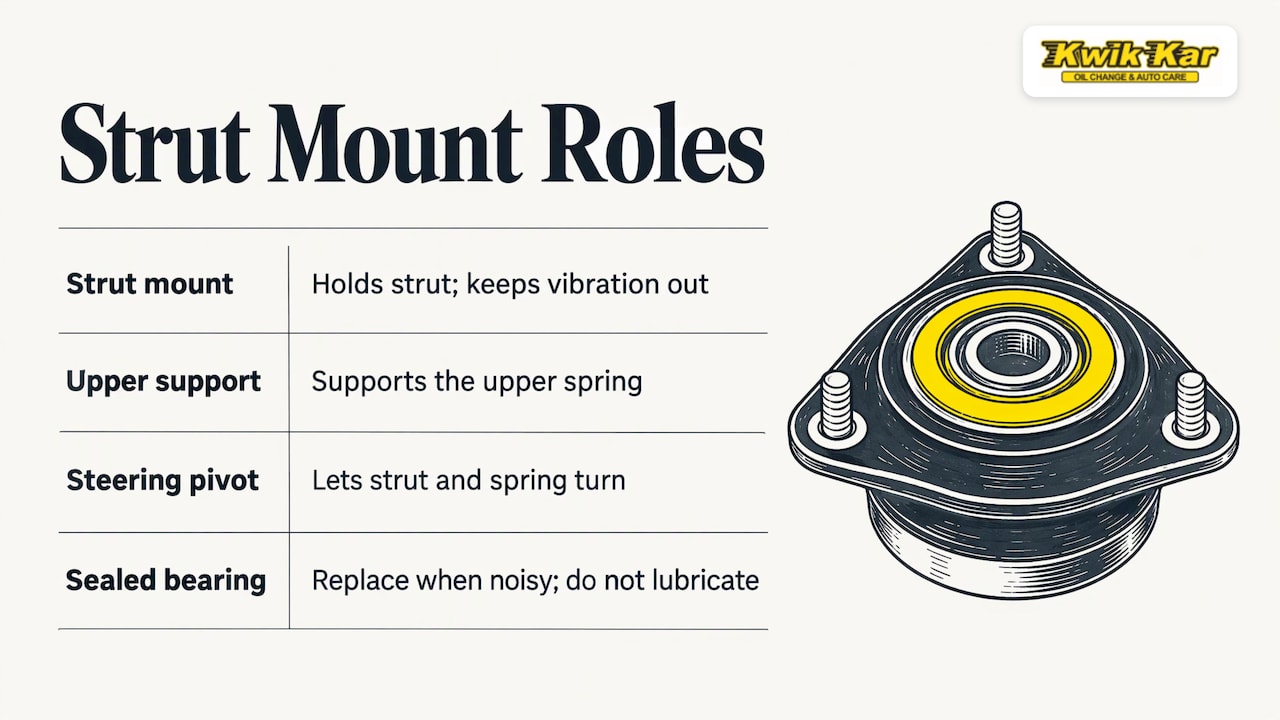
Many front suspensions use a strut: a shock absorber and spring combined in one assembly. The top of that strut bolts into the car’s body through a strut mount, a rubber-and-metal part that holds the strut in position and keeps road vibration out of the cabin. On most front-wheel setups the mount also includes a bearing, which lets the strut and spring turn with the wheels when you steer.
Brake & Front End Magazine explains that the upper mount and bearing plate act as both the upper spring support and the steering pivot. The same article notes the bearings are sealed assemblies that cannot be lubricated, so a noisy or binding one is replaced rather than greased.
Wear comes from sheer repetition. One parts manufacturer estimates a strut moves up to 1,750 cycles per mile, and potholes and curb strikes push and pull on the mount each time. Once the thin rubber layer between the mount and the strut tower breaks down, vibration and noise travel straight into the body. That is why the sound lines up with bumps.
What does strut mount noise sound like?
The sound depends on which part is failing.
| What you hear | When it happens | Most likely part |
|---|---|---|
| Dull clunk or knock | Over bumps, potholes, speed bumps | Worn or collapsed rubber mount, or loose mounting hardware |
| Creak or groan | Turning at low speed, parking | Dry or rough strut bearing, binding spring seat |
| Pop or snap | As the wheel turns, often from a stop | Bearing sticking and releasing |
| Rattle | Uneven pavement | Loose mount or worn hardware |
| Notchy steering, poor return to center | After a turn | Resistance in the upper bearing |
This mapping matches what technical guidance from a suspension manufacturer says: noise over bumps points to the upper mounting plate, while noise when turning points to the upper bearing assembly.
There is one more pattern worth knowing. A failed mount rarely makes noise at highway speed. Constant load keeps the parts pressed together, so the sounds show up in moments when the suspension shifts between loaded and unloaded, such as backing out of a driveway or winding through a parking garage. If your car is quiet on I-30 but complains in a grocery store lot, that is a useful clue to pass along to the technician.
Other symptoms that come with a worn strut mount
Noise is usually the first sign, but not the only one. Technical training material lists a worn or collapsed mount as causing clunks over bumps, changes in camber or caster, uneven tire wear and a knock when steering combines with suspension travel. Camber is the inward or outward tilt of the tire, and caster is the forward or backward angle of the steering axis. Both affect how the tire meets the road.
In plain terms, watch for:
- A steering wheel that feels notchy or does not return to center smoothly after a turn.
- Vibration through the wheel or body that was not there before.
- A car that pulls, wanders or feels less planted than it used to.
- Tires wearing faster on the inside or outside edge. Our guide on what causes uneven tire wear explains how to read the pattern.
- Steering wobble that only appears under braking, which can mean the top of the strut is moving more than it should.
A worn mount changes the wheel’s alignment angles, so a car with a bad mount often needs an alignment afterward. Our article on the signs your car needs an alignment covers what that looks like from the driver’s seat.
How do you know it is the strut mount and not something else?
This is where guessing gets expensive. Noise travels through metal and rubber, so the sound you hear at the top of the wheel arch may not start there. A trade publication on suspension diagnostics notes that a worn lower ball joint can make a pop that sounds like it comes from the strut mount. Sway bar links, control arm bushings, tie rods and even a loose wheel can also knock or creak over bumps.
A thorough inspection usually works through these steps:
- Listen to the driver. The most useful test drive starts by reproducing your complaint. Tell the technician where, how fast and in what situation the noise happens. Trade guidance stresses that letting the driver describe it before diagnosing leads to a faster repair.
- Look at the mounts. Cracked rubber or separation between rubber and metal is a visible sign.
- Turn the wheels lock to lock with the weight off the suspension. Roughness or popping can point to the upper strut mount bearing. Raising the vehicle and moving the wheels by hand can reveal bearing problems that power steering assist may hide.
- Check the fasteners. A mount can look fine and still be loose at the bolts. Training material specifically warns that fastener checks should not be skipped just because the rubber looks good.
- Isolate the source. Because noise travels, shops sometimes use listening tools that pick up sound at the mount, control arms and body to find where it is loudest.
At Kwik Kar, ASE-certified technicians carry out inspections like this, and we use digital vehicle inspections so you can see what was found instead of taking it on faith. If you want to understand the wider family of sounds first, our guides to suspension noise over bumps and suspension clunking noise walk through the other likely culprits.

Strut mount, strut bearing or worn strut: which is it?
Drivers often search for these three as if they were separate problems. They are neighbors, and they often wear together.
- The strut mount is the stationary rubber-and-metal cushion. Its failure shows up as clunks over bumps.
- The strut bearing spins with the wheel. Its failure shows up as creaks, pops and heavy steering at low speed.
- The strut itself controls bounce. Our guide on how to tell if struts need replacing covers bouncing, nose dive and leaking.
Trade guidance on bounce testing says more than two or three bounces at a corner typically indicates a shock absorber problem. A car can have a worn strut and a worn mount at once, and since replacing one usually opens up access to the other, the two are commonly handled together.
Can you drive with a bad strut mount?
It depends on how far it has gone. A mount with a mild noise and no looseness is a reason to book an inspection soon. One that has separated is a different situation. One parts supplier advises against continuing normal driving with a broken or separated strut mount, since a mount that lets the strut move, binds the steering or allows contact with the tire or body can affect vehicle control.
Stop driving and get the car inspected where it sits, or have it towed, if you notice any of these:
- The steering catches or binds when you turn.
- The car feels unstable, or the front end drops or leans abnormally.
- A loud metal-on-metal impact comes from the wheel well.
- You can see the strut or spring out of its normal position.
Fort Worth’s stop-and-go traffic, pothole-pocked side streets and long highway runs all load the front suspension. If you drive a heavy SUV or pickup, or put daily miles on a rideshare or delivery vehicle, the mounts take more punishment, so a new noise deserves an earlier look.
Can noisy strut mounts be quieted without replacing them?
Usually not for good. Sprays and lubricant may quiet a dry rubber contact for a short time, but the bearing is sealed and cannot be lubricated, and a worn mount does not heal. Trade guidance is blunt: if the mount or bearing plate is rusted, loose, worn, noisy, binding or damaged, it must be replaced.
There is an exception on the shop side. Some noises come from loose hardware rather than a failed part. A suspension manufacturer notes that a metallic clunk after a strut job usually means loose or worn mounting hardware, and that bearing noise while turning can come from improper loading of the mount during installation. The same source points out that a mount can look tight but still move while driving, and that hardware can stretch if it is over-torqued or retightened repeatedly. That is why new mounts and new hardware belong with new struts.
What does strut mount replacement cost?
Costs vary by vehicle, by whether one or both sides are done, and by whether the full strut assembly is replaced. Published U.S. estimates give a rough frame:
- One parts source puts a single mount at $20 to $100 for the part and about $100 to $300 in labor, or $120 to $400 for one mount, and $400 to $1,200 for whole strut assemblies on both sides.
- For a specific vehicle, RepairPal’s September 2026 estimate for a Honda Pilot shock or strut replacement was $1,107 to $1,428 before taxes and fees, with struts replaced in pairs.
The range is wide because a compact sedan and a three-row SUV are very different jobs. Prices at Kwik Kar are quoted for your specific vehicle after inspection. We do not publish a flat price for this work, so ask for an estimate when you bring the car in.
Budget for an alignment too. Replacing a strut or mount changes suspension geometry, and our breakdown of wheel alignment cost shows what that step typically adds.
Why strut work is a shop job
Strut replacement means compressing a coil spring, and the stored energy is serious. A parts guide warns that compressing a spring is extremely dangerous and can cause serious injury if the tool slips. Beyond the hazard, the job depends on correct torque, new hardware and an alignment afterward. A shop does all of that as one repair, so the noise is gone for the right reason.
Why we handle strut mount noise at one shop
Our perspective
Strut mount noise is rarely one part. The clunk you hear may start at the mount, a ball joint or a sway bar link, so our approach is to find the source before quoting a repair. Our ASE-certified technicians work from a thorough inspection, and our digital vehicle inspections let you see what we see.
We would rather you leave knowing why the car makes the noise than leave with a parts list. Struts, mounts, alignment and tires all affect each other, and handling them together at 9613 White Settlement Rd means one team sees the whole front end.
We are RepairPal certified, and qualifying repairs carry our 24-month/24,000-mile warranty. For drivers in White Settlement, Westworth Village, Westover Hills, River Oaks, Lake Worth and Benbrook, that means a single stop for diagnosis, repair and alignment.
Kwik Kar
Get a strut mount noise checked in West Fort Worth
If your car clunks over bumps or creaks when you turn, bring it to our shop on White Settlement Rd. We offer shocks and struts, wheel alignment, tires and full diagnostics under one roof, and our wheel alignment service can follow a mount repair so the car tracks straight again. You can schedule a visit online and tell us when and where the noise happens.

Rideshare, delivery and fleet drivers can also set up service for multiple vehicles. Because a noise that gets worse can also take a vehicle off the road, a quick inspection at the first clunk costs less downtime than waiting. You can reach us through our website.
FAQ
Why does my car clunk over bumps but not on the highway?
A worn strut mount or loose mounting hardware lets parts move when the suspension shifts between loaded and unloaded, such as over a speed bump or pothole. At highway speed constant load keeps the parts pressed together, so the noise often disappears. A quiet highway ride does not mean the part is healthy.
Is strut bearing noise different from strut mount noise?
Yes. The mount mostly clunks over bumps, while the bearing creaks, groans or pops when you turn the wheel at low speed. They sit together at the top of the strut and often wear at the same time, so both are inspected during one visit.
Should strut mounts be replaced when I replace struts?
Yes. Suspension manufacturers recommend installing new mounts and hardware with new shocks or struts, because old hardware can stretch and a mount can look fine while still moving. Replacing them together also avoids paying for the same labor twice.
Do I need an alignment after strut mount replacement?
Usually, yes. Removing and replacing the strut and mount can change camber and caster, so a post-repair alignment protects your tires and steering feel. We can check it during the same visit.
How much does it cost to fix strut mount noise?
It depends on the vehicle and whether one or both sides need work. Published U.S. figures range from about $120 to $400 for a single mount to more for whole strut assemblies. We quote after inspection for your specific vehicle.
Sources
- Curing Shock, Strut and Suspension Noise, Brake & Front End
- Suspension Noise Diagnostics, Brake & Front End
- Best practice advice on strut mount replacement, Delphi Auto Parts
- Noise With New Shocks & Struts, Monroe
- Shock & Strut Installation Tips, Monroe
- What Does a Bad Strut Mount Sound Like?, SolutionSphere
- Inspect front strut bearing and mount, MasterTechPrep ASE G1 lesson
- How to diagnose different suspension noise issues, Vehicle Service Pros
- Growing your strut service, Fender Bender
- Can you drive with a broken strut mount?, GSW Auto Parts
- Honda Pilot Suspension Shock or Strut Replacement Cost, RepairPal
- What Is a Strut Mount: Function, Symptoms & Replacement Cost, Gdstauto
- Diagnosing & Replacing Suspension Struts, Go-Parts