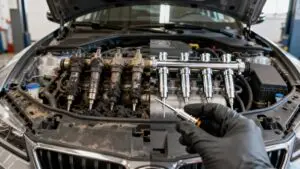





A suspension clunking noise means something that should be tight has gone loose, worn or broken. Common culprits are sway bar links, ball joints, control arm bushings, strut mounts and worn shocks or struts. AAA says a heavy clunk over rough pavement is a sign your suspension needs attention, and a loose exhaust can sound much the same. A technician should confirm the source before any parts are replaced.
This guide helps you narrow down where the clunk is coming from, decide whether it’s safe to keep driving, and know what to expect when you bring the car in.
TL;DR
- A clunk over bumps usually points to a worn suspension part: sway bar links, ball joints, bushings, strut mounts, shocks or struts. Exhaust, brake hardware and loose wheels can mimic it.
- Treat it as a prompt-service issue, not a wait-and-see one. AAA warns that compromised shocks and struts can reduce control and wear out other parts.
- Notes on when it happens (speed, turning, front or rear, cold or warm) help a technician find the cause faster.
- Texas dropped the annual safety inspection for personal vehicles, so no inspection will catch a worn part for you. You need to bring it in yourself.
- Cost depends on the part, the vehicle and the labor. Ask for a written estimate after a hands-on inspection.
Table of Contents
- What a suspension clunk sounds like
- The most common causes of front end clunking
- Clunks that aren’t the suspension
- Is it safe to drive with a clunking suspension?
- Track the clunk before you call
- What happens at the shop
- What suspension repair costs
- Our perspective: fix the cause, not the sound
- Get a clunk checked in Fort Worth
- FAQ
- Sources
What a suspension clunk sounds like
Your suspension connects the wheels to the body and absorbs every bump, dip and pothole between you and the road. Springs carry the weight, shocks and struts control the bounce, and links, arms, bushings and joints hold everything in position. When one of those holds slack it shouldn’t have, metal or hard rubber knocks against something. That is the clunk.
The sound is usually described in a few ways:
- A single heavy thud over a speed bump or pothole, often a loose shock, strut mount or worn bushing.
- A lighter, repeated knock or rattle over small, choppy bumps, which often points to sway bar links.
- A clunk when you turn the wheel or pull into a driveway, which can involve ball joints, strut mounts or steering parts.
- A clunk when you brake or accelerate, where the weight shifts and a loose bushing or mount lets a part move.
The sound alone won’t tell you the part. ASE’s technician training on noise and vibration rests on the same idea: you isolate the path of the noise instead of guessing from how it sounds.
The most common causes of front end clunking
Most clunks that reach the cabin from the front of the car come from the front suspension, because that end carries the engine and does the steering. Here are the parts a technician checks first. ASE’s automobile task list covers diagnosing suspension noises and inspecting these groups: stabilizer bar links and bushings, ball joints, control arm bushings, strut mounts, shocks and struts, coil springs and steering linkage.
| Part | What it does | Typical clue | Urgency |
|---|---|---|---|
| Sway bar links | Tie the stabilizer bar to the suspension to limit body roll | Rattle or knock over small bumps, sometimes in corners | Moderate: fix soon |
| Ball joints | Pivot points between control arms and steering knuckles | Clunk over bumps, loose or wandering steering | High: don’t wait |
| Control arm bushings | Rubber cushions where arms attach to the frame | Clunk when braking, accelerating or hitting bumps | Moderate to high |
| Strut mounts | Connect the top of the strut to the body | Clunk or creak when turning or over bumps | Moderate to high |
| Shocks and struts | Control bounce and keep the tires planted | Heavy thud, extra bounce, nose dive when braking | High: affects control |
| Steering linkage (tie rods and related parts) | Carry your steering input to the wheels | Clunk with steering play or a loose feel | High: don’t wait |
Worn strut mount symptoms
The strut mount is a rubber and metal assembly at the top of the strut, often with a bearing that lets the strut turn with the wheels. When it wears, you may notice:
- A clunk or pop when you turn the wheel at low speed
- A knock over bumps that seems to come from the top of the front wheel area
- A creaking or groaning sound when the car settles
- A steering wheel that feels slightly less precise
If you also notice a bouncy ride, our guide on how to tell if struts need replacing walks through that side of the problem, and why a car bounces while driving covers the related ride symptoms.
Shocks and struts
A worn shock can knock internally or loosen at its mounting hardware. Either way, it stops controlling the spring, and your tires may lose steady contact with the road. Our page on when to replace shock absorbers lays out the signs for Fort Worth drivers.
Bushings and links
Rubber bushings dry out, crack and shrink. Sway bar links wear at their small joints. Neither looks dramatic, but a loose one lets metal hit metal, and a loose link is often the cheapest fix on the list. Don’t assume yours is the cheap one without a look, though.
Clunks that aren’t the suspension
A noise that seems to come from the suspension can start somewhere else. The same ASE material points to brake hardware, tires or wheels, the exhaust, the driveline, body panels and aftermarket accessories as other sources. Some to rule out:
- Loose exhaust hangers or heat shields. AAA notes a loose exhaust can sound like a suspension clunk. This tends to be more of a rattle at idle or over rough spots.
- Worn wheel bearings. These usually hum or growl and change with speed or turning. See our guide to confirming wheel bearing noise.
- A worn CV axle. Clicking or clunking on turns or under acceleration often points here. We cover simple field checks for CV axle noise.
- Loose brake hardware. A clunk when you first press or release the brakes can come from calipers, pads or their hardware. Our brake problems guide lists the common symptoms.
- Tires or wheels. A loose lug nut, a damaged tire or something lodged in the wheel can thump. Check lug nuts only if you can do it safely and have the right tools.
- Cargo and accessories. A tool box in a truck bed, a roof rack or a loose jack in the trunk can sound just like a failing part.
The fastest way to separate these is timing. When does it happen, at what speed, and on which side?
Is it safe to drive with a clunking suspension?
It depends on the part, and you can’t tell from the driver’s seat. A clunking sway bar link is annoying but rarely a safety emergency. A worn ball joint or steering component is a different story, because a joint that separates can cost you steering control. Because you can’t tell which one you have, the careful rule is to get it looked at soon.
Stop driving and call for help or a tow if:
- The steering feels loose, wanders or pulls hard to one side.
- The clunk is new, loud and gets worse quickly.
- A corner of the car sits visibly lower than the others.
- You see fluid leaking from a shock or strut, or a damaged tire.
- The noise comes with a warning light, a grinding sound or a burning smell.
If none of those apply, keep your speed down, avoid rough roads and heavy loads, and book an inspection in the next few days. If you tow, haul or carry a full load of passengers, be even more cautious. Extra weight puts more stress on worn parts.
There is one more Texas-specific wrinkle. As of January 1, 2025, the state no longer requires safety inspections for noncommercial vehicles, though emissions testing still applies in Tarrant County before registration renewal. A passing emissions test says nothing about your suspension, so nobody will flag a worn ball joint for you. Our guides to what a vehicle safety inspection covers and Fort Worth emissions prep explain the difference.
Track the clunk before you call
You don’t need tools to help your technician. A few minutes of notes can shorten the diagnosis. AAA suggests bringing your maintenance and repair history, and a short recording and notes on the noise if it’s safe to make them. Write down:
- Where it seems to come from: front, rear, left or right.
- When it happens: over bumps, in turns, braking, accelerating, or at a certain speed.
- The road surface: speed bumps, potholes, rough concrete, smooth highway.
- Temperature: only when cold, or after the car warms up.
- What changed recently: new tires, a lift or lowering kit, a recent pothole hit, a towing job.
Have a passenger record audio if you can. Never film or take notes while driving yourself.
What happens at the shop
AAA draws a useful line between a multipoint inspection and diagnosis. A multipoint check reviews the overall health of tires, shocks, struts, springs, ball joints, bushings and steering parts. Diagnosis hunts down the root cause of one specific noise. For a clunk you want both, and a careful technician will usually:
- Talk with you about when and where you hear the noise.
- Road test the car to reproduce it.
- Lift the vehicle and check for play in joints, links, mounts and bushings, and look for leaks, cracks and torn boots.
- Inspect the tires, wheels and brake hardware, and check the exhaust.
- Explain what was found and which findings explain the noise.
Two things to keep in mind. A clean checklist doesn’t prove the noise has no cause, and a worn part doesn’t automatically prove it caused the noise. Ask what was tested and how the conclusion was reached. That’s the kind of explanation you should expect from a shop.
What suspension repair costs
Nobody can quote your repair honestly from a sound. The price depends on which part has failed, your vehicle, labor time, rust and whether other parts are damaged. For a sense of the range, RepairPal’s published estimates for shock or strut replacement run from $635 to $755 for a 2000 Toyota Camry, $790 to $1,003 for a Ford F-150 and $1,667 to $1,776 for a 2007 Chevrolet Tahoe. Those are examples, not a Fort Worth quote, and they vary by taxes, fees and location.
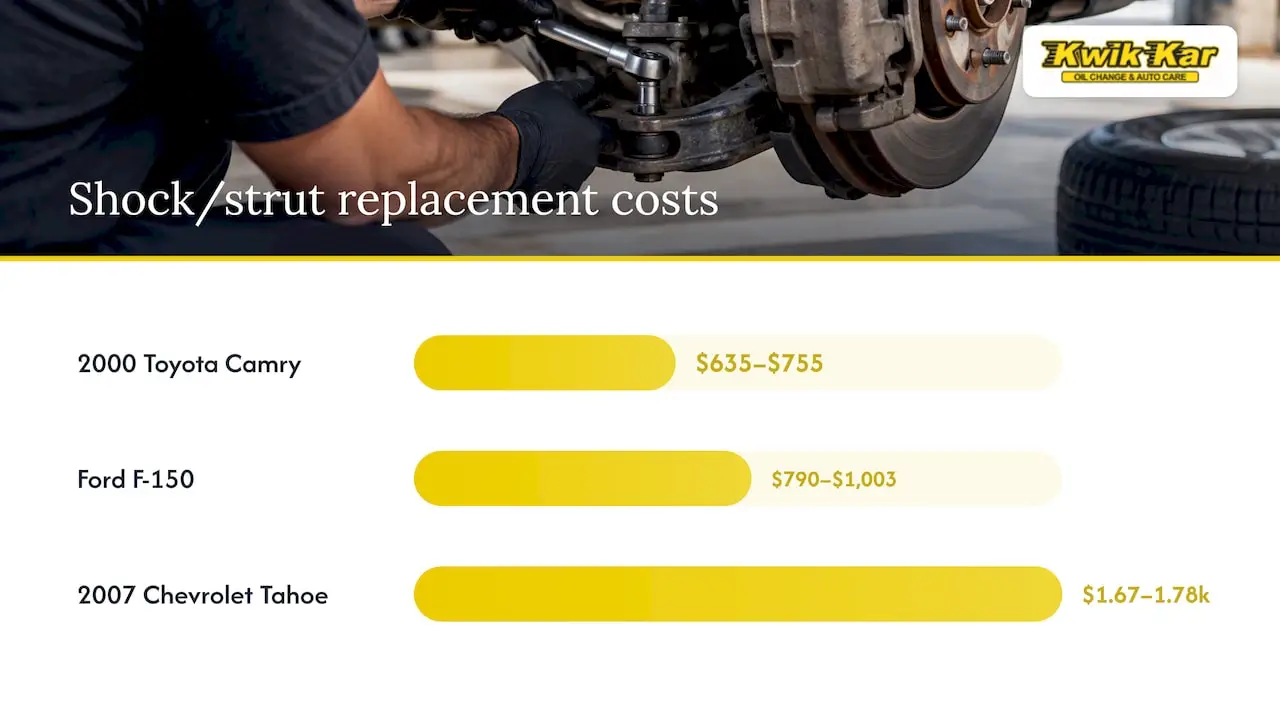
The pattern matters more than the numbers. Trucks, SUVs and European vehicles with complex or air-assisted suspensions tend to cost more, and parts are often a big part of that. If you drive a European brand, it also helps to understand how parts sourcing shapes the bill. This Portuguese-language look at European-brand maintenance costs in Brazil shows how much OEM parts availability can drive the total. Our own article on Audi air suspension warnings covers a common example here at home.
We don’t publish prices for our suspension work, because a number without an inspection would be a guess. We give you a written, vehicle-specific estimate after we look at the car.
Our perspective: fix the cause, not the sound
We see the same pattern often. A driver lives with a clunk for months because the car still drives. Then a small worn link turns into a worn ball joint, a loose strut turns into a damaged mount, and a cheap repair becomes a bigger one. The sound is a symptom, and what we want to know is why it’s there.
That’s why our approach starts with the inspection. Our technicians are ASE and RepairPal certified, and we use digital vehicle inspections so you can see what we see instead of taking our word for it. You decide what gets done and in what order, and we’ll tell you which items affect safety and which can wait.
We also don’t like replacing parts by guesswork. If the noise turns out to be an exhaust hanger or a loose heat shield, we’d rather tell you that than sell you struts. If it is the suspension, you’ll know which part and why.
— Kwik Kar
Get a clunk checked in Fort Worth
If your car, SUV or truck is clunking over bumps, bring it to Kwik Kar White Settlement. We handle suspension and steering work alongside brakes, tires and routine care, so one visit can rule out or confirm the likely sources. Fleet managers and rideshare or delivery drivers, who put heavy miles on suspension parts, can also ask about maintenance for multiple vehicles. See all of our services and call or book an appointment for an inspection and written estimate.
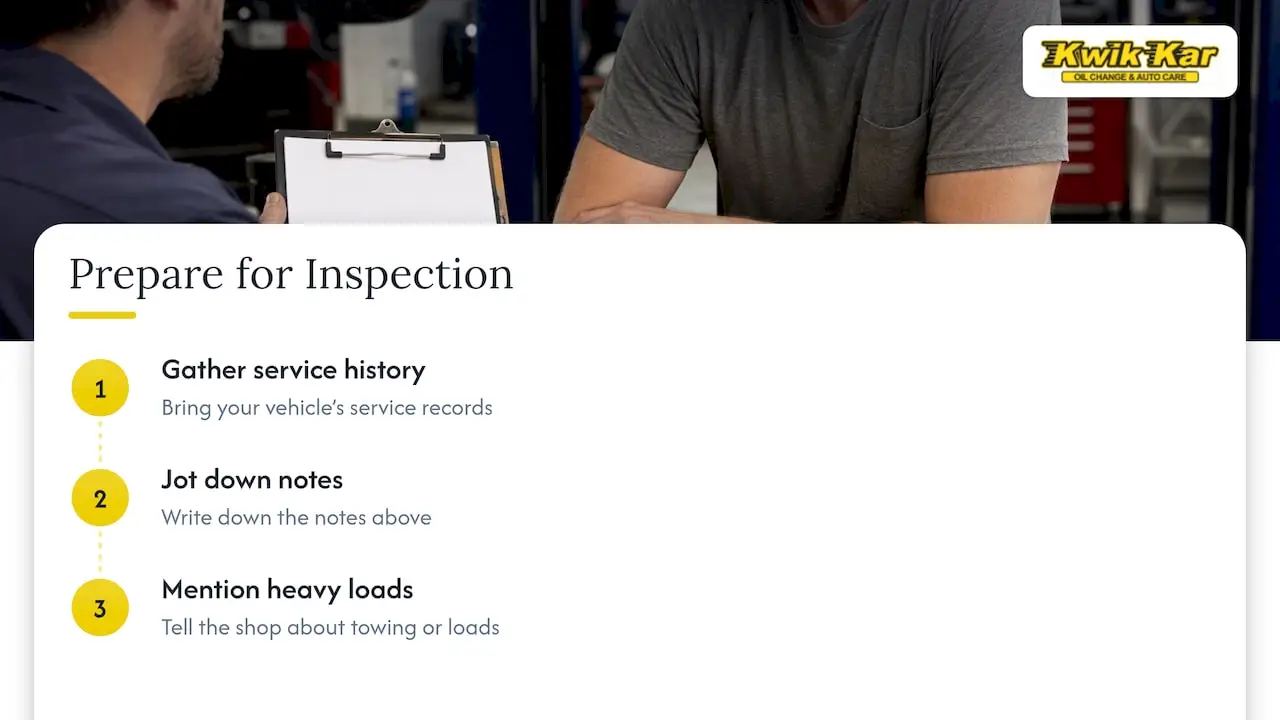
A few steps to prepare: gather your service history, jot down the notes above, and tell us if the car has been towing or carrying heavy loads. Regular preventative maintenance visits also give a technician a regular look at the bushings, boots and mounts before they start to knock.
FAQ
Why is my suspension making a clunking noise?
Something in the suspension or steering has loosened or worn out. Sway bar links, ball joints, control arm bushings, strut mounts and shocks or struts are the usual suspects. Exhaust parts, brake hardware or loose items in the vehicle can sound similar, so an inspection is the only way to be sure.
Is it safe to drive with a clunking suspension?
It can be for a short time, but you can’t know without an inspection. A worn sway bar link is minor, while a worn ball joint or steering part can affect control. AAA advises prompt service, so keep your speed low and get it checked soon.
Why does the clunk only happen on one side or over certain bumps?
Wear is rarely even. One link, bushing or mount may loosen before its twin on the other side. Noise that appears only over sharp bumps, or only in turns, tells the technician which parts are loaded at that moment.
How much does it cost to fix a clunking suspension?
It ranges from a small repair to a major one, depending on the part, the vehicle and the labor involved. Published estimates for shock or strut replacement alone range from several hundred dollars to well over $1,500 depending on the vehicle. We provide a written estimate after inspecting your car.
Do worn strut mounts cause a clunk when turning?
They can. A worn mount may pop or clunk as the strut turns with the wheel, and you may feel it over bumps too. Ball joints and steering parts can cause a similar sound, so have the front end checked before replacing anything.
Sources
- AAA Club Alliance: What does that strange car smell or weird noise mean?
- AAA Club Alliance: Vehicle noises you should never ignore
- AAA: What is a multi-point car inspection?
- ASE Automobile Test study guide
- ASE: Introduction to noise, vibration and harshness
- TxDMV: Inspection and registration calendar
- RepairPal: Ford F-150 shock or strut replacement cost estimate