




A humming, growling, or rumbling sound coming from one of your wheels is most often a sign of a worn or failing wheel bearing, and it deserves attention soon rather than later. The noise typically grows louder as you speed up and shifts when you turn. From here, you can either schedule a diagnostic visit or carefully check the wheel yourself if you feel comfortable doing so. Waiting too long can turn a simple repair into a bigger, costlier one.
TL;DR:
- A grinding or roaring noise indicates advanced wheel bearing wear or seal failure, while a steady hum suggests early-stage deterioration.
- One-sided noise that lessens when turning away from a wheel points to that side’s bearing issue, with vibration and wobble signaling severe damage.
- Ignoring early symptoms can lead to hub damage or loss of steering control, so moderate hums need prompt inspection, but grinding requires immediate towing.
- Proper diagnosis involves road testing, checking for wheel play, and using listening tools, especially if noise persists during turns or has associated dashboard alerts.
- Professional repair typically involves replacing the entire hub assembly or bearing, with verification drive tests afterward ensuring the issue is resolved.
Table of Contents
- Common Wheel Bearing Sounds and What They Usually Mean
- Other Signs That Point to Wheel Bearing Failure
- How to Confirm Which Wheel Bearing Is Bad
- Is It Safe to Drive With Wheel Bearing Noise?
- What Happens During a Professional Inspection and Repair
- Why Early Diagnosis Matters
- Get Your Wheel Bearing Noise Checked
- FAQ
- Sources
Common Wheel Bearing Sounds and What They Usually Mean
Wheel bearings let your wheels spin smoothly with minimal friction, and when they wear out, that friction turns into noise you can hear from inside the cabin. The type of sound often tells you how far the wear has progressed.
A low hum or steady growl that gets louder as your speed increases is the most common early symptom. It can sound like driving on a coarse road surface even when the pavement is smooth. As wear advances, that hum can deepen into a rumble, almost like rolling over rumble strips at a steady pace.
Grinding, roaring, or clicking sounds usually point to more advanced damage. Grinding often means metal is contacting metal inside the bearing. A roaring noise may suggest a damaged seal has let dirt or moisture inside. Clicking, especially during turns, can also come from a constant velocity axle rather than the bearing itself, which is why isolating the sound matters before assuming the cause.
Turning the steering wheel can help you narrow things down. A bearing that’s failing on one side often gets quieter when you turn away from that side, because turning shifts weight off the damaged bearing, and louder when you turn toward it, since that shifts more load onto it.
- A steady hum that rises with speed usually points to early-stage bearing wear.
- A grinding or roaring sound suggests the bearing has worn significantly or the seal has failed.
- Noise that changes when turning left versus right helps identify which side is affected.
- Clicking during turns can also indicate a CV axle issue worth ruling out.
Several symptoms often described in consumer guides, including humming, growling, clicking, and steering feel changes, can range from a minor nuisance to a genuine safety concern, according to KBB’s wheel bearing guide. If you’re also hearing noise that sounds more like it’s coming from the driveline, our field tests for CV axle noise can help you tell the difference in minutes.
Other Signs That Point to Wheel Bearing Failure
Noise rarely travels alone when a bearing is failing. Paying attention to what else your vehicle is doing can sharpen your diagnosis and help you judge how urgent the problem really is.
A wheel bearing that’s developed play can cause steering wheel vibration, especially at highway speeds. This differs from a tire imbalance vibration, which tends to come and go with speed changes and smooths out once you hit a certain range; bearing-related vibration tends to stay present and often grows worse the longer you drive.
Other clues include an ABS warning light, pulsing brake pedal feel unrelated to braking, or a wheel that seems to wobble slightly when inspected. Uneven tire wear on one wheel, when the others look normal, can also point to a bearing problem that’s letting the wheel sit at a slight angle.
- Steering vibration that persists regardless of speed often points to bearing wear rather than tire imbalance.
- An ABS light or odd pedal feel can mean a bearing or wheel speed sensor issue, as explained in our diagnostic approaches to warning lights and dashboard alerts.
- Uneven wear on a single tire, without a clear alignment cause, is worth investigating.
- Any looseness you can feel in the steering wheel at low speed warrants a closer look.
If your dashboard lights up alongside the noise, our guide on what an ABS light means walks through what the sensor is telling you. The more of these signs that show up together, the sooner we’d recommend getting the vehicle looked at.
How to Confirm Which Wheel Bearing Is Bad
Pinpointing the exact wheel before any repair saves time and money. A methodical road test paired with a few garage checks can usually get you there.
- Reproduce the noise on a safe road test. Drive at a steady speed on a quiet road and note when the sound is loudest.
- Use turns to isolate the side. Gently weave left and right or find a stretch where you can turn in both directions; a noise that intensifies when turning toward one side often points to that wheel’s bearing.
- Jack up the vehicle safely and support it on stands. Never rely on a jack alone while working underneath.
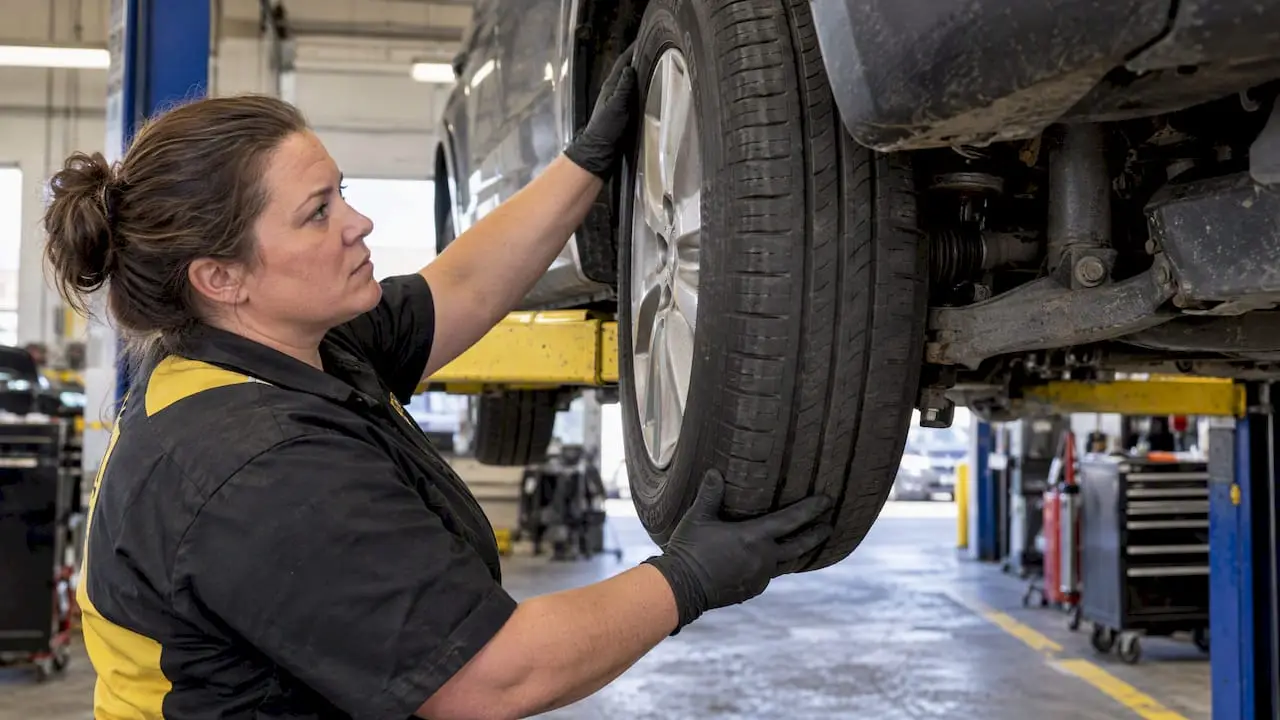
- Check for wheel play. Grab the tire at the top and bottom, then side to side, and feel for looseness in either direction (radial or axial movement beyond a slight amount can indicate bearing wear).
- Spin the wheel by hand. Listen and feel for roughness, grinding, or resistance that shouldn’t be there.
- Use chassis ears or a mechanic’s stethoscope for a precise read. Attaching chassis ears to the suspected knuckle and the opposite knuckle during a comparative test drive is the method outlined in OEM-style wheel bearing inspection and replacement guidance, and it’s the most reliable way to confirm a side when the road test alone isn’t conclusive.
Pro Tip: If jacking up the car and checking for play feels outside your comfort zone, a quick road test followed by a professional listen with proper diagnostic tools will get you a clearer answer faster.
If the noise is severe, paired with a grinding sensation through the steering wheel, or the wheel shows visible wobble, stop driving and have the vehicle towed rather than risking a drive to the shop.
Is It Safe to Drive With Wheel Bearing Noise?
A failing wheel bearing doesn’t just make noise. Left unaddressed, it can eventually seize, damage the hub assembly, or, in severe cases, lead to a loss of steering control if the wheel separates from the hub. That’s an extreme outcome, but it illustrates why this isn’t a symptom to put off indefinitely.
Ignoring early warning signs can allow a bearing to progress from a manageable repair to complete failure, which raises both the cost and the risk involved, according to Synchrony’s guide to wheel bearing replacement.
- A mild, steady hum that doesn’t change dramatically: get it checked within the next week or two.
- Grinding, a strong vibration, or a wheel that feels loose: stop driving and have the vehicle towed.
- Any noise paired with an ABS light or pulling to one side: schedule a diagnostic appointment soon rather than waiting.
- Noise that’s getting louder week over week: treat it as advancing wear, not a one-time fluke.
Matching the urgency to what you’re hearing and feeling helps you avoid both unnecessary panic and unnecessary risk.
What Happens During a Professional Inspection and Repair
Once you bring a vehicle in for suspected wheel bearing noise, the diagnostic process follows a logical sequence. A technician will typically start with a test drive to hear the noise firsthand, then use listening tools to confirm which wheel is affected before touching anything.
From there, the repair usually involves either replacing the full hub assembly, which includes the bearing already built in, or repacking and replacing the bearing on its own, depending on how the wheel end is designed on your particular vehicle. Many modern vehicles use sealed hub assemblies, which is why a full assembly replacement is often the practical choice.
After the repair, a proper shop will take the vehicle on a verification test drive to confirm the noise is gone before handing back the keys.
- Ask what parts are being used and whether they’re new or remanufactured.
- Ask about the warranty terms on both parts and labor.
- Request a written estimate before work begins so there are no surprises.
- Ask whether a post-repair test drive is included to confirm the fix.
Why Early Diagnosis Matters
A wheel bearing rarely fails overnight, which gives you a window to catch it before it becomes a bigger repair or a safety issue. Experienced technicians can approach every noise complaint carefully, listening, inspecting, confirming, and documenting with photos so you see exactly what is found. If you’re hearing anything unusual from a wheel, bring it in and let’s take a closer look together.
— Kwik Kar
Get Your Wheel Bearing Noise Checked
A noisy wheel bearing doesn’t get better with time, and catching it early usually means a simpler, less expensive fix than waiting until it fails completely. Professional auto care providers diagnose and repair wheel bearing issues using qualified technicians and quality parts, with consistent attention to detail for any service.

When you schedule an appointment with us, you’ll get a hands-on inspection, a written estimate before any work begins, and a clear explanation of what we found and why we recommend it. If uneven tire wear shows up alongside the noise, we can also take a look at your tires while the vehicle is already up on the lift.
Ready to find out what’s causing that noise? Visit our services page to book a diagnostic appointment with our team.
FAQ
What does a wheel bearing sound like when it’s going?
A failing wheel bearing typically produces a humming, growling, or rumbling noise that gets louder as your speed increases. As wear progresses, it can shift into a grinding or roaring sound, especially under turns.
Is it safe to drive with wheel bearing noise?
A mild, steady hum is usually safe to drive on for a short time while you arrange a diagnostic visit. Grinding, strong vibration, or a loose-feeling wheel means you should stop driving and have the vehicle towed, since continued driving risks hub damage or loss of steering control.
How expensive is it to replace a wheel bearing?
Wheel bearing replacement cost varies by vehicle make and labor rates in your area, so getting a local estimate gives you the most accurate number according to J.D. Power’s cost guide. Our wheel bearing replacement cost guide breaks down what typically affects the price.
How much will it cost to fix my wheel bearing?
Cost depends on whether the repair involves a full hub assembly replacement or a bearing-only service, along with your specific vehicle’s parts and labor time. Requesting a written estimate before work begins is the clearest way to know what you’ll pay.
Sources
- WHEEL BEARING NOISE INSPECTION & REPLACEMENT GUIDELINES (OEM bulletin)
- KBB: Wheel bearing replacement
- How much does a wheel bearing replacement cost? — Synchrony
- How much does it cost to replace wheel bearings — J.D. Power