


Fix safety-critical systems first, then protect your powertrain, and defer cosmetic work until funds allow. That single rule, combined with the 50% cost-vs-value threshold, gives you a working framework for budgeting car repairs before you spend a dollar. For structural or panel work, always check OEM or I-CAR service information before authorizing repairs.
- Safety-critical first: Brakes, steering, tires, lights, and airbag systems. These affect whether you arrive safely.
- Powertrain protection next: Cooling system, alternator, water pump, and transmission warning signs. Ignoring these turns a $400 fix into a $3,500 rebuild.
- Comfort and cosmetic last: Dents, worn upholstery, non-essential electronics. Real money, but zero safety impact.
Pro Tip: Kwik Kar Oil Change & Auto Care offers ASE-certified technicians, transparent line-item estimates, and repair financing options to help you phase repairs without sacrificing safety.
Key Takeaways
Fixing safety-critical systems first, applying the 50% cost-vs-value rule, and getting written line-item estimates from at least two shops will protect both your safety and your budget.
| Point | Details |
|---|---|
| Safety-first triage | Fix brakes, steering, tires, and airbag systems before any other repair category. |
| Apply the 50% rule | If total repairs exceed 50% of vehicle value, seriously evaluate replacement before committing. |
| Get line-item estimates | Request at least two written quotes with part numbers, labor hours, and warranty terms. |
| Build a monthly repair fund | Setting aside $75–$150 per month prevents the next repair from becoming a financial emergency. |
| Kwik Kar Oil Change & Auto Care | Offers ASE/RepairPal-certified service, transparent estimates, and financing to help phase repairs by priority. |
Table of Contents
- How do you prioritize car repairs when you can’t fix everything at once?
- A simple decision framework for triaging your repair list
- What should a trustworthy car repair estimate include?
- Which repair systems should you budget for first?
- When should you repair a body panel vs. replace it?
- What can you fix yourself and what needs a certified technician?
- How do you build a short-term repair budget that actually works?
- Warning signs that you may be losing money on repairs
- How Kwik Kar Oil Change & Auto Care supports budgeted repairs
- Why safety-first budgeting is the only approach that holds up
- Kwik Kar Oil Change & Auto Care: transparent repairs, real priorities
- Sources
- FAQ
How do you prioritize car repairs when you can’t fix everything at once?
Use this three-tier checklist to decide your next move today.
Stop driving immediately if you notice:
- Brake pedal sinking to the floor or pulsating hard
- Steering pulling sharply or feeling loose and unresponsive
- Tire visibly flat, bulging, or showing cord
- Airbag warning light on after a collision
- Smoke from the engine or a strong burning smell
Schedule within 48 hours:
- Check engine light flashing (steady CEL can wait a few days; flashing means active misfire)
- Visible fluid leak under the car (oil, coolant, or brake fluid)
- Grinding or squealing brakes that still stop the car
- One headlight or brake light out
Can wait up to 30 days:
- Minor cosmetic damage with no structural compromise
- Non-critical warning lights (TPMS after a known nail, for example)
- Worn wiper blades, cabin air filter, or minor interior issues
Pro Tip: Photograph every symptom and save every written estimate line by line. That paper trail protects you in warranty disputes and makes future budgeting for car repairs far more accurate.
A simple decision framework for triaging your repair list
Safety-first triage works in four ranked steps: safety, powertrain preservation, general reliability, then comfort. Here is how to apply it to a real quote.
- Sort every line item into one of the four tiers. A brake caliper is Tier 1. A water pump leak is Tier 2. A cracked dashboard trim is Tier 4. Write the tier next to each line.
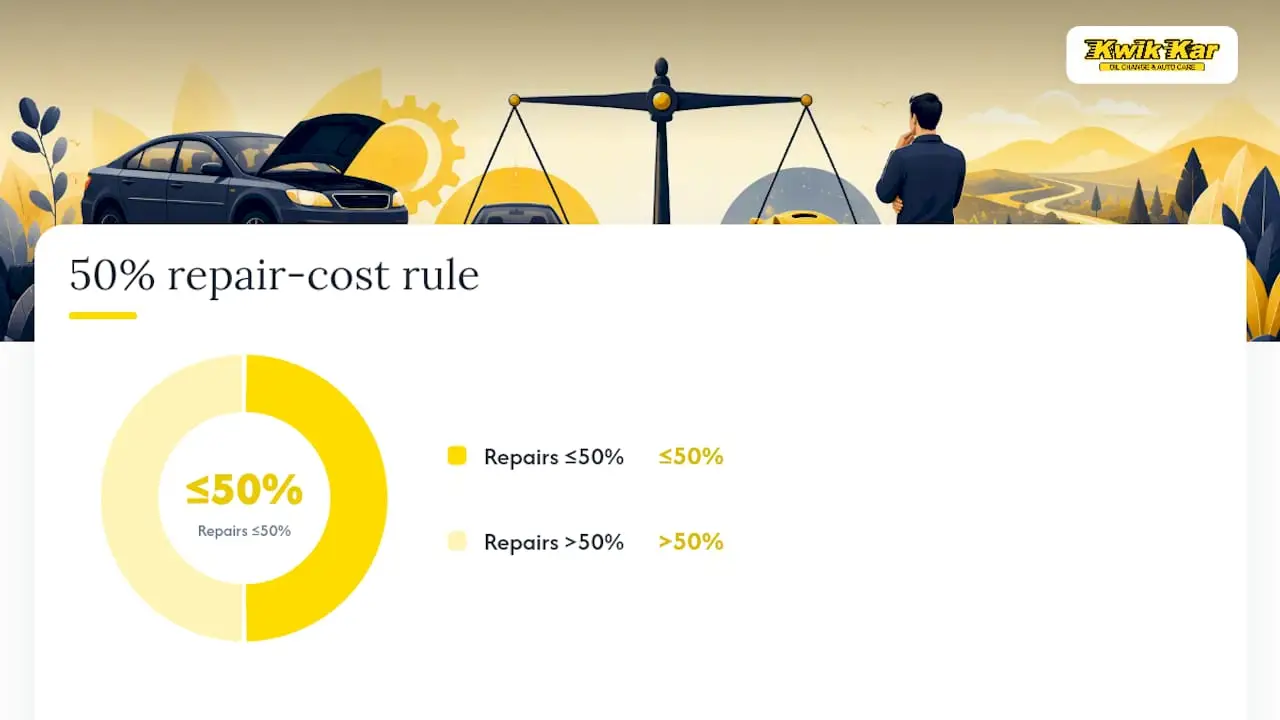
- Apply the 50% rule to the total. Add up all repair costs. If the sum exceeds 50% of your vehicle’s current market value, replacement deserves a serious look before you commit. Use a tool like Kamocars’ car value estimator to get a quick baseline.
- Check recurrence. Has the same system failed twice in 18 months? A repair that keeps coming back is not a permanent fix. Factor that into urgency.
- Weigh permanence. A timing belt replacement is a long-term solution. A stop-leak additive in the cooling system buys time but is not a fix. Temporary measures belong in the budget only when cash flow forces it, and they need a follow-up date.
Pro Tip: Write the repair tier, estimated cost, and “permanent or temporary?” next to each item on your estimate. That one-page worksheet becomes your prioritization plan.
What should a trustworthy car repair estimate include?
Always request at least two written, line-item estimates before authorizing any repair over $200. A reliable estimate covers:
- Part numbers and part type (OEM, remanufactured, or aftermarket) for every component being replaced
- Labor hours broken out by task, not lumped into one total
- Warranty terms on both parts and labor, stated in writing
- Repair scope describing exactly what condition is being corrected
When comparing two quotes, match scope first. A lower price that covers fewer tasks is not a bargain. Ask shops whether remanufactured parts with warranties are available; they often cost 20–40% less than new OEM parts while meeting the same performance standard. Shops vary significantly in approach: dealerships tend to follow strict OEM replacement policies, while certified independent shops may recommend remanufactured options that balance cost and safety.
Pro Tip: Ask the shop to note financing or payment-plan options on the estimate itself. Some shops, including Kwik Kar Oil Change & Auto Care, can split larger repairs into manageable payments so you address Tier 1 items immediately rather than deferring them.
Which repair systems should you budget for first?
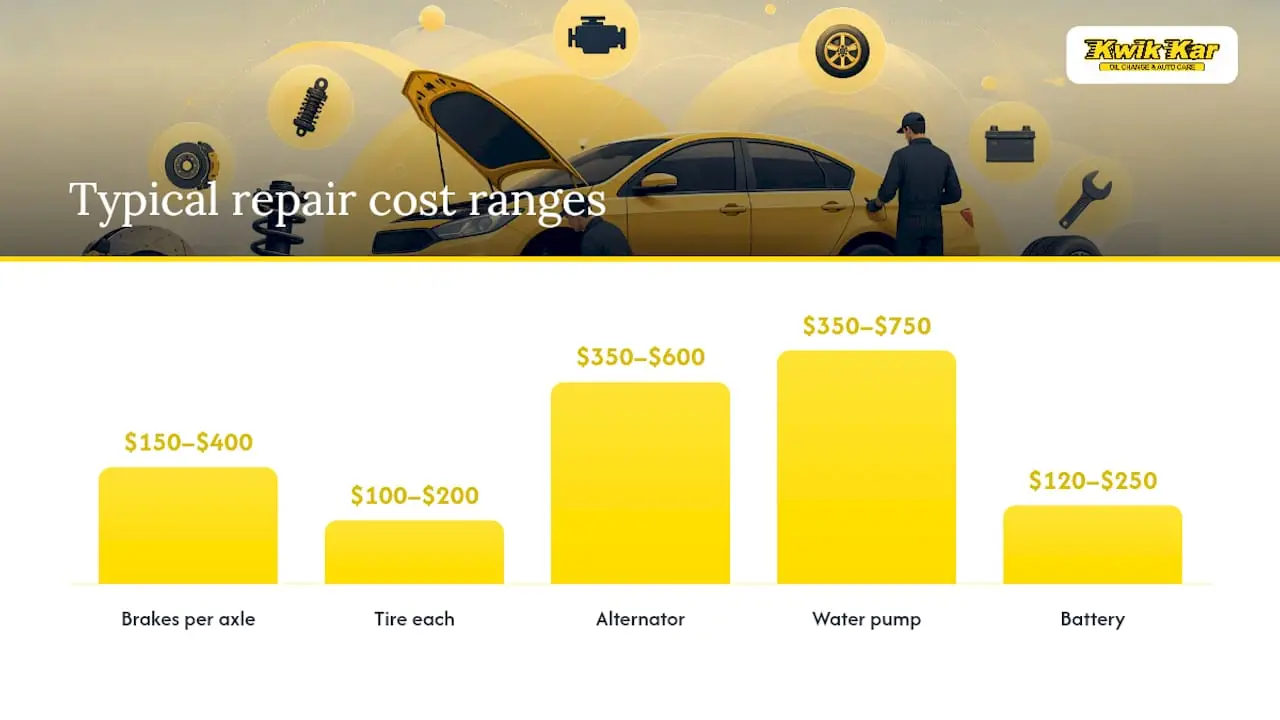
Safety-critical systems come first, powertrain-protection systems second, and comfort-related items last. The cost ranges below, sourced from AutoDana’s repair cost guidance, give you a planning baseline. Actual costs vary by vehicle make, model year, and your location.
| System | Typical Cost Range | Urgency | Budget Note |
|---|---|---|---|
| Brake pads and rotors | $150–$400 per axle | Safety-critical | Address immediately; delay causes rotor damage and higher cost |
| Tires (per tire) | $100–$200 | Safety-critical | Worn tread or sidewall damage is a stop-driving issue |
| Alternator replacement | $350–$600 | High — powertrain | Failure leaves you stranded; no warning before total shutdown |
| Water pump replacement | $350–$750 | High — powertrain | Failure causes overheating and potential engine damage |
| Battery replacement | $120–$250 | Moderate | Cold weather accelerates failure; test before winter |
| Shocks and struts | $350–$600 per axle | Moderate | Affects handling and tire wear; not an immediate stop |
| Transmission repair | $1,800–$3,500 | High — powertrain | Early diagnosis saves thousands; slipping or hard shifts need prompt attention |
When a repair cost for a single system approaches or exceeds your vehicle’s monthly payment equivalent, weigh it against the 50% rule before proceeding. A 12-year-old vehicle worth $4,000 with a $2,200 transmission quote is right at that threshold.
When should you repair a body panel vs. replace it?
Repair when the structure and corrosion protection can be fully restored. Replace when welds, adhesives, or crush zones are compromised. That is the short answer, and I-CAR’s OEM repair guidance backs it up with a detailed technical checklist.
Before authorizing any panel work, verify these factors:
- Material type: Aluminum panels require different tools and techniques than mild steel or high-strength steel. Mixing methods causes hidden corrosion.
- Weld and adhesive condition: Factory welds and structural adhesives that are damaged in a collision often cannot be safely restored to OEM spec through repair alone.
- Crush zone integrity: Crumple zones are engineered to absorb impact energy. A repaired crush zone that looks straight may not perform correctly in a second collision.
- Corrosion protection: Any repair that breaks through factory coatings needs proper resealing. Skipping this step leads to rust within two to three years.
Pro Tip: Ask the shop to cite the specific OEM service information document in the written estimate before you authorize panel replacement. A shop that cannot name the source is guessing.
What can you fix yourself and what needs a certified technician?
Some jobs genuinely save money as DIY. Others create safety or warranty risks that cost far more to undo.
Safe DIY repairs:
- Engine oil and filter changes
- Windshield wiper blades
- Battery replacement (most vehicles)
- Cabin and engine air filters
- Simple sensors like an O2 sensor on an accessible location
Always use a certified technician for:
- Brake system work (calipers, lines, master cylinder)
- Steering and suspension components
- Airbag system repairs or replacements
- Complex electrical diagnostics and ECU programming
- Transmission internal work
A DIY attempt becomes a false economy when the job requires special tools, torque specs you cannot verify, or ECU calibration after the repair. Getting it wrong on a brake line or a suspension component puts you back in Tier 1 territory, with a larger bill. Keep receipts and part warranties for every DIY repair; that documentation matters if a shop later diagnoses a related failure.
How do you build a short-term repair budget that actually works?
Categorize first, then allocate. Here is a practical five-step approach to car repair expense planning:
- List every known repair from your most recent estimate or inspection report.
- Assign each item a tier (safety, powertrain, reliability, comfort) and mark it permanent or temporary.
- Total Tier 1 and Tier 2 costs. That number is your immediate funding target.
- Set a monthly repair fund. Even $75–$150 per month set aside specifically for vehicle repairs prevents the next surprise from becoming a crisis. Use a preventive maintenance schedule to anticipate upcoming needs.
- Compare financing options for large Tier 1 repairs. Payment plans, 0% APR credit cards, and shop-offered financing let you address safety issues now without depleting emergency savings.
Pro Tip: Shops may offer payment plans for large repairs. Ask specifically about financing at the time of the estimate, not after you have already approved the work.
Warning signs that you may be losing money on repairs
Repeated major repairs are the clearest signal that the math has shifted. Recurring failures on the same system suggest you are subsidizing a depreciating asset rather than maintaining a reliable one.
Watch for these red flags:
- The same system has failed twice within 18 months
- You have called for a tow more than twice in a year
- Multiple major systems (transmission, engine, suspension) are failing simultaneously
- Structural rust is visible on frame rails or floor pans
- Total repair costs in the past 12 months exceed 50% of the vehicle’s current value
That threshold is a useful reference even outside of collision scenarios. Before deciding to replace, though, factor in the full cost of a replacement vehicle: depreciation on a new purchase, first-year registration, insurance rate changes, and financing charges. In many cases, repairing a paid-off vehicle is still cheaper than taking on a car payment, even with a significant repair bill.
How Kwik Kar Oil Change & Auto Care supports budgeted repairs
Kwik Kar Oil Change & Auto Care in Fort Worth offers ASE and RepairPal certification, transparent line-item estimates, and financing options designed to help you phase repairs by priority rather than by what happens to be urgent today.
What to expect from a visit focused on repair prioritization:
- A multi-point inspection that identifies and ranks issues by safety urgency
- A written, line-item estimate with part numbers, labor hours, and warranty terms
- Honest guidance on which repairs are permanent fixes vs. temporary measures
- Financing and payment-plan options for larger Tier 1 and Tier 2 repairs
- Coverage of a broad range of services: brakes, alternator and starter work, engine and transmission diagnostics, and routine maintenance
Why safety-first budgeting is the only approach that holds up
Every week, vehicles come into the shop with deferred Tier 1 repairs that have cascaded into far larger problems. A brake job ignored for three months becomes a rotor replacement plus a caliper. A slow coolant leak becomes an overheated engine. The pattern is consistent: the repairs that feel deferrable rarely stay that way.
They are a way of being honest with yourself about what your vehicle actually needs versus what you can put off. Bring a prioritized estimate to Kwik Kar Oil Change & Auto Care for a transparent second opinion. You may find that the most urgent fix is more affordable than you expected, especially with financing available.
Kwik Kar Oil Change & Auto Care: transparent repairs, real priorities
When your repair list is longer than your budget, the difference between a shop that hands you a single lump-sum number and one that walks you through a prioritized, line-item estimate is significant. Kwik Kar Oil Change & Auto Care in Fort Worth does the latter, backed by ASE certification and RepairPal verification that holds the shop accountable to fair pricing and quality parts.
Whether you need a multi-point inspection to rank your repairs, a written estimate you can actually compare, or financing options to handle a Tier 1 fix without draining your savings, Kwik Kar Oil Change & Auto Care is set up to help you move forward with confidence. Stop by or call to schedule your prioritization inspection today.
Sources
The technical guidance in this article draws on the following sources. When asking your shop about panel repairs, ask them to cite the specific OEM service document in the written estimate.
- CRN-2332 — I-CAR RTS
- Questions to ask before repairing or replacing a car — Jalopnik
- How to decide between repairing or replacing car parts — AutoDana
- 7 steps to prioritize car repairs for safety — Car Brands
FAQ
What is the safest way to prioritize car repairs on a budget?
Fix safety-critical systems first: brakes, steering, tires, lights, and airbag components. Then address powertrain risks like cooling and alternator issues before spending on comfort or cosmetic repairs.
How does the 50% rule work for deciding to repair or replace a car?
What should a car repair estimate include?
A trustworthy estimate lists part numbers, part type (OEM, remanufactured, or aftermarket), labor hours per task, warranty terms, and a clear description of the repair scope. Always request this in writing before authorizing work.
Can Kwik Kar Oil Change & Auto Care help me phase repairs over time?
Yes. Kwik Kar Oil Change & Auto Care provides written, prioritized estimates and offers financing and payment-plan options so you can address safety-critical repairs immediately while scheduling less urgent work as your budget allows.
When should I stop driving and get a repair done immediately?
Stop driving if your brake pedal sinks to the floor, your steering feels loose or unresponsive, a tire is visibly flat or showing cord, or you see smoke from the engine. These are Tier 1 conditions that make the vehicle unsafe to operate.