




Transfer case service is a drain-and-refill of the fluid inside the gearbox that splits power between your front and rear axles, plus an inspection of the case for leaks, debris and wear. The right interval comes from your owner’s manual. It ranges from every 15,000 miles on some vehicles to no scheduled replacement on others, and towing or off-road use usually calls for the shorter end.
We do this work at our shop at 9613 White Settlement Rd, Fort Worth, TX 76108, for drivers across White Settlement, West Fort Worth, Westworth Village, Westover Hills, River Oaks, Lake Worth and Benbrook. Below is how the service works, how to read your manual, and what to do when your truck or SUV starts making noises.
TL;DR
- A transfer case service replaces the fluid with the exact type your manufacturer specifies and checks the old fluid for metal debris or contamination.
- Intervals vary a lot by vehicle. Your owner’s manual, and its severe-use schedule if you tow or drive off-road, is the authority.
- Grinding, whining, rough or delayed 4WD engagement and binding on turns are reasons to have the drivetrain inspected soon.
- Cost is mostly a short labor job plus a small amount of fluid, so it is usually far cheaper than a failed transfer case.
- Texas dropped annual safety inspections for most non-commercial vehicles in 2025, so a drivetrain check is now something you schedule on purpose.
Table of Contents
- What is a transfer case, and what does service include?
- How often should transfer case fluid be changed?
- Does severe use change the interval?
- What are the warning signs that a transfer case needs attention?
- Can you drive with a bad transfer case?
- How much does transfer case service cost?
- Is transfer case maintenance necessary?
- Transfer case, differential or transmission: which fluid is which?
- What about European vehicles, DSG and Mercedes transmissions?
- Our perspective on transfer case service
- Seasonal timing for Fort Worth drivers
- Do you still need an inspection in Texas?
- Book transfer case service in West Fort Worth
- FAQ
- Sources
What is a transfer case, and what does service include?
If your vehicle has four-wheel drive or all-wheel drive, the transfer case sits behind the transmission and sends power to both the front and rear driveshafts. Think of it as a traffic director for torque. Inside are gears or a chain, bearings and a shaft, all running in lubricant.
That lubricant is not the same in every vehicle. Transfer cases may be filled with gear oil, automatic transmission fluid, or specialty lubricants, depending on the design. Using the wrong one is how a cheap service turns into an expensive repair.
A standard service typically follows these steps:
- Inspect for leaks. We look at the case seals, vent and driveshaft connections.
- Drain the old fluid. We also look at its color, smell and any particles.
- Check for contamination. A standard service involves inspecting the old fluid for metallic debris or contamination before refilling. Fine metal or a burnt smell tells us something about internal wear.
- Refill with the specified fluid. The correct fluid type and quantity are the ones the manufacturer mandates, and most automakers require a specific formula.
- Road check. We confirm 4WD engages and disengages normally.
Our digital vehicle inspections let you see what the technician sees, so a dark fluid or a weeping seal is something we can show you instead of just describe.
How often should transfer case fluid be changed?
There is no single number, and any page that gives you one for every vehicle is guessing. Manufacturers disagree with each other, and sometimes with themselves.
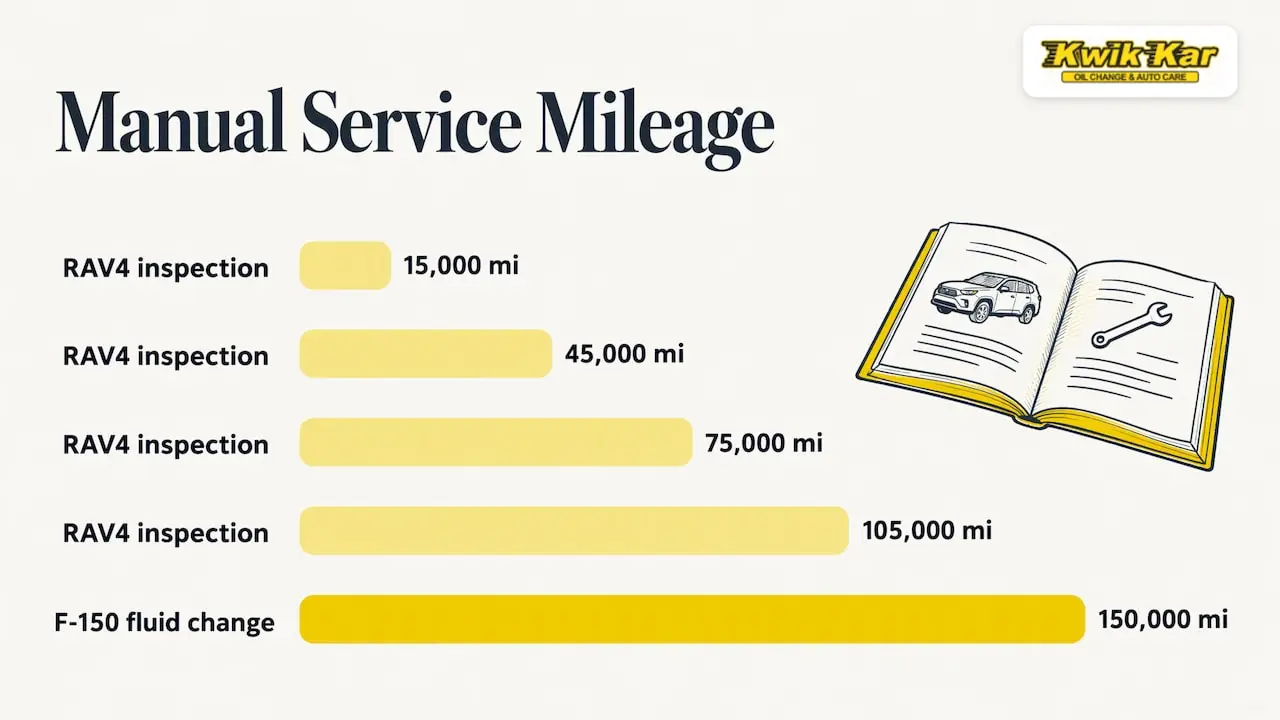
Published manual intervals range from every 15,000 miles to no replacement at all. A few examples from the same guide show the spread:
| Vehicle example | What the manual schedule says |
|---|---|
| 2024 Toyota RAV4 | Transfer case oil inspections at 15,000, 45,000, 75,000 and 105,000 miles under normal use |
| 2025 Ford F-150 | Fluid change listed at 150,000 miles, though a note says the transfer case needs no scheduled maintenance |
| Many other 4×4 trucks and SUVs | Somewhere between those extremes, so check the manual |
That F-150 entry is a good reminder to read both the schedule and its footnotes. Some manuals describe the fluid as lifetime fill under normal driving, while the severe-use schedule says otherwise.
How to find your vehicle’s schedule
- Open the owner’s manual and look for the maintenance schedule, then the severe-use or special-conditions schedule.
- Search the index for “transfer case,” “transfer gear oil” or “4WD.”
- If the manual is missing, bring the VIN and we can look up what the manufacturer specifies for your vehicle.
- Note the fluid specification as well as the mileage. Both matter.
We do not apply a blanket mileage to every vehicle that comes in. We follow the manufacturer’s schedule and add judgment based on how the vehicle is used and what the inspection shows.

Does severe use change the interval?
Yes. Towing, off-roading and water crossings justify shorter transfer case fluid intervals. Heat, heavy loads and moisture all break down lubricant faster. For a broader look at how hard use affects utility vehicles, this guide to utility vehicle maintenance and uptime is worth a read.
In West Fort Worth, severe use can look like:
- Pulling a trailer or boat out to Lake Worth or on a road trip.
- Hauling heavy loads in a pickup on I-30 and Loop 820.
- Long Texas summer afternoons in stop-and-go traffic with the engine and drivetrain running hot.
- Gravel roads, ranch trails or driving through standing water after a heavy storm.
Most manuals classify towing and heavy-load driving as severe service. If that describes your week, use the severe schedule, not the normal one.
What are the warning signs that a transfer case needs attention?
The common symptoms are grinding, whining or chain noise, delayed or rough 4WD engagement, and binding, shuddering or hopping on turns.
In plain terms:
- Whining or humming that changes with speed. Worn bearings or low lubricant are possible causes.
- Grinding when shifting into 4WD. The shift mechanism or gears may be worn, or the fluid may be wrong or depleted.
- 4WD takes a long time to engage or will not engage. This can be a fluid issue, but it can also be an electrical shift motor, a sensor or a linkage problem.
- Binding or hopping on tight turns. This is common when drivetrain components are fighting each other. It can also point to mismatched tires, so we check tire sizes and tread too.
- Fluid spots under the middle of the vehicle. A leaking seal or case gasket is a service item in its own right.
- A 4WD or service light on the dash. A scan with professional diagnostic equipment tells us whether it is a transfer case code or a sensor fault.
Because several of these symptoms overlap with differential, driveshaft and transmission problems, we diagnose first. Our guides on signs of transmission problems and differential fluid service help you tell the neighbors apart.
Can you drive with a bad transfer case?
Sometimes, but it is a gamble. In some vehicles with a failed transfer case, it may still be possible to drive in front-wheel drive, but you risk catastrophic drivetrain damage. The same source advises that if the vehicle grinds loudly or will not move, it should be towed.
Practical rules of thumb:
- Mild noise, still drives normally: book an inspection this week and avoid towing, hard acceleration and off-road use until then.
- Loud grinding, vibration or a burning smell: stop driving and arrange a tow. Continuing can turn a service-level problem into a replacement.
- Vehicle will not move in any gear: do not force it. Tow it in.
If you are unsure which category you are in, call us and describe what you hear and feel.
How much does transfer case service cost?
We do not publish a flat price because the fluid type, quantity and vehicle design change the job. What drives the cost is straightforward, though.
One published guide estimates that labor averages around half an hour at a shop rate of $70 to $100, and fluid runs $20 to $100 or more per litre, with most cases needing under two litres. Those are general figures, and actual quotes depend on your vehicle and the shop.
Factors that move the price:
- Fluid type. Specialty lubricants cost more than conventional gear oil.
- Access. Some drain and fill plugs are easy to reach, others are tucked behind skid plates or exhaust parts.
- Condition. A leaking seal or worn shift motor adds a repair on top of the service.
- Bundled work. Doing it alongside front and rear differential service or other fluid exchange services can make one visit cover several jobs.
We give you the quote before work starts, and we show you findings from the inspection first.
Is transfer case maintenance necessary?
If your manual lists it, yes. Fluid is the only thing protecting gears, chains and bearings from heat and wear, and it ages like any lubricant. Skipping service on a vehicle that tows or sees heavy use is one of the easier ways to shorten the life of the drivetrain.
If your manual says no scheduled maintenance, it is still reasonable to have the case inspected for leaks during other routine visits, especially as mileage climbs. An inspection costs little and catches a weeping seal before the fluid level drops.
Transfer case, differential or transmission: which fluid is which?
These three components are often confused, and they are serviced separately.
| Component | What it does | Where it sits |
|---|---|---|
| Transmission | Selects gear ratios from the engine | Behind the engine |
| Transfer case | Splits power to front and rear axles in 4WD and many AWD vehicles | Behind the transmission |
| Differentials | Let the wheels on an axle turn at different speeds | At each driven axle |
Each has its own fluid and its own interval. Our guides on what a transmission service involves and what four-wheel drive service involves go further into each one.
What about European vehicles, DSG and Mercedes transmissions?
Many drivers searching for transfer case service also want to know about VW DSG or Mercedes transmission service. These are different systems, but the same principle applies: the manufacturer’s schedule and specified fluid rule.
A DSG is a dual-clutch automatic. Its fluid and, on many models, its filter are serviced on a schedule set by Volkswagen for your specific engine and gearbox, and the fluid is not interchangeable with a regular automatic’s. Mercedes automatics likewise call for model-specific fluid and procedures. We do not quote a universal number for either, because intervals differ by model and year. Look up your schedule in the manual or ask us to pull it for your VIN.
Our explainer on DSG transmission service covers what the work involves, and why European vehicles need specialized tools explains why the right equipment matters on these cars.
Our perspective on transfer case service
We see the same pattern often: a truck or SUV that has been towing, hauling and sitting in summer traffic for years, with a drivetrain nobody has looked at since it left the dealer. The owner did nothing wrong. The transfer case is simply out of sight, so it is out of mind.
We think of it as part of full drivetrain care, not a one-off. Our ASE-certified technicians inspect the transfer case, differentials and transmission together, and our digital vehicle inspections let you see what we find. We follow your manufacturer’s fluid specification, because the wrong lubricant causes more trouble than a late service.
We are a RepairPal-certified shop, and we are set up for both routine fluid work and the repairs that can follow when an inspection turns up a problem. Qualifying repairs carry our 24-month/24,000-mile warranty.
Kwik Kar
Seasonal timing for Fort Worth drivers
Transfer case service is not seasonal in the way that A/C or batteries are, but local conditions give you good moments to schedule it:
- Before summer road trips or towing season. Heat is hard on lubricant. Have the drivetrain checked before you hook up a trailer.
- After a stretch of heavy towing or water crossings. If you went through deep water, do not wait for the next scheduled interval. Moisture can contaminate the fluid.
- Alongside other fluid work. If you are already due for differential or transmission service, ask us about the transfer case during the same visit.
- Before a long highway trip. A preventive inspection is cheaper than a breakdown far from home.
Our guide on seasonal tire checks in Texas is a useful companion, since mismatched or unevenly worn tires can stress a 4WD or AWD system.
Do you still need an inspection in Texas?
Since January 1, 2025, most non-commercial vehicles in Texas no longer need an annual state safety inspection. That does not mean the drivetrain stops needing attention: the schedule in your manual is now the main prompt. Qualifying commercial vehicles remain subject to safety inspection requirements, and Tarrant County has emissions-testing requirements for eligible vehicles. Confirm your own vehicle’s status with the Texas Department of Public Safety or the Tarrant County Tax Office before you renew registration.
If you run a fleet of work trucks, our fleet maintenance program can keep drivetrain service on a predictable schedule with consolidated billing.
Book transfer case service in West Fort Worth
We are a full-service maintenance and repair center, not just an oil change stop. Our technicians handle drivetrain inspections and fluid exchange, along with brakes, engine diagnostics, transmissions, electrical, suspension, alignment, tires and A/C.
You can see everything we do on our services page, or schedule an appointment at 9613 White Settlement Rd, Fort Worth, TX 76108. Bring your owner’s manual if you have it, and tell us whether you tow or drive off-road. You can also find us at kwikkarwhitesettlement.com.
FAQ
How often should I change transfer case fluid?
Follow your owner’s manual. Published schedules run from every 15,000 miles to no scheduled replacement, depending on the vehicle. If you tow, drive off-road or cross water, use the severe-use schedule, which is usually shorter.
What is included in a transfer case service?
A technician inspects for leaks, drains the old fluid and checks it for metal particles or contamination. The case is then refilled with the manufacturer-specified fluid in the right quantity. We also confirm that 4WD engages normally.
Can I use any fluid in my transfer case?
No. Some transfer cases use gear oil, others use automatic transmission fluid or a specialty lubricant. Use the type your manufacturer specifies, because the wrong fluid can cause shifting problems and wear.
Can I drive with a bad transfer case?
It depends on the failure, and continuing to drive risks serious drivetrain damage. If you hear loud grinding or the vehicle will not move, have it towed. For milder symptoms, book an inspection soon and avoid towing and off-road driving.
Is transfer case service the same as differential service?
No. They are separate components with separate fluids and intervals, though we can often service them in the same visit.
Sources
- Transfer Case Function, Fluid Level, & Condition
- How to Change Transfer Case Fluid the Right Way
- Transfer Case Fluid: How Often Should It Be Changed
- How Often to Change Transfer Case Fluid: 13 Vehicles
- Transfer case failure guide for Kia and Hyundai SUVs
- Utility vehicle maintenance and uptime