



Four-wheel drive service is a specialized drivetrain maintenance procedure that inspects, lubricates, and repairs the transfer case, front and rear differentials, driveshafts, U-joints, and seals to keep your 4WD system operating reliably. Understanding what four-wheel drive service involves helps you protect one of the most mechanically complex systems on your vehicle. Whether you drive a Ford F-150 through Fort Worth traffic or take a Toyota 4Runner off-road on weekends, routine 4WD maintenance prevents the kind of failures that leave you stranded and facing repair bills that dwarf the cost of prevention.
What four-wheel drive service involves: core components explained
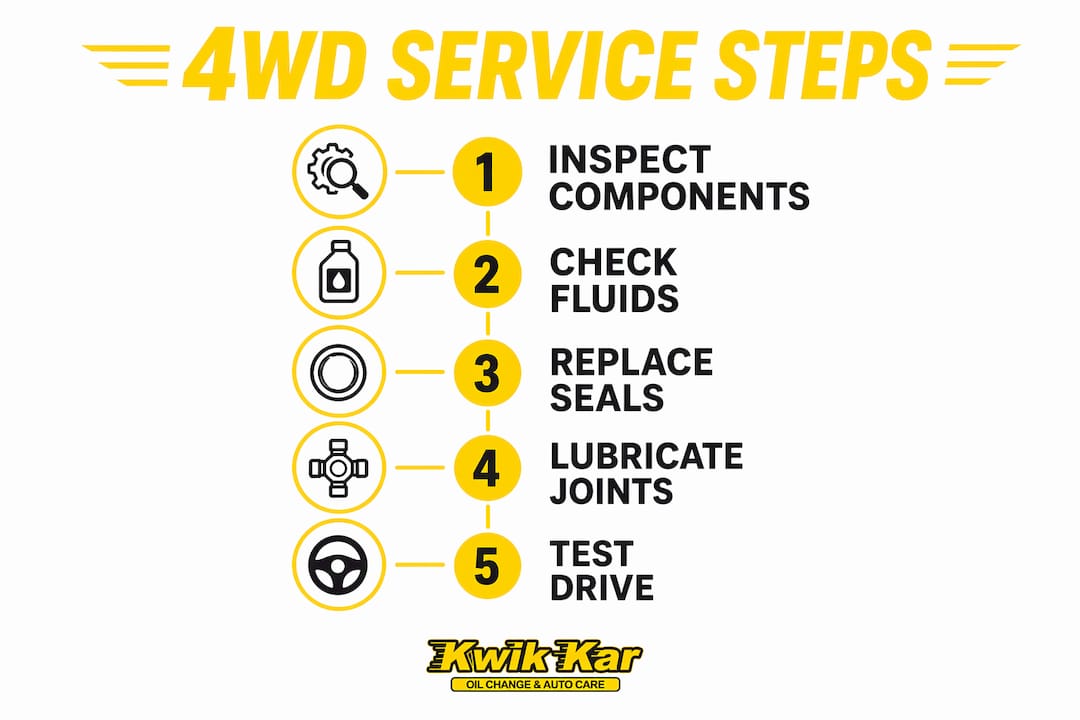
Four-wheel drive service covers a comprehensive inspection and maintenance of the transfer case, front and rear differentials, driveshafts, and related drivetrain components. Each part plays a specific role, and a failure in one puts stress on the others. Knowing what technicians actually check gives you a clearer picture of why this service matters.
Transfer case
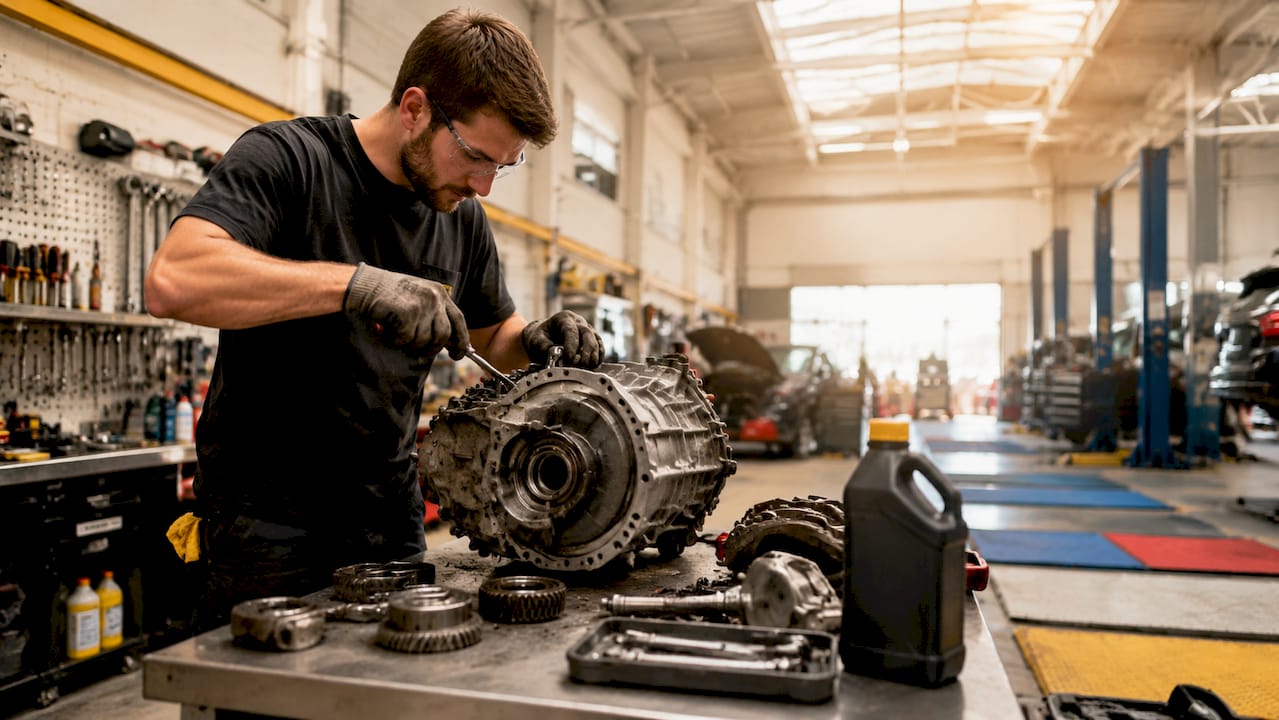
The transfer case splits engine power between the front and rear axles, making it the mechanical heart of any 4WD system. During a service visit, technicians inspect the transfer case for fluid leaks, check the fluid level and condition, and replace the fluid if it shows signs of contamination or has reached its service interval. They also examine the case housing for cracks and verify that engagement works smoothly across all drive modes, from two-wheel drive to 4-High and 4-Low.
Front and rear differentials
Differentials allow wheels on the same axle to rotate at different speeds, which is critical when cornering or navigating uneven terrain. A differential fluid service includes draining old fluid, inspecting it for metal particles, and refilling with the correct gear oil to OEM specification. Technicians also check differential seals and gaskets for leaks, since a slow seal leak can drop fluid levels low enough to cause gear damage before any warning light appears.
Driveshafts, U-joints, and CV joints
Driveshafts transfer torque from the transfer case to the axles, and they rely on U-joints or CV joints to accommodate suspension movement. Worn U-joints produce vibrations under load, clunking sounds during acceleration, and grinding noises at speed. Technicians check for play in the joints, inspect the driveshaft for balance and straightness, and look for torn CV boots that allow grease to escape and contaminants to enter.
Seals and gaskets
Seals and gaskets are the unsung components of any 4WD system. A failed axle seal or transfer case output seal allows gear oil to leak onto brake components or the ground, creating both a safety hazard and an accelerating wear problem. Technicians inspect every seal point during a thorough four-wheel drive checkup and replace any seal showing cracking, hardening, or active leakage.
Pro Tip: Ask your technician to show you the drained differential fluid before it is disposed of. Dark, metallic-smelling fluid with visible particles signals internal wear that a simple fluid change will not fix on its own.
How fluids are checked and replaced in 4WD systems
Fluid service is the single most impactful part of four-wheel drive maintenance, and it is also where the most costly mistakes happen. Using the wrong fluid type causes accelerated wear, clutch slip, overheating, and leaks. The transfer case and differentials each require specific lubricants, and those specifications vary by manufacturer, model year, and even trim level.
The table below shows the most common fluid types used in 4WD systems and their primary functions.
| Component | Common Fluid Type | Primary Function |
|---|---|---|
| Transfer case | ATF, SAE 75W-90 gear oil, or OEM-specific fluid | Lubricates gears and clutch packs, prevents overheating |
| Front differential | SAE 75W-90 GL-5 gear oil | Lubricates ring and pinion gears, protects seals |
| Rear differential | SAE 75W-90 GL-5 gear oil (or 75W-140 for heavy duty) | Same as front; heavier spec for towing applications |
| Limited-slip differential | GL-5 gear oil plus friction modifier additive | Prevents chatter and protects clutch discs |
Transfer case fluid and differential fluid are not interchangeable, even though both are gear-based lubricants. Many transfer cases require a specific automatic transmission fluid, such as Dexron VI or Mercon LV, rather than gear oil. Pouring GL-5 gear oil into a transfer case designed for ATF damages the internal clutch packs within a few thousand miles. Verifying the correct specification through your owner’s manual, the fill plug markings, or a dealer VIN check is the only reliable way to avoid this mistake.
For severe service, including regular off-roading, towing, or driving in extreme temperatures, transfer case fluid intervals of every 20,000 to 30,000 miles are the standard recommendation. Normal highway driving may extend that interval, but contamination from water intrusion during stream crossings or winter slush can make an earlier change necessary regardless of mileage.
Pro Tip: If your vehicle has a limited-slip rear differential, always add the manufacturer-specified friction modifier additive when changing the fluid. Skipping it causes a shuddering sensation during low-speed turns, often described as feeling like driving over rumble strips.
What symptoms signal a 4WD system problem?
Recognizing early warning signs of drivetrain trouble is the first step toward avoiding a major repair. The challenge is that symptoms often overlap among the transfer case, differentials, driveshafts, and even tires, making professional diagnosis necessary to pinpoint the actual cause.
Common symptoms that warrant a four-wheel drive checkup include:
- Delayed or rough engagement when shifting into 4-High or 4-Low, which can indicate a worn transfer case chain, low fluid, or a failing actuator
- Vibrations at highway speed that worsen under load, pointing to an unbalanced driveshaft or worn U-joints
- Grinding or clunking noises during acceleration or deceleration, which may originate from differential gears, U-joints, or CV joints
- Fluid puddles under the vehicle, particularly near the axles or center of the undercarriage, indicating seal or gasket failure
- Dashboard 4WD warning lights or service indicators, which signal electronic faults in the control module or engagement sensors
Modern 4WD systems rely on electronic control units and sensors to manage engagement, torque distribution, and mode selection. A mechanical inspection alone is not enough. Technicians use electronic diagnostic scanners to read fault codes from the 4WD control module, identify sensor failures, and verify that the system is engaging correctly across all modes. Combining mechanical inspection with electronic diagnostics is what separates a thorough four-wheel drive repair process from a surface-level check.
Fluid analysis adds another layer of accuracy. Detecting metal particles in drained transfer case or differential fluid reveals internal wear that would otherwise go unnoticed until a component fails completely. This is why a quality 4WD service does not simply drain and refill fluids. It treats the old fluid as diagnostic evidence.
Recommended service intervals and special considerations
Timing your four-wheel drive maintenance correctly protects your investment and keeps your vehicle safe. The right schedule depends on how you drive, where you drive, and what your manufacturer specifies.
- Follow your owner’s manual first. Manufacturer intervals are the baseline. For most 4WD vehicles under normal driving conditions, differential and transfer case fluid changes fall between 30,000 and 60,000 miles.
- Switch to severe-service intervals if applicable. Off-road use, frequent towing, extreme heat or cold, and deep water crossings all qualify as severe service. Under these conditions, fluid change intervals of 20,000 to 30,000 miles apply to the transfer case.
- Schedule a post-winter inspection every spring. Road salt and de-icing chemicals accelerate corrosion on driveshafts, U-joints, and transfer case seals. Spring inspections prevent seized components and catch corrosion before it becomes structural damage.
- Inspect every six months or seasonally at minimum. A seasonal 4WD inspection catches fluid contamination, seal weeping, and wear signs before they escalate. This is especially relevant in climates with harsh winters or hot, dusty summers.
- Check immediately after any deep water crossing. Water can enter the transfer case and differentials through the vent tubes or compromised seals. Contaminated fluid looks milky gray and must be changed right away to prevent corrosion and gear damage.
The table below summarizes typical service intervals based on driving conditions.
| Driving Condition | Fluid Change Interval | Inspection Frequency |
|---|---|---|
| Normal highway/city driving | 30,000 to 60,000 miles | Every 12 months |
| Severe service (towing, off-road) | 20,000 to 30,000 miles | Every 6 months |
| Post-winter in salt-heavy climates | As needed based on contamination | Every spring |
| After deep water crossings | Immediately if contamination suspected | After each event |
Even family vehicles that never leave paved roads benefit from this schedule. Heat cycles, minor seal weeping, and normal gear wear degrade fluid quality over time regardless of terrain. Routine service prevents unexpected failures that can strand a vehicle and compromise safety for everyone on board.
Key takeaways
Four-wheel drive service protects the transfer case, differentials, driveshafts, and seals through fluid replacement, leak inspection, and electronic diagnostics performed at intervals matched to your driving conditions.
| Point | Details |
|---|---|
| Core components covered | Service addresses the transfer case, front and rear differentials, driveshafts, U-joints, CV joints, and seals. |
| Correct fluid specification | Using the wrong fluid type causes accelerated wear, clutch slip, and seal damage. Always verify OEM spec. |
| Severe-service intervals | Off-road use and towing require fluid changes every 20,000 to 30,000 miles, not the standard highway interval. |
| Electronic diagnostics matter | Modern 4WD systems need control module scans alongside mechanical inspection to catch sensor and actuator faults. |
| Post-winter inspection | Salt and de-icing chemicals corrode driveline components. A spring inspection prevents seized parts and extends component life. |
Why most drivers underestimate 4WD service until it’s too late
At Kwik Kar Oil Change & Auto Care, we see a consistent pattern: drivers bring in vehicles with grinding noises or engagement failures that could have been prevented with a single fluid change two years earlier. The misconception we hear most often is that four-wheel drive service is only for people who wheel through mud on weekends. That is simply not accurate.
A family SUV parked in a Fort Worth driveway still cycles through heat and cold, and those temperature swings degrade gear oil just as surely as a trail run does. The seals on a transfer case that has never seen a dirt road still age and weep. What changes with off-road use is the pace of degradation, not the process itself.
The other overlooked detail is fluid specification. We have seen transfer cases filled with the wrong gear oil by well-meaning shops that did not check the OEM requirement. The damage from that mistake does not show up immediately. It shows up 15,000 miles later as a whine that turns into a grind that turns into a rebuild. Checking the correct fluid specification before every service is a non-negotiable step, not an optional one.
Seasonal inspections are the third area where drivers consistently fall short. If you live somewhere that uses road salt, a spring inspection is not a luxury. It is the difference between catching a corroded U-joint boot and replacing a seized driveshaft. The cost difference between those two outcomes is significant.
— Kwik Kar
Schedule your 4WD service with Kwik Kar Oil Change & Auto Care
Kwik Kar Oil Change & Auto Care serves Fort Worth drivers with thorough, transparent four-wheel drive maintenance performed by RepairPal-certified technicians. Every service uses OEM-specified fluids for the transfer case and differentials, and every inspection includes both mechanical checks and electronic diagnostics to catch problems before they become failures.
Whether you drive a daily commuter SUV or a dedicated off-road rig, our team tailors the service to your vehicle’s specific requirements and your driving habits. We walk you through every finding before any work begins, so you always know what your vehicle needs and why. If you want to stay ahead of drivetrain wear and protect your investment, explore our affordable maintenance services or schedule your four-wheel drive checkup today.
FAQ
What does four-wheel drive service include?
Four-wheel drive service includes inspecting and servicing the transfer case, front and rear differentials, driveshafts, U-joints, CV joints, and seals. It covers fluid replacement with OEM-specified lubricants, leak checks, and electronic diagnostics for the 4WD control system.
How often should I service my 4WD system?
Under normal driving conditions, differential and transfer case fluids typically need changing every 30,000 to 60,000 miles. Severe service conditions like off-roading or towing reduce that interval to every 20,000 to 30,000 miles.
Can I use any gear oil in my transfer case?
No. Many transfer cases require a specific automatic transmission fluid rather than gear oil, and using the wrong type causes clutch slip, overheating, and accelerated wear. Always verify the OEM specification through your owner’s manual or a dealer VIN check before adding any fluid.
What are the warning signs that my 4WD system needs service?
Common signs include delayed or rough engagement when shifting into 4WD, vibrations at highway speed, grinding or clunking noises, fluid puddles under the vehicle, and dashboard 4WD warning lights. Any of these symptoms warrants a professional inspection to identify the source.
Do family vehicles need 4WD service even without off-road use?
Yes. Heat cycles, normal gear wear, and aging seals degrade transfer case and differential fluid over time regardless of terrain. Routine service prevents unexpected failures and keeps the drivetrain safe for everyday driving.