



This glossary turns common auto-repair words into plain English so you can read an estimate without guessing. You’ll find a quick acronym cheat, category-by-category definitions, and a checklist for what to ask before you sign anything. Trusted references like AAA, Autocare, and the team at Kwik Kar Oil Change & Auto Care back every definition here.
Key Takeaways
Understanding basic auto-repair vocabulary lets you read an estimate accurately, ask the right follow-up questions, and avoid authorizing work you don’t understand.
| Point | Details |
|---|---|
| Get it in writing | Insist on an itemized written estimate before any work begins. |
| Codes aren’t verdicts | A diagnostic scan points to a system; ask how it was confirmed by inspection. |
| Match urgency to symptom | Steam, grinding, or a rising temperature gauge mean stop now, not later. |
| Know your parts options | Ask whether parts are OEM, aftermarket, or rebuilt, and why. |
| Ask before authorizing extra work | Any cost increase mid-repair needs your explicit sign-off. |
Table of Contents
- Auto Repair Terms Beginners Glossary: Quick Acronym Cheat
- Brake Terms Every New Car Owner Should Know
- Engine and Tune-Up Vocabulary That Signals Repair Severity
- Cooling System Terms and When Overheating Becomes an Emergency
- Drivetrain and Transmission Terms That Affect Cost
- Electrical System Terms and What a Diagnostic Scan Actually Proves
- Steering and Suspension Terms Tied to Common Symptoms
- Oil, Fluids, and Filters: Knowing What’s Urgent
- Estimate and Pricing Terms You’ll See on Every Invoice
- Using This Glossary at the Shop: A Practical Checklist
- Why Kwik Kar Oil Change & Auto Care Built This Glossary
- Sources
- FAQ
Auto Repair Terms Beginners Glossary: Quick Acronym Cheat
Before you even walk in, scan these. Each one shows up on estimates more than you’d think.
- OBD-II: The onboard computer port technicians plug into to read trouble codes. It tells you a problem exists, not always which part caused it.
- ECU: The engine control unit, your car’s central computer. If it’s acting up, expect an electrical diagnosis.
- ABS: Anti-lock braking system, prevents wheel lockup during hard stops. Safety-critical, never delay this repair.
- AWD/4WD: All-wheel or four-wheel drive. Affects how many components (and how much cost) a drivetrain repair touches.
- RPM: Revolutions per minute, how fast your engine spins. High idle RPM can flag a vacuum leak or sensor issue.
- TSB: A technical service bulletin from the manufacturer describing a known issue and fix. Often free under warranty, owner-paid after.
- OEM: Original equipment manufacturer parts, made by (or for) your car’s builder. Matters for fit and cost.
Brake Terms Every New Car Owner Should Know
Brakes are where “I’ll get to it later” gets expensive fast. Your ABS system pulses the brakes automatically to stop wheel lockup on slick roads. Brake pads press against rotors (the metal discs) to slow the wheel; pads wear down and need replacing more often than rotors. Brake fluid transfers pedal pressure through the lines, and bleeding the brakes removes trapped air that makes the pedal feel spongy. The master cylinder is what turns your foot pressure into hydraulic force in the first place.
- Squealing usually means pads are near their wear limit.
- A spongy or sinking pedal often points to air in the lines or a failing master cylinder, and it deserves attention right away.
- Grinding means metal on metal. That’s urgent, not routine.
Ask your shop: “Is this wear normal for my mileage?” and “Are you replacing pads only, or rotors too?”
Engine and Tune-Up Vocabulary That Signals Repair Severity
The powertrain is your engine and transmission working together to move the car, and you’ll see that word a lot on bigger estimates because it signals work that touches both systems. Inside the engine, pistons move up and down inside cylinders, and spark plugs ignite the fuel that drives that motion. The timing belt or timing chain keeps engine components moving in sync. A belt that snaps can bend valves and wreck the engine, while chains last longer but cost more to replace. The serpentine belt is a separate, external belt that runs your alternator, power steering, and AC, and it’s a routine swap by comparison. A blown head gasket (the seal between engine block and cylinder head) usually means mixed coolant and oil, a repair job that runs into serious labor hours.
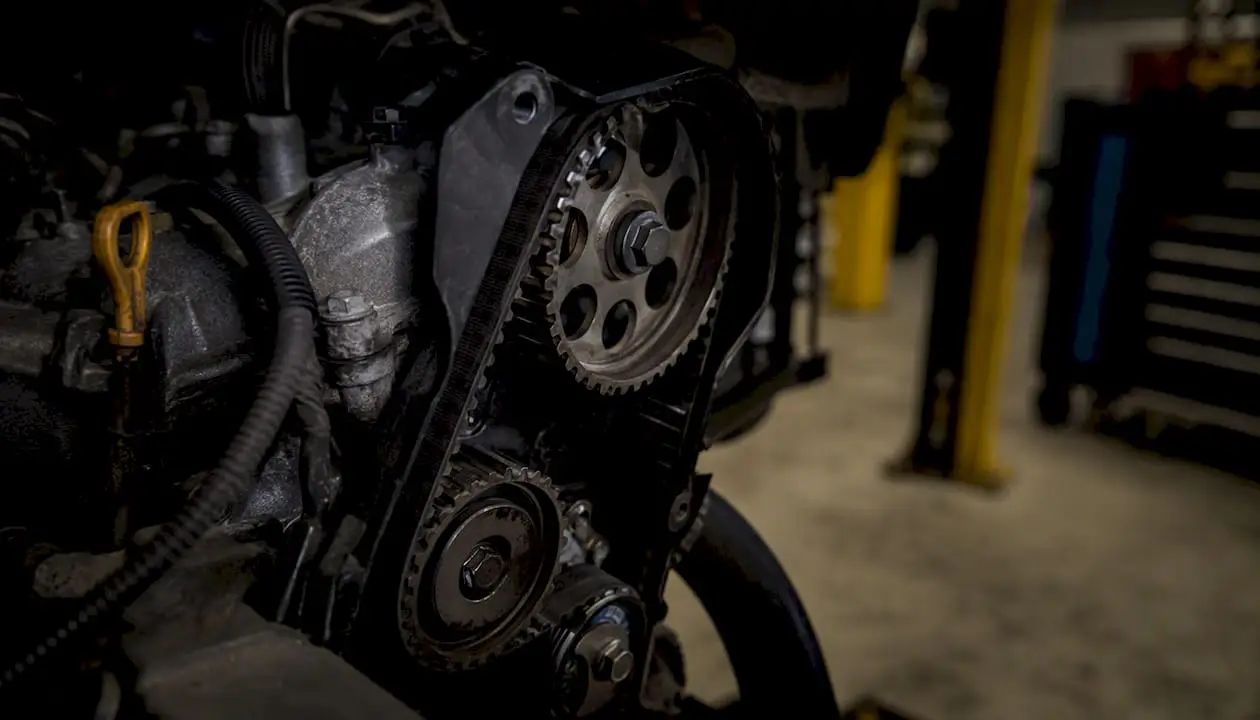
Ask about expected lifespan on belts, whether the shop found metal shavings in the oil, and if any repair carries a parts warranty.
Cooling System Terms and When Overheating Becomes an Emergency
Coolant (or antifreeze) circulates through the radiator, which sheds engine heat into outside air. The thermostat controls how much coolant flows based on temperature, and the water pump keeps that coolant moving. Rubber hoses connect it all, and they crack with age.
- Rising temperature gauge: pull over before it maxes out.
- Steam or a sweet smell: stop immediately, this is an emergency, not a top-off situation.
- Slow coolant loss over weeks: schedule service soon, but it’s not a roadside crisis.
Drivetrain and Transmission Terms That Affect Cost
The drivetrain includes everything that sends engine power to the wheels: the transmission, driveshaft, and differential. Automatic transmissions use a torque converter instead of a clutch to transfer power smoothly, and manual transmissions rely on a physical clutch that wears out with stop-and-go driving. CV axles carry power to the wheels and often show a telltale clicking sound when turning if they’re failing.
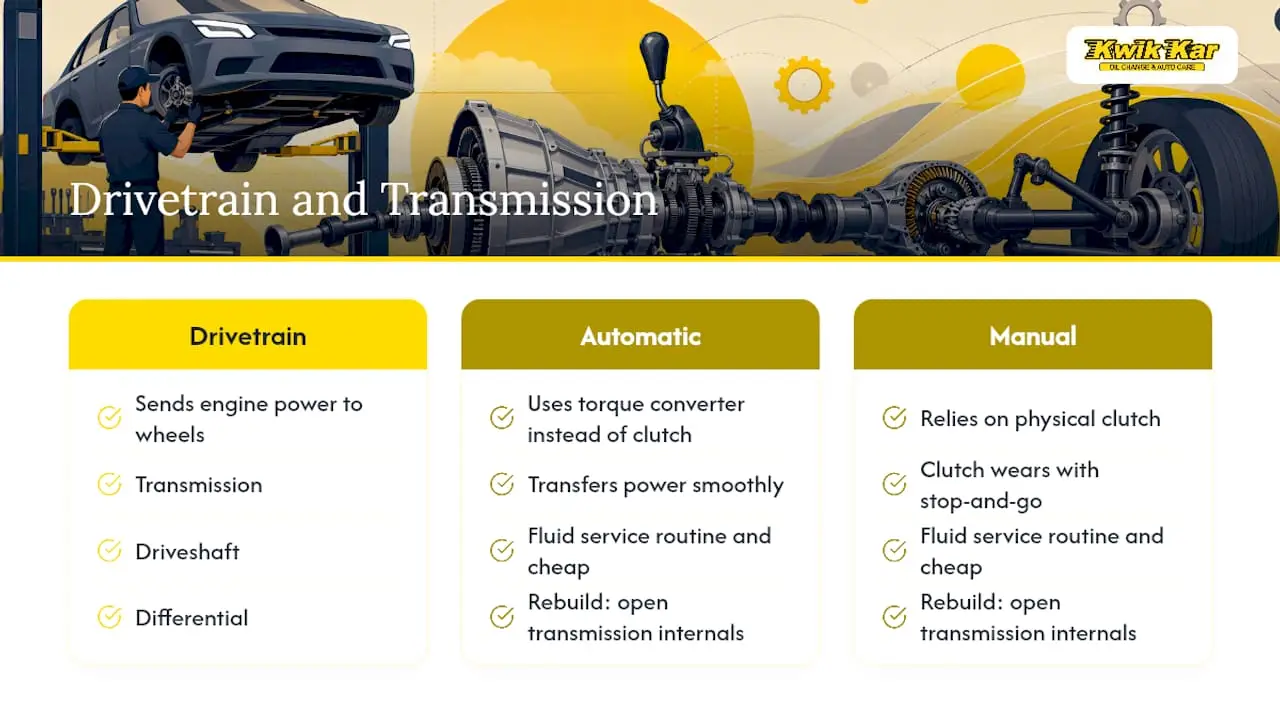
Transmission fluid service is routine and cheap compared to a rebuild, which involves opening the transmission to replace worn internal parts, or a full replacement, which swaps in a new or remanufactured unit. Ask: “Are you recommending a fluid service, a rebuild, or a full replacement, and why?” That single question tells you whether you’re looking at a $150 job or a $3,000 one.
Electrical System Terms and What a Diagnostic Scan Actually Proves
Your battery stores electrical energy, the alternator recharges it while the engine runs, and the starter cranks the engine to life. The ECU oversees engine performance and triggers your check engine light when something’s off. A technician runs an OBD-II scan to pull trouble codes, but AAA notes that codes point to a system, not always the exact failed part, so a code often needs a physical inspection to confirm the actual cause. Ask: “What did the scan show, and how did you confirm it with an inspection?”
Steering and Suspension Terms Tied to Common Symptoms
An alignment adjusts wheel angles so your car drives straight without pulling. Wheel balancing corrects uneven weight distribution that causes vibration at speed. Shocks and struts absorb bumps, control arms connect the suspension to the frame, bushings cushion those connection points, and tie rods link your steering to the wheels.
- Pulling to one side: often alignment.
- Shimmy at highway speed: often balancing or a worn tire.
- Uneven tread wear: usually alignment or suspension components.
- Clunking over bumps: often worn bushings or control arms.
Ask: “Is this a suspension issue, an alignment issue, or both?”
Oil, Fluids, and Filters: Knowing What’s Urgent
Engine oil lubricates moving parts and gets filtered by the oil filter to trap debris. An oil leak is a steady drip that needs prompt attention, while an oil seep is a slow weep that’s worth monitoring but rarely urgent on its own, according to definitions in the Diamond Certified glossary. Transmission fluid, brake fluid, power steering fluid, and coolant each lubricate or transfer force in a specific system, and low levels in any of them are worth a same-week check.
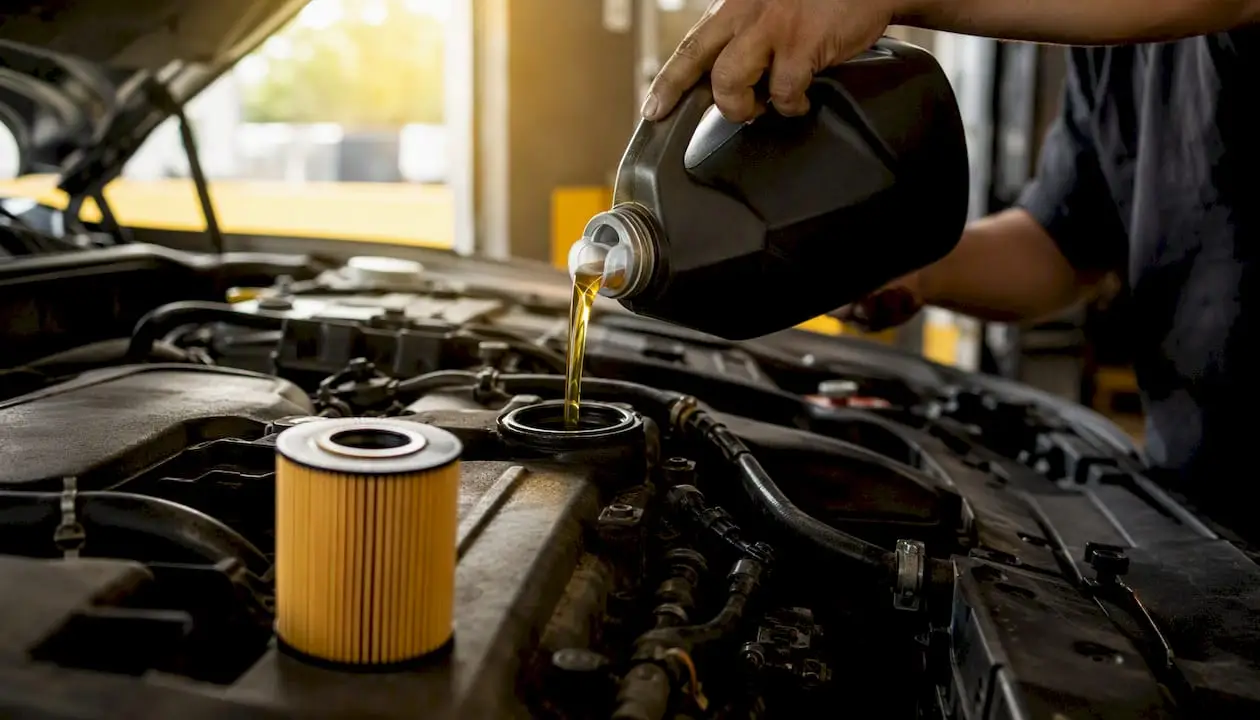
Ask: “Is this a leak or a seep, and where exactly is it coming from?” A preventive maintenance schedule keeps most fluid issues from turning into repairs.
Estimate and Pricing Terms You’ll See on Every Invoice
An estimate is the shop’s projected cost before work starts; a work order is the authorized job once you approve it; an invoice is the final bill. OEM parts come from your car’s manufacturer, aftermarket parts are made by a third party (often cheaper, quality varies), and rebuilt or salvaged parts are used components restored or pulled from other vehicles. Warranty coverage and the shop’s labor rate (charged per hour, separate from parts cost) round out the paperwork.
Every legitimate written estimate should itemize the recommended repairs, the specific parts used, labor costs, and a total price, and it should require your signature before work begins. That’s your formal authorization for the shop to proceed, and you have the right to ask for it in writing every time.
- If a quote looks vague, say: “Can you break this down by parts and labor?”
- If a number jumps mid-repair, say: “I didn’t authorize this. Can you explain the change?”
Our guide to what repair estimates should include walks through this in more detail.
Using This Glossary at the Shop: A Practical Checklist
Walk in prepared and the whole visit gets easier. Here’s the drop-off sequence:
- Ask for a written estimate before any work starts, itemized by parts, labor, and total price.
- Confirm which parts are OEM, aftermarket, or rebuilt, and ask why the shop recommends that option.
- Ask what a diagnostic code showed and how it was confirmed with a physical inspection.
- Ask about warranty coverage on both parts and labor.
- Ask for an estimated timeline and what happens if the job runs long.
- Get a callback before any work beyond the original estimate begins.
Sample questions to keep in your back pocket:
- “Is this wear normal for my mileage?”
- “What’s the expected lifespan of this part?”
- “Are you recommending OEM or aftermarket, and why?”
- “How long will labor take?”
Pro Tip: A diagnostic code tells a technician which system is misbehaving, not necessarily which single part failed. Ask how the shop verified the code with a physical inspection before you approve a parts replacement.
If a repair is bigger than your budget allows right now, financing options can spread out the cost instead of forcing you to skip necessary work. For maintenance planning between visits, a maintenance-by-mileage schedule helps you catch issues before they become emergencies.
Why Kwik Kar Oil Change & Auto Care Built This Glossary
Confusing terminology shouldn’t stand between you and a fair repair. Kwik Kar Oil Change & Auto Care employs ASE and RepairPal certified technicians and backs every estimate with transparent, itemized pricing, no surprise line items, no jargon left unexplained. That’s the standard we hold every visit to.
Sources
- Insist on a written repair estimate | AAA Auto Repair
- AAA Auto Repair Glossary (PDF)
- Glossary of Auto Repair Terms | Diamond Certified
- Autocare
FAQ
What’s the difference between an oil leak and an oil seep?
A leak drips steadily and needs prompt attention; a seep is a slow weep that’s worth monitoring but usually not an emergency.
Should I choose OEM or aftermarket parts?
OEM parts match your manufacturer’s original specs, while aftermarket parts are often cheaper with varying quality. Ask your shop why they’re recommending one over the other for your specific repair.
Does a check engine light always mean a serious problem?
Not necessarily. The code points to a system, and a technician still needs to confirm the exact cause through a physical inspection before recommending repairs.
What should a written estimate always include?
An itemized list of parts, labor costs, and a total price, along with your signature authorizing the shop to proceed with that specific work.
Is a timing belt more urgent than a serpentine belt?
Yes. A timing belt failure can cause serious internal engine damage on many engines, while a serpentine belt replacement is routine maintenance with far lower risk.