




A differential fluid change replaces the gear oil that lubricates and cools the gears inside your axle housing. Most rear-, four- and all-wheel-drive vehicles need it somewhere between 30,000 and 60,000 miles, sooner if you tow, haul or drive in heat and heavy traffic. Some manufacturers list much longer intervals, so your owner’s manual sets the final number. Front-wheel-drive cars usually handle it during transmission service.
This guide explains what the fluid does, how often to change it, why front and rear differentials can run on different schedules, and what a proper service looks like. We are Kwik Kar Oil Change & Auto Care at 9613 White Settlement Rd, Fort Worth, TX 76108, and we see these questions often from White Settlement and West Fort Worth truck, SUV and family-car owners.
TL;DR
- Differential fluid (gear oil) protects the gears and bearings in your axles. Without it, metal wears against metal and heat builds fast.
- Typical intervals run 30,000 to 60,000 miles, but the owner’s manual rules. Towing, hauling and off-road use shorten it.
- Front-wheel-drive cars often have the differential inside the transaxle, so transmission service covers it. Rear, 4WD and AWD vehicles may need a separate service.
- Use the exact gear oil your manual specifies. Gear oils are not interchangeable.
- Leaks, whining, clunking or a burning smell near the axle are reasons to have it inspected soon.
Table of Contents
- What does differential fluid do?
- How often should you change differential fluid?
- Do front and rear differentials follow different schedules?
- When should you change it sooner?
- What are the signs your differential needs attention?
- Which fluid does your differential need?
- What does a professional differential fluid change involve?
- Our perspective on differential service
- Differential service at Kwik Kar in Fort Worth
- Do you still need an inspection in Texas?
- Frequently asked questions
- Sources
What does differential fluid do?
When you turn, the wheels on the outside travel farther than the wheels on the inside. The differential lets them rotate at different speeds while still sending power to both. Inside the axle housing, gears mesh under heavy pressure, and gear oil keeps them from grinding.
According to a differential service guide, the fluid lubricates bearings, gears and clutches, carries wear particles away from critical surfaces, and moves heat into the differential case. In limited-slip differentials and many modern AWD systems, it also matters for proper clutch operation.
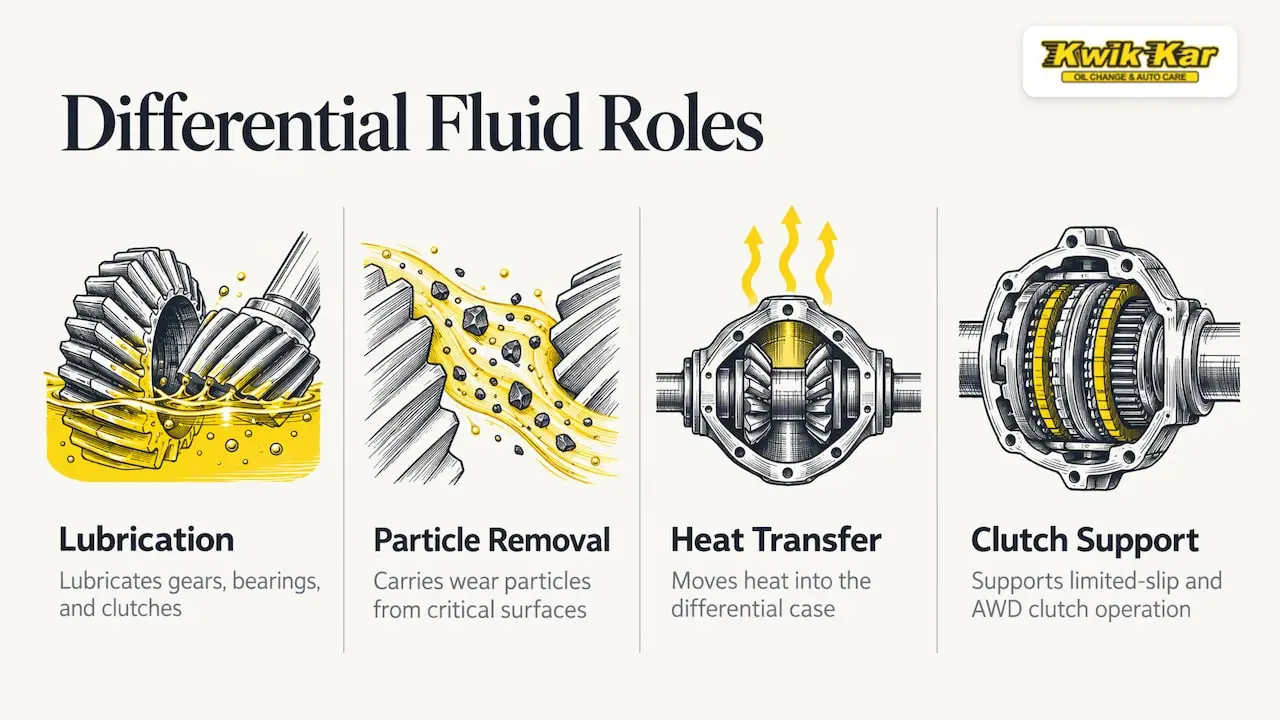
The fluid is sometimes called gear oil, and it is built for high pressure more than the high temperatures engine oil sees, according to UTI. One important difference from engine oil: differentials do not have a filter. Every metal particle that wears off stays in the housing until the fluid is drained.
How often should you change differential fluid?
There is no single number, and we will not make one up. What the published guidance shows is a range:
- Castrol says many manufacturers recommend 50,000 to 100,000 miles for normal driving with modern synthetics, and 30,000 to 50,000 miles (roughly two to three years) can be prudent under severe service.
- AutoZone gives a wider 20,000 to 60,000 miles depending on vehicle type and manufacturer requirements.
- Jalopnik reports intervals vary widely, including a 150,000-mile interval for Ford F-150s that drops to 30,000 miles with heavy towing in temperatures above 70 degrees.
- Kia’s 2025 owner’s manual says rear differential oil on AWD models should be inspected every 40,000 miles or 48 months.
The pattern is clear. Manufacturers differ, and conditions change the answer. Your manual’s maintenance schedule, including its severe-use section, is the starting point. Our guide on how service intervals are determined explains why those schedules read the way they do.
What if the manual lists “inspect” instead of “replace”?
Some schedules say to inspect the differential oil at a set mileage rather than replace it. Inspection means someone checks the level and the condition of the fluid. If it is dark, thick or contains metal debris, it is time to replace it, as JEGS notes. An inspection at a regular service visit is a sensible way to catch a problem early, particularly on a vehicle with high mileage or an unknown service history.
Is an early change worth it on a new vehicle?
Cars.com reports some thinking that an early change may help, much like an engine’s first oil change, by flushing out tiny metal shavings from break-in. It is not a universal rule, so follow your manual and ask us if you are unsure.
Do front and rear differentials follow different schedules?
Often, yes. It depends on how your vehicle delivers power.
| Drivetrain | Where the differential fluid is | What it usually means for service |
|---|---|---|
| Front-wheel drive | Inside the transaxle with the transmission | Changing transmission fluid typically changes it too |
| Rear-wheel drive | Rear axle housing | Separate gear oil service, per manual |
| 4WD (trucks, many SUVs) | Front and rear axle housings, plus a transfer case | Front and rear may each need service |
| AWD | Rear differential, sometimes front as well | Often rear only, depending on design |
Cars.com explains that a scheduled differential change is likely only called for on rear-, four- or all-wheel-drive vehicles, and may apply only to the rear differential, since some AWD models are essentially front-wheel-drive vehicles with an added driveshaft to the rear.
If you own a 4WD pickup, front differential fluid deserves the same attention as the rear. UTI notes that servicing both together keeps maintenance consistent and avoids uneven wear. Our overview of front and rear differential fluid goes deeper on the differences, and the four-wheel-drive service guide covers what else a 4WD system needs.
When should you change it sooner?
Severe use breaks gear oil down faster. Think of it as the oil being sheared and cooked more than it was designed to be over long stretches. Conditions that count:
- Towing a trailer or boat, especially in summer
- Hauling heavy loads in a pickup or SUV
- Off-road or unpaved-road driving
- Frequent stop-and-go driving in high heat
- Driving through deep water
Honda’s own maintenance guidance for mountain driving at very low speeds or trailer towing calls for a first differential fluid change at 7,500 miles, then every 15,000 miles. That is one manufacturer, on one older model, but it shows how much severe use can compress an interval. AMSOIL says frequent towing or heavy hauling, particularly in warm weather, can push some recommendations to as often as every 30,000 miles.
Kia’s manual adds a specific case: if the vehicle has been submerged or driven through a flood, the fluids should be changed as a precaution. After a flooded-street drive in North Texas, that is worth remembering.
What this means in West Fort Worth
Fort Worth summers are long and hot, and many of our customers commute on I-30, Loop 820 and Chisholm Trail Parkway, with plenty of stop-and-go in between. Pickup owners from Benbrook, River Oaks and Westover Hills often tow trailers to Lake Worth or on road trips. None of that means every vehicle needs a shortened interval. It does mean that if you tow or haul regularly, you should read the severe-use schedule in your manual, not just the normal one.
What are the signs your differential needs attention?
Fluid that is overdue can be silent until damage starts. That is why the calendar and odometer matter more than symptoms. Still, these signs are worth acting on:
- Whining, howling or humming, especially when turning or at steady highway speed
- Clunking or clicking when you get on or off the throttle
- Vibration from under the vehicle
- A burning or hot-gear smell near the rear axle after a highway run
- Fluid on the underside of the axle housing or spots on your driveway
These symptoms come from AutoZone and CarParts.com. Noise is a late sign. Family Handyman quotes a technician warning that once noises start, damage is already done and new fluid will not undo it.
Why a leak should not wait
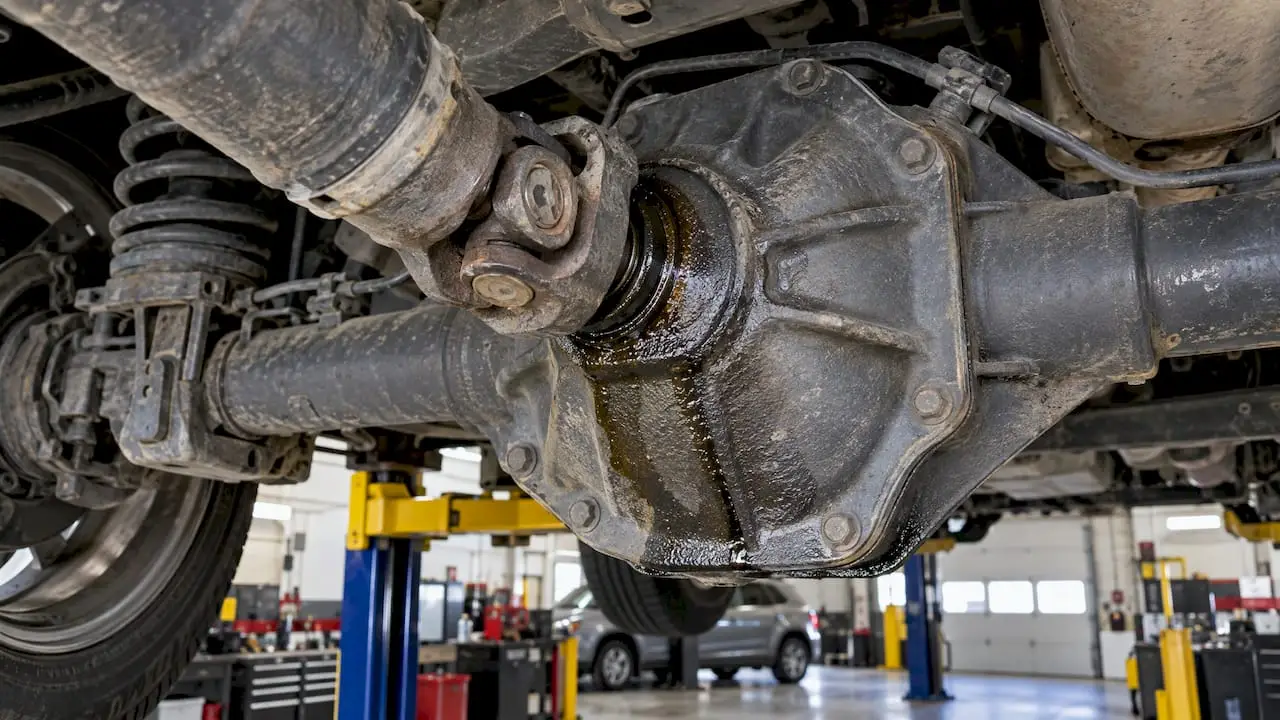
Leaks usually start at the cover gasket, pinion seal or axle seals, which are rubber and degrade with age, CarParts.com explains. A small seep may not make the vehicle unsafe right away, but low fluid means gears and bearings wear quickly. Toyota’s 2017 recall notice for certain Tacomas shows how serious it can get: a leaking rear differential that keeps running can be damaged, and in some cases could seize.
If you see wet gear oil or smell something sharp and burnt, have the axle inspected. We check the level, the condition of the fluid and the seals, then explain what we find.
Which fluid does your differential need?
This is where mistakes cost money. Gear oil is graded by viscosity (such as 75W-90) and by an API GL rating, and your manual specifies both. Most modern hypoid differentials call for API GL-5, per Castrol, which also warns that using GL-4 where GL-5 is required can damage gear tooth surfaces within thousands of miles.
Specifications really do vary by vehicle. Hyundai’s 2022 Kona manual lists a rear differential (4WD) fluid of API GL-5, SAE 75W/90, at about half a quart. The 2010 Nissan Frontier manual lists different oils for the front and rear final drives, and a different one again for rear drives on 6-speed manual models.
Two more points matter:
- Limited-slip differentials often need a friction modifier added to the gear oil, as CarParts.com advises, and your manual will say so.
- Capacity differs between front and rear and between models, so the right amount is as important as the right grade.
If you want to understand the numbers on the bottle, our explainer on what oil viscosity means covers the basics.
What does a professional differential fluid change involve?
The steps are straightforward, but each one affects the result:
- Check the specification. The correct fluid type and quantity come from the manufacturer.
- Warm the fluid. A short drive helps it drain and carry debris out with it.
- Loosen the fill plug first. Castrol calls this the golden rule: if the fill plug is seized after you drain the fluid, you cannot refill.
- Drain the old fluid through the drain plug or by removing the cover, depending on the design.
- Inspect what comes out. Fine metallic paste on a magnetic plug is normal wear. Chunks or shavings are not.
- Clean and reseal. Torque the plug to spec, and replace the cover gasket or crush washer when needed, as O’Reilly’s how-to describes.
- Refill until the fluid reaches the bottom of the fill hole, then add a friction modifier if the differential requires one.
- Test drive and listen for noise, then check for leaks.
The differential service guide points out that differentials require special tools for assembly and setup, and a failure often ends in a costly rebuilt or replacement unit, while the fluid change is comparatively easy. That gap in cost is the practical reason to keep up with it.
Our perspective on differential service
We treat differential fluid as part of a complete maintenance plan, not a stand-alone upsell. Many drivers know their engine oil schedule by heart and have never been told the axle exists as a service item. That is an easy gap to close.
When a truck or SUV comes in for service, we look at the drivetrain the way the manufacturer designed it: which axles have fluid, what the manual specifies, and how the vehicle is actually used. Our technicians are ASE-certified, and our shop holds RepairPal certification. We use digital vehicle inspections so you can see what we see, and professional diagnostic equipment when a noise or warning light points to something deeper.
Our approach is simple. We confirm the right fluid for your vehicle, we tell you what the manual calls for, and we recommend only what your vehicle needs. If a leak or noise suggests something more than fluid, we explain the likely cause and your repair options before any work starts. Qualifying repairs carry our 24-month/24,000-mile warranty.
Kwik Kar
Differential service at Kwik Kar in Fort Worth
Differential work is one of the full-service repair and maintenance options we offer, alongside transmission service, brakes, engine diagnostics, alignment, suspension and electrical repair. That range helps, because a drivetrain noise is not always the differential. It can be a wheel bearing, a tire, a driveshaft joint or a transmission issue, and an inspection tells them apart.
We are at 9613 White Settlement Rd, Fort Worth, TX 76108, one location serving drivers from White Settlement, Westworth Village, Westover Hills, River Oaks, Lake Worth and Benbrook. We do not publish prices for these services, so ask us for an estimate for your vehicle.
Bring your owner’s manual if you have it, or tell us your year, make and model and how you use the vehicle. You can schedule service online. If you run a work truck or several vehicles, ask about our fleet maintenance options. For more background, read our differential fluid service guide.
Do you still need an inspection in Texas?
A different kind of “inspection” often gets mixed into these conversations, so here is the current rule. Since January 1, 2025, most non-commercial vehicles in Texas no longer need an annual safety inspection before registration, because of House Bill 3297. Those vehicles pay a $7.50 inspection program replacement fee at registration instead.
Two things did not change. Vehicles registered in emissions counties still need emissions tests, and Tarrant County is on the list of those counties. Commercial vehicles in all counties still need a passing safety inspection.
The end of the safety inspection makes your own maintenance schedule matter more, not less. The state itself reminds drivers to service their vehicles regularly. A differential check fits naturally into a preventive visit, and our preventive maintenance page lists what that includes.
Frequently asked questions
Is differential fluid the same as transmission fluid?
No. Differential fluid is heavy gear oil for the axle gears, and transmission fluid is a different product for the transmission. On front-wheel-drive cars the two systems share a housing, so one service can cover both. On rear-, four- and all-wheel-drive vehicles, the differential usually has its own fluid.
Can I skip a differential fluid change if I do not tow?
Your manual decides. Some manufacturers list long intervals or an inspection only, and normal driving is easier on the fluid. Fluid still ages and collects metal particles with no filter to catch them, so an inspection at regular service visits is a good habit.
Does a differential fluid change fix a noisy differential?
Not always. Fresh fluid protects parts that are still in good shape, but it cannot repair worn gears or bearings. If your differential already whines or clunks, have it diagnosed so the cause is known before any fluid goes in.
How long does the service take?
Time depends on the vehicle, whether it has front and rear differentials, and whether a cover gasket or seal needs replacing. We can give you a realistic estimate when you schedule.
Sources
- Do You Need to Change the Differential Fluid? (Cars.com)
- Differential Service Basic Theory and Procedure
- What Is Differential Fluid? (UTI)
- How to Change Differential Fluid (Castrol USA)
- How to Replace Differential Fluid (AutoZone)
- How Often Do You Need To Change Differential Fluid? (Jalopnik)
- 2025 Kia owner’s manual, maintenance
- Signs Your Differential Fluid Needs To Be Changed (JEGS)
- Maintenance Minder (Honda)
- How Often Should I Change Differential Fluid? (AMSOIL)
- How to Perform a Differential Flush (Family Handyman)
- What Is a Rear Differential? (CarParts.com)
- Rear Differential Leaks (CarParts.com)
- Toyota Tacoma rear differential recall notice (NHTSA)
- 2022 Hyundai Kona owner’s manual
- 2010 Nissan Frontier owner’s manual
- Rear Differential Fluid Change: How-To (O’Reilly Auto Parts)
- Vehicle Safety Inspection Program Changes Now in Effect (Texas DPS)
- Texas vehicle inspection changes (TxDMV)