



European cars do not all take the same coolant. Most use an organic-acid formula (OAT, HOAT or silicate-enhanced SiOAT) that matches a manufacturer specification such as VW’s G12++, G13 or G12evo. The right one is the one your owner’s manual names, not the one that matches the color of what is in your reservoir.
This guide explains what the letters and numbers mean, how the main chemistries differ, when mixing is safe, and what to do if you are unsure. It is written by the team at Kwik Kar Oil Change & Auto Care, 9613 White Settlement Rd, Fort Worth, TX 76108, where we service European vehicles for drivers across White Settlement and West Fort Worth.
TL;DR
- Use the coolant specification in your owner’s manual or service information. Color is a dye, not a standard.
- Modern European coolants are mostly OAT, HOAT or SiOAT. Volkswagen Group cars use the G-series names (G11, G12, G12+, G12++, G13, G12evo).
- G12++ and G13 are fully compatible with each other, according to an Audi bulletin. Other mixes can reduce corrosion protection or cause gelling.
- A “universal” coolant is not proven to suit every vehicle. Choose one that states it meets your manufacturer’s spec.
- If the wrong coolant went in, a full flush and refill is the safest correction.
Table of Contents
- Why does the coolant type matter in a European car?
- What are the main European coolant technologies?
- What do G11, G12, G12++, G13 and G12evo mean?
- Can you mix European coolant types?
- Does coolant color tell you what you need?
- OEM coolant vs universal coolant: how to decide
- Mixing ratio and water quality
- Our perspective: what we see in Fort Worth
- Signs the cooling system needs attention
- Why European cars need more than a bottle of coolant
- Need coolant service for a European car near White Settlement?
- A note on Texas inspections and your cooling system
- FAQ
- Sources
Why does the coolant type matter in a European car?
Coolant does two jobs: it carries heat away from the engine, and it protects the metals and seals in the cooling system from corrosion. The second job is where chemistry matters. Coolant formulas are built around the materials in a given system: the water pump, radiator, heater core, engine block, hoses and seals. A coolant that does not suit those materials can reduce corrosion protection and cause material-compatibility problems.
European engines often combine aluminum, plastic housings and specific gasket materials. Coolant makers have also changed chemistry over the years to address compatibility with parts such as gaskets and catalytic converters. Downgrading the chemistry can damage gaskets or cause gelling, according to the same trade publication.
The damage is slow. A wrong coolant rarely causes trouble the day it goes in. Months later you may see a clogged heater core, a weeping water pump or an overheating warning in Fort Worth summer traffic, when the cooling system has the least margin.
What are the main European coolant technologies?
European vehicles have used inorganic, OAT, HOAT, PHOAT and SiOAT coolants. Here is how they differ in plain terms.
| Type | What it means | Where you see it |
|---|---|---|
| IAT (inorganic additive) | The older “green” style, with inorganic inhibitors that wear out faster | Older vehicles; the VW G11 family is a standard-technology coolant |
| OAT (organic acid) | Organic inhibitors with longer replacement intervals | Most manufacturers moved to OAT in the late 1990s |
| HOAT (hybrid OAT) | OAT with a higher silicate level to protect aluminum | Many European and some domestic applications |
| SiOAT (silicate-enhanced OAT) | A European approach that includes silicates; many products can meet G12++, G13 and manufacturer formulations | Appeared in 2010-and-newer vehicles |
The timeline and the OAT and SiOAT descriptions come from a trade article for U.S. technicians. If you want a deeper look at the first two families, see our page on OAT vs HOAT coolant and how a wrong mix can restrict flow.
HOAT vs OAT: which one is yours?
The practical difference is the inhibitor package. OAT gives long service life. HOAT adds silicates to protect aluminum surfaces. SiOAT, the European variant, also uses silicates. That is why you cannot assume an OAT coolant and a HOAT coolant are interchangeable just because both are “long life.”
To identify what your car needs, find the recommendation in your owner’s manual or service information, then check the data sheet on the new coolant for the OEM approvals it lists. A product that says only “for all makes” is not telling you much.
What do G11, G12, G12++, G13 and G12evo mean?
The G-numbers are Volkswagen Group coolant standards. The group worked with a coolant chemistry company to develop them, and they include G11, G12, G12+, G12++, G13 and G12evo. Because VW, Audi, Porsche, Skoda and others share them, you will see these names far beyond a single badge.
| Spec | Typical factory color | Notes |
|---|---|---|
| G11 | Green-blue | Older standard-technology coolant |
| G12 | Red | Organic-acid coolant |
| G12+ | Purple | Replaced in service by G12++ |
| G12++ | Purple | Introduced for service in model year 2005 |
| G13 | Purple | Introduced for factory fill and service in model year 2008 |
| G12evo | Purple | Introduced in model year 2019; the only coolant specified for the Audi e-tron |
The colors, model years and e-tron detail come from a 2022 Audi technical service bulletin. An earlier Audi bulletin confirms that G11, G12 and G12+ were superseded, with G12++ for service in 2005 and G13 in 2008.
G12 vs G13: what is the real difference?
G12 is an older red organic-acid coolant. G13 is the later purple one, and one manufacturer guide notes it is based on glycerine from biological waste products. The same guide says G12evo replaced G13 in 2018 and is more efficient, especially at the freezing point.
For day-to-day ownership, the key point is that G12++ and G13 are fully compatible. A G12 car is a different story. Do not assume a purple product is a drop-in for a red-coolant car without checking the specification.
Can you mix European coolant types?
Sometimes, but not by guessing. Audi’s bulletin tells technicians to use its chart to see which factory-fill coolants can be mixed, and warns that mixing may reduce corrosion protection, with the exception of G12++ and G13, which are compatible. Mixing G11 and G12 can form aggressive acids and cause clumping that blocks cooling channels.
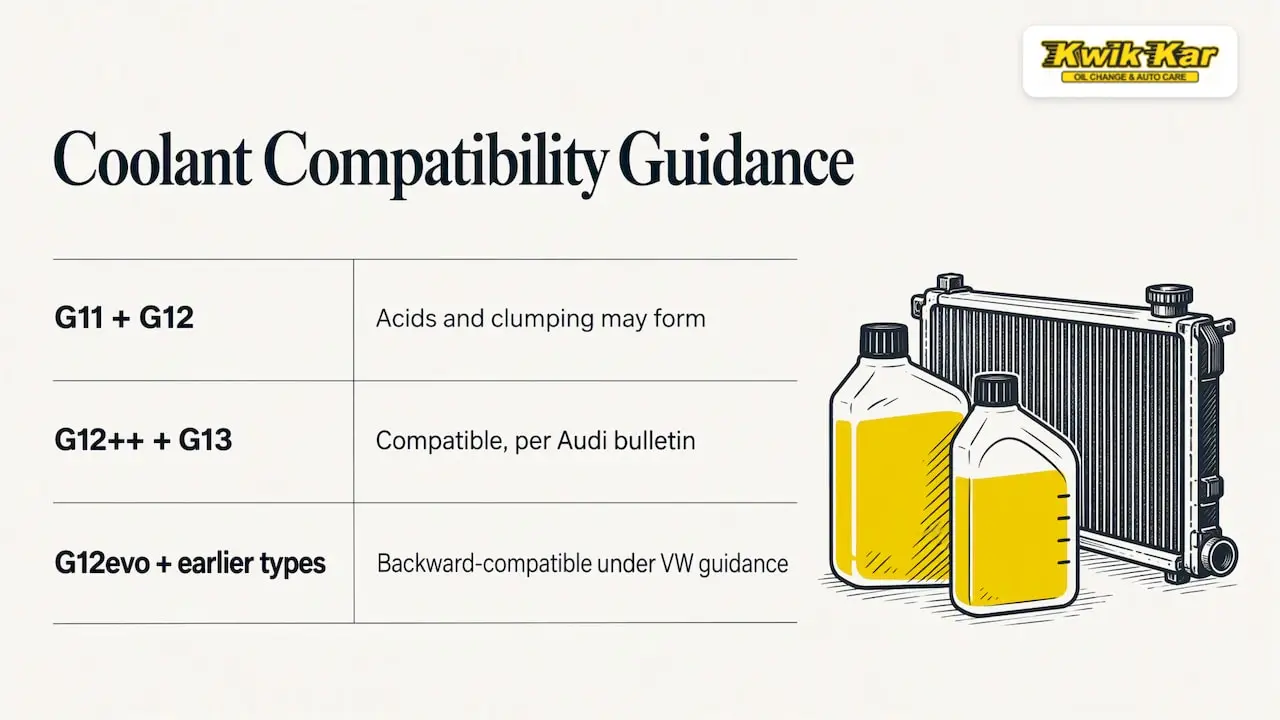
There is one manufacturer-specific exception. A 2023 Volkswagen U.S. technical bulletin says the latest G12evo formulation is backward-compatible with all its engine concepts and can be used for refills or top-offs, including mixing with earlier coolant variations. That is a Volkswagen instruction, not a rule for every European make.
For Volvo, one parts catalog guide advises that if the coolant in the car is not blue, you should flush and refill with the specified European-type concentrate. Always verify against your own model’s documentation.
If the wrong coolant went in
The safest correction is a full system flush and refill with the correct chemistry, not topping off and hoping. If you cannot get the specified coolant in an emergency, distilled water above freezing is a better temporary choice than the wrong coolant. Have the system flushed properly as soon as you can. Our guide to the coolant flush interval covers how to think about timing.
Does coolant color tell you what you need?
No. Coolant colors are dyes, not an industry standard. A coolant manufacturer also notes that different chemistries can share a color, and one technology can appear in different colors.
Factory-fill colors in a specific manufacturer’s bulletin are useful for that manufacturer’s own products, as in the Audi table above. Aftermarket bottles and a reservoir that has darkened with age are not reliable evidence. Read the spec, not the shade.
OEM coolant vs universal coolant: how to decide
The cleanest guidance we have seen comes from a carmaker. Ford’s U.S. position statement says no single universal coolant has been proven to work in all vehicles and that shops should use the coolant specified by each vehicle’s manufacturer. It adds that non-approved coolant can cause delayed additive-compatibility problems, though warranty coverage is not automatically voided by its use. That is a Ford statement, but the reasoning applies to any brand.
A sensible checklist before you buy a bottle:
- Find the specification in the owner’s manual or service information (for example, a VW G-number or a Mercedes sheet number).
- Look for that exact approval printed on the bottle’s label or data sheet.
- Confirm whether it is a concentrate or pre-diluted.
- Skip anything that only claims to be compatible “with most vehicles.”
Some products are written specifically for European cars. One 2025 brochure describes a Si-OAT antifreeze for 2014 and newer Mercedes-Benz and 2008 and newer Audi/Volkswagen applications, which shows how model-year specific this can get.
Mixing ratio and water quality
For most coolants, the water-to-coolant ratio should fall between 40/60 and 60/40. If you buy concentrate, dilute it with the right water. Audi’s bulletin says to mix additives only with distilled water and not deionized water. Tap water carries minerals that can build up deposits, so avoid it for permanent fills.

Our perspective: what we see in Fort Worth
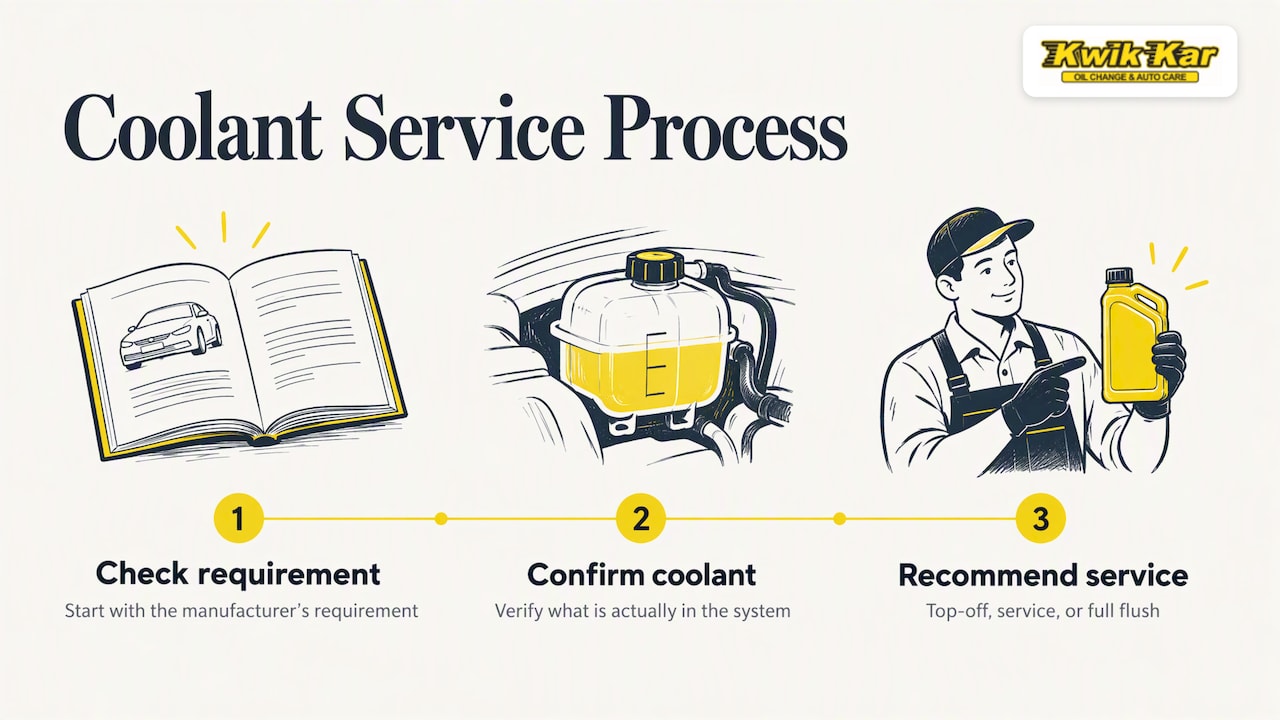
We treat coolant as a specification job, not a color-matching job. When a European car comes into our shop on White Settlement Rd, we start with the manufacturer’s requirement, confirm what is actually in the system, and only then recommend a top-off, a service or a full flush. Our technicians are ASE-certified, and we are RepairPal certified, so we explain the work in plain terms and show you what we found through a digital vehicle inspection.
Texas heat is hard on cooling systems. Long stop-and-go stretches on I-30 and Loop 820, and highway runs out toward Lake Worth, Benbrook or Weatherford, all load the system. That does not mean you need coolant service sooner than your manufacturer says. It means a system with mixed or wrong coolant has less room for error here than it would in a cooler climate.
So our advice is simple: do not let anyone add “whatever is on the shelf.” Ask what specification it meets. If the answer is vague, ask again.
— Kwik Kar
Signs the cooling system needs attention
Coolant chemistry problems show up through symptoms. Watch for:
- A temperature gauge that climbs in traffic but settles on the highway
- A sweet smell or visible residue near the radiator, hoses or water pump
- A low reservoir that needs frequent top-offs
- Sludge, rust-colored fluid or gel-like clumps in the reservoir
- Weak cabin heat, which can point to a restricted heater core
Low coolant has several causes, and our page on no coolant in a car walks through the checks. To find a leak yourself, see how to check for coolant leaks. If you spill coolant while topping off, wipe it up promptly. It is toxic to pets, and a guide to cleaning your engine bay safely helps you avoid damaging sensitive parts while you do it.
A flashing check engine light or a temperature warning should not wait. Pull over safely and have the car looked at before driving on.
Why European cars need more than a bottle of coolant
Correct coolant is only half of a proper service. Many European engines have bleed procedures, plastic fittings and sensors that call for the right equipment. Our overview of why European vehicles need specialized tools explains what that looks like. Air trapped after a refill can cause hot spots, so the refill method matters as much as the fluid.
At our shop we use professional diagnostic equipment to pressure test the system and check for leaks before and after service. Qualifying repairs are covered by our 24-month/24,000-mile warranty.
Need coolant service for a European car near White Settlement?
We handle cooling system inspections, coolant exchanges and repairs such as radiators, water pumps and hoses as part of our full-service auto repair and preventative maintenance. Drivers from Westworth Village, Westover Hills, River Oaks, Lake Worth and Benbrook come to our single Fort Worth location at 9613 White Settlement Rd.
You can see everything we do on our services page, or schedule a visit through our website at kwikkarwhitesettlement.com. For help finding a local option, read how to service your European car locally in Fort Worth. Bring your owner’s manual if you have it. If you do not, we can look up the specification.
A note on Texas inspections and your cooling system
Since January 1, 2025, non-commercial vehicles in Texas no longer need a safety inspection before registration, under House Bill 3297. Emissions tests are separate and are still required for vehicles registered in emissions counties, which include Tarrant County. Qualifying commercial vehicles remain subject to safety inspection requirements. Check the Texas DPS page for current details.
With no annual inspection forcing a once-over, it is easy for the cooling system to go unchecked. A routine preventive inspection fills that gap.
FAQ
What color is G11 coolant?
Factory-fill G11 is green-blue, according to an Audi bulletin. Color is only a dye, though, so confirm the specification in your manual before buying. Aftermarket products can use different colors for the same chemistry.
Is G12++ the same as G13?
They are different specifications, but they are fully compatible with each other. G13 came later, in model year 2008 for factory fill, and G12++ was introduced for service in 2005. Check your manual for which one your engine calls for.
Can I use universal coolant in my European car?
We recommend against relying on that word alone. Carmakers such as Ford state that no universal coolant is proven to work in every vehicle. Buy a product that lists your manufacturer’s specification.
What happens if I drive with low coolant?
The engine can overheat, which can lead to warped parts or a damaged head gasket. If the gauge climbs or a warning appears, pull over safely and let the engine cool before checking anything. Have the cause diagnosed rather than just refilling.
Can I add water instead of coolant?
Only as a short-term measure. Distilled water is a better stopgap than the wrong coolant, but it dilutes protection and is not a fix. Have the system tested and refilled to the correct ratio soon after.
Sources
- European Coolant: Does It Matter to U.S. Technicians?
- Not all coolants are the same! (technical guide)
- Understanding Coolant Technology
- Audi Technical Service Bulletin, 2022
- Audi Technical Service Bulletin, 2013
- Volkswagen Technical Bulletin 19-17-01, 2023
- Ford Motor Company Position Statement on Universal Antifreeze Coolants
- Just Chill: Making Sense of the Coolant Conundrum
- The Complete Guide to Using and Choosing the Right Car Coolant
- What Coolant Does My Car Need? A Color-Coded Guide
- Antifreeze/Coolant Guide for Asian and European Nameplates
- Si-OAT antifreeze brochure update, 2025
- Texas DPS: Vehicle Safety Inspection Program Changes Now in Effect
- How to Clean Your Engine Bay Safely Without Damage