


OAT coolant relies on organic acid technology, while HOAT blends organic acids with inorganic inhibitors such as silicates. The one rule that matters is to follow the specification in your owner’s manual and never mix the two chemistries. If you are unsure what is in your system, or you suspect a mix, plan a flush or let a technician take a look.
TL;DR:
- OAT uses organic additives, while HOAT combines organic acids with inhibitors such as silicates; each formula suits materials in a particular cooling system.
- Coolant color cannot identify its chemistry: orange dyes appear in different formulas, so match the bottle’s stated specification to the code in your owner’s manual.
- Mixing incompatible coolants can make additives fall out of solution, forming sludge that blocks narrow passages, restricts flow, and can overheat or damage components.
- If the coolant looks cloudy, muddy, or stringy, the temperature rises, or cabin heat weakens, have a technician inspect it and assess whether a flush is needed.
- Coolant has no universal replacement mileage; follow the interval for your vehicle’s specification, and check the coolant level only when the engine is cold.
Table of Contents
- What are the quick differences between OAT and HOAT coolant?
- How does the chemistry change corrosion protection?
- Can you mix OAT and HOAT coolant?
- How do you identify the right coolant for your car?
- How long does coolant last and what maintenance does it need?
- What should you do if you find mixed or wrong coolant?
- Why do owners bring coolant questions to a shop?
- Ready to book a coolant inspection or fluid exchange?
- FAQ
- Sources
What are the quick differences between OAT and HOAT coolant?
Here is the short version for owners comparing the two:
- OAT (organic acid technology): Uses organic additives for long-life corrosion protection. Service intervals vary by vehicle, so follow the schedule in your owner’s manual.
- HOAT (hybrid organic acid technology): Combines organic acids with inorganic inhibitors such as silicates, so it protects metal surfaces in a different way from OAT.
- Service life: Manufacturers often advertise “long-life” intervals, but the exact number depends on the OEM specification for your engine. We do not quote a universal mileage here because it varies by vehicle.
- Best fit: OAT suits systems designed around long-life organic chemistry. HOAT suits systems where the maker calls for hybrid protection. Neither is better in general, only better for a given engine.
Think of it like motor oil grades: the right answer is the one your engine was built around, not the one that sounds more advanced.
How does the chemistry change corrosion protection?
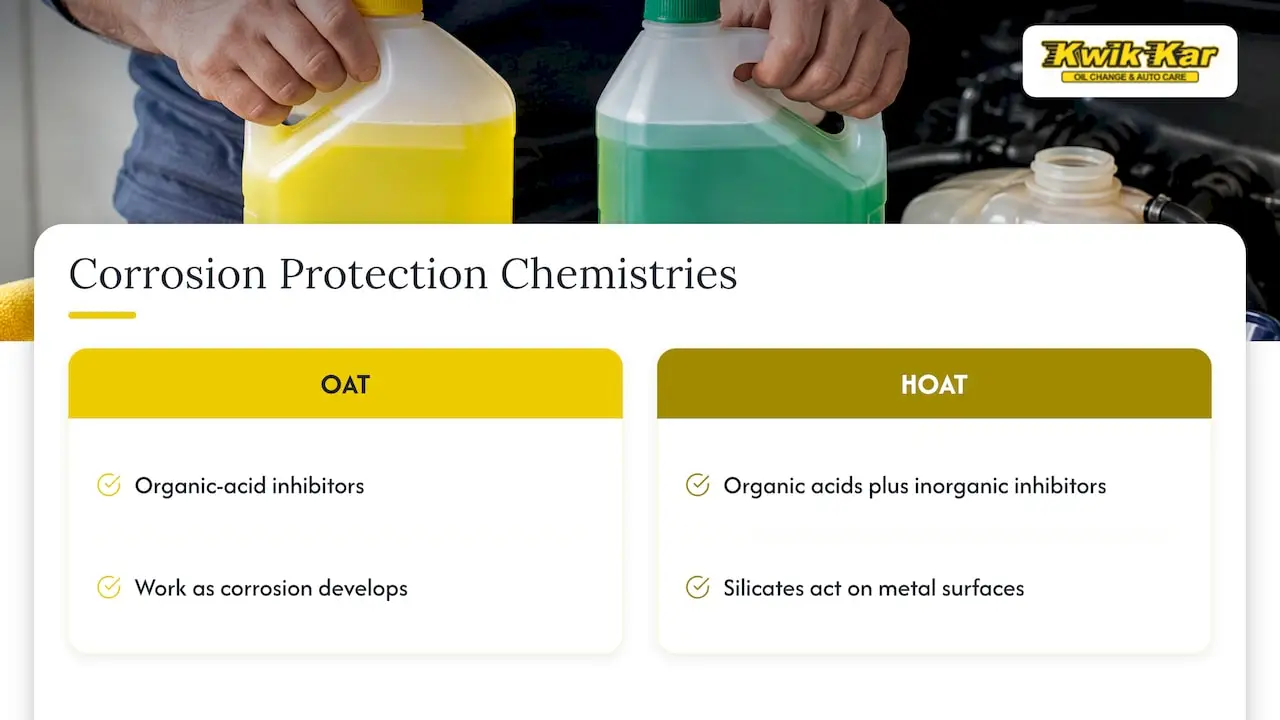
OAT inhibitors work as corrosion begins. OAT coolants provide corrosion protection as corrosion sites develop. Follow your owner’s manual for the service interval.
HOAT takes a hybrid route. It keeps the organic acids but adds inorganic inhibitors such as silicates, which give a different protection profile on metal surfaces. Both chemistries aim for the same result, a cooling system that does not rust, scale or eat away at its own parts.
So why do manufacturers choose one over the other? Cooling systems are engineered as a whole, and coolant chemistry is selected to match the radiator, water pump and engine block materials. Use the wrong formula and you can trigger chemical reactions that target specific components. That is the reason we treat the OEM spec as the deciding factor and not personal preference or a brand name on the jug.
Can you mix OAT and HOAT coolant?
Generally, no. These chemistries are often incompatible, and the damage is not cosmetic. When incompatible coolants meet, the additives can drop out of solution. Mixing mismatched coolants can produce gel-like sludge that blocks narrow coolant passages, restricts flow and leads to overheating and component damage.
Picture a heater core or radiator tube slowly clogging, like a drain collecting grease. Flow drops, heat builds, and the engine ends up working in conditions it was never meant to handle.
Watch for these signs:
- The temperature gauge climbs or the warning light comes on, so read our guide on what to do when the engine temperature light is on
- If you notice weak or no cabin heat, have the cooling system checked.
- Coolant that looks cloudy, muddy, stringy or oddly discolored
- If you have repeated cooling-system problems, have the system checked.
Pro Tip: If you topped off with the wrong coolant once, do not wait for symptoms. Have the system checked and ask a technician whether a flush is needed.
How do you identify the right coolant for your car?
Color will not tell you. Colors are branding, and two coolants of the same shade can be chemically incompatible. Not every orange coolant is OAT, because several makers use orange dye for different chemistries. Follow these steps instead:
- Check the owner’s manual. Look for the exact OEM specification, usually a code or a standard name rather than “OAT” or “HOAT.” Ford, for example, ties its products to codes such as WSS-M97B44-D in Motorcraft’s coolant literature.
- Check service stickers and records. Past invoices or an under-hood label may show what was used last.
- Match the product label to the spec. Read the fine print on the bottle and confirm it states the same specification your manual calls for. Manufacturer charts such as Motorcraft’s usage chart map products to OEM codes and model years, but they still rely on the code, not the color.
- Still unsure? Schedule an inspection or a fluid exchange so a technician can confirm and correct it.
How long does coolant last and what maintenance does it need?
Manufacturers commonly describe their coolants as “long-life,” but the actual interval comes from the OEM specification for your vehicle. Your manual is the authority, and we follow it when we service a car.
Between services, run through this checklist:
- Inspect the coolant level when the engine is cold
- Look at clarity: coolant should look clean, not rusty, oily or cloudy
- Check hoses and connections for leaks, and use our coolant leak checking guide if you see drips or crusty residue
- Have the radiator cap and system pressure-tested
- Follow the OEM replacement interval for your engine
Schedule a radiator flush or fluid exchange when you see contamination, suspect mixing, cannot confirm the coolant history, or the fluid has simply aged out. Our overview of flushing car fluids explains what that involves.
What should you do if you find mixed or wrong coolant?
Start with simple checks, then decide how far to go:
- Look inside the reservoir or radiator neck for sludge, gel or floating particles
- Watch the temperature gauge on your next drive and note any climb
- Notice odd colors or smells in the coolant
- If the level is low, read our guide on what to do with no coolant in the car
If you suspect mixed coolant or see sludge, have a technician inspect the system and determine whether it needs a flush and refill to the OEM specification. If the engine is overheating, stop driving and have it looked at before damage spreads.
Why do owners bring coolant questions to a shop?
If you have doubts about what is in your car or are seeing symptoms, ask a technician to check the coolant against your OEM specification. If you have doubts about what is in your car or you are seeing symptoms, bring it in and let us inspect it.
— Kwik Kar
Ready to book a coolant inspection or fluid exchange?
If you suspect mixing, see contamination, or cannot confirm your OEM spec, we can help. Ask us about having the cooling system inspected and the coolant checked against the specification your manufacturer calls for. We recommend professional service when coolant looks dirty, the engine runs hot, or the coolant history is unknown.
You can see what we handle on our services page and read about our preventative maintenance and fluid exchange services. Stop by Kwik Kar White Settlement or request an appointment to get your cooling system checked.

FAQ
Are HOAT and OAT coolants compatible?
Usually not. Mixing different coolant chemistries can cause additive dropout and sludge that restrict flow, as described by coolant makers. Stick with the specification in your owner’s manual.
Is HOAT better than OAT coolant?
Neither is better in every case. OAT and HOAT each fit different cooling systems, and the right one is the one your manufacturer specifies. Using the correct spec matters more than choosing a type.
How do I know if my coolant is OAT or HOAT?
Color is not a reliable clue. Check the owner’s manual for the OEM specification, then match it to the product label or your service records. If you cannot confirm it, a technician can help.
Are all orange coolants OAT?
No. Several manufacturers use orange dye for different chemistries, so the shade alone does not identify the formula. Match the coolant to the chemical specification your engine requires.