




A noise over bumps almost always means a suspension or steering part has worn enough to move, rub or bang where it should not. The usual suspects are control-arm bushings, ball joints, sway bar links, shocks or struts, and strut mounts. The sound itself (a clunk, a squeak, a rattle or a groan) is your best clue to which one, and it is worth having checked soon, because suspension parts wear together and a small noise rarely stays small.
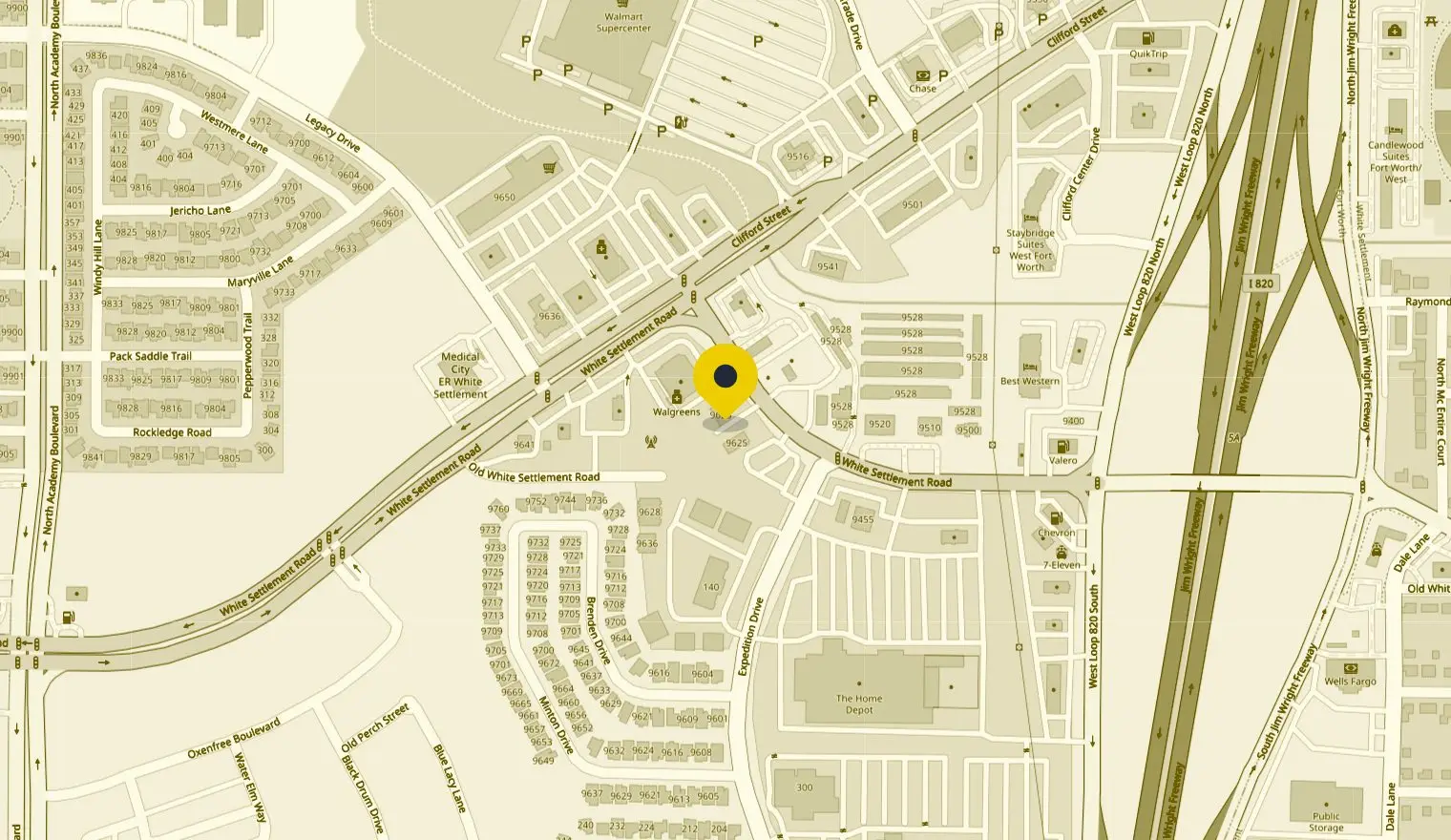
This guide explains what each sound usually points to, how to tell a worn strut from other faults, what you can safely check yourself, and what a proper inspection looks like. We are Kwik Kar Oil Change & Auto Care at 9613 White Settlement Rd, Fort Worth, TX 76108, and we see these noises every week from drivers in White Settlement, West Fort Worth, Westworth Village, Westover Hills, River Oaks, Lake Worth and Benbrook.
TL;DR
- A clunk over bumps usually comes from worn control-arm bushings, ball joints, sway bar links or struts. A squeak or groan usually means a dry or worn joint or bushing.
- Bouncing, nose dive when braking, or a floppy ride suggest worn struts or shocks, not just a noisy joint.
- Suspension noise is a safety item, even if the car is not about to fall apart. Do not let it ride for months.
- Do not spray lubricant on a noisy joint and call it fixed. It hides the symptom and does not repair the wear.
- A technician can pin down the source with a road test and a hands-on inspection of each component. We can do that at our White Settlement Rd shop.
Table of Contents
- Why does my car make noise when I go over bumps?
- What the sound tells you
- Common causes, one by one
- Bad strut symptoms vs. other suspension problems
- What if it sounds like something is loose?
- Should you spray WD-40 on a squeaky suspension?
- Is it safe to drive with suspension noise?
- How a technician finds the source
- Repair options and what to expect
- Noises that are not suspension
- Fort Worth driving and your suspension
- Our perspective: treat the noise as information
- Book a suspension inspection in West Fort Worth
- A note on Texas inspections
- FAQ
- Sources
Why does my car make noise when I go over bumps?
Your suspension is a set of moving parts that connect the wheels to the body: springs, shocks or struts, control arms, ball joints, sway bar links and rubber bushings. Every bump pushes these parts through their range of travel. When a bushing cracks, a joint loosens or a damper stops controlling movement, you hear it.
Automotive reporting on suspension diagnosis lists worn control-arm bushings, shocks or struts, and stabilizer-bar links and bushings among the common sources of noises over bumps. Another consumer guide describes the same pattern: slack in the suspension lets components bang together, and worn struts or shock absorbers can let the car bottom out.
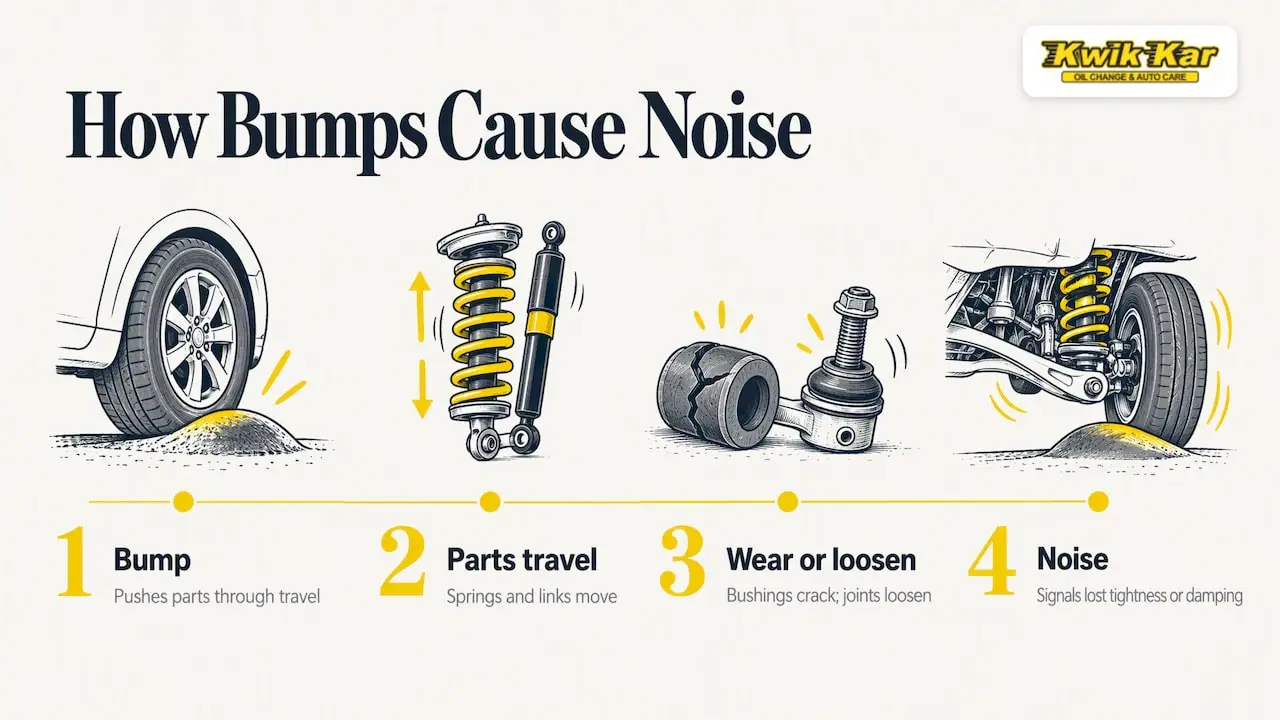
In short, the noise is a symptom of lost tightness or lost damping. The job is to find which part lost it.
What the sound tells you
No sound is a perfect diagnosis, but it narrows the list. Use this table as a starting point, then let a technician confirm.
| What you hear | When it happens | Common causes |
|---|---|---|
| Sharp clunk or knock | Over bumps, potholes, driveway dips | Worn sway bar links, control-arm bushings, ball joints, tie rod ends, strut mounts |
| Hollow thud or bottoming-out feel | After a big dip or at speed over rough pavement | Worn struts or shocks, collapsed bump stops |
| Squeak or creak | Slow bumps, speed humps, turning into a driveway | Dry or worn bushings, dry ball joints |
| Groan when turning the wheel | Parking and low-speed turns | Dry joint in the steering linkage or suspension |
| Rattle | Rough or washboard roads | Loose sway bar hardware, worn links, loose heat shields or underbody parts |
| Repeated bounce after a bump | Highway dips, railroad crossings | Worn shocks or struts |
Common causes, one by one
Control arms and bushings
Control arms hold each wheel in position while it moves up and down. Their rubber or fluid-filled bushings absorb shock. When a bushing wears, the arm shifts, and you can feel a clunk as you steer over a bump. Worn control arms can also let the wheel drift out of alignment, according to a J.D. Power guide to front-end clunks, which also notes that off-road driving can speed up control-arm wear. That matters for pickup and SUV owners who leave pavement for work sites, ranch roads or weekend trails.
Ball joints
A ball joint is a pivot that lets the wheel move up and down and steer at the same time. Grime getting into a joint can generate noise, and a badly worn joint can make the car hard to hold in a straight line, per the same J.D. Power source. A clunk over bumps combined with wandering or loose steering is a reason to stop postponing the inspection.
Sway bar links and bushings
The sway bar limits body roll in turns. Its end links are small, inexpensive-looking parts that work hard, and they are a frequent source of a light clunk or rattle over uneven pavement. Worn links or bushings are a possible cause of front-end clunks over bumps.
Struts and shock absorbers
Shocks and struts control how fast the springs compress and rebound. A strut is a structural part that also carries a spring; a shock is a damper only. When they wear, the car feels bouncy or floppy, the nose dives under braking, and you may see fluid leaking from the body. Reduced damping also dulls steering response.
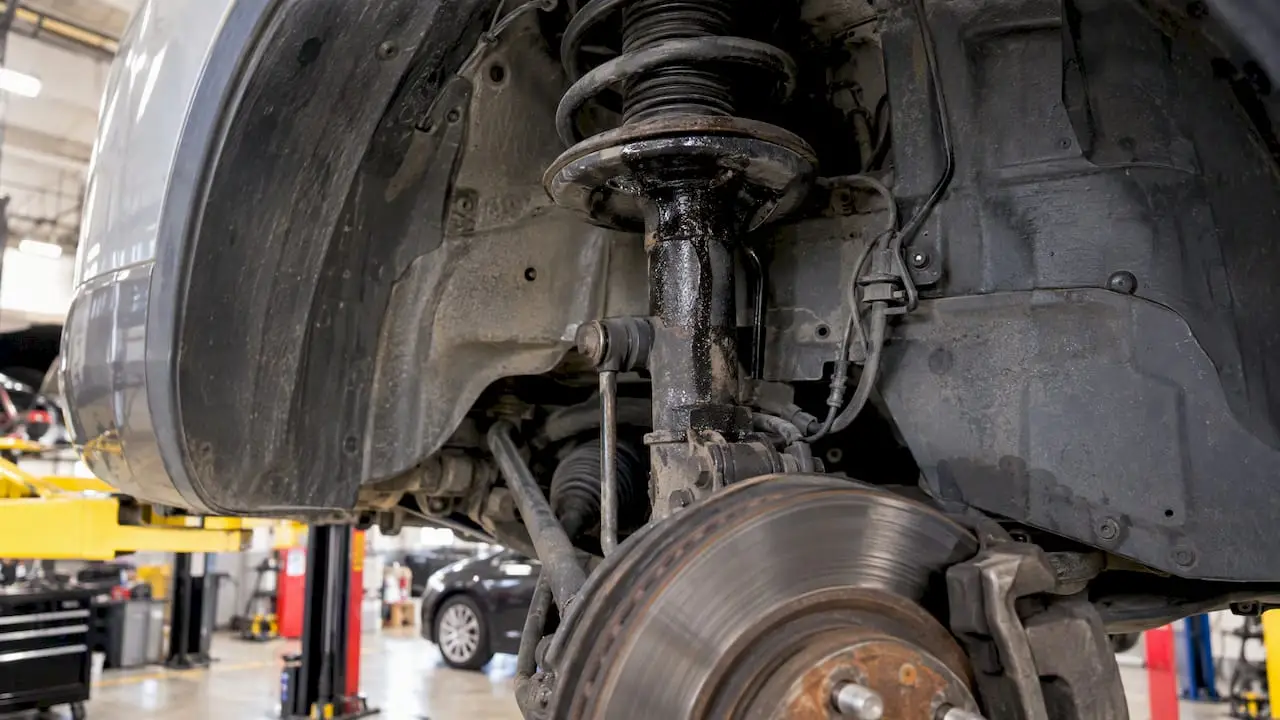
If the ride has changed along with the noise, read our driver’s guide on how to tell if struts need replacing or our page on a car that bounces while driving.
Strut mounts and tie rod ends
A strut mount is the rubber-and-bearing assembly at the top of the strut. When it wears, you can hear a clunk or a creak when turning or going over bumps, even if the strut itself is fine. Tie rod ends connect the steering rack to the wheels, and a worn one can clunk over bumps and also cause loose steering or uneven tire wear.
Bad strut symptoms vs. other suspension problems
Because noises are easy to mislabel, look at the whole picture. Struts are one possibility, not the default answer.
More likely worn struts or shocks when you notice:
- The car keeps bouncing after a dip instead of settling.
- The front end dives noticeably when you brake.
- The body leans or sways more than it used to in crosswinds and lane changes.
- Oil or fluid is wet on the body of the strut or shock.
- Tires wear in a cupped or scalloped pattern.
More likely a joint, link or bushing when you notice:
- A sharp, metallic clunk on a single bump, with the ride otherwise normal.
- A noise that changes when you turn the wheel.
- Steering that feels loose, or the car pulls or wanders.
- A squeak that is worst on slow, small bumps.
One fluid detail is worth knowing. Manufacturer service guidance notes that light misting on a shock or strut from evaporated fluid in hot conditions is normal and does not hurt ride performance, while heavy runs and drips usually mean damage to the rod or seal. The same document says each shock or strut should be judged individually and only a defective one replaced, as the manufacturer’s instructions require. A damp, dusty strut is not automatically a bad one, and that is why a hands-on look beats guessing.
Our dedicated page on suspension clunking noise: causes, safety and what to do goes deeper on the clunk-specific side.
What if it sounds like something is loose?
Sometimes a bump produces a rattle that sounds like a loose tool in the trunk. Check the simple things first: unload the cargo area, look for a loose jack or spare, and make sure nothing is rolling in the glove box or under a seat. Pickup owners should also check toolboxes, tie-down hardware and bed accessories.
If the noise remains, a few cautious checks can help:
- Park on level ground with the engine off. Push down firmly on each corner of the car. A healthy suspension compresses and settles once. A worn one keeps bouncing or makes a noise.
- Listen from different positions. Sound travels through metal. Manufacturer diagnostic guidance warns that a noise heard in one spot may actually start somewhere else, so do not trust your ears alone.
- Look for obvious damage. Torn rubber boots, cracked bushings, grease on the inside of a wheel or a dangling sway bar link are all worth noting.
- Note the conditions. Write down whether it happens cold or warm, in turns or straight, loaded or empty, front or rear. This is the most useful thing you can hand a technician.
One shop-style test is a helper rocking the steering wheel while you watch the steering components with the car parked, and some mechanics use a long screwdriver against the ear as a listening tool, both described in this suspension diagnosis article. We would not suggest crawling under a car at home unless you have proper stands and experience. If you do lift a vehicle, the same article advises supporting it under the control arms or the rear axle instead of the frame so the suspension sits at a natural angle, which also changes how parts load and sound.
For more detail on what you can do safely without tools, see our safe parking lot checks for a suspension clunk.
Should you spray WD-40 on a squeaky suspension?
We advise against it. A squeak means friction, and friction means a part is dry, worn or both. Spraying a general-purpose lubricant on rubber bushings can quiet the noise for a few days, but it can also attract dirt and can soften or swell some rubber compounds. More important, it covers up a warning sign instead of fixing it. A groaning noise when turning the steering wheel typically means a dry joint, likely at the idler or pitman arm on vehicles that have that style of steering linkage. The repair is to inspect, then lubricate where the part is designed to be greased or replace what has worn out.
Is it safe to drive with suspension noise?
A noisy suspension does not usually mean something is about to fall off. Still, chassis and suspension noises should be checked for safety. The risk is not the noise. It is what the noise stands for: a joint that could loosen further, a damper that no longer keeps the tire planted, or a bushing that lets alignment shift.
Here is a plain way to sort urgency:
- Get it looked at this week: a new clunk, a squeak that is getting louder, a mild bounce, or a change in how the car rides.
- Stop driving and call for help: a loud bang with sudden loose or vague steering, the car pulling hard to one side after a bump, a wheel that looks tilted, or a clunk paired with a wobbling wheel.
- Can be scheduled with normal service: a faint rattle you can trace to a light-duty part such as a sway bar link, once a technician confirms nothing critical is involved.
Worn dampers also lengthen the time a tire stays properly in contact with the road, which matters in a panic stop on a crowded stretch of I-30 or Loop 820. We do not quote a specific number because it depends on the vehicle, the parts and the road.
How a technician finds the source
Guessing is expensive. Replacing a strut when a $20-class link was the culprit wastes your money, and so does the reverse. A sound diagnosis follows a sequence.
- Listen to your description. When, where, how often, and at what speed.
- Road test. Technicians use dynamic road testing and bounce tests to reproduce a noise, taking into account road conditions and weight distribution, as NHTSA-published manufacturer guidance on noise identification describes.
- Lift and inspect. With the vehicle raised, the technician checks for play in ball joints, tie rod ends, control-arm bushings and links, looks at strut mounts and leaks, and examines tires for wear patterns.
- Digital vehicle inspection. We document what we find so you can see photos and notes of the worn part instead of taking our word for it.
- Explain the options in plain language. What must be fixed now for safe operation, what can wait, and what the repair involves.
That last step matters. Good shops separate repairs that are critical to safe operation from those that can be postponed, which is also how shock and strut maker guidance recommends presenting options.
Repair options and what to expect
The right repair depends on the part:
- Sway bar links and bushings: Usually replaced as a part. Often a smaller repair than other suspension work.
- Control-arm bushings or arms: Depending on design, the bushing is pressed out or the whole arm is replaced.
- Ball joints and tie rod ends: Replaced, followed by an alignment check.
- Struts and shocks: Replaced, often as a pair on the same axle for even handling, although only a defective one needs replacing if the other tests fine. Strut jobs generally call for an alignment afterward.
- Strut mounts: Frequently replaced with the strut since the assembly is already apart.
We do not publish prices for these jobs, because cost depends on the vehicle, the part and what we find during inspection. We will give you the estimate before work begins. Qualifying repairs at Kwik Kar carry a 24-month/24,000-mile warranty.
Why alignment often follows
Any repair that moves or replaces steering and suspension parts can change the wheel angles. Uneven or fast tire wear after a suspension repair is a sign the alignment was skipped. Read our guide to the signs your car needs an alignment to know what to look for.
Noises that are not suspension
Not every bump noise starts in the springs and joints. Two other sources are commonly confused with it:
- Wheel bearings usually hum or growl, and the sound changes with speed or when you turn. See how technicians confirm wheel bearing noise.
- CV axles typically click when turning sharply, and a clunk can happen when you accelerate or let off. Learn the tests that confirm CV axle noise.
Brakes can also squeal or clunk over bumps when pads or hardware are loose, which our brake squeal checklist covers.
Fort Worth driving and your suspension
Local conditions do not cause suspension wear on their own, but they shape how fast you notice it. Stop-and-go traffic on Camp Bowie and White Settlement Rd means constant braking, which makes weak struts show up as nose dive. Summer heat is hard on rubber bushings and boots over time. Expansion joints on highway overpasses, construction patches and potholes after winter freeze and thaw all deliver sharp hits. If you tow, haul or drive a truck loaded with tools, the springs and dampers work harder than on a lightly used commuter, and any off-pavement driving adds wear to control arms.
Heading out on a road trip? Have a noise checked before you load the car, not after you are two hundred miles from home.
Our perspective: treat the noise as information
We approach a suspension complaint the same way we approach any repair: find the cause before we recommend anything. Customers often arrive sure it is the struts, or sure it is “just a bushing.” Sometimes they are right. Often the real problem is a link or a mount that costs far less than they feared, and sometimes a clunk that sounded minor turns out to be a ball joint we are glad was caught early.
That is why our technicians are ASE-certified and why we use professional diagnostic equipment together with a hands-on inspection. We show you what we find through a digital vehicle inspection, and we explain the difference between a repair that affects safe operation and one that can wait. We are RepairPal certified and CARFAX Top-Rated, and we would rather earn your trust with a clear explanation than a long list of parts.
Our advice is simple: when a new sound shows up over bumps, do not wait for it to get worse and do not mask it. Get it checked while the repair is still small.
— Kwik Kar
Book a suspension inspection in West Fort Worth
If your car is clunking, squeaking or bouncing over bumps, bring it to 9613 White Settlement Rd, Fort Worth, TX 76108. Our shop serves drivers across White Settlement, West Fort Worth and the nearby communities of Westworth Village, Westover Hills, River Oaks, Lake Worth and Benbrook. You can schedule an appointment online, see the full list of our repair services, or visit our website for more. If you run several vehicles, ask about our fleet maintenance and repair options.
A note on Texas inspections
A common question is whether a suspension noise will affect an inspection. Since January 1, 2025, most non-commercial vehicles in Texas no longer need a safety inspection before registration, and owners pay an inspection program replacement fee at registration instead. Commercial vehicles are still required to pass a safety inspection. Tarrant County is one of the counties where eligible non-commercial vehicles still need an annual emissions inspection. Whatever the state requires, a worn suspension is a good reason to inspect on your own schedule. Check the official Texas DPS pages for current rules for your vehicle.
FAQ
Why does my car clunk over bumps but only at low speed?
Low-speed clunks usually come from loose or worn parts that knock when the suspension moves slowly and there is no road noise to cover them: sway bar links, bushings, strut mounts or ball joints. A technician can lift the car and check each one for play. It is not a sound to ignore, even if it seems harmless.
Can bad struts make noise?
Yes. Worn struts can thud or knock as the suspension bottoms out, and their mounts can clunk or creak. They usually also change the ride: more bounce, more nose dive when braking, and sometimes visible fluid on the body. If you only have a noise and the ride feels normal, the cause may be a link, bushing or joint instead.
Is it okay to drive to the shop with a clunking suspension?
In most cases, a mild clunk with normal steering is fine for a short, careful drive to a shop. If steering feels loose, the car pulls hard, you hear a loud bang or a wheel looks tilted, do not drive it. Call for a tow instead.
Do I need to replace all four struts at once?
Not necessarily. Each strut or shock should be tested on its own, and a defective one can be replaced alone. Replacing pairs on the same axle is common for even handling. Your technician can explain what makes sense for your vehicle.
How long does a suspension inspection take?
The time depends on the shop’s schedule and how easily the noise can be reproduced. Booking ahead helps, and a clear description of when the sound happens speeds up diagnosis. Use our online scheduler to choose a time that suits you.
Sources
- How To Fix Car Suspension Clunks and Rattles, Popular Mechanics
- What Causes Front-End Clunking Noise When I Am Going Over Bumps, J.D. Power
- Car suspension noise: what to do about creaking, clunking and other worrying sounds, Carbuyer
- Suspension & Steering Parts Checklist, National OEM Parts
- Noise Issues Part 1: Identification, NHTSA
- Shock and strut service bulletin, NHTSA
- Inspecting Shocks & Struts, Monroe
- Vehicle Safety Inspection Changes Take Effect January 2025, Texas DPS
- Vehicle Safety Inspection Program Changes Now in Effect, Texas DPS
- Inspection Criteria for Emission Inspection, Texas DPS