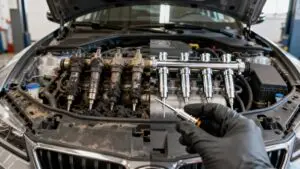





A fluid service costs a few hundred dollars, while solenoid or seal fixes are somewhat more expensive. Rebuilds and remanufactured or new OEM replacements can cost several thousands of dollars or more. The number that actually matters is whether your transmission has a minor, fixable problem or internal damage to the clutch packs and gears. Before you approve any of it, pay for a real diagnostic. A scan tool check and fluid inspection cost far less than guessing wrong.
TL;DR:
- Most transmission problems can be addressed with a diagnostic check costing $150 to $300, avoiding costly guesswork before repairs.
- Rebuilds cost between $1,800 and $4,500, and are best for vehicles with limited internal damage and good resale value when performed by skilled technicians.
- Transmission replacement costs range from $3,000 to over $8,000, with remanufactured units offering factory testing and longer warranties.
- Specialized transmissions like CVT and dual-clutch systems typically cost 20% to 40% more to repair or replace due to proprietary parts and programming.
- Delayed fluid maintenance significantly increases long-term costs, as degraded fluid causes most internal transmission failures.
Table of Contents
- How Much Does Transmission Repair Cost on Average?
- Transmission Repair Cost by Service Type
- What Makes One Transmission Quote Higher Than Another?
- Rebuild vs. Replace: Which One Actually Makes Sense?
- Warning Signs That Determine Your Repair Scope
- How to Lower Your Long-Term Transmission Cost
- Does Transmission Repair Cost Vary by Region or Vehicle?
- Does Vehicle Age or Mileage Change the Repair Cost?
- Will Insurance Cover Transmission Repair Costs?
- How Long Does Transmission Repair Take, and Does It Affect Cost?
- What Kwik Kar Sees When Customers Bring In Transmission Problems
- Get an Accurate Transmission Diagnosis Before You Spend a Dollar
- Sources
- FAQ
How Much Does Transmission Repair Cost on Average?
You’re going to see wildly different numbers depending on where you look, and that’s not because anyone is lying to you. It’s because “transmission repair” covers everything from a $150 fluid top-off to an $8,000 factory replacement, and most articles blend all of it into one confusing average.
Here’s how the ranges actually break down, based on national data from USA Today:
- Fluid service: $150 to $400
- Minor repairs (seals, sensors, small leaks): $200 to $1,500
- Full rebuild: $1,800 to $5,500
- Remanufactured replacement: $3,000 to $6,000
- New OEM replacement: $4,500 to $8,000 or more
Labor often constitutes a significant portion of the repair bill, and shops may charge a diagnostic fee of a few hundred dollars to determine the exact issue before repair. That fee often gets waived or applied toward the repair if you move forward.
Why do published averages swing so much? Three reasons: the data source (dealership pricing skews higher than independent shop averages), your specific vehicle (a CVT costs more to service than a basic four-speed automatic), and your region (labor rates in a major metro differ from a smaller market). RepairPal’s replacement cost estimator is a solid benchmarking tool if you want a second opinion before you commit to a quote.
Transmission Repair Cost by Service Type
Not every transmission problem costs the same to fix, and knowing which category you’re in helps you sanity-check a quote before you sign off on it.
- Fluid service. A flush or fluid exchange is typically the least expensive transmission maintenance and the most effective preventive step.
- Solenoid or sensor replacement. These small electronic components control shift timing and generally cost more than a fluid service. When one fails, you often get harsh or delayed shifts that feel far worse than the actual fix costs.
- Seal and gasket repair ($200-$600). Leaks usually trace back to worn seals rather than internal damage, which makes this one of the more affordable fixes on the list.
- Valve body or torque converter work ($500-$3,500). The valve body directs fluid to control gear changes, and torque converter issues often show up as shuddering at highway speed. Scope varies a lot depending on whether the part needs cleaning, resealing, or full replacement.
- Clutch pack and rebuild work ($2,500-$4,500). Once you’re replacing internal clutch packs, you’re deep into rebuild territory, according to cost data from TheHowMuch.
- CVT and dual-clutch (DCT) repairs. These specialized transmissions run 20% to 40% higher than a standard automatic on comparable repairs, largely because of proprietary parts and programming requirements.
What Makes One Transmission Quote Higher Than Another?
Two shops can look at the same problem and hand you quotes $1,500 apart, and it’s rarely because one of them is padding the bill.
- Where you take it. Dealerships typically charge the highest labor rates, independent general shops fall in the middle, and dedicated transmission specialists often price competitively while bringing more specific expertise to the job.
- Parts you choose. A used transmission is cheapest but carries the least certainty. A remanufactured unit costs more but comes factory-tested with a longer warranty. New OEM sits at the top of the price range and typically only makes sense under manufacturer warranty or for high-value vehicles.
- Programming and calibration. Many modern transmissions need software programming after a replacement, which adds cost. A TCU remap or recalibration sometimes factors in here too, especially on vehicles with modified tuning history.
- Vehicle complexity. Luxury imports, trucks with towing history, and AWD systems all add labor hours and part costs compared to a basic front-wheel-drive sedan.
Rebuild vs. Replace: Which One Actually Makes Sense?
This is the decision that determines whether you’re paying $2,000 or $6,000, and it depends less on brand loyalty and more on math. Rebuilding a transmission means a technician tears the unit down, replaces worn internal components like clutch packs and seals, and reassembles it in place. It’s usually the cheaper path, but the outcome depends heavily on the rebuilder’s skill and the quality of parts used.
- Rebuild: Typically $1,800 to $4,500. Best when the vehicle still has real resale value, the damage is contained, and you trust the shop’s track record.
- Remanufactured replacement: Typically $3,000 to $6,000. The unit is factory rebuilt to precise tolerances and tested before it ships, which is why KBB notes reman units usually carry longer, more consistent warranties than a local rebuild.
- New OEM replacement: $4,500 to $8,000+. Usually reserved for vehicles still under factory warranty or high-value cars where anything less than factory-new isn’t acceptable.
Pro Tip: Ask any shop quoting a rebuild whether the tech is ATRA certified and what specific warranty terms apply in writing. A verbal “12 months” promise means nothing if it’s not on the invoice.
If you want to see what a local rebuild actually involves, Kwik Kar Oil Change & Auto Care’s transmission rebuild process walks through the teardown and reassembly steps in plain language.
Warning Signs That Determine Your Repair Scope
Your symptoms are the first clue to your final bill, so pay attention before you call a shop. Delayed engagement when you shift into drive, slipping gears where the engine revs but the car doesn’t accelerate, a burning smell, whining or grinding noises, fluid leaks, and dashboard warning lights are the most common indicators of a failing transmission.
- A proper diagnostic includes a scan tool check for stored codes, a fluid inspection for color and smell, and a pressure test or valve-body check to isolate mechanical from electronic faults.
- This diagnostic typically costs $150 to $300 and can prevent you from paying for a rebuild when the real problem was a $200 solenoid.
- Write down when symptoms happen (cold starts, highway speeds, towing) since that detail helps a technician narrow the diagnosis fast.
For a deeper look at specific symptoms, see this breakdown of common transmission problem signs.
How to Lower Your Long-Term Transmission Cost
Most expensive transmission repairs start as cheap ones that got ignored. Fluid health is the single biggest lever you control, since degraded fluid is behind most internal transmission failures.
- Service your fluid every 30,000 to 60,000 miles, sooner if you tow or drive in heavy stop-and-go traffic.
- Address a solenoid or seal issue at $200 to $900 rather than letting it snowball into a $3,000+ rebuild six months later.
- Consider financing or a payment plan for larger repairs rather than delaying diagnosis, since delay is what turns a repair into a replacement.
Pro Tip: If your car is worth less than the repair estimate, get a second opinion before you spend a dollar. Sometimes the financially smart move is redirecting that money toward a different vehicle.
Kwik Kar Oil Change & Auto Care’s guide on transmission fluid benefits breaks down exactly what a fluid service does for shift quality and long-term reliability.
Does Transmission Repair Cost Vary by Region or Vehicle?
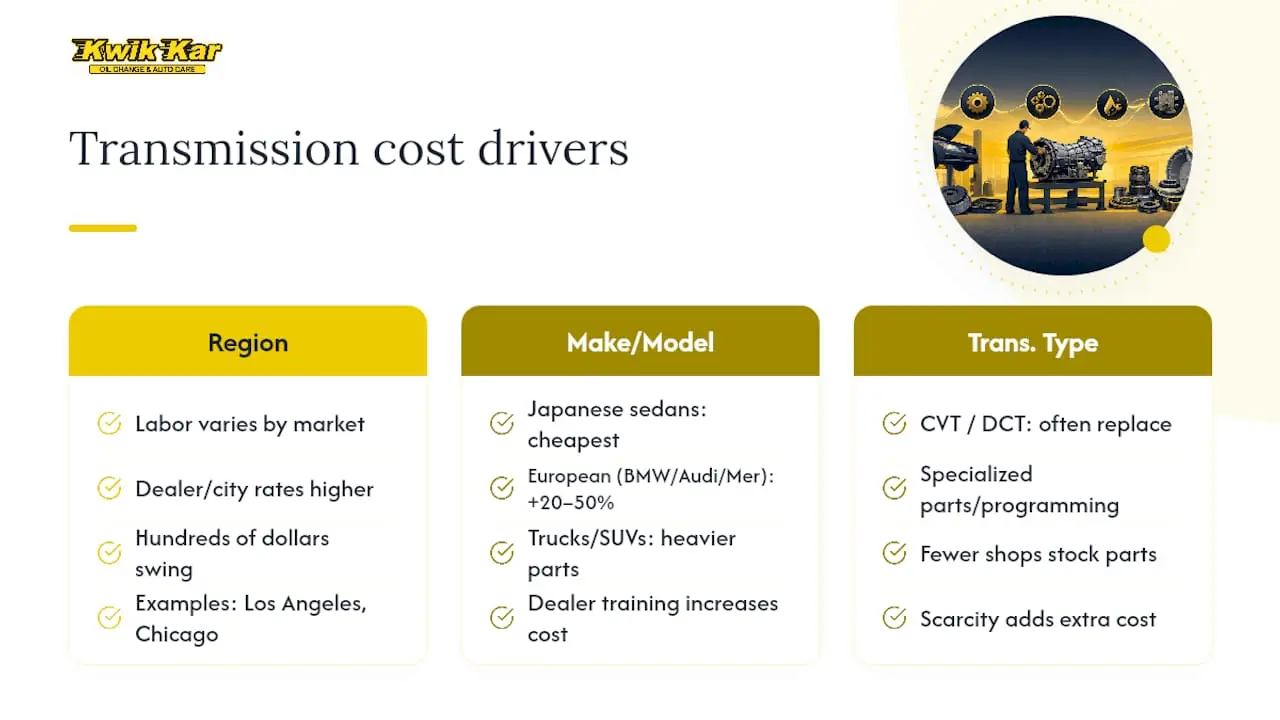
Yes, and the swing can be significant. Labor rates alone shift the total by hundreds of dollars between a major metro shop and a smaller market, since dealership and city labor rates in places like Los Angeles or Chicago typically run higher than in smaller towns.
Vehicle make and model matter just as much as geography. A basic Japanese sedan with a conventional automatic is usually the cheapest transmission to rebuild or replace because parts are common and labor is well documented. European makes like BMW, Audi, or Mercedes often run 20% to 50% higher because of specialized parts, dealer-only software requirements, and technicians who need manufacturer-specific training. Trucks and SUVs with towing packages carry heavier-duty transmissions that cost more in parts even when the labor hours are similar to a sedan.
Hybrid and CVT-equipped vehicles add another layer. Because CVTs and dual-clutch transmissions use specialized components and programming, they tend to push owners toward a full replacement rather than a rebuild, since rebuilding these units requires parts and expertise that fewer shops carry in stock. That scarcity alone can add real cost, independent of the actual mechanical damage.
Before you accept a quote, ask whether the price reflects your specific make and model or a generic average. A shop quoting from real experience with your vehicle will usually have a tighter, more accurate number than one estimating from a national chart.
Does Vehicle Age or Mileage Change the Repair Cost?
Age and mileage don’t directly raise the price of parts or labor, but they change which repair actually makes financial sense. A transmission with 40,000 miles that’s showing early solenoid trouble is a strong candidate for a targeted repair, because the rest of the unit is still relatively fresh and the investment protects a car with plenty of life left.
A transmission with 150,000 miles that’s slipping tells a different story. At that mileage, internal wear on clutch packs, bushings, and seals is often widespread even if only one component is triggering the symptom you noticed first. Rebuilding at that stage can turn into a repeated expense if other components fail within a year or two.
This is where the rebuild vs. replace math gets personal. If your car is older and higher mileage but still runs well otherwise, a quality rebuild or reman unit can extend its life at a fraction of what a new car payment would cost. If the vehicle already has other age-related issues (worn suspension, high oil consumption, an aging cooling system), pouring $4,000 into a transmission may not be the better use of that money. A transmission replacement guide can help you weigh that decision against your car’s overall condition rather than the transmission in isolation.
Will Insurance Cover Transmission Repair Costs?
Standard auto insurance almost never covers transmission repair or replacement when the cause is normal wear and tear or lack of maintenance. Comprehensive and collision coverage are built around accidents, theft, weather damage, and similar events, not mechanical failure from age or mileage.
There are exceptions. If your transmission was damaged as a direct result of a covered accident (a collision that ruptured the transmission housing, for example), your collision coverage may pay for that specific repair. If you’re financing a newer vehicle and carrying a mechanical breakdown insurance policy or an extended warranty purchased separately from your regular auto policy, that coverage can apply to transmission failure. Manufacturer warranties on new vehicles typically cover the powertrain, including the transmission, for a set number of years or miles, which is why replacement costs on a newer car are often a warranty claim rather than an out-of-pocket expense.
If you’re outside of warranty and without a mechanical breakdown policy, plan on paying directly. This is where financing options and payment plans become genuinely useful tools rather than a last resort, since a $3,000 to $6,000 bill rarely fits comfortably into a monthly budget without some kind of structured payment.
How Long Does Transmission Repair Take, and Does It Affect Cost?
Timeline and cost are connected more than most people expect. A basic fluid service takes under an hour and is priced accordingly. A solenoid or sensor swap usually takes half a day to a full day, since the transmission pan often needs to come off to access the part.
Rebuilds take longer: expect two to five days depending on parts availability and how much teardown is required. That timeline reflects real labor hours, not shop inefficiency, since a technician has to disassemble the unit, inspect every component, source replacement parts, rebuild, and then road test the vehicle before handing it back.
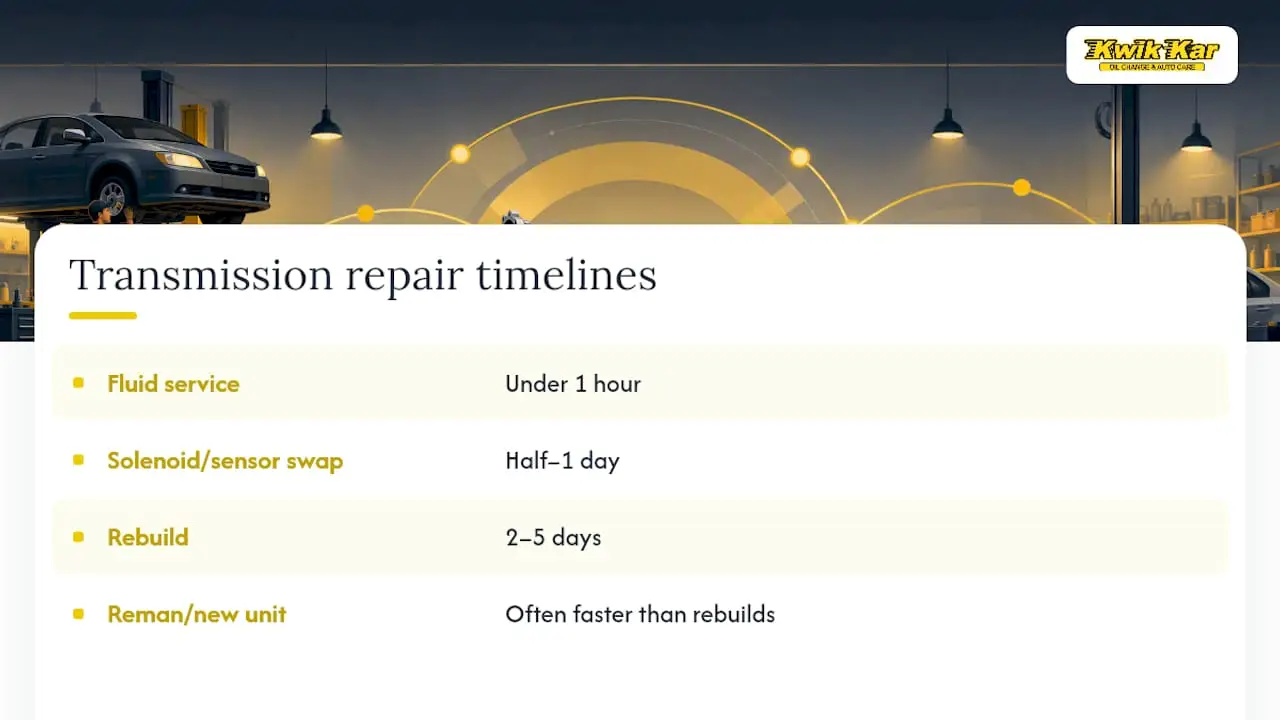
Replacements with a remanufactured or new OEM unit can sometimes move faster than a rebuild, ironically, because the replacement unit arrives ready to install rather than needing to be built from your car’s original parts. That’s part of why reman units carry a cost premium. You’re paying for both consistency and turnaround speed. Rush jobs or same-day promises on major transmission work are worth questioning. Quality diagnostic and rebuild work takes the time it takes, and a shop that skips steps to hit an unrealistic deadline is a shop cutting corners you’ll pay for later.
What Kwik Kar Sees When Customers Bring In Transmission Problems
Most transmission visits at Kwik Kar Oil Change & Auto Care start the same way: a scan tool check, a fluid inspection, and a plain-language conversation about what the codes and symptoms actually mean. Our certified technicians walk customers through rebuild, reman, and replacement options with real cost and warranty differences spelled out before any work begins. That’s the same standard behind our RepairPal certification: transparent pricing and no upsell pressure. If a shop can’t explain why a rebuild costs less than a replacement in your specific case, that’s worth a second opinion.
— Kwik Kar
Get an Accurate Transmission Diagnosis Before You Spend a Dollar
A guessed repair costs more than a diagnosed one, every time. Kwik Kar Oil Change & Auto Care runs a full scan and fluid check before recommending anything, so you’re paying for the actual problem instead of a shop’s best guess.

That diagnostic includes the same scan tool and fluid inspection covered earlier, plus a straightforward explanation of whether you’re looking at a minor fix, a rebuild, or a full replacement. Our transmission service page covers what’s included and how our certified technicians approach each repair. If the estimate lands higher than your budget allows right now, our auto repair financing options break down payment plans that spread the cost without delaying the repair. Call to schedule a diagnostic, or book online, and get a real number instead of a guess.
Sources
- Signs of a bad transmission | AutoZone
- Signs your transmission is about to fail | USA Today
- How much does transmission repair cost? | TheHowMuch
- Transmission repair and replacement | KBB
- Transmission problem warning signs | Valvoline
FAQ
Is It Worth Fixing the Transmission on a Car?
It usually is if the vehicle still has meaningful resale value and the repair cost stays well under half of what the car is worth. If the estimate approaches or exceeds the car’s value, replacing the vehicle often makes more financial sense than replacing the transmission.
What Are the Signs of a Bad Transmission?
Delayed engagement, slipping gears, burning smells, whining or grinding noises, fluid leaks, and dashboard warning lights are the primary warning signs of transmission trouble. Any combination of these warrants a diagnostic before the problem worsens.
What Is the Biggest Killer of Transmissions?
Degraded or low fluid is the leading cause of transmission failure, since fluid health directly affects internal wear on clutch packs and seals. Skipping recommended fluid service intervals is the single most preventable mistake owners make.
Is It Cheaper to Replace an Engine or Transmission?
Transmission rebuilds and replacements are generally comparable in cost to engine work at similar scope, though a full engine replacement often runs higher due to more complex labor and larger part costs. Both repairs follow the same logic: rebuild when damage is contained and the vehicle has value, replace when you need consistent, warrantied reliability.
How Much Does a Transmission Diagnostic Cost?
A proper diagnostic, including a scan tool check and fluid inspection, typically costs $150 to $300 and is often applied toward the repair if you move forward with the shop.