




Your car starts acting different before it quits. Maybe it hesitates when you shift into drive. Maybe it flares between gears, bangs into gear, or leaves you with that sick feeling that something expensive is coming. By the time most owners start searching for answers, they're not looking for theory. They want to know two things fast. Is the transmission failing, and what's the smartest way to deal with it without wasting money?
That's the right way to think about replacing a transmission. The mechanical work matters, but the bigger mistake usually happens before the wrench turns. Owners get rushed into the wrong repair, the wrong replacement unit, or the wrong shop. A transmission job is too expensive for guesswork.
The good news is that you can approach it logically. If you understand the symptoms, the replacement choices, the primary cost drivers, and the quality checkpoints that separate a durable repair from a comeback, you can make a sound decision even if you're not a mechanic.
Is Your Transmission Failing? Signs and Diagnosis
The most common starting point is uncertainty. The car still moves, so you wonder if it's safe to keep driving. Or the check engine light is on, but you're hoping it's something minor.

Transmission problems have also become more common as vehicles stay on the road longer. In 2024, over 65% of vehicles on the road exceeded 10 years of age, directly driving a 24% increase in transmission repairs globally, according to SNS Insider's transmission repair market report. If your vehicle is older or higher mileage, you're not dealing with an unusual situation.
Symptoms that deserve attention
A failing transmission rarely announces itself with one neat symptom. It usually shows up as a pattern.
Watch for these issues:
- Delayed engagement: You shift into drive or reverse and the vehicle pauses before moving.
- Slipping: Engine RPM rises, but the vehicle doesn't accelerate the way it should.
- Harsh shifting: Gear changes feel abrupt, heavy, or jarring.
- Unusual noises: Whining, humming, clunking, or grinding during acceleration or shifting.
- Burning smell: Overheated transmission fluid has a sharp, burnt odor.
- Warning lights: A check engine light or transmission warning light can point to stored trouble codes.
Some of these symptoms can overlap with engine, driveline, or electronic control problems. That's why diagnosis matters more than assumptions.
Don't approve a replacement just because the vehicle “feels bad.” Confirm whether the problem is inside the transmission, in the control system, or somewhere else in the drivetrain.
A practical owner checklist
Before you call a shop, gather a few useful observations. This helps a technician narrow the problem faster and helps you describe the complaint clearly.
Check the fluid condition
If your vehicle has a dipstick and the manufacturer allows it, look at the transmission fluid. Healthy fluid is typically clean and not burnt. Dark, contaminated, or burnt-smelling fluid raises concern.Notice when the problem happens
Cold start only? Hot after driving? Only on upshifts? Only in reverse? Those details matter.Listen carefully
A whine under load points technicians in one direction. A clunk on engagement points in another. Try to identify whether the sound happens at takeoff, during shifts, or at highway speed.Pay attention to dashboard behavior
If the check engine light came on after a harsh shift, say so. If cruise control stopped working at the same time, mention that too.Stop driving if it's slipping badly
Continued driving can turn a repairable situation into a full replacement.
For a broader symptom checklist, this guide to signs of transmission problems is a useful starting point before you schedule an inspection.
What diagnosis should look like
A proper transmission diagnosis includes more than a short drive around the block. A technician should confirm the complaint, scan the vehicle, inspect fluid condition, and rule out outside causes like wiring faults, cooler flow issues, or mount and driveline problems. Sometimes the transmission is failing internally. Sometimes the transmission is being commanded badly because another system has a fault.
That distinction is everything. Replacing a transmission won't fix a bad wiring issue, and fluid service won't save a unit with severe internal damage.
New, Rebuilt, or Used? Choosing Your Transmission
Once replacement is confirmed, this becomes the most important financial decision in the whole job. Not labor. Not scheduling. The unit you choose.
Many consumer guides gloss over this point, but the choice between a used or remanufactured transmission is a frequently underexplained decision point, especially for owners trying to balance cost, downtime, and warranty risk, as noted in this discussion of replacement tradeoffs.
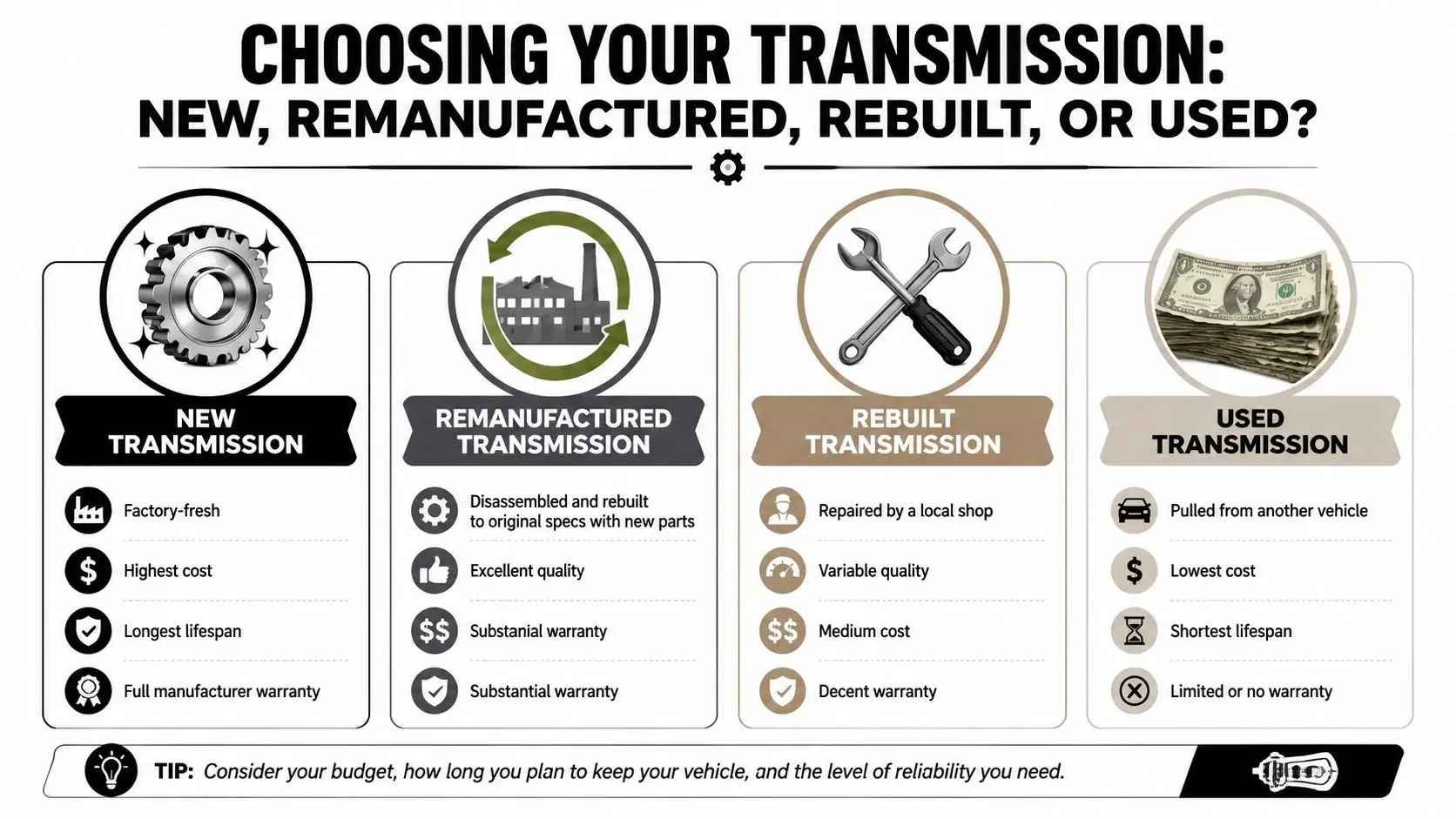
Transmission Replacement Options Compared
| Option | Average Cost (Parts Only) | Typical Warranty | Reliability Outlook | Best For |
|---|---|---|---|---|
| New | Qualitatively the highest parts cost | Usually strongest manufacturer-backed coverage | Best odds of factory-level consistency | Newer vehicles, long-term ownership, owners who want the least compromise |
| Remanufactured | Often below new, above rebuilt or used | Usually stronger than used and often stronger than local rebuilds | Strong when built to original specifications with updated components | Owners keeping the vehicle and wanting a balance of cost and durability |
| Rebuilt | Varies widely by shop and parts replaced | Depends heavily on the rebuilder and scope of work | Can be good or inconsistent | Vehicles where a trusted specialist is doing the work and the failure is clearly understood |
| Used | Usually lowest upfront parts cost | Often limited | Highest uncertainty because wear history is unknown | Lower-value vehicles, short-term ownership, strict budget situations |
How I'd frame the decision
A new transmission is the cleanest answer on paper. It's factory fresh, and it removes a lot of uncertainty. The problem is cost. On many older vehicles, the price of a new unit can push the repair close to what the car is worth.
A remanufactured transmission is often the best middle ground for owners who plan to keep the vehicle. A proper reman unit is fully disassembled, inspected, rebuilt to spec, and fitted with replacement parts where needed. It usually makes the most sense when you want predictability without paying the premium for new.
A rebuilt transmission can be a smart choice, but only if you trust the shop doing the rebuild and understand exactly what “rebuilt” means in that case. Some rebuilds are thorough. Some are limited repairs to address a specific failure. Those are not the same thing.
A used transmission is where people either save money intelligently or buy the same problem twice. Used units make sense when the vehicle's value is modest, the budget is tight, and you're realistic about risk. They make less sense when you need dependable long-term service and can't afford repeated downtime.
Practical rule: Match the transmission option to how long you plan to keep the vehicle, not just to what hurts least today.
A better decision framework
Use these questions:
How long will you keep the vehicle?
If you're keeping it for years, a stronger replacement unit usually makes more sense than the cheapest available option.What is the vehicle worth to you?
Not just market value. Think about condition, maintenance history, and replacement cost for another vehicle.Can you tolerate downtime?
Fleet vehicles, work trucks, and daily commuters usually need a more predictable solution.How risk-sensitive are you?
If one breakdown would create a major hardship, don't buy uncertainty to save money upfront.What warranty is in writing? Always ask whether the warranty covers parts, labor, or both, and what could void it.
The wrong unit is often more expensive than the expensive unit. If a used transmission fails early, you may end up paying labor twice, buying fluid twice, and losing confidence in the vehicle altogether.
How Much Does Replacing a Transmission Cost?
This is the figure many drivers seek first, and it is a reasonable question. The average transmission replacement costs between $4,000 and $7,000, while preventive maintenance over 150,000 miles typically totals $1,000 to $2,250. That means for every dollar spent on preventive maintenance, drivers can potentially save $2 to $4 in future repair costs, based on this maintenance and replacement cost breakdown.

That range exists because a transmission job isn't one line item. It's a stack of decisions and requirements.
What you're paying for
The final bill usually comes from three buckets.
The transmission unit itself
New, remanufactured, rebuilt, or used will change the invoice substantially.Labor
This is a major part of replacing a transmission because the job involves heavy removal, reinstall, setup, and testing.Supporting materials and related parts
Fluid, gaskets, seals, filters, and sometimes mounts, coolers, or external components need attention at the same time.
If you've ever wondered why labor adds up quickly on major repairs, this explanation of why mechanics charge so much gives useful context around tooling, training, and time-intensive work.
Why some estimates look low and then change
A low quote can leave out important parts of the job. It may not include related failures discovered during teardown. It may assume a certain replacement unit that isn't available. Or it may skip quality-control steps that don't look exciting on paper but matter later.
That's why I tell owners to ask what the estimate includes, not just what the total is.
Here's a useful visual overview of the cost conversation:
Downtime matters too
Replacing a transmission usually isn't a quick in-and-out service. The shop has to diagnose correctly, source the right unit, remove the old transmission, inspect related components, install the replacement, fill and verify fluid correctly, and complete testing. If anything else is found during the process, the clock extends.
That matters for daily drivers and even more for work vehicles. A cheaper option that creates more downtime may not be cheaper in real life.
A transmission estimate should answer two questions at once. What will this cost, and what risk am I buying at that price?
What Happens During a Transmission Replacement
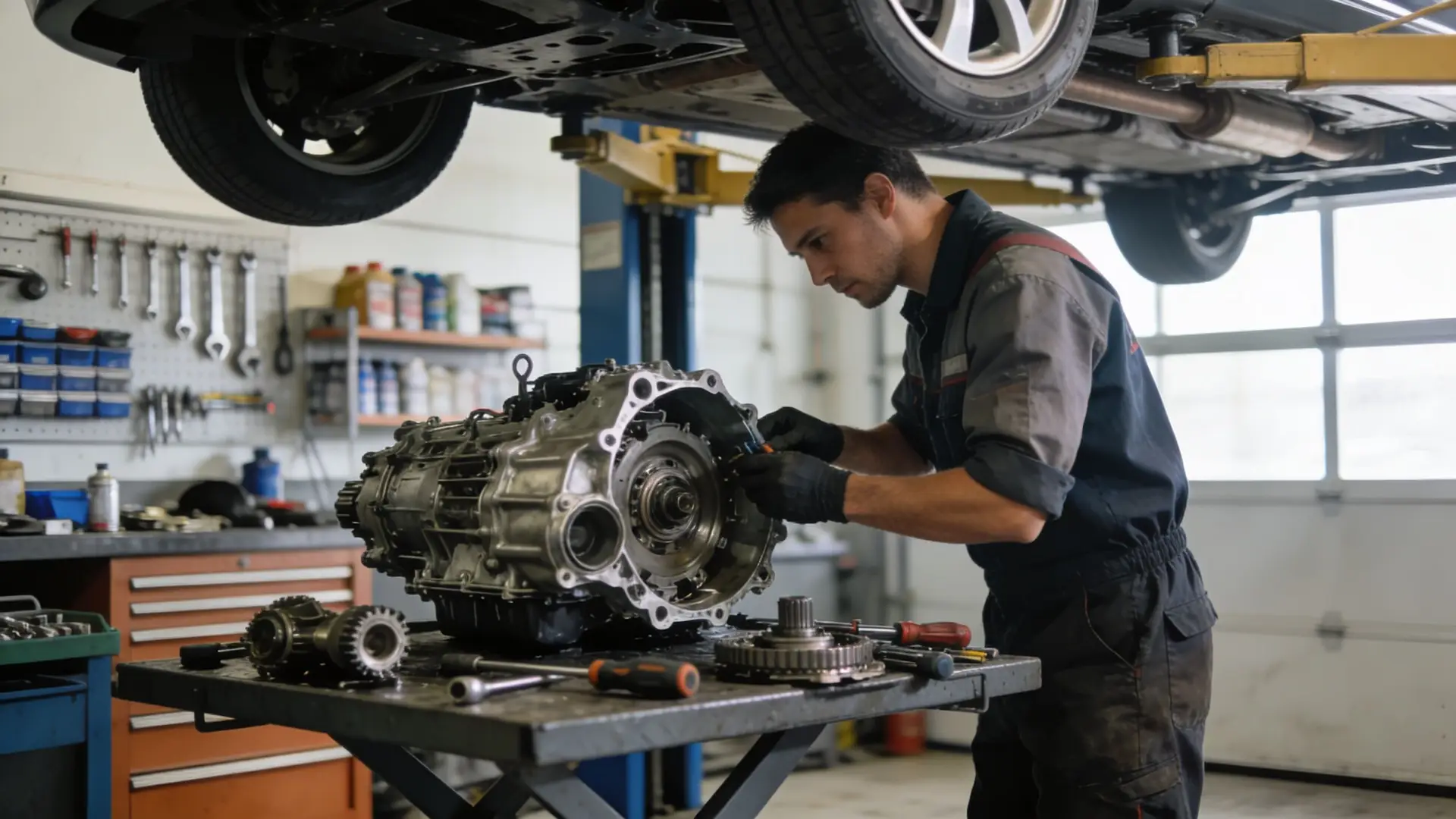
Most owners never see the actual job, so the repair can feel mysterious. It shouldn't. A professional transmission replacement follows a clear sequence, and each step has a reason.
The vehicle is confirmed before parts are ordered
A careful shop doesn't rush to pull the transmission just because the symptoms seem obvious. The first stage is confirming that replacement is necessary. That includes scanning for codes, checking operation, evaluating fluid, and looking at related systems that can affect shift behavior.
If replacement is the right call, the technician identifies the correct transmission and any related hardware or service items needed for the installation.
Removal is heavy work, but precision matters more than force
Once the vehicle is safely lifted, the transmission has to be separated from everything that connects it to the rest of the drivetrain and vehicle systems. That can include driveshafts or axle assemblies, cooling lines, electrical connectors, shift linkage, crossmembers, mounts, and the torque converter area.
Professional experience proves its value here. Connectors break when rushed. Cooler lines get contaminated when handled carelessly. Fasteners get damaged when the wrong tools or procedures are used.
The replacement unit then goes in with attention to alignment, torque specifications, fluid fill procedure, and all the details that keep leaks and drivability problems from showing up later.
The part many shops miss
Modern transmissions don't just rely on hard parts. They also rely on software logic and learned behavior. Failure to properly reset and relearn a transmission's adaptive strategies post-replacement results in harsh shifting and premature damage in approximately 15% to 20% of jobs, according to GEARS Magazine's guidance on transmission replacement procedures.
That matters because the control module may still be trying to operate the new transmission using learned values from the failed one.
If a shop can't explain how it handles adaptive reset and relearn, that's a warning sign.
Relearn procedures are not optional
Different manufacturers handle this differently. Some vehicles require battery disconnect and memory reset procedures. Others require scan-tool functions and prescribed drive cycles. A proper installation includes following the manufacturer's process so the vehicle can calibrate shift timing and pressure to the replacement unit.
This is one area where modern transmission work separates itself from old-school mechanical swapping. You're not just replacing a gearbox. You're integrating a component into a controlled electronic system.
Final inspection before delivery
Before the vehicle goes back to the owner, a good shop checks for leaks, verifies engagement, confirms shift quality, and reviews fluid level using the correct procedure for that transmission. Any warning lights, abnormal noises, or irregular shift events have to be resolved before handoff.
When replacing a transmission goes well, the owner notices confidence more than drama. The vehicle engages properly, shifts cleanly, and behaves consistently. That's the outcome you're paying for.
DIY Transmission Replacement vs Professional Service
Some owners are capable with tools. They've done brakes, suspension work, maybe even engine repairs. Replacing a transmission still belongs in a different category.
The first issue is equipment. This job is far easier and far safer with a hydraulic lift, a transmission jack, calibrated torque wrenches, and OEM-grade scan tools. Doing the same work on the ground with improvised support adds risk immediately. The transmission is heavy, awkward, and not forgiving if it shifts unexpectedly.
Where DIY usually goes wrong
The problem usually isn't effort. It's missing one critical piece.
A home mechanic may get the old unit out and the replacement installed, then run into one of these issues:
- Improper torque converter installation causing damage on startup
- Missed electrical or cooler line problems that affect operation after install
- Incorrect fluid fill procedure on a unit that has strict temperature-based checking
- No adaptive reset or relearn capability after replacement
- No practical warranty backup if the unit or installation has a problem
Those aren't minor details. Any one of them can ruin an expensive transmission quickly.
Safety has to be part of the decision
This isn't just a technical challenge. It's a physical hazard. Supporting a vehicle improperly, balancing a transmission without the right jack, or working under a drivetrain that isn't secured correctly can lead to serious injury.
There's also the risk of false savings. If the DIY install goes wrong, the owner often ends up paying for towing, replacement parts, more fluid, and professional correction work. At that point, the labor savings are gone.
A transmission replacement is one of those repairs where “I can probably do it” isn't the same as “I should do it.”
For simple maintenance, DIY can make sense. For replacing a transmission, professional service is usually the safer and cheaper path once you account for tools, setup, diagnostics, and the cost of getting one detail wrong.
Choosing a Shop and Maintaining Your New Transmission
By the time you're ready to approve the repair, the unit choice and the shop choice should work together. A good transmission installed poorly is still a bad outcome. A modestly priced unit installed and validated correctly can serve well.
What to ask before you authorize the job
Use a short checklist when you talk to a shop:
Ask about technician qualifications
ASE credentials matter because transmission work combines mechanical skill with electronic diagnosis.Ask what replacement options they offer
You want a clear explanation of new, remanufactured, rebuilt, and used, plus the tradeoffs of each.Ask for the warranty in writing
Verbal reassurance isn't enough. Get the coverage terms on parts and labor.Ask how they verify the repair
A professional answer should include diagnostics, fluid verification, and road testing.Ask how they communicate during the job
On major repairs, you need updates when parts availability changes or related issues are found.
For local owners comparing providers, this list of transmission shops in Fort Worth, TX can help with early screening.
What quality control should look like
Professional shops separate themselves in this regard. Professional transmission replacement involves a multi-stage testing protocol that ensures a 99%+ installation success rate. This includes in-shop diagnostics and a post-service road test to validate performance under load, catching 85% to 90% of potential issues before customer delivery, according to Mister Transmission's step-by-step explanation of the replacement process.
That kind of process matters more than polished sales language. It means the shop is looking for hydraulic leaks, control issues, and drivability problems before you get the keys back. Kwik Kar Oil Change and Auto Care is one local option that also offers transmission service and flush work for ongoing maintenance, which can be useful when the issue is service-related rather than replacement-related.
How to protect the replacement
After the job, don't treat the vehicle like nothing happened. Follow the shop's instructions. Pay attention to break-in guidance if they provide it. Return promptly if you notice a leak, warning light, delayed engagement, or unusual shift feel.
Long term, the basics still matter. Keep the fluid service schedule current, address cooling issues quickly, and don't ignore early symptoms. A new transmission can fail for the same reasons the old one did if the underlying causes aren't corrected.
Replacing a transmission is expensive, but it doesn't have to be confusing. If you choose the right unit for your goals, insist on proper installation procedures, and work with a shop that can explain its testing process clearly, you'll make a far better decision than someone who shops on price alone.
If you're weighing whether to repair, rebuild, or move forward with replacing a transmission, Kwik Kar Oil Change and Auto Care can help you review the options, understand the tradeoffs, and decide on a practical next step for your vehicle.