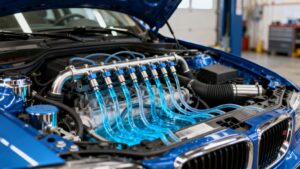
When you turn the heat on and get hit with a blast of frigid air, it’s not just uncomfortable—it's your car telling you something isn't right. The good news is, you can often figure out what's wrong by starting with the simplest checks. Before you even think about a complicated repair, make sure your coolant level is full and your engine is up to its normal operating temperature.
A lot of the time, the fix is as simple as topping off the coolant or dealing with a faulty thermostat. These are common culprits and much easier to tackle than a deep-dive into the dashboard.
Why Is My Car Heater Blowing Cold Air?
Your car's heating system is actually a clever bit of recycling. It uses the massive amount of heat your engine generates anyway. A special fluid, the coolant (or antifreeze), circulates through the engine to pull that heat away and prevent overheating.
Part of that hot coolant's journey takes it through a small radiator-like component tucked away behind your dashboard called the heater core. Your blower fan then pushes air across this hot core, warming it up before it flows out of your vents and into the cabin. When any piece of that system breaks down, you're left shivering.
Common Reasons Your Car Heater Is Not Working
Before you start picturing a huge repair bill, let’s walk through the usual suspects. Most of the time, a heater problem comes down to one of these five issues.
- Low Coolant Level: This is hands-down the most common reason for a heater to fail. If there isn't enough coolant in the system, it can't make it to the heater core to provide heat. Simple as that.
- Stuck Thermostat: This little valve controls your engine's temperature. If it gets stuck open, the engine never properly warms up, meaning the coolant never gets hot enough to heat your car.
- Clogged Heater Core: Think of it like a clogged artery. Over time, gunk, rust, and debris in the cooling system can build up and block the small passages in the heater core, stopping the flow of hot coolant.
- Faulty Blower Motor: If you get no air at all from your vents—hot or cold—the problem isn't the heat, it's the fan. The blower motor is responsible for pushing the air through the system.
- Blend Door Actuator Failure: Inside your dash, a small door pivots to mix hot and cold air to get your desired temperature. If the little motor that controls this "blend door" dies, it can get stuck on the cold side.
This flowchart is a great visual tool to help you connect what you’re experiencing to the most likely cause.
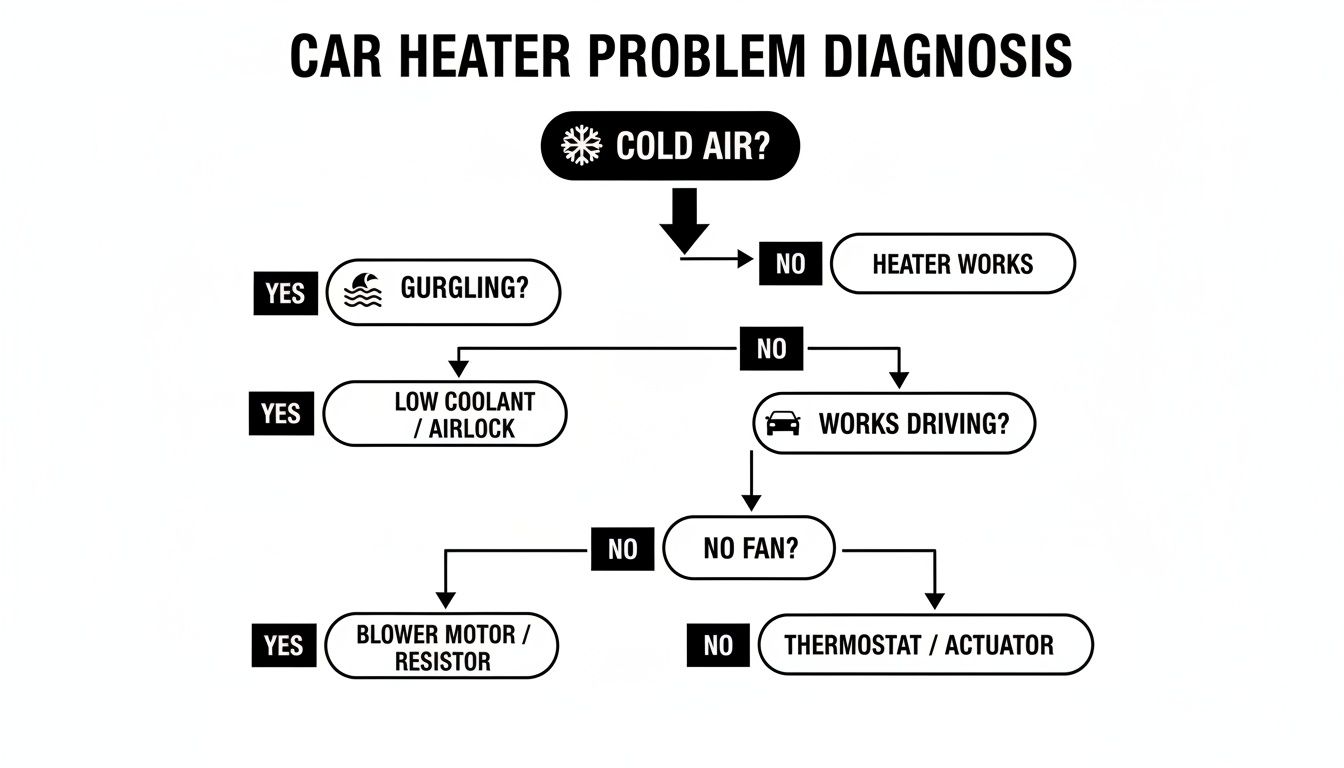
As you can see, certain symptoms like a gurgling noise or the heater only working when you're driving fast are dead giveaways that point you straight to either a coolant or thermostat issue.
To help you get started, here's a quick reference table. Just find the symptom that matches what's happening with your car to see the most likely cause.
Quick Diagnostic Guide for Car Heater Problems
| Symptom You Are Experiencing | Most Likely Cause | What to Check First |
|---|---|---|
| No air blowing from the vents at all | Faulty Blower Motor | Check the fuse for the blower motor |
| Air blows, but it's always cold | Low Coolant or Thermostat | Check the coolant level in the reservoir |
| Gurgling sound from the dashboard | Low Coolant (Air in system) | Check the coolant level and look for leaks |
| Sweet, syrupy smell inside the cabin | Leaking Heater Core | Check for dampness on the passenger-side floorboard |
| Heater only works when driving at high speeds | Low Coolant or Thermostat | Check coolant level; if full, suspect the thermostat |
| Fan only works on the highest setting | Blower Motor Resistor | The resistor is likely burned out |
This table is just a starting point, but it covers the vast majority of heater problems we see.
Listening to Your Vehicle's Symptoms
Your car is pretty good at telling you what’s wrong if you know how to listen. Paying attention to the little details can save you hours of guesswork.
For instance, do you hear a gurgling sound from behind the dashboard when you first start the engine? That's almost always the sound of air bubbles trapped in the cooling system, which is a classic sign of low coolant.
Another tell-tale sign is a heater that blows warm when you’re on the highway but turns cold the second you stop at a red light. This scenario screams "stuck-open thermostat" or, less commonly, a failing water pump.
Key Takeaway: The symptoms are your best diagnostic tool. That sweet, antifreeze smell in the cabin is a dead giveaway for a leaking heater core. A fan that only works on its highest speed points directly to a failed blower motor resistor.
By carefully observing the "when" and "how" of the failure, you can narrow down the possibilities before you even pick up a tool. This first step is crucial. It helps you figure out if you're dealing with a simple fix or something more serious. For a deeper look into decoding your car's signals, check out our guide on how to diagnose problems with your car. From there, you'll know exactly what to do next.
Gathering Your Tools for Heater Repair
Before you even think about popping the hood, let’s talk tools. Nothing kills the momentum of a DIY repair faster than frantically digging through a messy toolbox for that one socket you need right now. Having everything you need laid out and ready to go makes the job smoother, safer, and a whole lot less frustrating.
The good news? You don’t need a professional mechanic's setup to tackle most of the common heater problems. A solid set of basic hand tools will get you through the majority of these fixes.
The Essential DIY Toolkit
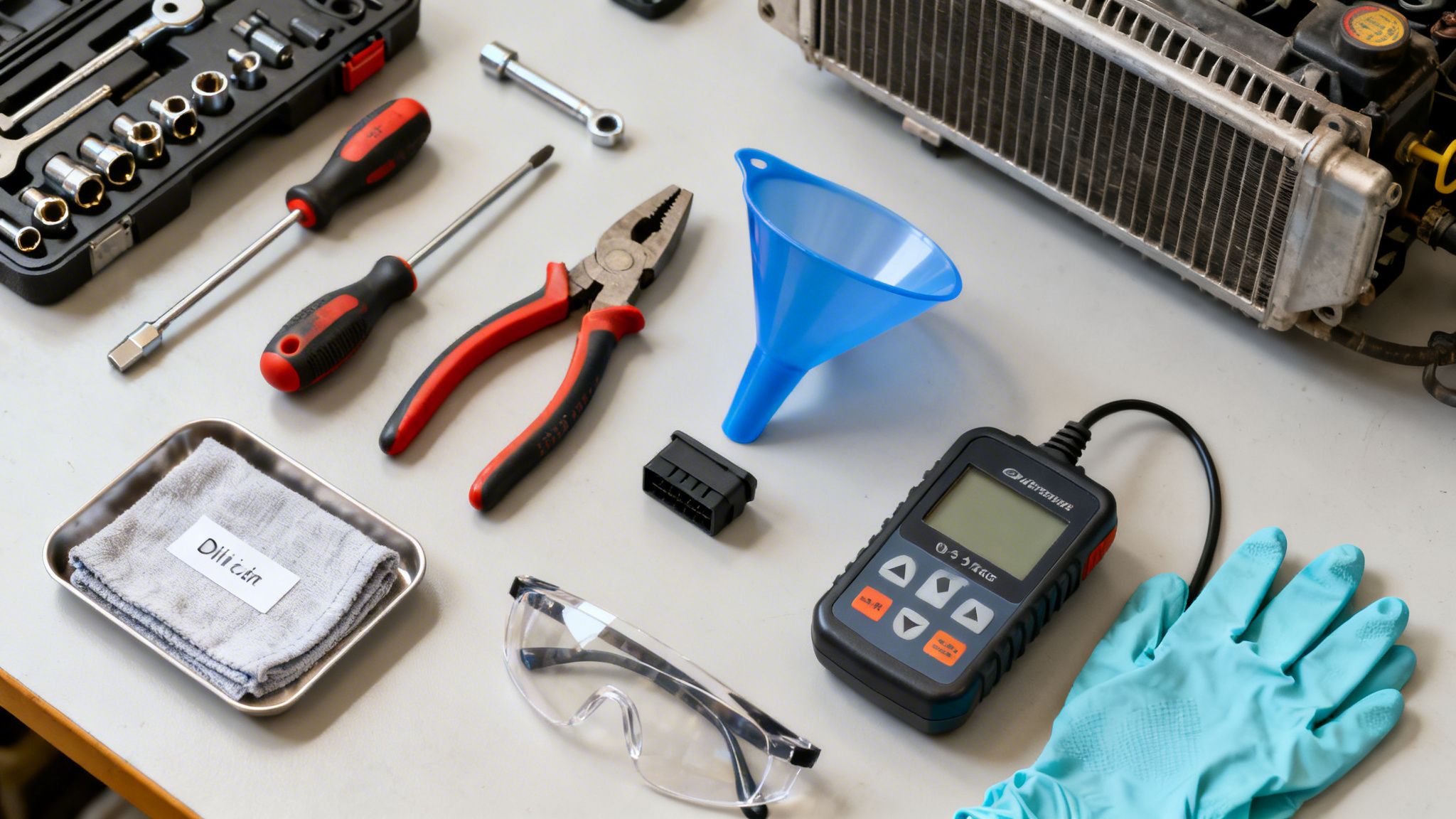
For the diagnostics and repairs we’re about to walk through, these are the core items you'll want within arm's reach. Think of this as your starting lineup for getting that heat blowing again.
- Socket Set with Ratchet: This is your MVP. You'll need a range of metric sizes, usually from 8mm to 14mm, for everything from hose clamps to the thermostat housing.
- Screwdriver Set: You can't get far without a good mix of Phillips and flat-head screwdrivers. They’re crucial for prying off interior trim panels and loosening various clamps.
- Pliers: A few different types—needle-nose, slip-joint, and channel-lock—are incredibly handy. They’re perfect for grabbing stubborn hoses and wrestling with spring clamps in tight engine bays.
- Drain Pan or Bucket: When you’re working on the cooling system, spills are going to happen. A drain pan is a must-have for catching coolant and keeping your garage floor clean.
With these basics, you’re well-equipped for a coolant flush or a thermostat swap. But if you want to make your life a lot easier, a couple of extra items are worth their weight in gold.
Tools That Make the Job Easier
While not absolutely essential, adding these to your collection can save you a ton of guesswork and hassle, especially when you're dealing with the cooling system. Proper preparation with the right your tools is half the battle.
OBD-II Scanner
If that check engine light is staring you in the face, this little gadget is a lifesaver. It plugs in right under your dashboard and reads the trouble codes your car's computer has stored. A code like P0128 can point you directly to a bad thermostat, saving you from a wild goose chase.
Spill-Free Coolant Funnel
Trust me, this thing is a game-changer. It locks onto your radiator or coolant reservoir, letting you pour in new fluid without making a mess. More importantly, it’s the best way to properly "burp" the cooling system—a vital step to remove trapped air bubbles that cause overheating and, yes, a heater that blows cold.
Pro Tip: Never, ever work on a hot engine. The cooling system is under pressure, and the coolant can easily be over 200°F (93°C). Popping a hot radiator cap is a recipe for serious burns. Let everything cool down completely.
Finally, don't skimp on safety gear. A decent pair of mechanic's gloves will save your hands from cuts, grease, and hot parts. Safety glasses are non-negotiable—you do not want coolant splashing in your eyes. With your gear ready, you’re set to figure out what’s wrong and get it fixed.
Practical DIY Fixes for Your Car Heater
Alright, you’ve gathered your tools and have a good idea of what might be causing the trouble. It’s time to get your hands dirty and learn how to fix a car heater. We'll walk through the most common fixes you can tackle yourself, starting with the easiest and most frequent culprit: your coolant.
These repairs are totally approachable for a weekend mechanic. Just remember to put safety first—always work on a cool engine and wear your gloves and glasses.
Addressing Low Coolant and Trapped Air
More often than not, a heater blowing cold is a direct result of low coolant. When that level drops, air gets sucked into the system, creating big pockets that stop hot coolant from circulating through the heater core. Think of it like a stubborn air bubble in a water pipe blocking all the flow.
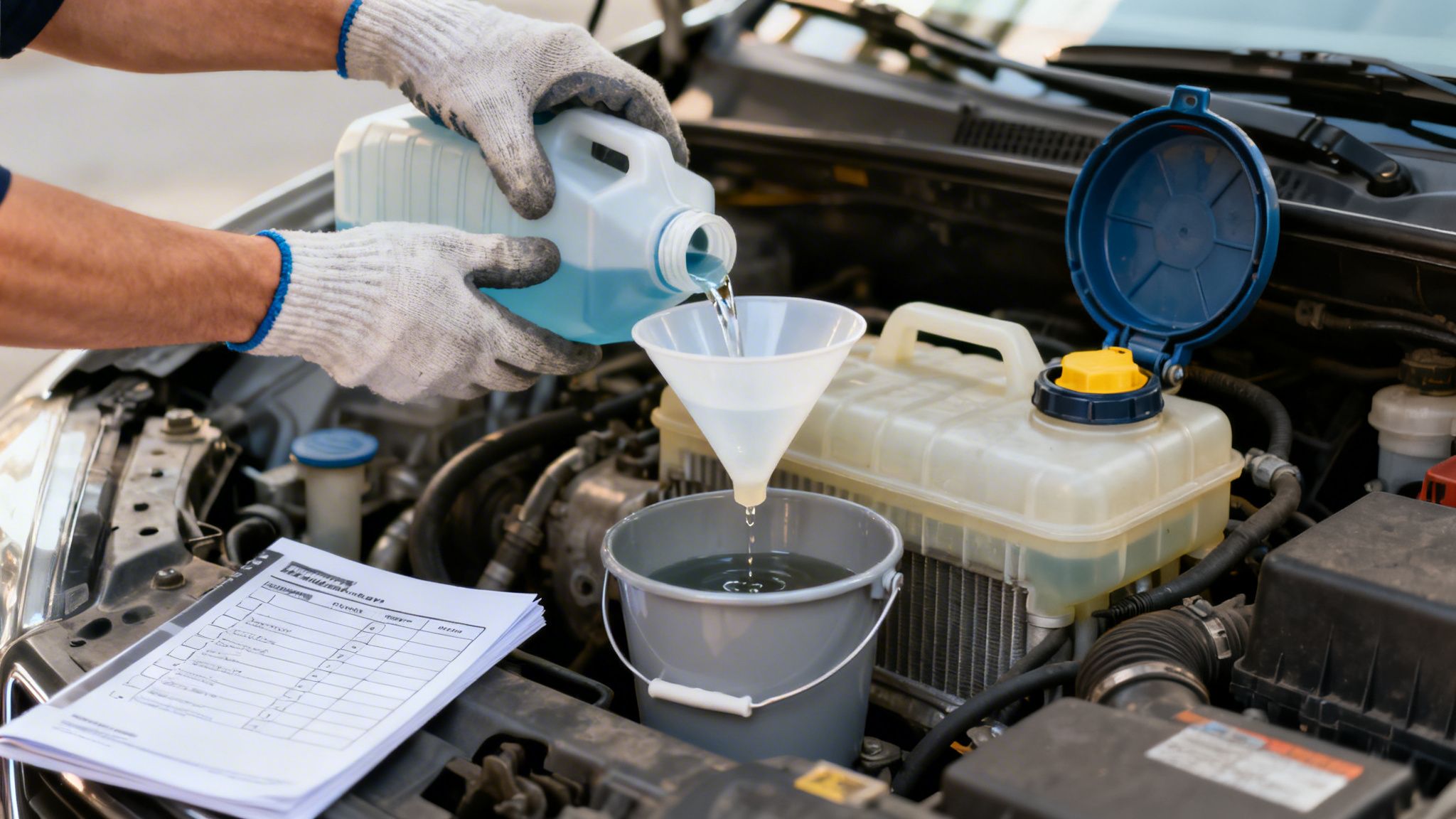
First thing's first, find your coolant reservoir. It’s that semi-transparent plastic tank near the radiator with "MIN" and "MAX" lines etched on the side. If the fluid is dipping below the "MIN" line, you've almost certainly found your problem.
Getting Your Coolant Service Right
- Grab the Right Coolant: Not all antifreeze is created equal. Your car needs a specific type (like HOAT or OAT) and color (green, orange, pink). Double-check your owner's manual because using the wrong stuff can cause some serious internal damage.
- Top Off the Reservoir: Make sure the engine is completely cool. Then, slowly add the correct coolant until the level hits the "MAX" line. Don't go past it.
- Bleed the Air Out: This is the most important part. To get rid of that trapped air, you have to "burp" the system. A spill-free funnel kit makes this job incredibly easy and mess-free. Just attach it to the radiator, fill it partway with coolant, and start the engine with the heater blasting on high. You’ll see bubbles rising through the funnel—that’s the air escaping. Let it run until the bubbles stop completely.
Real-World Tip: Always slide a large drain pan or bucket under the car before you start. Even if you're careful, some spillage is bound to happen. Antifreeze is highly toxic to pets, so a thorough cleanup is non-negotiable for their safety.
Replacing a Faulty Thermostat
If your coolant level is perfect but your temperature gauge never seems to climb to its normal halfway point, you’re probably looking at a thermostat that's stuck open. It's just a small, cheap valve that controls the engine's temperature, and swapping it out is a classic DIY job that can bring your heat right back.
You'll usually find the thermostat inside a metal "housing" where the upper radiator hose connects to the engine block. Look for a dome-shaped part held on by two or three bolts.
A Quick Guide to Thermostat Replacement
- Drain a Little Coolant: You don't need to empty the whole system. Just drain enough so the coolant level is below the thermostat housing. Use that drain pan to catch it.
- Remove the Housing: Loosen the hose clamp and wiggle the radiator hose off the housing. Then, unbolt the housing itself. It might be stuck on there pretty good, so a gentle tap with a rubber mallet can help break the seal.
- Swap the Thermostat: Pay close attention to how the old thermostat is sitting before you pull it out. The new one has to go in the exact same way.
- Clean Everything Up: Scrape off all the old gasket gunk from both the engine block and the thermostat housing. You need a perfectly clean surface to get a good seal.
- Install and Refill: Pop in the new gasket and thermostat, bolt the housing back on, and reattach the hose. Finally, pour back the coolant you drained and bleed the system again to get rid of any new air pockets.
This repair is a bit more involved, but it’s a huge confidence-builder. Plan for an hour or two, and you’ll have fixed one of the most common causes of weak or nonexistent heat.
Fixing the Blower Motor Resistor
What if you feel heat, but the fan only works when you crank it to the highest setting? That's the textbook symptom of a failed blower motor resistor. This little electrical part is what gives you different fan speeds. When it burns out, the high setting is the only one that works because it bypasses the resistor completely.
You can usually find the resistor tucked away in the HVAC housing right behind the glove box. It’s mounted in the direct path of the airflow to keep it from overheating and is typically held in by a couple of screws with a wire harness plugged into it.
This is often a 20-minute fix that just needs a screwdriver or a small socket. Unplug the connector, remove the screws, and the old resistor pulls right out. The new one slots in, you reconnect everything, and all your fan speeds should work again. It’s a simple, cheap part that makes a world of difference.
While you're in there, it’s a great time to check your cabin air filter. A dirty filter can kill your airflow and cause musty smells. Why not knock out both at once? You might also want to check out our guide on how to clean your car's AC vents for even better air quality.
Getting to Know the Heater Core
Alright, so you've checked the coolant, the thermostat is opening and closing like it should, and you’ve ruled out the easy stuff. It’s time to face the final boss in the battle of how to fix a car heater: the heater core. There's a good reason this part is last on the diagnostic list.
Think of the heater core as a mini radiator that's buried deep inside your dashboard. Hot coolant flows directly from your engine into this little guy. When you crank up the heat, the blower motor forces air across its scorching hot fins, and voilà—you get warm air in the cabin. When it goes bad, though, it causes some very specific and unpleasant problems.
Telltale Signs of a Failing Heater Core
A bad heater core is more than just an inconvenience; it makes its presence known in some pretty unmistakable ways. If any of these symptoms sound familiar, the heater core should be your prime suspect.
- A Sweet, Syrupy Smell: This is the dead giveaway. Engine coolant has a unique, sickly sweet odor. If you smell that inside your car, it’s almost certainly a heater core leak.
- Constantly Foggy Windows: A leaking core releases coolant vapor into the cabin, which then sticks to the inside of your windshield. It creates a stubborn, greasy film that’s impossible to wipe away and fogs up at a moment's notice.
- Damp Passenger-Side Floorboard: The heater core is almost always located on the passenger side of the dash. When it springs a leak, coolant will drip right down and soak the carpet.
- Unexplained Coolant Loss: Are you constantly adding coolant to the reservoir but can't find a single leak in the engine bay? The coolant is likely disappearing inside your dashboard, thanks to the heater core.
Any of these signs mean you need to act fast. A coolant leak, no matter where it is, can lead to the engine overheating, which is a much bigger problem.
Can You Get Away with a Heater Core Flush?
Before you start pricing out a replacement job that will make your wallet cry, there's one last trick up the sleeve: a heater core flush. Over years of service, rust, gunk, and sediment can build up inside the core’s tiny passages, creating a stubborn clog that stops hot coolant from flowing through. A good flush can sometimes break that clog loose and get your heat working again.
To do this, you’ll need to pop the hood and disconnect the heater core's inlet and outlet hoses. Using a garden hose with very gentle pressure, you push water through the core in the opposite direction of normal flow. This "backflushing" motion is often enough to dislodge whatever is blocking it up.
Crucial Warning: I mean it when I say use low water pressure. The tubes inside a heater core are paper-thin. Blasting them with full pressure from a hose is a surefire way to rupture them, instantly turning a simple clog into a guaranteed leak.
If a gentle flush does the trick, you’ve just saved yourself a massive repair bill. But if the clog won't budge or if the core is already leaking, replacement is your only option.
The Hard Truth About Heater Core Replacement
Let's be blunt: replacing a heater core is one of the most labor-intensive jobs you can do on a car. The part itself usually isn't that expensive. The problem is getting to it. To access the heater core on most vehicles, a mechanic has to remove the entire dashboard—we're talking the steering column, instrument cluster, airbags, wiring, everything.
This isn’t a quick job. A professional technician will typically book anywhere from 8 to 15 hours of labor, depending on the car. With so many delicate electrical connectors and critical safety components involved, this is a repair that almost always belongs in the hands of experts, like our team here at Kwik Kar.
The global automotive heater core market was valued at around USD 2.482 billion in 2024 and is expected to keep growing. That number shows just how essential—and common—these repairs are. You can read more about the automotive heater core market on marketresearchfuture.com. Knowing the sheer scale of the job helps you understand why it's a repair best left to the pros.
Knowing When to Call a Professional Mechanic
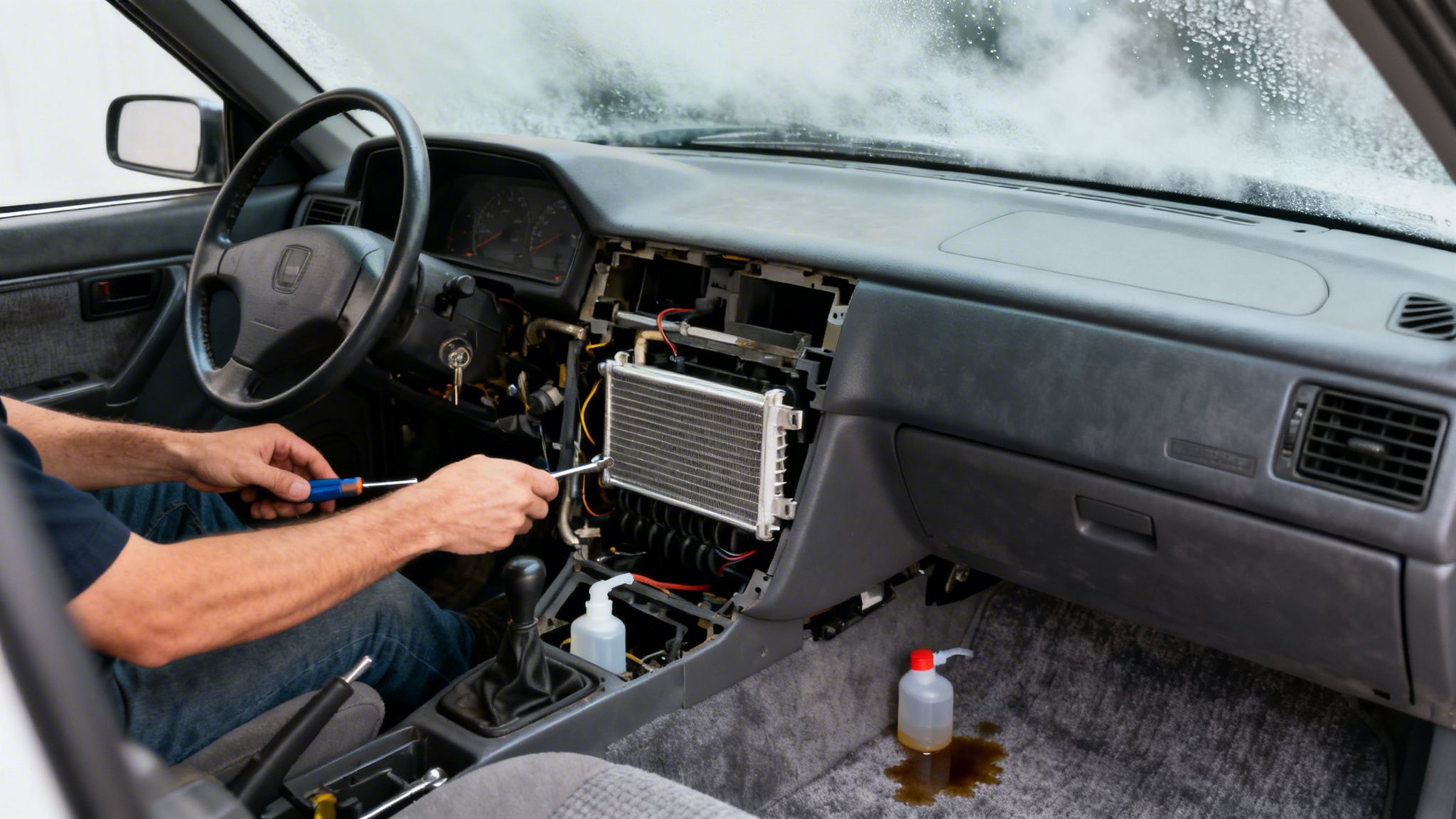
There’s a special kind of pride that comes from fixing your own car, but one of the most important skills any home mechanic can learn is knowing when to hang it up and call in a pro. Some jobs just aren't meant for the driveway. They demand a level of expertise, specialized tools, and a delicate touch that only comes with years of experience.
Trying to push your limits can quickly turn a straightforward fix into a very expensive headache. Part of understanding how to fix a car heater is knowing when not to. You have to be honest with yourself about the complexity of the job versus your skillset and what's in your toolbox. When a repair starts to feel overwhelming, that's your cue to get some backup.
Red Flags That Signal It's Pro Time
Some repair scenarios should be an immediate red flag, telling you it’s time to pick up the phone. Attempting these jobs without the right training can lead to even more damage—or worse, put your safety at risk. Don't think twice about calling an expert if you run into any of these situations.
- Heater Core Replacement: This is the big one we've been talking about. It’s a massive undertaking that requires pulling apart the entire dashboard, including sensitive components like airbags, the steering column, and a complex web of wiring. This is easily an 8-15 hour job for an experienced technician; it's just not a realistic weekend project for most people.
- Complex Electrical Diagnostics: If you're wrestling with a modern climate control system that’s completely unresponsive, the issue is likely buried deep in a control module or a wiring harness. Tracing these electrical gremlins requires professional diagnostic tools and schematics that are worlds beyond a basic code reader.
- Anything Involving the A/C System: Your car’s heater and air conditioning systems are deeply intertwined. If a repair involves discharging and recharging the A/C refrigerant, it legally has to be done by a certified professional with a specialized recovery machine. Venting refrigerant into the atmosphere is illegal and seriously harms the environment.
These jobs represent a massive leap in difficulty and risk. A simple mistake, like mishandling an airbag, can have dangerous consequences.
Expert Insight: The moment a repair requires dismantling the dashboard, the risk-to-reward ratio shifts dramatically for a DIY mechanic. The sheer number of delicate plastic clips, hidden screws, and critical electrical connectors makes it incredibly easy to cause expensive, hard-to-fix secondary damage.
The Value of Professional Expertise
Bringing your car to a certified shop like Kwik Kar isn’t admitting defeat—it’s making a smart call. Professional technicians have access to vehicle-specific repair databases, specialized equipment, and the hands-on experience to pinpoint problems quickly and get them fixed right the first time. This is more true than ever as cars become increasingly complex.
The automotive world is always changing, especially with the rise of electric vehicles that use incredibly sophisticated thermal management systems. The global automotive heater core market is projected to grow from USD 7.9 billion in 2025 to USD 11.1 billion by 2035, a trend driven by these advanced HVAC needs. You can see more on this growing market on factmr.com. This constant evolution makes professional service more valuable than ever.
Ultimately, going to a pro ensures the job is done correctly, safely, and gets you back on the road with heat you can count on. If you're not sure who to trust with your vehicle, our guide on how to find a trustworthy mechanic can point you in the right direction.
Common Questions About Car Heater Repair
Even with a step-by-step guide, it’s normal to have a few more questions pop up. When you're trying to figure out how to fix a car heater, you'll run into plenty of real-world concerns, from how much it'll cost to whether it's even safe to drive.
Let's run through some of the most common questions we hear from drivers at the shop. Think of this as the FAQ for those "what if" moments.
How Much Does It Typically Cost to Fix a Car Heater?
This is always the first question, and for good reason. The honest answer? It really depends. The final bill is tied directly to what part failed. Some fixes are incredibly cheap if you do them yourself, while others are a major investment.
Here’s a realistic breakdown of what to expect:
- DIY Coolant Top-Off: This is the easiest and cheapest fix. All you need is the right jug of antifreeze, which usually runs $20 to $40.
- Thermostat Replacement: A great DIY project for a Saturday. The part itself is pretty affordable, typically between $15 and $50. If you have a professional handle it, you’re likely looking at $150 to $300, which includes the part, labor, and a fresh coolant flush.
- Blower Motor Resistor: Another one that’s often straightforward to do yourself. The resistor is usually just $20 to $60, and it's often in an easy-to-reach spot.
- Heater Core Replacement: This is the big one. The heater core itself isn't terribly expensive, maybe $100 to $400, but getting to it is the problem. Because it's buried deep in the dashboard, labor costs can skyrocket, often landing between $800 and over $1,500.
Can I Still Drive My Car if the Heater Is Broken?
Technically, yes, you can probably drive your car. But the real question you should be asking is why the heater is broken in the first place. That's what determines if it's safe.
If it's just a dead blower motor or a blend door that's stuck on cold, you’re fine to drive—you’ll just be uncomfortable. But if the heat is gone because of a coolant leak or a thermostat that's stuck open, you are seriously risking your engine.
Crucial Safety Note: A broken heater is often the very first sign of a cooling system problem. Ignoring it can lead to engine overheating, which can warp cylinder heads or cause other permanent, catastrophic damage. That turns a minor inconvenience into a multi-thousand-dollar repair.
If your heater isn’t working, your eyes should be glued to that temperature gauge. If it starts creeping past the halfway mark, pull over safely and shut the engine off immediately.
Why Does My Heater Only Get Warm When I Accelerate?
That’s a classic symptom, and it almost always points to one of two culprits: you’re low on coolant, or your water pump is on its way out.
When your coolant level is low, there just isn't enough hot fluid to circulate through the heater core when the engine is idling. As soon as you hit the gas, the water pump spins faster, building enough pressure to shove the remaining coolant through the system. That gives you a temporary burst of heat until you let off the gas and the pressure drops again.
Now, if you've checked and your coolant is topped off perfectly, the water pump itself is the likely suspect. Over time, the little fins, or impellers, on the pump can corrode and wear away, making it too weak to push enough coolant at low engine speeds.
Is My AC Related to My Heater Problem?
It might sound odd, but yes, your air conditioning and heating systems are more connected than you’d think. In modern cars, it's all part of one integrated "climate control" system, and the AC has a job to do even on the coldest days.
Ever notice how fast your defroster clears a foggy windshield? That’s the AC at work. When you select the defrost setting, the AC compressor automatically engages. It’s not to make the air cold, but to pull moisture out of it—acting as a powerful dehumidifier. The system then heats that dry air and sends it to the windshield.
If your AC system is on the fritz, your defroster won't be nearly as effective, which can be a real safety issue in frosty or rainy weather.
If you’ve run through these steps and the fix is more than you want to tackle, don’t worry. The certified technicians at Kwik Kar Oil Change and Auto Care are here to help. We have the right tools and expertise to diagnose the problem quickly and get your heat working again. Schedule your appointment today and drive warm this winter.