




The most reliable way to protect a catalytic converter is to layer defenses: park where a thief has no room to work, add a physical shield that turns a quick cut into a slow, noisy one, mark the part so it can be traced, and make sure your insurance covers the loss. No single step makes a truck or SUV theft-proof, but each layer pushes a thief toward the next car. If your converter has already been taken, or your car is running rough and you are not sure why, our team at Kwik Kar Oil Change & Auto Care at 9613 White Settlement Rd, Fort Worth, TX 76108 can inspect the exhaust and find out what it needs.
TL;DR
- Thieves target the converter because it holds precious metals, and pickups and SUVs sitting higher off the ground are the easiest to reach.
- Layer your defenses: garage or wall parking, a bolted metal shield, VIN etching or high-heat paint, and a vibration alarm set to a sensitivity you can live with.
- Theft is covered under comprehensive insurance, not liability-only coverage, so check your policy before you need it.
- A car will still run without its converter, but it will be loud, will fail emissions testing in Tarrant County and can be harmful to breathe around.
- If it happens, photograph the damage, file a police report and call your insurer before anything gets repaired.
Table of Contents
- Why do thieves steal catalytic converters?
- Which vehicles are most at risk?
- How can you stop your catalytic converter from being stolen?
- Do catalytic converter shields actually work?
- What about Fort Worth, Tarrant County and fleet vehicles?
- Will a car run without a catalytic converter?
- What should you do if your converter is stolen?
- How we think about converter theft
- How do you get your vehicle checked after a theft or a warning light?
- Does Texas still require inspections, and does it matter after a theft?
- A practical prevention plan for the week ahead
- FAQ
- Sources
Why do thieves steal catalytic converters?
A catalytic converter is part of your exhaust system. It uses precious metals to turn harmful exhaust gases into less harmful ones. Those metals are the reason it gets stolen: scrap buyers pay for what is inside, and a thief with a battery-powered saw does not need to know anything about your car.
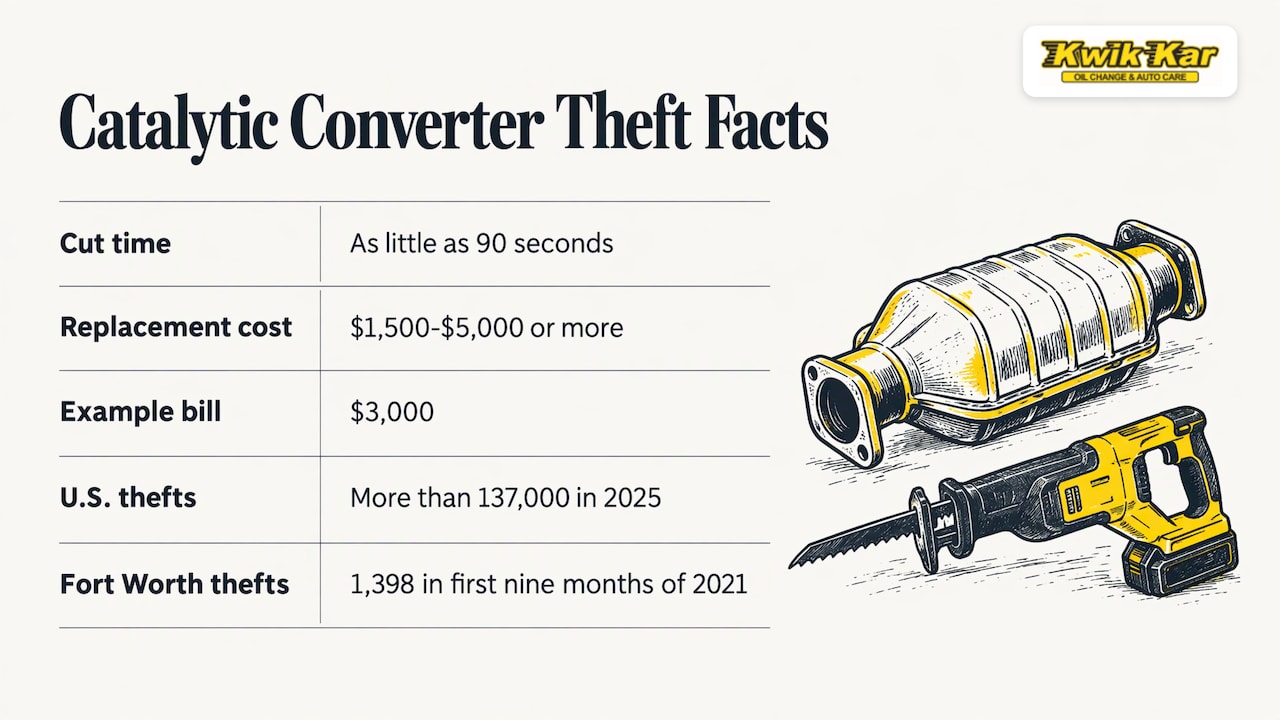
The speed is the problem. AAA, citing National Insurance Crime Bureau data, notes a converter can be cut off in as little as 90 seconds with a hand-operated tool, and that replacement costs run from $1,500 to $5,000 or more depending on the vehicle. Kelley Blue Book puts one possible replacement bill at $3,000.
The problem has not gone away. CARFAX data released in June 2026 estimates more than 137,000 converters were stolen in the U.S. in 2025. Closer to home, the Fort Worth Star-Telegram reported that Fort Worth police recorded 1,398 converter thefts in the first nine months of 2021 alone, and police published a list of vehicles likely to be targeted.
Which vehicles are most at risk?
Height and converter value drive the risk. CARFAX’s June 2026 ranking of the most-targeted vehicles lists the Ford F-150, Hyundai Tucson, Ford Explorer, Ram 2500, Chevrolet Silverado, Chevrolet Traverse, Ram 3500, Ford EcoSport, Ford Expedition and Chevrolet Trax. CARFAX’s editor-in-chief points out that most of these are pickups and SUVs that sit higher off the ground, which makes the converter easier to get to. Hybrid converters can be worth up to $1,400 because they hold more precious metals.
In Fort Worth, that describes a lot of what is parked in driveways, apartment lots and job-site yards. If you drive a full-size pickup, a work van or a three-row SUV, treat prevention as routine maintenance, not an extra.
How can you stop your catalytic converter from being stolen?
Think in layers. Each step below takes away time, noise cover or resale value from a thief. Progressive’s guidance recommends stacking several of them instead of relying on one.
1. Park where there is no room to work
A thief needs to slide under the car. A garage is best. If you park outside, back or nose the vehicle up against a wall so the exhaust side cannot be reached. Choose lit lots with cameras, and park close to building entrances when you are shopping or at work. Kelley Blue Book recommends camera-covered, well-lit areas and suggests considering a dash camera. According to Mercury Insurance’s guidance, most theft cases at one North Carolina tire shop happened in residential lots where cars sit overnight, which is a good reminder that your own driveway or apartment lot deserves the most thought.
2. Add a physical shield or cage
This is the layer most readers search for. A converter shield is a metal plate, cage or strap that covers or locks around the converter so the thief has to cut through it first. The Caldwell County, Texas Sheriff’s Office says aftermarket shields, cages and cat straps that bolt around the converter add 15 to 20 minutes of cutting time and usually send a thief elsewhere. That matters because thieves rely on speed and low noise.
What to know before you buy one:
- Cost. Farmers Insurance puts a shop-installed metal shield bolted to the vehicle frame at about $350 including installation, while shields bought online run about $150.
- Installation. The same source notes that installing a frame-mounted shield involves drilling frame holes and usually requires a vehicle lift because of limited space under the car.
- Fit. Choose a shield made for your vehicle’s exhaust layout and ground clearance, and make sure it does not trap heat or rattle against the exhaust.
- Emissions and identification. California’s Bureau of Automotive Repair advises that a theft-prevention device should not be welded or attached directly to the converter and must leave all identifying information visible. That is California’s rule, but the same logic applies anywhere emissions testing looks at the converter: do not cover the markings.
- Warranty. The National Insurance Crime Bureau advises confirming that any modification, including welding the converter to the frame, will not void a warranty, extended warranty or repair agreement.
3. Mark the converter
Etching your VIN or license plate number into the converter helps police and scrap dealers identify it as stolen. The Caldwell County Sheriff’s Office notes that some auto-parts retailers and the Sheriff’s Office can do it, and Kelley Blue Book says many police departments and some muffler shops will etch a plate number for free. Marking does not stop the cut. It makes the part harder to sell and easier to trace.
Bright high-heat paint can also signal that a converter is marked. Kelley Blue Book cautions that daily exhaust heat burns off ordinary paint, so only paint rated for high heat is worth using, and it should not cover any identifying numbers.
4. Set a vibration or tilt alarm
Many factory and aftermarket alarms can be set to trigger on vibration or tilt. The Sheriff’s Office guidance suggests setting them to the highest sensitivity. In practice, a very sensitive alarm in a busy apartment lot may go off for passing trucks, so find a setting you will keep switched on. An alarm that you disable every week protects nothing.
5. Consider a weld or a lock
Progressive lists having a bolted converter welded in place as another deterrent, and NICB mentions additional welding to the frame. This is work for a qualified exhaust technician, and it comes with the warranty caveat above.
Do catalytic converter shields actually work?
They raise the cost of the theft, which is what you want. A shield will not make a cut impossible. The NBC DFW report quoted an Arlington mechanic describing a heavy cage that thieves still cut through, and police told the station a thief can slide under a car and take the part within a minute. So the honest answer is that a shield works best as one layer among several: it buys you minutes, and minutes are what a thief on a residential street does not have.
Here is how the main layers compare.
| Layer | What it does | Typical cost | Best for |
|---|---|---|---|
| Garage or wall parking | Blocks access under the car | Free | Every vehicle |
| Metal shield or cage | Adds cutting time and noise | About $150 DIY, about $350 installed (Farmers) | Trucks, SUVs, vans |
| VIN or plate etching | Aids tracing and recovery | Often free through police or some shops | Every vehicle |
| High-heat paint | Signals the part is marked | Low | Supplement to etching |
| Vibration or tilt alarm | Alerts you to movement | Varies | Cars parked in earshot |
| Camera or dash cam | Records activity | Varies | Lots without lighting or cameras |
What about Fort Worth, Tarrant County and fleet vehicles?
Whether you live near White Settlement, Westworth Village, Westover Hills, River Oaks, Lake Worth or Benbrook, the pattern is the same: cars that sit overnight in the open are the easiest targets. A few local habits help.
- Commuters. Park in a garage level or a staffed, lit lot, nose against a wall when you can.
- Families. Keep the family SUV in the garage, even if the garage is full of storage. The wall-parking trick works in a driveway too if you can back up to a fence or the house.
- Rideshare and delivery drivers. Your vehicle is parked at odd hours in different places. Choose lit, busy spots for breaks and keep your converter on the shortlist of things you check at the end of a shift.
- Fleet owners. Work trucks and vans sit high, park in predictable places and cluster in yards, which a fleet-theft analysis lists as reasons they are hit. The NICB advises securing and lighting business fleet lots at night. Rotating parking positions and putting high-clearance vehicles nose-in against a fence are simple, free steps. Check your commercial policy for secured-parking requirements and per-vehicle deductibles. For multi-vehicle maintenance, see our fleet maintenance and repair services.
Texas also tightened the market for stolen parts. According to NBC DFW, a 2021 Texas law requires recycling facilities to mark converters and take a thumbprint from the seller, who must show documentation proving ownership of the vehicle the part came from.
Will a car run without a catalytic converter?
Yes, in the short term. Star-Telegram reporting lists the signs that a converter is gone: a loud engine roar, more exhaust fumes or unusual smells, missing parts under the exhaust area, sputtering acceleration and a check-engine light. The same report notes that in Texas a vehicle without a converter could fail the emissions testing required with inspection, which would block registration renewal.
Do not keep driving it for weeks. Exhaust fumes can leak closer to the cabin than you would expect, and a loud, rough-running vehicle is a sign something else may have been damaged during the cut, such as oxygen sensors or exhaust piping. If the dash light is on and you do not know why, our guide to what a service engine light means explains the common causes.
What should you do if your converter is stolen?
Follow this order. Mercury Insurance lays out the same basic sequence.
- Move to a safe area and do not drive the vehicle until a mechanic has checked it.
- Photograph the damage, including the cut pipe and the area around it.
- File a police report with your VIN, the location, the time and your photos.
- Call your insurer with the report number, photos and any repair estimates. The Caldwell County guidance says most auto policies require theft notification within 24 hours.
- Get a written inspection and estimate of what needs replacing, since sensors and pipes are often damaged too.
On coverage: Mercury says comprehensive coverage typically pays for replacement and related removal repairs after your deductible, and liability coverage does not cover theft. The Sheriff’s Office guidance adds that converter theft falls under comprehensive, not collision. Read your declarations page now, while you have time, and confirm you carry comprehensive. Insurance terms differ by company and policy, so your insurer is the one to confirm your deductible and what is covered.
How we think about converter theft
Most of the converter-related visits we want to avoid are the ones where an owner learns about the problem when the car sounds like a race car in the driveway. The best protection starts before that.
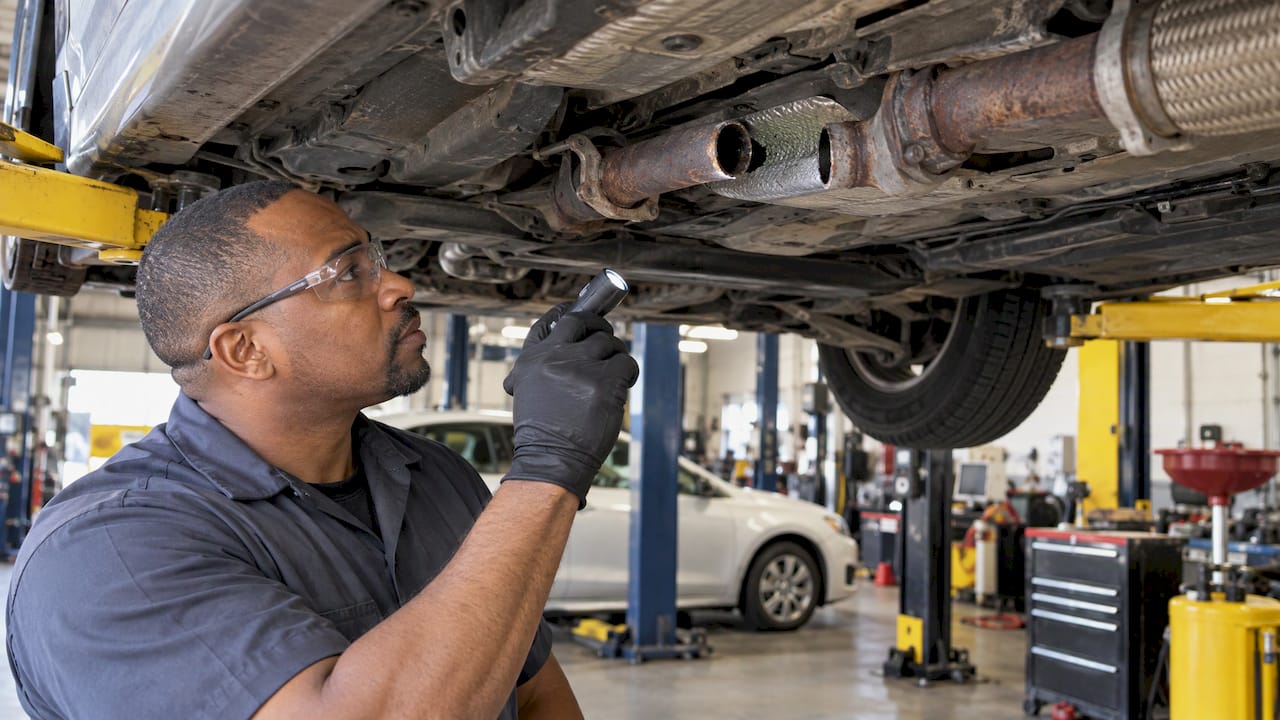
We would put it this way: prevention is a maintenance habit, like checking tires or tracking oil changes. During a digital vehicle inspection, our ASE-certified technicians look at the whole underside of the vehicle, including the exhaust system, hangers, mounts and any shield or hardware already fitted. That gives you a clear picture of what is under your truck or SUV.
If a converter has been stolen, the repair is rarely just one part. A thorough exhaust and engine diagnostic, using professional diagnostic equipment, helps sort out what was damaged, what the check-engine light is reporting and what a proper repair involves. Qualifying repairs carry our 24-month/24,000-mile warranty.
Our shop is at 9613 White Settlement Rd in Fort Worth, and we serve drivers from White Settlement and the west side of Fort Worth to nearby communities.
Kwik Kar
How do you get your vehicle checked after a theft or a warning light?
If your car is loud, the check-engine light is on or you suspect someone has been under it, a proper diagnosis comes first. We offer engine diagnostics, and our technicians are ASE-certified. We are also RepairPal and ASE certified, and we have been recognized as CARFAX Top-Rated. Our digital vehicle inspections let you see what the technician sees before you approve any repair.
You can see everything we handle on our services page, from engine diagnostics and electrical work to brakes, alignment, tires and routine maintenance. If you want to book a visit, use our schedule page.
The more routine side of things matters too. While your vehicle is in for an oil change or preventive maintenance, ask for an exhaust and underbody check as part of the inspection. It takes a few minutes and gives you a baseline for later.
Does Texas still require inspections, and does it matter after a theft?
It matters because the converter is checked during emissions testing. The Texas Department of Motor Vehicles announced that beginning January 1, 2025, Texas vehicle owners are no longer required to get a safety inspection before registration, under House Bill 3297, which ended the safety inspection program for non-commercial vehicles. The annual $7.50 fee continues under the name Inspection Program Replacement Fee. State law still requires emissions inspections before registration in 17 counties, and Tarrant County is one of them.
So for most personal vehicles in Fort Worth, there is no annual safety inspection, but there is still an emissions test when you renew registration. A car with a missing or non-working converter is likely to have trouble there. Qualifying commercial vehicles remain subject to safety inspection requirements, so fleet owners should confirm which of their vehicles are covered through the state before renewing.
A practical prevention plan for the week ahead
You do not need to do everything at once. Here is a sensible order.
- Today: Check your policy for comprehensive coverage and note your deductible.
- This week: Decide where the vehicle sleeps. Garage first, wall second, lit and camera-covered lot third.
- This month: Get the VIN etched, and add a shield that fits your exact vehicle. Confirm warranty terms first.
- Ongoing: Set the alarm sensitivity you will actually use, and ask for an underbody look at your next service visit.
Prevention is also cheaper than the alternative. A shield around $350 installed, set against replacement bills of $1,500 to $5,000 or more, is a straightforward trade for the owner of a high-risk truck or SUV.
FAQ
What is the best way to prevent catalytic converter theft?
Use several layers instead of one. Park in a garage or with the exhaust side against a wall, add a bolted metal shield, etch your VIN into the converter and set a vibration alarm. Each layer adds time or risk for a thief, which is what pushes them to another vehicle.
How much does a catalytic converter shield cost?
Farmers Insurance cites about $350 for a shop-installed shield bolted to the frame and about $150 for a shield bought online. Installation usually involves drilling into the frame and typically needs a lift, so fit and installation quality matter as much as the price.
Does insurance cover a stolen catalytic converter?
Comprehensive coverage typically does, after your deductible, according to Mercury Insurance. Liability coverage does not. Most policies require prompt notice, so report the theft to police and your insurer as soon as you find it.
Can I drive my car with a stolen catalytic converter?
The car will usually run, but it will be loud and release more exhaust fumes, and it could fail Tarrant County emissions testing. Have it checked before driving it further, since nearby sensors and pipes can be damaged.
Which vehicles do thieves target most?
CARFAX’s June 2026 list is led by the Ford F-150, Hyundai Tucson and Ford Explorer, and most vehicles on it are pickups and SUVs that sit higher off the ground. Hybrids are also targeted because their converters hold more precious metals.
Sources
- CARFAX: Top 10 vehicles targeted by catalytic converter thefts (PR Newswire)
- Fort Worth Star-Telegram: Why are people stealing catalytic converters and how to stop it
- AAA: Four ways to protect yourself from catalytic converter theft
- Kelley Blue Book: Catalytic converter theft tips
- Progressive: How to prevent catalytic converter theft
- Caldwell County, Texas Sheriff’s Office: Vehicle theft prevention
- Farmers Insurance: How to protect your catalytic converter from theft
- California Bureau of Automotive Repair: Catalytic converter theft and Smog Check
- National Insurance Crime Bureau: Catalytic converter thefts
- Mercury Insurance: What to do if your catalytic converter is stolen
- NBC DFW: How to curb costly catalytic converter thefts
- Texas Department of Motor Vehicles: Vehicle inspection changes