




A car that shudders at a red light only when the air conditioning is running is usually telling you one of three things: the engine is not compensating for the compressor’s extra load, the compressor or its clutch is dragging, or the cooling fan is not moving air at a stop. All three are diagnosable in one visit. If you drive around White Settlement or West Fort Worth, you can book a diagnostic at our shop at 9613 White Settlement Rd, Fort Worth, TX 76108, and we will find out which one it is.
TL;DR
- A brief dip in rpm when the AC clutch engages is normal. A drop that stays, or an idle that hunts up and down, is not.
- The most common causes are a dirty throttle body or idle air control valve, a dragging compressor or clutch, worn engine mounts, and a cooling fan that is not running at idle.
- If the AC also stops cooling in traffic but improves at highway speed, airflow over the condenser is the first suspect.
- If the temperature gauge climbs, a warning light comes on or you see steam, shut the engine off and let it cool.
- A scan-tool check and a look at the compressor, belt and fan tell the difference quickly.
Table of Contents
- Why the AC makes an engine idle roughly
- What counts as normal, and what does not
- The most common causes
- Radiator fan not working at idle
- Why the AC stops cooling in traffic
- Quick comparison: which symptom points where
- Checks you can safely make
- Does idling with the AC on waste fuel?
- Perspective
- Getting it diagnosed in West Fort Worth
- FAQ
- Sources
Why the AC makes an engine idle roughly
The AC compressor is driven by the engine’s belt. When you press the AC button, a clutch engages the compressor, and the engine suddenly has more work to do. The engine computer (the powertrain control module, or PCM) is supposed to open the idle air path slightly and bring rpm back up. According to one repair guide, a faulty or dirty idle air control valve, a dirty throttle body or a faulty cooling or condenser fan can all stop that from happening smoothly.
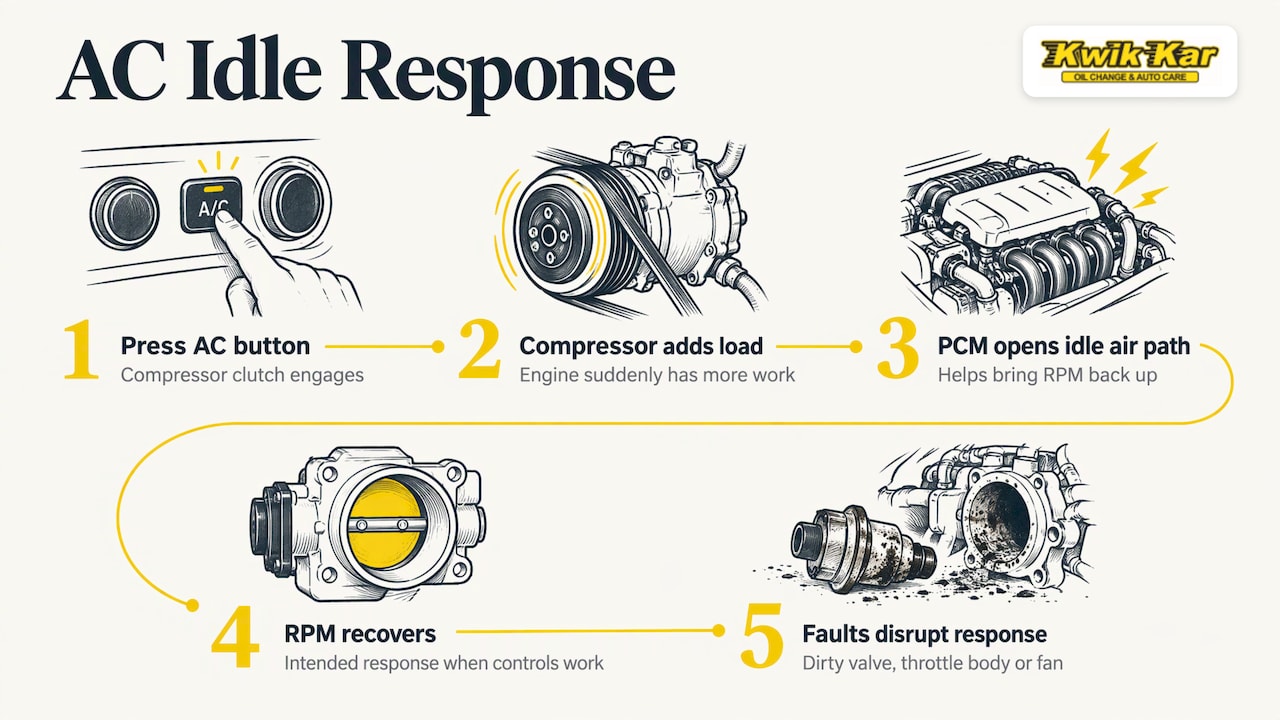
At idle, the engine makes only enough torque to keep itself turning. A weak cylinder, a small vacuum leak or a sticky air passage is a large share of what the engine has, so the AC load exposes it. That is why a problem that is invisible while you drive shows up at a stoplight with the AC on, as diagnostic notes on idle vibration explain.
What counts as normal, and what does not
When the clutch clicks on, expect a half-second dip and a recovery, often to a slightly higher idle. A shop guide on AC shake and stall describes a problem as an idle that sags a few hundred rpm and stays there, or hunts up and down. A repair guide puts the line at a loss of more than 200 rpm with no recovery.
Pay attention to how it feels:
- A rhythmic stumble usually points to a misfire in one cylinder.
- A sag or wandering revs usually points to a lean condition such as a vacuum leak, or an idle-control fault.
- A single jolt every time the AC kicks in can be a worn engine or transmission mount rocking the engine, which feels like a rough idle even when the engine is fine.

The most common causes
Dirty throttle body or idle air control valve
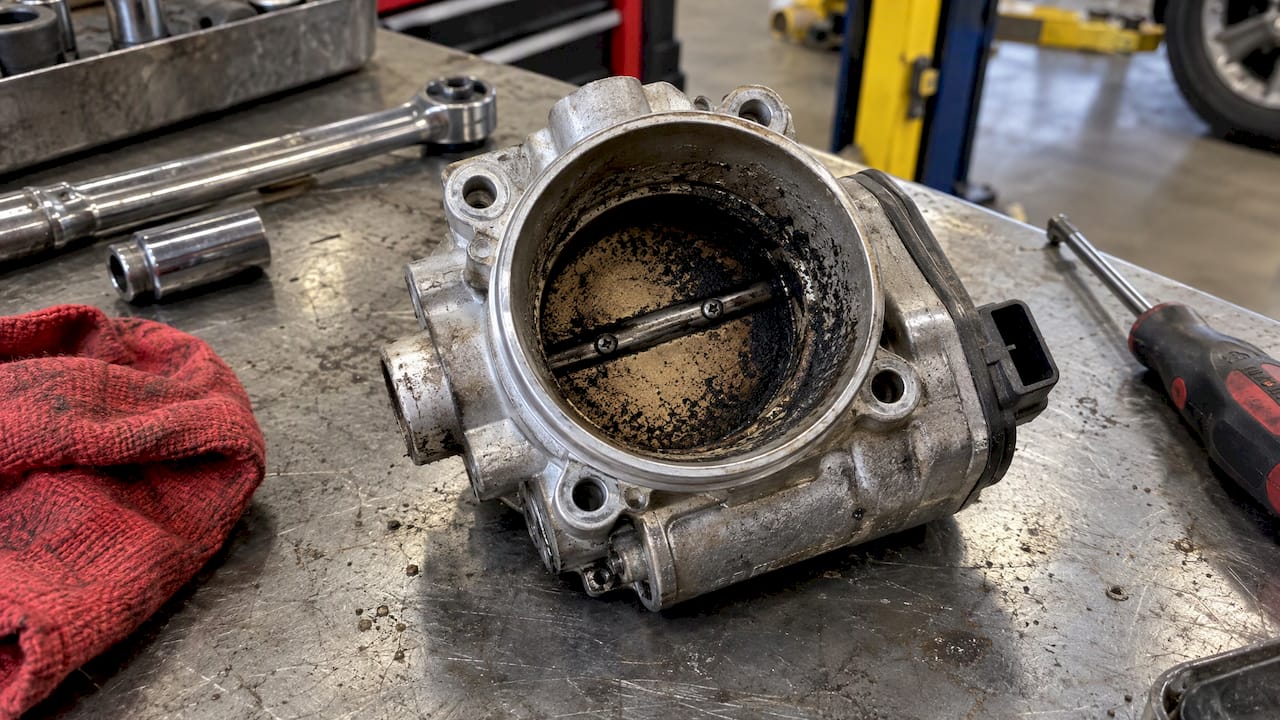
Carbon builds up around the idle air control (IAC) valve and throttle passages, restricting the small amount of air the engine needs at idle. On older cars that is a clogged IAC valve. On throttle-by-wire cars, a faulty throttle position sensor can do the same job. The AC load simply makes it noticeable. A throttle body cleaning and a check of the idle-control data usually settles this.
Dragging compressor or failing clutch
A compressor that is stiff or starting to seize puts a heavy, uneven load on the engine. One AC guide calls this the leading mechanical cause, because the engine’s idle-up strategy is calibrated for a healthy compressor. Signs of a failing clutch or compressor include:
- Warm air even though the blower works
- The clutch rapidly cycling on and off
- Squealing, grinding or chirping from the compressor
- A burnt smell near the belt
- The belt visibly jerking when the AC engages
These are listed in a clutch diagnosis guide, which also notes that a seized compressor is the one that stalls the engine outright, as another shop guide describes. If you hear squealing or grinding, have it looked at promptly rather than running the AC for weeks, because a slipping clutch generates serious heat. A compressor manufacturer’s bulletin says it can reach 1,200 degrees F within minutes and destroy the coil, hub and bearing. The same bulletin says clutch failures are usually the result of another problem, such as pressure or voltage issues, which is why the root cause needs finding rather than just swapping the clutch. For the clutch side in detail, see our page on an AC clutch not engaging.
Worn engine or transmission mounts
If the engine itself runs smoothly but the cabin shakes when the compressor kicks on, a mount may be letting the engine rock. This is a physical, not a fuel or ignition, problem, and a technician can see it by watching the engine move with the AC cycled.
Vacuum leaks, spark plugs and fuel injectors
A small unmetered air leak is a big share of idle airflow, so it leans the mixture and makes the idle hunt. Worn spark plugs or a dirty fuel injector make a cylinder weak, and the AC load turns a mild roughness into a visible shake. If your check engine light is on, the stored codes narrow this down quickly. Our guide to narrowing a rough idle at a stop walks through the likely faults.
Radiator fan not working at idle
This cause links the rough idle to the next symptom. At a stoplight there is no ram air through the grille, so the electric fan has to pull air across the radiator and the AC condenser. If it does not run, the AC’s high-side pressure climbs, the engine works harder, and idle speed can drop or stall. A trade magazine case study traced exactly this on a PT Cruiser: a failed low-speed fan winding caused pressure to rise at stoplights, the idle dropped and the engine could stall.
A simple clue: overheating in traffic that clears up at road speed often means a failed fan motor, a blown fuse, a bad relay, damaged wiring or a sensor fault. The temperature sensor tells the computer when to switch the fan on, and a defective relay will not power the circuit.
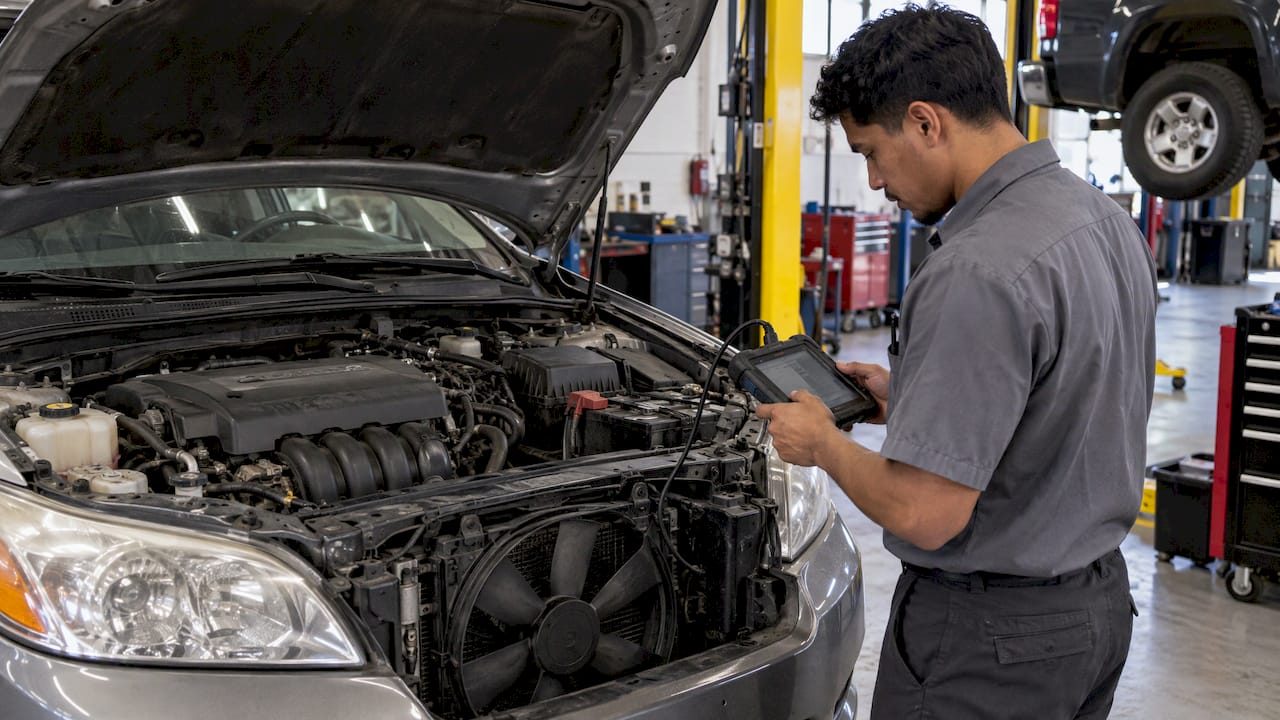
If your temperature light is on, read what to do about an engine temperature light. For overheating generally, see why a car overheats.
Why the AC stops cooling in traffic
The same airflow problem explains an AC that blows cool on the freeway and warm in stop-and-go traffic on I-30 or Loop 820. One parts maker’s tech tip says inadequate condenser airflow is a common reason for warm air when a vehicle idles for a long time. Its corrections start with the basics: a condenser free of debris, a fan that runs correctly, and no damaged fins or misaligned air shrouds.
Other causes of weak cooling include low or contaminated refrigerant, a plugged cabin air filter, clogged evaporator fins and low coolant, all listed in a professional service procedure. If your AC is low on refrigerant, there is a leak somewhere, and a recharge alone will not last. Read our notes on refrigerant leak symptoms and how automotive AC works.
Fort Worth summers make every one of these faults easier to notice, because the system works hardest when it is hot outside and you are sitting still. Pickup and SUV owners towing or idling in loaded school-pickup lines put even more demand on the cooling package.
Quick comparison: which symptom points where
| What you notice | Likely area | Next step |
|---|---|---|
| Idle dips and stays low, hunts, no noise | Throttle body, IAC valve, vacuum leak | Scan data and throttle body service |
| Squeal, grinding, jerking belt when AC starts | Compressor, clutch, belt | Stop using AC and have it inspected |
| Clutch never clicks, air is warm | Fuse, relay, pressure switch, clutch coil, low refrigerant | Electrical and pressure check |
| Rough at stops, AC warm in traffic, better at speed | Cooling fan, condenser airflow | Fan and condenser check |
| One thump when AC engages, smooth otherwise | Engine or transmission mount | Mount inspection |
| Rhythmic stumble regardless of AC | Misfire: plugs, coil, injector | Code scan and ignition check |
Checks you can safely make
Keep these simple and keep your hands away from moving parts.
- Listen and watch. With the parking brake on, turn the AC on and off. Note whether the idle recovers, whether the clutch clicks, and whether any squeal or belt movement accompanies it.
- Check the fan. Turn the AC on at idle and see whether the fan starts, as one troubleshooting guide suggests as a first step.
- Look at the front of the condenser. Leaves, bugs or bent fins in front of the radiator restrict airflow.
- Check for warning lights. A check engine light can also indicate a vacuum hose leak, and AAA notes a hose that is hard, crunchy, soft or oil-soaked should be replaced.
- Only check coolant when the engine is fully cool. If the gauge climbs, a warning light comes on or steam appears, shut the engine off and let it cool before touching anything.
Guides like these cannot replace an in-person inspection. If the symptoms continue, a technician with scan tools can read live data, see whether misfire counters rise on one cylinder, and check whether fuel trim falls as revs rise, which is what separates a misfire from a vacuum leak. A hose or cooling check is also a good moment to review the similar warning signs in this cooling-system buyer’s guide.
Does idling with the AC on waste fuel?
Yes, the AC adds load. One fuel-use guide estimates a typical four-cylinder car uses about 0.1 to 0.2 gallons an hour idling without AC and about 0.3 to 0.4 with it. A rough idle is not caused by that extra fuel use, but a struggling engine tends to be a less efficient one, which is one more reason to fix it.
Perspective
When a rough idle only shows up with the AC on, the car is giving you a useful clue. The AC is the extra load that exposes a weakness the engine was hiding, so the fix is rarely “the AC” alone.
That is why we look at the whole picture: idle control, the compressor and clutch, the belt, the cooling fan and the mounts. Our technicians are ASE-certified, and our shop is RepairPal certified. We use professional diagnostic equipment and digital vehicle inspections, so you can see what we see before you approve work.
Qualifying repairs carry our 24-month/24,000-mile warranty. We are a full-service repair center for brakes, electrical, transmissions, cooling, A/C and more, not just oil changes.
Kwik Kar
Getting it diagnosed in West Fort Worth
We serve drivers from White Settlement, Westworth Village, Westover Hills, River Oaks, Lake Worth and Benbrook at one location: 9613 White Settlement Rd, Fort Worth, TX 76108. Our engine diagnostic, A/C and cooling services cover the full chain from throttle body to compressor to fan, and our fleet team handles multi-vehicle accounts for rideshare and delivery drivers whose AC runs all day. Visit our website or schedule a visit.

FAQ
Is it normal for my car to shake a little when the AC turns on?
A brief dip as the clutch engages is normal, because the compressor adds load. The engine should recover within a moment. If the idle stays low, hunts or shakes the cabin, have it checked.
Can a bad AC compressor cause a rough idle?
Yes. A dragging or seizing compressor loads the engine unevenly, and a seized one can stall it. Squealing, grinding or a jerking belt at engagement are the typical warning signs.
Why does my AC blow warm air at a stoplight but cold on the highway?
Most often, not enough air is passing over the condenser at idle. A fan that is not running, a blocked condenser or damaged fins are the usual causes. Low refrigerant can also contribute.
Is it safe to keep driving with a rough idle and the AC on?
For a mild idle dip, usually yes, but avoid the AC if you hear grinding or squealing. If the temperature gauge rises or a warning light comes on, pull over, shut the engine off and let it cool.
Sources
- My Car Idles Rough When the AC Is On
- Car Idles Rough When AC Is On: 7 Causes
- Engine Shakes or Vibrates at Idle
- Why Does My Car Shake or Stall When the AC Is On
- What causes a car to shake at idle or with the AC on
- Bad AC Compressor Clutch? How to Diagnose It
- Compressor service bulletin
- Trouble Shooter: Idle Speed
- Overheating and Radiator Fan Not Running
- Radiator fan not working
- Inadequate Condenser Airflow
- MACS Recommended Service Procedures
- AAA Car Care: Belts & Hoses
- How Much Gas Does Idling Use