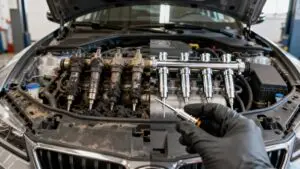





When the A/C clutch won’t engage, the compressor never spins, and the air from your vents stays warm. The usual causes are low refrigerant that trips the low-pressure safety switch, a blown fuse, a failed relay, a bad clutch coil, or a clutch air gap that is too wide. Most of these can be narrowed down in order, from the simplest check to the most involved. Here is how that order works, what each result means, and when it is time to hand the car to a shop.
TL;DR
- The clutch only engages when the computer, the pressure sensors, the relay and the coil all agree. A fault in any one keeps it disengaged.
- Low refrigerant is the most common cause, because a low-pressure switch blocks the clutch to protect the compressor.
- Check the fuse and swap the relay first. Both take minutes and resolve many cases.
- Don’t force the clutch on as a first test. Bypassing the controls can damage a dry or seized compressor and the wiring.
- If the fuse, relay and pressure all check out, the problem is the coil, the ground, the air gap or the control module, and that needs meters and a scan tool.
Table of Contents
- What the A/C clutch does and why it refuses to engage
- The most common causes, from most to least likely
- How to check it step by step
- Can you force the A/C clutch to engage?
- What does a blown A/C clutch fuse mean?
- A/C clutch relay symptoms
- Bad compressor or just the clutch?
- Why Fort Worth driving makes this show up in summer
- Perspective: how we approach a clutch that won’t engage
- When to bring it to a shop
- Get your A/C checked in West Fort Worth
- FAQ
- Sources
What the A/C clutch does and why it refuses to engage
Your A/C compressor is driven by the engine’s belt, but it does not run all the time. A magnetic clutch sits on the front of it. The clutch has three main parts: a coil, a belt pulley that spins whenever the engine runs, and a pressure plate (the hub) connected to the compressor shaft. According to Vehicle Service Pros, the coil usually has a constant 12-volt feed and is switched on by completing its ground side.
When the coil is energized, its magnet pulls the hub into the spinning pulley. Griffiths describes it as friction taking over so the two pieces turn together. That is the click you hear a moment after turning the A/C on.
The computer does not hand that permission out freely. On the Ford Focus, for example, the service manual says the powertrain control module only engages the clutch through the relay when the pressure transducer reads an acceptable pressure, engine coolant temperature is not excessively high, and no wide-open-throttle condition is detected. Other makes differ in the details, but the idea is the same. A clutch that stays idle is sometimes the system protecting itself rather than a broken part.
The most common causes, from most to least likely
R & Y A/C Compressors lists the usual suspects as low refrigerant triggering the low-pressure switch, a blown fuse, a failed relay, or a bad clutch coil, and says that checking the fuse and refrigerant pressure alone resolves most cases.
| Cause | What you might notice | Who usually handles it |
|---|---|---|
| Low refrigerant (leak) | Air gradually got warmer over weeks, then the clutch stopped clicking | Shop with gauges and leak detection |
| Blown fuse | Everything else on the A/C panel works, but no click at all | You, then a shop if it blows again |
| Failed relay | Intermittent clicking, or no click with a good fuse | You can swap it; a shop confirms |
| Bad clutch coil | No click, fuse may blow, coil reads out of range | Shop |
| Air gap too wide or worn clutch faces | Clutch engages only sometimes, or slips | Shop |
| Poor ground or wiring break | No click, power present on one side only | Shop |
| Control module or sensor issue | All simple checks pass, system pressure is fine | Shop with a scan tool |
Low refrigerant and the low-pressure switch
The low-pressure switch is a safety device. Refrigerant carries lubricating oil through the system, so running the compressor with too little of it starves the compressor of oil. R & Y explains that the switch is there to keep the compressor from seizing.
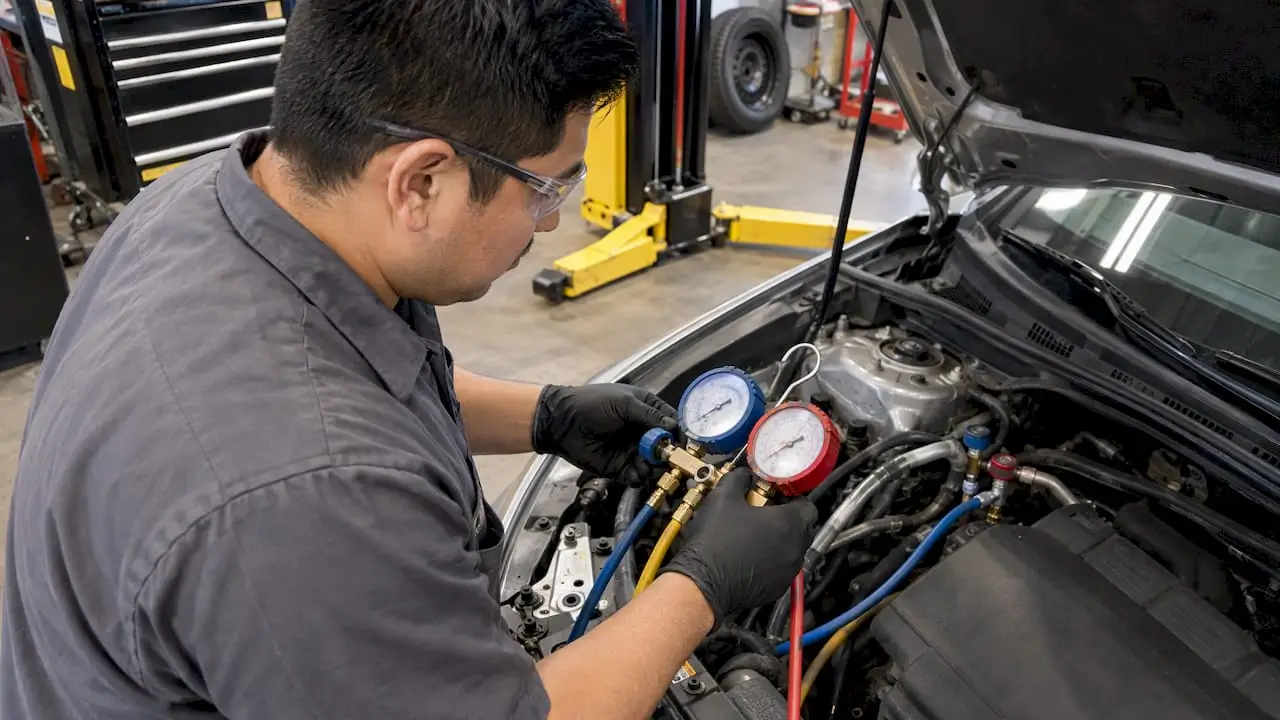
A healthy system, according to Friday Parts, usually shows a static pressure close to the outside temperature in degrees Fahrenheit, so roughly 80 PSI on an 80°F day. If pressure is very low, under about 20 to 30 PSI, there is likely a leak and the switch is shutting the system down.
Refrigerant does not get used up. If it is low, it went somewhere. That is why topping it off without finding the leak is a short-term fix at best. Our guide to refrigerant leak symptoms covers what technicians look for before recharging.
Fuse and relay problems
The fuse and relay are the cheap, quick items. The relay is the middle link: the control module tells it to close, and it then powers the clutch coil. Knowing which of those two steps is failing narrows the problem fast, as Vehicle Service Pros recommends when starting at the relay.
A worn or shorted clutch coil
The coil is an electromagnet. Heat, age and moisture can break down the winding insulation. A coil that has shorted internally draws too much current, and the fuse blows as soon as the A/C is commanded on. A coil that has gone open does nothing at all.
Air gap and mechanical wear
The hub and pulley need to sit a small, specific distance apart. If the gap grows too large, the magnetic field may not be strong enough to pull them together. Vehicle Service Pros also lists damaged clutch faces and a separated pulley as possible causes. Fort Worth’s long stretches of stop-and-go traffic mean a clutch cycles on and off a lot in summer, and that kind of repeated engagement is where wear shows up.
Control module and sensor faults
If the power side of the relay circuit is good and the relay tests fine, the attention shifts to the engine computer. It may not be completing the ground path because system pressures read below specification, an input sensor is misreporting, or modules are not communicating. This is the point where a basic test light stops being enough.
How to check it step by step
The sensible order runs from the quickest checks to the most technical. R & Y’s diagnostic guide walks through it: fuse, relay swap, refrigerant pressure with gauges, pressure-switch test, voltage at the clutch coil, coil resistance, ground, then scanning for fault codes. It reports that most cases are resolved in the first four steps.
- Look and listen. With the engine running and A/C on max, watch the center of the compressor pulley. Does the hub spin with the pulley, or sit still? Listen for a click when the A/C is switched on and off.
- Check the fuse. Your owner’s manual or the fuse box lid shows which one feeds the A/C circuit. A blown fuse is a clue, not the answer. Something made it blow.
- Swap the relay. Many cars have another relay of the same type for a non-critical circuit. Trading them is a one-minute test.
- Check system pressure. This needs a gauge set. R & Y says a properly charged system typically shows 80 to 120 PSI on both sides at ambient temperature with the engine off, and that a low side under 25 to 30 PSI is too low for the switch to allow engagement. In its diagnostic guide, it adds that below 50 PSI the system has lost a significant amount of refrigerant, and a reading of zero means a substantial leak that has to be found and repaired before any refrigerant goes in.
- Test voltage and ground at the coil. A technician confirms power arrives at the clutch connector when the system calls for it, and that the ground path is complete.
- Measure coil resistance. Specifications vary. Sanden’s on-vehicle test procedure gives 2.8 to 4.4 ohms for its field coils and says readings outside the range will not engage or will open fuse circuits. It also calls for more than 11.5 volts at the coil with the engine running and the clutch engaged. Always compare against your own vehicle’s specification.
- Check the air gap. The gap is measured at several points around the clutch, and Griffiths notes it should be checked at three points equally spaced.
- Scan for codes. If everything above passes, the control module, a sensor or a communication fault is next.
What a good coil test tells you
With the engine off, a technician can apply 12 volts from a battery or other power source directly to the coil wire. If the hub snaps into the pulley, Griffiths says the coil is fine. If the clutch only works when powered directly, the problem is upstream: low refrigerant, or a relay or fuse stopping current from reaching the coil. Good coils usually read about 2.9 to 3.2 ohms, though the range varies by manufacturer.

Can you force the A/C clutch to engage?
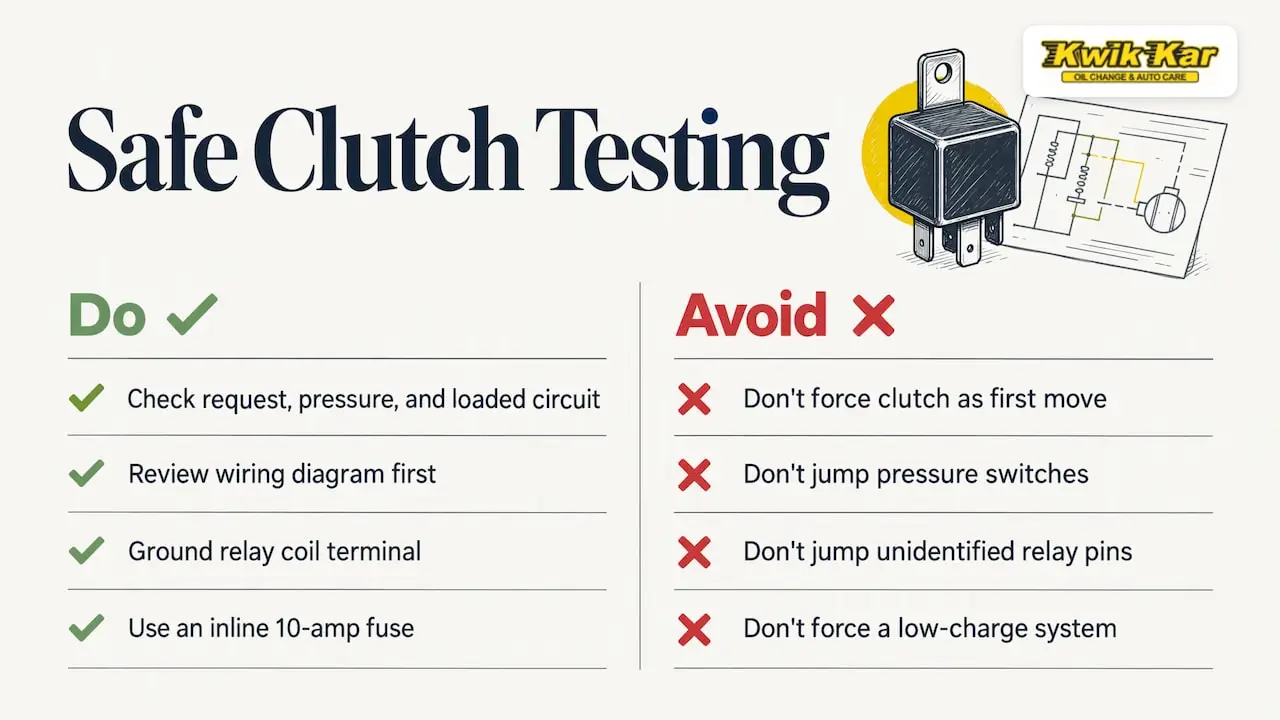
You will see “jump the relay” advice online. It has a place, but not as the first move. ElectroDuraParts warns that a forced clutch can run a dry or empty system, defeat pressure protection, overload wiring, or drive a seized compressor. It recommends starting with request, command, pressure and loaded-circuit tests.
Professionals see the same pattern. The Mobile Air Conditioning Society’s service report notes that many technicians keep guessing by jumping across low- and high-pressure switches, and that it takes little time to review the wiring diagram and check the obvious items first. The same report suggests grounding the relay coil terminal as a better approach than hot-wiring the clutch: if the compressor engages, the relay is good. If the relay clicks but the compressor does not engage, a break in the wire is more likely than a bad relay.
If you do test with jumper wires, use proper protection. For bench-testing a coil, MACS says to use an in-line 10-amp fuse on the test wires. Jumping the wrong relay pins can also damage the control module, so identify the circuit from a diagram first.
There is a bigger point here. If the clutch refuses to engage because the system is low on refrigerant, forcing it on can ruin a compressor that was otherwise fine, turning a leak repair into a much larger bill.
What does a blown A/C clutch fuse mean?
A fuse that blows once can be a fluke. A fuse that blows again right after replacement means a fault that is drawing too much current. According to MACS, the most common cause of clutch-circuit fuses blowing is a coil with resistance that is too low, and it recommends checking with an ohmmeter.
A fuse that blows instantly when you press the A/C button while the blower still works is a typical sign of a shorted coil, according to VehicleRuns. Other causes include a short in the wiring, a seized compressor, a fan with worn bearings, or a faulty relay.
Two practical rules apply:
- Never fit a higher-amperage fuse to stop it blowing. That moves the damage from a fuse to the wiring.
- Find the cause before replacing the fuse again, as StartMyCar advises for the F-150’s A/C fuse.
A/C clutch relay symptoms
A failing relay typically shows up as one of two things:
- The clutch never engages, even though the fuse is fine and the pressure is good. The relay is not closing, or it is not receiving a command.
- The clutch stays on after you shut the A/C off or turn the car off. MOTOR Magazine reports that a stuck-closed clutch relay can keep the coil energized and drain the battery. On certain Honda models it can also push high-side pressure up until a relief valve opens, with odd sounds, smells and brief smoke from under the hood.
If you smell something strange or see smoke, turn the engine off and have the car checked before running the A/C again.
Bad compressor or just the clutch?
This is the question that decides the bill. If the clutch coil, relay, wiring or air gap is at fault, the clutch can sometimes be repaired on its own. If the compressor has seized internally, or has failed and sent debris through the lines, the repair grows to include flushing and other parts.
Published estimates give a sense of the spread, though your vehicle and parts choice change the number:
- TheCarBuzz puts compressor clutch repair at $150 to $400 and compressor replacement at $800 to $1,500 for parts and labor.
- CarTipsDaily cites $400 to $797 for clutch-only replacement, and says a fully seized compressor that sheds metal through the lines can exceed $2,000 once the system flush and other components are included.
Those are national ballparks, not Kwik Kar quotes. For what moves the number on a compressor job, see our breakdown of AC compressor replacement cost. The takeaway is simple: catching a clutch problem early, and not running a compressor dry, is how you keep it in the cheaper category.
Why Fort Worth driving makes this show up in summer
North Texas heat puts the A/C to work for months. In heavy stop-and-go traffic on I-30, Loop 820 or White Settlement Road, the compressor cycles constantly and the engine bay runs hot. On long highway runs the system holds a steady load, and any small refrigerant leak that has been slowly draining the system eventually crosses the low-pressure threshold.
If you drive a pickup or SUV, a larger cabin and, on some models, rear A/C circuits mean the system has more to cool and more connections that can leak. Drivers in Westworth Village, Westover Hills, River Oaks, Lake Worth and Benbrook often tell us the A/C quit on the first truly hot afternoon of the year. That is usually when a slow leak finally trips the safety switch.
Perspective: how we approach a clutch that won’t engage
We treat a clutch that won’t engage as a question, not a part to replace. The clutch is the last link in a chain that starts with refrigerant pressure, runs through the computer, fuse and relay, and ends at the coil. Replacing the clutch without checking the chain is how drivers end up paying twice.
Our ASE-certified technicians use professional diagnostic equipment to read system pressures, test the circuit under load and scan for codes, and our digital vehicle inspections let you see what we found rather than take our word for it. We are RepairPal certified, and qualifying repairs are backed by our 24-month/24,000-mile warranty.
Our advice is the same whether you drive a commuter sedan, a work truck or a European model: if the A/C stopped working, don’t keep forcing it. Bring it in, let us find out why the clutch is idle, and fix the cause once.
Kwik Kar
When to bring it to a shop
A fuse and relay swap is a reasonable driveway check. Past that, bring the car in if:
- The fuse blows again after replacement.
- Gauges, or a shop’s reading, show low pressure, which means there is a leak to locate.
- The clutch clicks but does not hold, or slips and squeals.
- You smell something burning, see smoke, or the battery drains with the car off.
- Your vehicle is European or has a complex multi-module A/C control system.
For a leak, a technician finds the source before recharging. Our guides on AC recharge services and how automotive A/C works explain the process in more detail.
Get your A/C checked in West Fort Worth
Kwik Kar Oil Change & Auto Care is a full-service repair center, not just an oil change shop. Our heating and cooling service covers A/C diagnosis and repair, and you can see everything else we handle, from brakes to electrical work, on our website. We do not publish prices for A/C work, because the right repair depends on what the diagnosis finds.

We are at 9613 White Settlement Rd, Fort Worth, TX 76108, serving White Settlement and West Fort Worth, and drivers from nearby Westworth Village, Westover Hills, River Oaks, Lake Worth and Benbrook. You can schedule a visit online.
FAQ
What stops an A/C clutch from engaging?
The most common causes are low refrigerant that trips the low-pressure switch, a blown fuse, a failed relay and a bad clutch coil. A wide air gap, a poor ground or a control module fault can also do it. Checking the fuse and system pressure resolves most cases.
How do I tell whether the compressor is bad or only the clutch?
Apply 12 volts directly to the coil with the engine off. If the hub snaps into the pulley, the coil works, and the problem is upstream. If the clutch engages but the compressor is noisy, seized or has shed debris, the compressor itself needs attention. A technician can confirm with gauges and a resistance test.
Is it safe to jump the A/C relay to make the clutch engage?
Not as a first test. Forcing the clutch can run an empty system dry, defeat pressure protection and overload wiring. If the clutch engages only when forced, that points to low refrigerant, a relay or fuse issue, or a control fault that needs proper diagnosis.
Why does my A/C clutch fuse keep blowing?
Usually because too much current is flowing in the circuit. A shorted clutch coil is the most common cause, though wiring shorts, a seized compressor or a bad relay can do it too. Don’t install a higher-rated fuse. Have the circuit tested.
How much does it cost to fix an A/C clutch?
Published national estimates run from roughly $150 to $797 for clutch repair, and well over $800 if the compressor must be replaced. The final number depends on your vehicle, the cause and whether other parts are affected. A diagnosis gives you a firm answer.
Sources
- Ford Focus Service Manual: Air Conditioning Description and Operation
- Vehicle Service Pros: Compressors, to spin or not to spin
- R & Y A/C Compressors: Clutch not engaging, 6 causes
- R & Y A/C Compressors: Complete diagnostic guide
- Friday Parts: A/C clutch not engaging
- Griffiths: Troubleshoot the AC system
- MACS service report, February 2015
- MACS: Facts to know about the compressor clutch coil
- Sanden on-vehicle test procedure
- ElectroDuraParts: Clutch diagnostic tests
- MOTOR Magazine: A/C compressor clutch relay
- VehicleRuns: AC fuse keeps blowing
- StartMyCar: 2018 Ford F-150 air conditioning fuse
- TheCarBuzz: Symptoms of a bad AC compressor
- CarTipsDaily: Cost to fix a freon leak