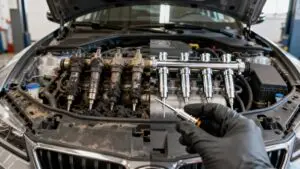





If your vents blow warm even after the AC has run for several minutes, you’re most likely dealing with a refrigerant leak, not a settings problem. The strongest tells are warm airflow that never turns cold, oily residue near AC components, and a compressor that clicks or short-cycles instead of running steadily. Run a quick visual and listening check yourself, but skip the temptation to just add refrigerant and hope. Book a professional leak diagnosis instead.
TL;DR:
- Most refrigerant leaks originate from aging rubber hoses, condenser fins, or compressor seals, often identified by oily residue or frosty lines.
- Visual and auditory clues such as oil stains, hissing sounds, or compressor short-cycling indicate a possible leak and require professional diagnosis.
- Topping off refrigerant without fixing the leak is only temporary, as it can harm the compressor and lead to more costly repairs later.
- DIY checks include measuring vent temperature, inspecting for ice or oil residue, and noting if cooling improves only during acceleration.
- Professional leak detection involves UV dye, electronic sniffers, and pressure testing, which ensures accurate repairs and compliance with environmental regulations.
Table of Contents
- AC Refrigerant Leak Symptoms: The Full Checklist
- Where AC Refrigerant Leaks Usually Start
- Checking Your AC Yourself Versus What a Shop Diagnostic Covers
- Why Recharging Alone Doesn’t Fix a Refrigerant Leak
- When to Book Professional AC Repair
- Preventing the Next AC Refrigerant Leak
- Kwik Kar Perspective: How We Diagnose Refrigerant Leaks
- Book Your AC Refrigerant Leak Diagnosis at Kwik Kar
- Sources
- FAQ
AC Refrigerant Leak Symptoms: The Full Checklist
Most drivers notice the same handful of warning signs before they ever think to ask “why is my AC not cooling?” Here’s how to read what your car is actually telling you.
Lack of cold air is the number one complaint. RepairPal identifies reduced cooling as the primary symptom of a low refrigerant charge. There’s a difference between air that’s warm briefly after startup (normal) and air that stays lukewarm or hot after several minutes of running (not normal). According to Kelley Blue Book, your AC should cycle from warm to noticeably cold within a few minutes. If it doesn’t, something is off, and a refrigerant leak is one of the likeliest culprits.
Audible clues often show up before the cooling loss becomes obvious; see this Haldex coupling noise troubleshooting guide for help distinguishing AC compressor noises from other drivetrain sounds. A hissing sound usually points to a larger, faster leak, while a clicking noise can mean the compressor clutch is short-cycling because it doesn’t have enough refrigerant pressure to run continuously. RepairPal notes this rapid cycling often comes paired with the radiator fan kicking into high speed and small surges in engine idle.
Visual signs tend to confirm what your ears already suspect:
- Oily or grimy film around hose fittings, the compressor, or the condenser
- Wet, dark stains near AC lines under the hood
- Frost or ice buildup on refrigerant lines or the evaporator, per KBB’s list of low-refrigerant signs
Inside the cabin, watch for AC that only feels cold while you’re accelerating, higher humidity than usual, or a defroster that struggles to clear the windshield. These are secondary clues, but they add up.
Pro Tip: Refrigerant is usually colorless and odorless, so don’t wait for a smell or a visible cloud. Carparts points out that oily residue and hissing are your best early clues, since most leaks are too slow to see with the naked eye.
Where AC Refrigerant Leaks Usually Start
Refrigerant doesn’t disappear on its own. If your system is low, refrigerant escaped through a specific point somewhere in the loop, and knowing the usual suspects helps you describe the problem accurately to a technician.
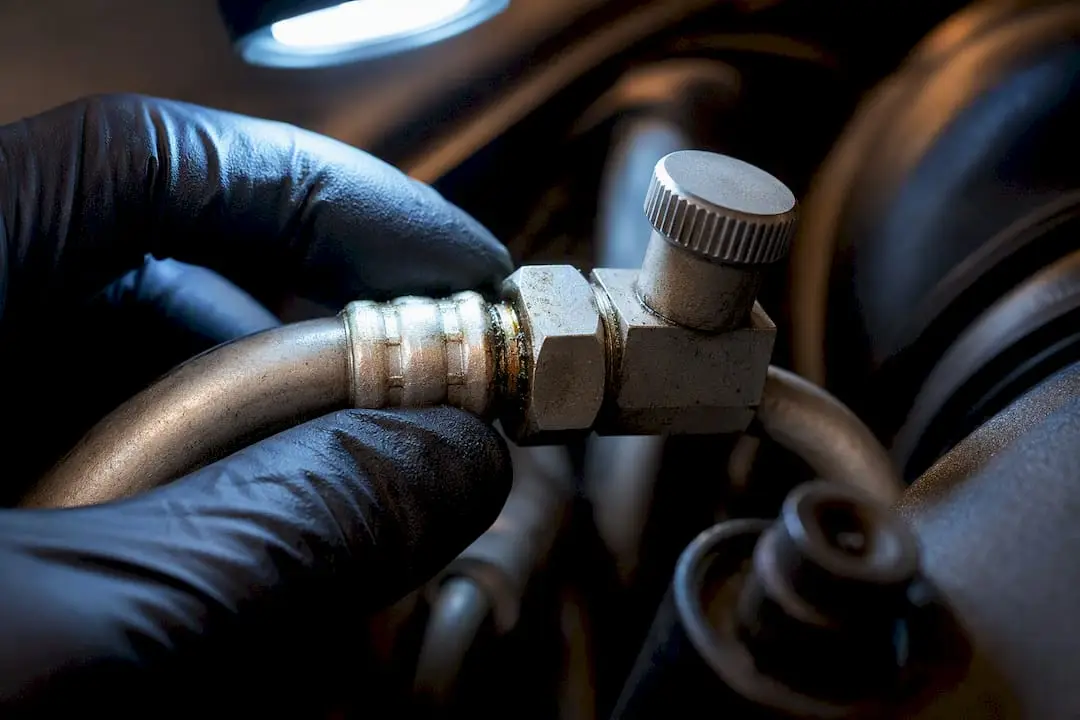
- Rubber hoses and crimped fittings. These flex constantly and are the most common failure point as they age.
- Condenser fins. Mounted at the front of the vehicle, they take the brunt of road debris and can develop pinhole leaks from rock strikes.
- Compressor seals. Wear over time, especially on higher-mileage vehicles.
- Service ports. Can develop slow leaks if the cap or valve seal degrades.
- Evaporator core. Buried behind the dashboard, this is the hardest spot to inspect and usually requires shop-level diagnostics to confirm.
Vibration, heat cycling, corrosion, and simple age all contribute to seal and hose failure over the years. There’s a practical reason oily residue is such a reliable clue: refrigerant carries a small amount of compressor oil with it as it circulates, so wherever that oil shows up as grease or a wet stain, that’s usually close to where the leak actually is. Technicians use that pattern to narrow down inspection points before reaching for detection tools. If you’re already noticing fluid under the hood and aren’t sure what you’re looking at, this guide to identifying fluid leaks can help you tell refrigerant oil apart from coolant or motor oil.
Checking Your AC Yourself Versus What a Shop Diagnostic Covers
You can safely run a few checks before booking an appointment. Here’s a simple order to work through:
- Measure vent temperature. Run the AC on max for a few minutes and feel whether the air actually gets cold or plateaus at lukewarm.
- Inspect visually under the hood. Look at hose fittings, the compressor, and the condenser for oily film or wet spots.
- Check for ice. After running the AC for several minutes, look at the accessible refrigerant lines for frost, a sign KBB associates with low charge.
- Notice acceleration behavior. If cooling only improves while you’re pressing the gas, that’s worth mentioning to your technician.
What you shouldn’t do: probe near the belt, fan, or compressor pulley while the engine runs, or attempt to open any AC line yourself. Refrigerant systems hold pressure, and refrigerant itself can cause frostbite or eye injury on contact. Handling it legally also requires certified recovery equipment, which is exactly why this stays a shop job.
A proper shop diagnostic goes further than what you can see or hear. AutoZone outlines the standard toolkit: UV dye added to the system that glows under a UV light at the exact leak point, electronic leak detectors that sniff out refrigerant vapor, and pressure or vacuum testing that reveals whether the system holds a seal over time. Full evacuation and recovery equipment lets a technician pull old refrigerant safely before repairs and recharge. That’s a level of precision a driveway inspection simply can’t match, since CarParts.com notes most leaks are too slow and too small to spot without instruments.
Why Recharging Alone Doesn’t Fix a Refrigerant Leak
Refrigerant doesn’t wear out or get “used up” the way engine oil does. If your system is low, that refrigerant went somewhere, and the only way it leaves a sealed system is through a leak. Kelley Blue Book makes this point directly: topping off without finding the leak is a temporary patch at best, because whatever refrigerant you add will eventually escape through the same opening.
There are real costs to repeating that cycle:
- Refrigerant carries the oil your compressor needs to stay lubricated, so running low starves it of lubrication over time.
- Repeated recharges without repair can accelerate compressor wear and lead to a much more expensive failure down the road.
- Certified shops are the only ones equipped to legally recover and recycle refrigerant during diagnosis, which matters for both compliance and for doing the repair correctly the first time.
A recharge feels like a fix because the cold air comes back. It isn’t one if the leak is still there.
When to Book Professional AC Repair
Certain signs mean it’s time to stop troubleshooting and schedule a visit. Book service if you notice:
- Vents still blowing warm after several minutes of AC running
- Visible oily residue anywhere along the AC lines or compressor
- Frost or ice on refrigerant lines
- A compressor clutch that won’t engage at all
- More than one recharge in recent memory without a diagnosed cause
At the shop, expect a workflow built around confirming the leak before touching anything. That typically means UV dye or electronic leak detection, a vacuum test to check whether the system holds pressure, targeted repairs (a hose, a condenser, a compressor seal, or in tougher cases the evaporator), then full evacuation and recharge to the manufacturer’s specification, followed by a performance test.
Before you approve the work, it’s fair to ask how the leak was located, which specific parts need replacing, what warranty applies to the repair, and whether the technician holds ASE or RepairPal-backed certification. If you want a primer on what those credentials actually mean before you ask, this guide to certified technicians breaks it down.
Preventing the Next AC Refrigerant Leak
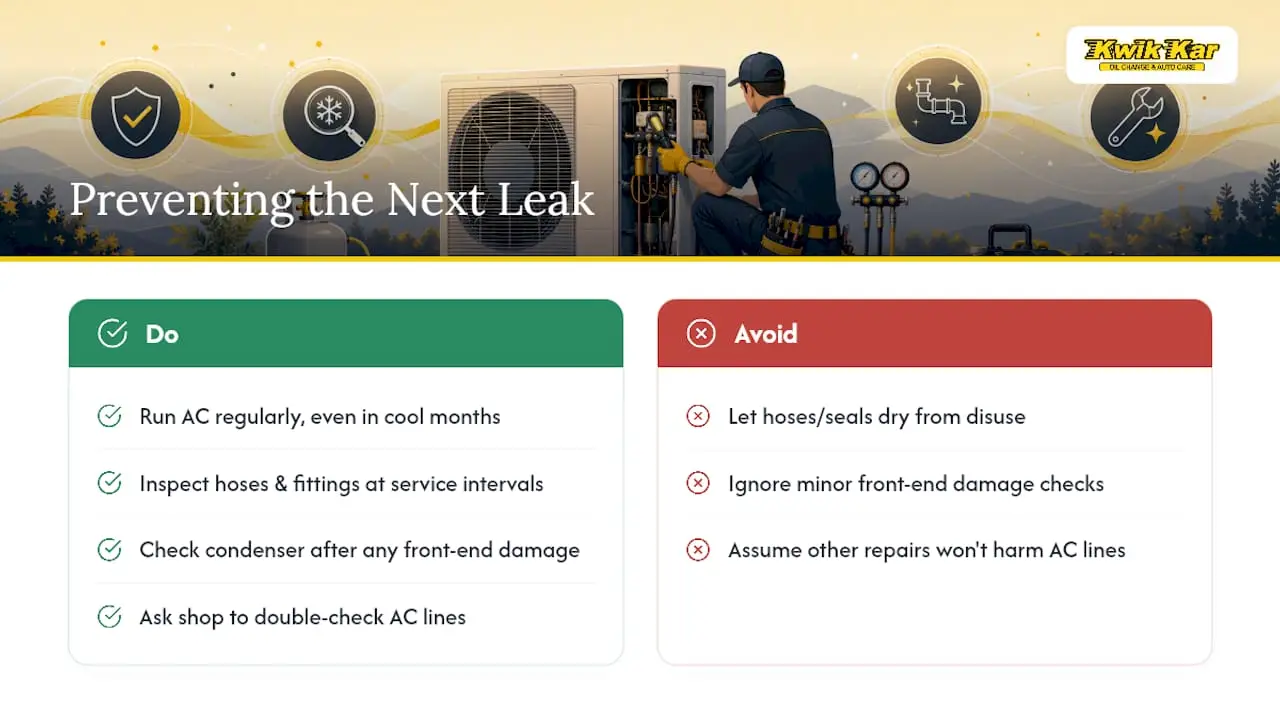
A little routine attention goes a long way toward avoiding a repeat leak. Run your AC periodically even in cooler months, since regular use keeps oil circulating through hoses and seals instead of letting them dry out. Have hoses and fittings inspected at normal service intervals, and get the condenser checked any time you’ve had front-end damage, even minor.
Pro Tip: If you’re getting engine-bay work done for something unrelated, like an alternator swap, ask the shop to double-check that no AC lines are in the way. Accidental line damage during other repairs is more common than most drivers realize.
Kwik Kar Perspective: How We Diagnose Refrigerant Leaks
Our ASE and RepairPal-certified technicians use UV dye, electronic detection, and vacuum testing before touching a single component, and we walk you through exactly what we found and why. Skip the guesswork of another recharge and get the leak located properly.
— Kwik Kar
Book Your AC Refrigerant Leak Diagnosis at Kwik Kar
Repeated recharges cost you more over time than finding the leak once and fixing it right. Kwik Kar Oil Change & Auto Care runs the same diagnostic sequence described above, UV dye, electronic detection, and vacuum testing, so you get a clear answer about where refrigerant is escaping instead of a guess dressed up as a repair.

When you bring your vehicle in, be ready to describe what you’ve noticed: how long it takes for vents to warm back up, whether you’ve seen oily residue, and whether the system has been recharged before. Our technicians are backed by ASE and RepairPal certification standards, so you get a clear, itemized estimate before any work begins, not a surprise invoice. If cost timing is a concern, ask about auto repair financing options available for larger AC repairs. Schedule your AC refrigerant leak diagnosis with Kwik Kar Oil Change & Auto Care today and get back to cold air you can count on.
Sources
Findings referenced above come from RepairPal, Kelley Blue Book, AutoZone, and CarParts.com. For more background, see our guides on how automotive AC works and car AC recharge services in Fort Worth.
- Signs Your A/C System Is Low on Refrigerant — RepairPal
- Freon: Signs Your Car Needs It — Kelley Blue Book
- Signs your car’s AC needs to be recharged — AutoZone
FAQ
What is the first sign of a refrigerant leak?
The most common early sign is AC vents blowing warm or lukewarm air instead of cooling down within a couple minutes of running, according to RepairPal.
Can I just add refrigerant myself to fix a leak?
Topping off without finding the leak is only a temporary fix, since the added refrigerant will eventually escape through the same opening, per Kelley Blue Book.
Does a refrigerant leak have a smell or color?
No, refrigerant is typically colorless and odorless, so oily residue, hissing sounds, and weak cooling are more reliable clues than smell, according to CarParts.com.
Is ice on the AC lines a bad sign?
Yes, frost or ice buildup on refrigerant lines or the evaporator can indicate a low refrigerant charge from a leak, per Kelley Blue Book.
How do shops find a refrigerant leak I can’t see?
Technicians use UV dye that glows under a UV light, electronic leak detectors, and vacuum or pressure testing, tools described by AutoZone that can pinpoint leaks invisible to the eye.