




Most vehicles need a new cabin air filter roughly every 12,000 to 30,000 miles, or every 12 to 24 months, depending on the model and driving conditions, with the longer intervals assuming milder environments. If you drive on dusty roads, sit in heavy traffic, or deal with heavy pollen seasons, check the filter sooner. When in doubt, pull it out and look at it, or have us take a look at your next visit.
TL;DR:
- Drivers facing dust, heavy idling, stop and go traffic, or high pollen should replace filters every 6 to 12 months or 6,000 to 10,000 miles.
- Replace the filter early if airflow drops or odors appear; check its pleats in bright light, since little light passing through signals restriction.
- Choose charcoal filters for recurring odors or fumes; allergy sufferers and urban drivers may benefit from HEPA or HECA style filters in recirculation mode.
- A Duke field study in taxis found that high efficiency filters, closed windows, and recirculation cut PM2.5 by 37% and ultrafine particles by 47%.
- Most drivers can replace a cabin filter in 10 to 15 minutes without special tools, but damaged housings or persistent odors call for professional inspection.
Table of Contents
- Manufacturer baseline intervals: why the mileage ranges differ
- When to replace sooner: severe driving conditions that shorten the clock
- How to check and replace your cabin air filter yourself
- Filter types: standard, charcoal, and HEPA-style options
- What a filter change costs and how long it takes
- Our technicians’ take on seasonal cabin filter checks
- Book a cabin air filter check at Kwik Kar
- FAQ
- Sources
Manufacturer baseline intervals: why the mileage ranges differ
Owner’s manuals do not all agree on a single number, and that is by design rather than an oversight. AutoZone notes that cabin air filter replacement intervals typically fall between 12,000 and 30,000 miles, or 12 to 24 months, depending on the manufacturer and model. That is a wide window, and the reason comes down to a few variables that change from one vehicle to the next.
Filter media quality plays a role. A denser, higher-efficiency filter can trap more debris before it chokes off airflow, which sometimes lets a manufacturer stretch the recommended mileage. Cabin ventilation design matters too: some vehicles pull air through tighter housings that clog faster, while others have more generous intake paths that give the filter a longer working life. Climate assumptions baked into the owner’s manual also shift the number. A schedule written for a temperate, low-dust environment will not hold up the same way for a driver logging miles on gravel roads or through a dry, windy region.
A few practical points worth keeping in mind:
- Check your owner’s manual or service schedule for the exact mileage and month interval set by your manufacturer.
- Treat the manual’s number as a starting point, not a guarantee, since it reflects “normal” driving conditions.
- Pair the mileage interval with a visual check at routine services rather than waiting for a hard deadline.
When to replace sooner: severe driving conditions that shorten the clock
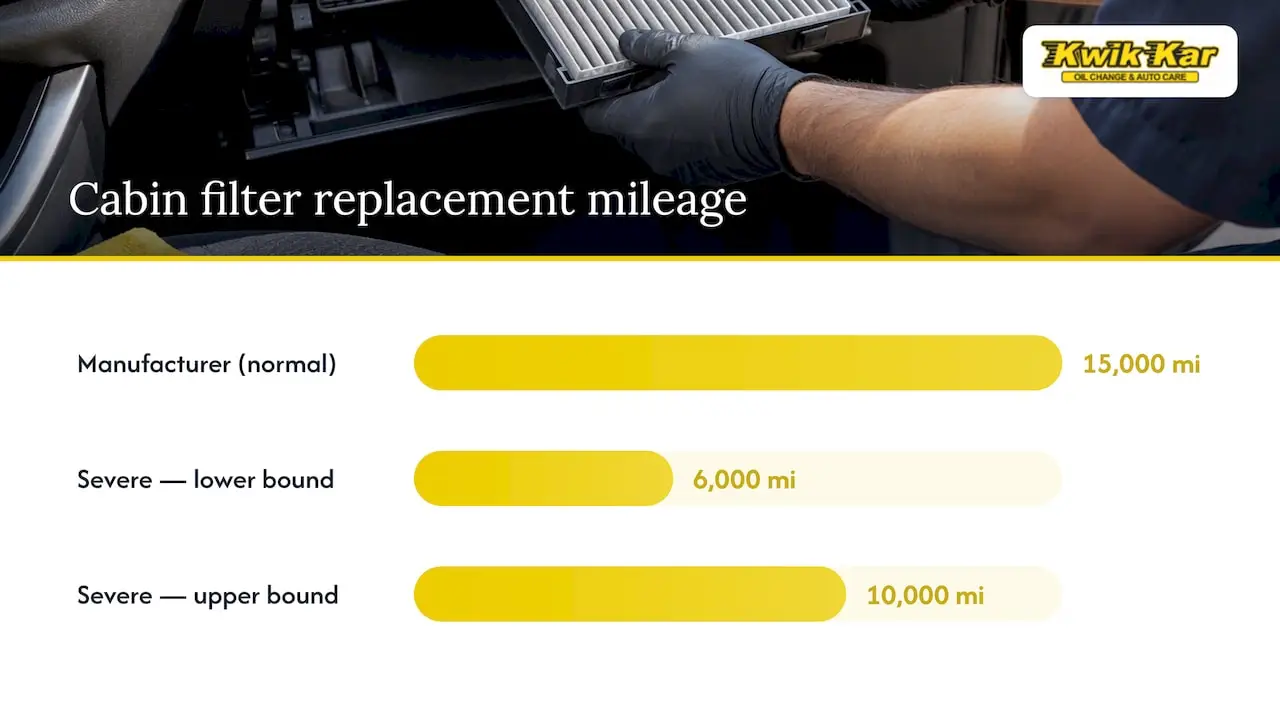
Manufacturer intervals describe what they call “normal” driving, but a lot of everyday driving in Fort Worth does not fit that definition. Dusty or unpaved roads, heavy stop-and-go city traffic, construction zones, and long stretches with the engine idling all load the filter faster than a quiet highway commute. Add pet hair, nearby construction, or a heavy pollen season, and a filter rated for 15,000 miles can clog well before it gets there.
A simple way to judge your situation:
- If you drive mostly paved roads with light traffic, the standard manufacturer interval is a reasonable guide.
- If you regularly hit dusty roads, idle in traffic, or live somewhere with high pollen counts, plan on replacing the filter every 6 to 12 months or every 6,000 to 10,000 miles.
- If you notice reduced airflow or odors well before either interval, treat that as your real deadline instead of the mileage on the sticker.
Kia’s owners manual guidance draws the same distinction between normal and severe conditions, pointing out that dusty roads and heavy idling justify more frequent inspection than the standard schedule allows. Technicians often suggest checking the filter at every oil change if you fall into that severe category, since it costs nothing to look and catches a clogged filter before it strains the blower motor.
Pro Tip: Build the cabin filter check into whatever service you already have on a schedule, like your oil change, so it never gets forgotten between seasons.
How to check and replace your cabin air filter yourself
The cabin air filter usually sits behind the glovebox, under the dash on the passenger side, or in the cowl area at the base of the windshield, depending on your vehicle. Finding it is the first step, and your owner’s manual will confirm the exact location for your model.
A basic inspection takes a few minutes:
- Open the glovebox or access panel and locate the filter housing.
- Slide or unclip the filter and look at it in good light for visible dirt, leaves, or debris packed into the pleats.
- Smell it. A musty or earthy odor is a sign it is overdue.
- Hold it up to a window. If little light passes through the pleats, airflow is already restricted.
Replacing it follows a similarly short process:
- Note the orientation arrows on the old filter before removing it, since the new one needs to face the same direction for proper airflow.
- Remove any retaining clips or the access cover gently, since plastic tabs can be brittle on older vehicles.
- Slide the new filter in, matching the airflow arrows, and reseat the cover or clips firmly.
- Double check that the housing seals completely. A gap here lets unfiltered air bypass the new filter entirely.
Most drivers can handle this in 10 to 15 minutes with no special tools. That said, a few situations call for a professional visit instead: a cracked or damaged filter housing, a blower that still sounds weak or noisy after a fresh filter, unusual odors that persist, or simply wanting it done quickly and correctly during a visit you already have planned. If you are addressing a lingering smell, our guide to AC odor troubleshooting covers what to check if the problem does not clear up after a filter swap, and our vent cleaning steps are worth a look once the new filter is in.
Filter types: standard, charcoal, and HEPA-style options
Not every cabin air filter does the same job, and the type you choose affects both protection and how often it needs attention. A standard filter catches dust, pollen, and larger debris, which handles the basics for most drivers. A charcoal or carbon filter adds a layer that absorbs odors and some volatile organic compounds, useful if you drive through areas with exhaust fumes or industrial smells. A HEPA or HECA-style filter goes further, targeting fine particles and ultrafine particles that slip past basic media.
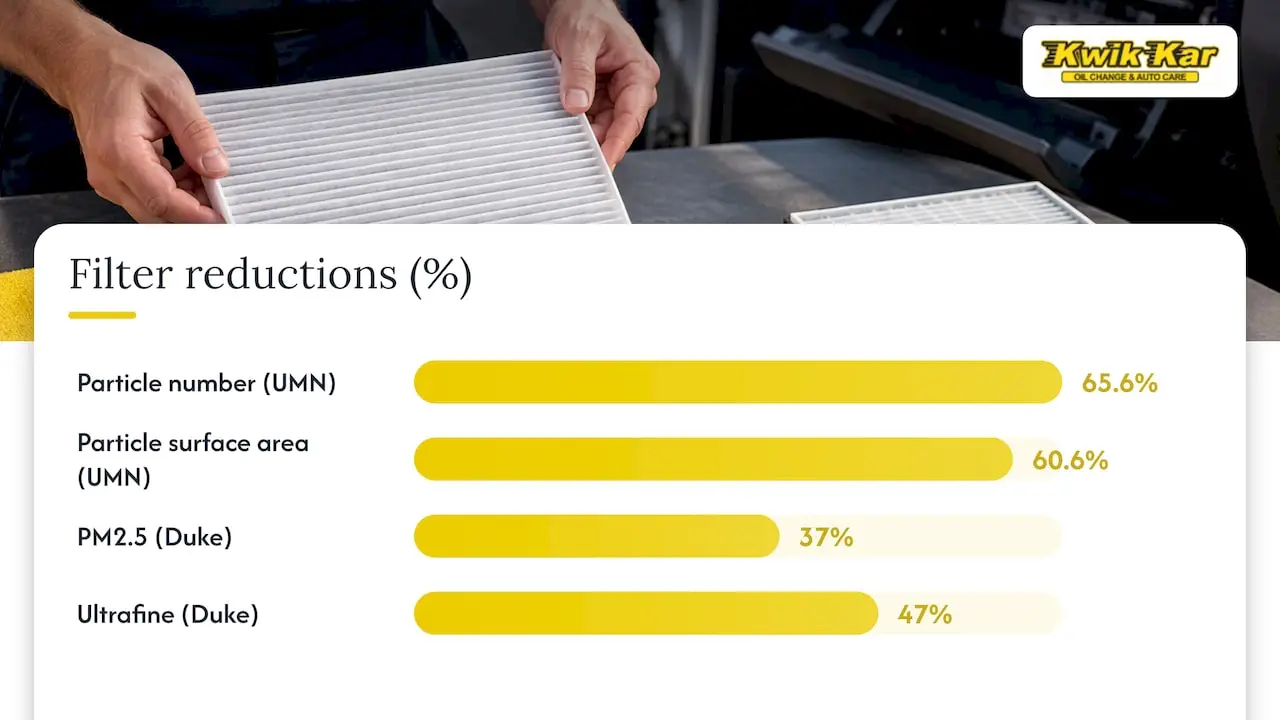
The performance difference is measurable. Laboratory and on-road testing from the University of Minnesota found that cabin air filters reduced in-cabin particle concentrations by roughly 65.6% for particle number and 60.6% for particle surface area at medium fan speed. A field study from Duke scholars found that pairing a high-efficiency cabin air filter with closed windows and recirculation mode cut in-cabin PM2.5 by 37% and ultrafine particles by 47% in a taxi study, a larger reduction than basic filters achieve on their own.
A few notes on choosing between them:
- Standard filters suit drivers with no particular allergy or air quality concerns and a typical commute.
- Charcoal filters make sense if odor or fumes are a recurring complaint.
- HEPA or HECA-style filters are worth the upgrade for allergy sufferers, frequent urban drivers, or rideshare and delivery drivers spending long hours in traffic, and they work best when run in recirculation mode.
What a filter change costs and how long it takes
Parts cost varies with filter type, with charcoal and HEPA-style filters priced higher than basic versions, and OEM parts generally running more than aftermarket equivalents. Shop labor for a cabin air filter is typically quick, often 15 to 45 minutes depending on the vehicle and how accessible the housing is.
A few things that can extend that time:
- A filter housing that is difficult to reach on certain models
- Additional diagnostics if the blower motor sounds weak or noisy even with a new filter installed
- An inspection of the cabin air intake if debris has built up beyond the filter itself
A badly clogged filter strains the blower motor over time, which is why technicians often check that component while they are already in there replacing the filter.
Our technicians’ take on seasonal cabin filter checks
We treat the cabin air filter as part of routine maintenance, not an afterthought. Checking it during an oil change or a seasonal service catches problems before a customer notices a smell or weak airflow. Hyundai’s service guidance backs this approach, recommending inspection at seasonal transitions, spring for pollen and fall for moisture related issues, rather than relying on mileage alone.
Our technicians look at the filter itself, the cabin air intake for blockages, and blower motor operation before confirming everything is clear. It is a small check with an outsized effect on comfort and air quality inside your vehicle.
— Kwik Kar
Book a cabin air filter check at Kwik Kar
If you would rather skip the glovebox crawling and let someone else confirm your filter is clean, that is exactly what we handle during a quick visit. We check the filter, the cabin intake, and blower performance together, so you leave knowing the whole system is working the way it should, not just that a new filter is installed.

A cabin filter inspection usually adds only a few minutes to a service you are already booking, like an oil change or a seasonal tune-up. Our preventative maintenance and filter replacement services cover this directly, with technicians and quality parts behind every job. If you are also due for other maintenance, our full services page lists everything from oil changes to brakes and diagnostics in one place.
A few reasons drivers choose to have us handle it:
- No guesswork about filter location or orientation on your specific model
- A technician check of the blower motor and intake while the housing is already open
- A fast visit that fits into a service you are already scheduling
Ready to get it checked? Schedule your visit with Kwik Kar and we will take care of the rest.
FAQ
What are the signs of a bad cabin filter?
Reduced airflow from the vents, musty or earthy odors inside the cabin, increased interior humidity, and visible dirt or debris on the filter are the main signs, according to Hyundai’s service guidance. A weaker blower motor sound can also point to a clogged filter straining the system.
How much should a new cabin air filter cost?
Cost depends on the filter type and whether you choose OEM or aftermarket parts, with charcoal and HEPA-style filters priced higher than basic versions. For an exact quote, ask us directly since we do not publish a flat rate across every vehicle.
Will a dirty cabin filter affect my AC?
Yes. A clogged filter restricts airflow through the HVAC system, which can weaken AC performance and force the blower motor to work harder than it should. Left long enough, that extra strain can lead to more expensive blower repairs, according to Hyundai’s guidance.
What happens if I don’t change the cabin air filter?
Airflow keeps weakening, odors and humidity build up inside the cabin, and the blower motor works harder to push air through the blockage. Over time that added strain can shorten the blower motor’s life and raise your repair bill.
Sources
- AutoZone — Cabin air filter
- Hyundai — Cabin air filter (service & parts)
- University of Minnesota — Laboratory and on-road evaluations of cabin air filters
- Duke scholars — Field study on HECA filters and in-cabin exposures