



Most drivers pay $150 to $300 per axle for brake pad replacement, with all four wheels typically landing between $300 and $600. Add worn rotors and that number jumps to $250 to $500 per axle, and luxury or performance vehicles can push well past that. If you’re hearing a squeal or feeling a pulse in the pedal, get a shop to inspect your pads this week rather than wait for a grinding sound to make the decision for you.
TL;DR:
- Brake pad replacement costs typically range from $100 to $300 per axle, with luxury vehicles often exceeding $600 per axle when rotors are included.
- The biggest cost factor is pad material, with ceramic pads being quieter and longer-lasting than organic or semi-metallic options, which impact the overall price.
- Resurfacing rotors is less common now due to their thinness, making replacement the default cost-adding step that can significantly increase the total bill.
- Labor complexity varies for models with electronic parking brakes or seized calipers, which can extend repair times and costs.
- DIY replacement can save $120 to $240 per axle but risks missing warning signs that a professional inspection would catch, potentially leading to much higher expenses long-term.
Table of Contents
- Brake Pad Replacement Cost Breakdown: Parts vs. Labor
- What Actually Changes Your Brake Job Cost Breakdown
- DIY vs. Professional Brake Service: The Real Math
- How to Estimate Your Bill and Question a Quote
- Kwik Kar’s Take: Safety First, Pricing Second
- Get a Straight Answer on Your Brakes at Kwik Kar
- Sources
- FAQ
Brake Pad Replacement Cost Breakdown: Parts vs. Labor
The number on your invoice is really two numbers stacked together: what the parts cost and what the shop charges to install them. Pulling those apart is the fastest way to tell whether an estimate is fair.
On the parts side, pads alone run $25 to $150 per axle depending on material, while rotors add another $60 to $150 per axle when they need replacing. Labor is where shop-to-shop variation shows up most, typically $80 to $200 per axle depending on your market and how straightforward the job is.
Put together, KBB’s cost data shows brake pad replacement averaging around $150 per axle, with a realistic range of $100 to $300 depending on your vehicle and pad choice. Here’s how that plays out by vehicle class for a pads-only job:
- Economy cars (Civic, Corolla, Sentra): $120 to $220 per axle
- Mid-size sedans and crossovers: $150 to $280 per axle
- Trucks and full-size SUVs: $180 to $320 per axle
- Luxury and performance vehicles: $300 to $600+ per axle
Watch for this on your invoice: shops commonly tack on a hardware kit ($10 to $30), a shop supply fee, and sometimes a disposal charge for the old pads. None of these are scams, but they should be itemized, not buried into a single “brake service” line.
What Actually Changes Your Brake Job Cost Breakdown
The same “brake pad replacement” can cost $180 or $700 depending on four variables that have nothing to do with the shop trying to overcharge you.
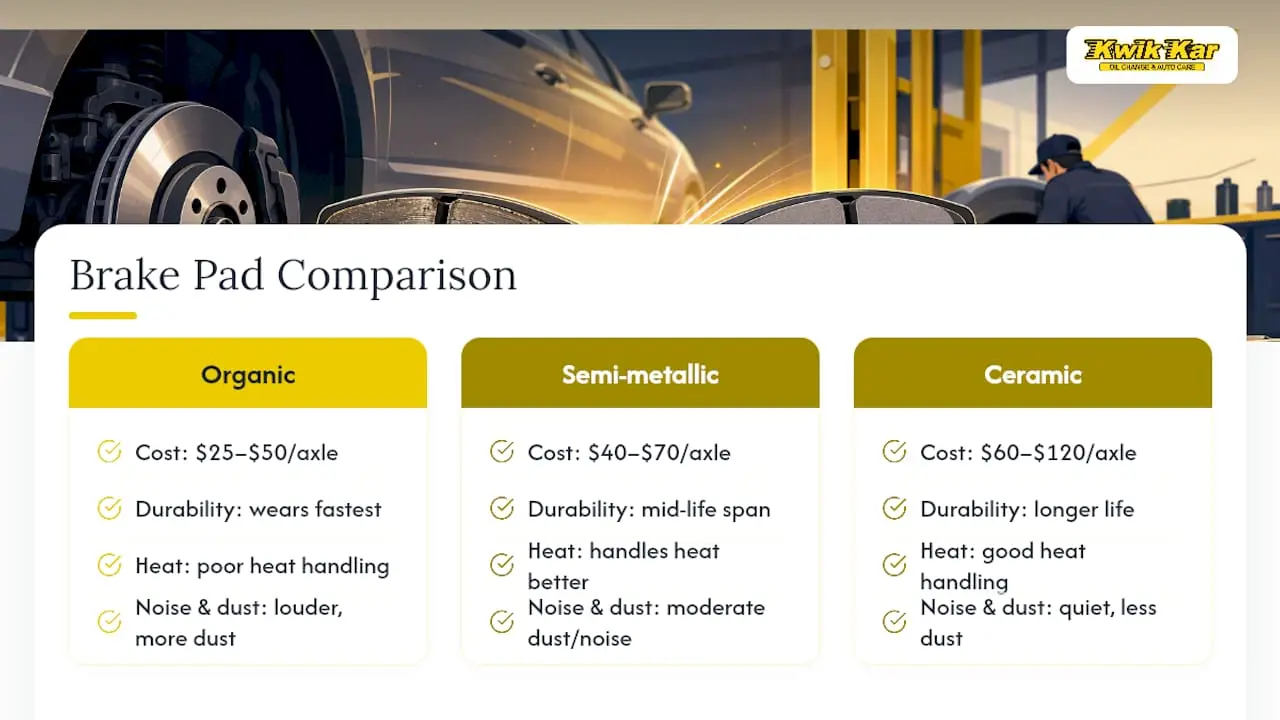
Pad material is the biggest lever on parts cost. Organic pads run $25 to $50 per axle but wear out fastest. Semi-metallic pads land at $40 to $70 and handle heat better, which matters for towing or performance driving. Ceramic pads cost $60 to $120 per axle, run quieter, produce less dust, and tend to extend rotor life since they’re gentler on the rotor surface. As one industry source notes, semi-metallic pads suit towing and performance use, while ceramic fits quiet daily driving and organic works for light-duty commuting on a budget.
Rotor condition is the real tipping point. Resurfacing (machining) a usable rotor costs far less than replacing it, but fewer than 30% of shops still offer resurfacing since modern rotors are often too thin to safely re-cut. That means replacement, not machining, has become the default, and it’s the single biggest reason a “brake pad job” balloons into a $250 to $500 per-axle bill.
Labor complexity varies too. Vehicles with electronic parking brakes need a scan tool to retract the caliper, and seized caliper bolts on older cars add shop time you’ll see reflected in the labor line.
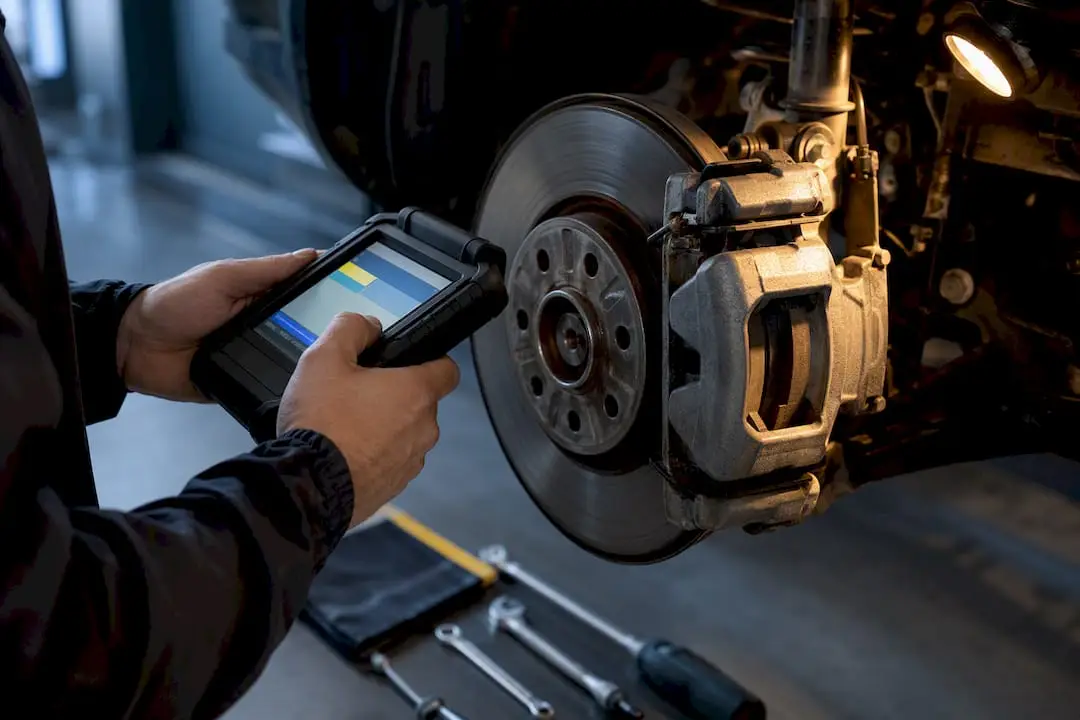
Pro Tip: If your car has an electronic parking brake, ask upfront whether the shop has the tool to release it. Some independent shops don’t, and you don’t want to find that out after they’ve already pulled the wheel.
DIY vs. Professional Brake Service: The Real Math
Replacing your own pads is genuinely doable for anyone comfortable with a jack, a torque wrench, and a Saturday afternoon. Here’s how the tradeoff actually breaks down:
- Parts-only cost. Buying pads and rotors yourself typically costs less than paying for full service, generally similar to shop parts prices.
- What you save. Skipping labor saves $120 to $240 per axle, the biggest reason DIY appeals to budget-conscious owners.
- What you give up. A shop provides a lift, a torque spec check, brake fluid inspection, and a second set of eyes on caliper slides and hoses. Miss a sticking caliper at home and you can burn through a new pad set in months.
- The real risk. Waiting too long or missing a warning sign turns a $150 pad job into a rotor replacement, since worn-out pads grind metal against metal fast.
If you’re mechanically confident, our DIY brake pad replacement guide walks through the process. If you’re not sure what you’re looking at under the wheel, that uncertainty alone is a good reason to book a professional brake inspection instead.
How to Estimate Your Bill and Question a Quote
Before you call a shop, do a quick visual check yourself. Look through the wheel spokes at the pad; if the friction material looks thinner than a quarter inch (about 4mm), that’s the standard trigger point for replacement. Note any squealing, grinding, vibration, or pulling to one side, and mention all of it when you call.
When you get a quote, ask these questions before you approve any work:
- “Can you break out parts and labor separately on the estimate?”
- “Are you measuring rotor thickness and runout before charging for replacement, or is that a flat recommendation?”
- “Does this price include the hardware kit, wear sensors, and disposal fees, or are those added later?”
- “What’s the labor rate per hour, and how many hours is this job estimated at?”
Pro Tip: A shop that measures your rotors before quoting replacement is doing it right. If a quote jumps straight to “rotors need replacing” without a measurement, ask them to show you the number.
Our guide on inspecting brake rotors shows you exactly what a technician checks for.
Kwik Kar’s Take: Safety First, Pricing Second
Certified technicians don’t guess at brake wear, they measure it, and that’s the difference between an honest quote and an inflated one. Catching thin pads early almost always costs less than waiting for a warning light, because worn pads chew into rotors and turn a $150 job into a $500 one. Marginal savings from delaying service rarely outweigh the risk of reduced stopping power. When in doubt, get the pads measured before you decide anything else.
— Kwik Kar
Get a Straight Answer on Your Brakes at Kwik Kar
Kwik Kar Oil Change & Auto Care gives you a transparent, itemized brake quote before any work starts, so you know exactly what you’re paying for parts versus labor and never get surprised by a rotor charge you didn’t approve.
Every brake job includes a full inspection by ASE and RepairPal certified technicians, quality pads and hardware matched to your vehicle, and a written estimate that separates every line item. If your invoice looks bigger than expected, our guide on common auto repair scams can help you spot the difference between a legitimate rotor replacement and an unnecessary upsell. Larger jobs, like pads and rotors together, can also be split into payments through our auto repair financing options.
Ready to find out what your brakes actually need? Visit the Kwik Kar brake service page to book an inspection, or check current oil change and service coupons to bundle your brake check with routine maintenance.
Sources
The cost ranges and safety guidance in this article draw from the following:
- Cost to replace brake pads and rotors | ConsumerAffairs
- Brake repair prices & cost estimates | KBB
- Carparts
- How Much Do Brake Pads Cost in 2026? | UseCalcPro
- 5 signs you need new brake pads | GEICO
For related reading, see our breakdown of brake rotor replacement cost and the signs that your brake pads are wearing out.
FAQ
How much does it cost to replace all four brake pads?
Expect $300 to $600 total for pads alone on most mainstream vehicles, or $500 to $1,000 total for pads and rotors on both axles.
Is it cheaper to replace brake pads yourself?
Yes, DIY typically saves $120 to $240 per axle in labor, but you take on the risk of missing a stuck caliper or worn rotor a shop would catch during inspection.
Can you drive with bad brake pads?
You can drive briefly with thin pads, but grinding noises mean metal-on-metal contact, which damages rotors fast and turns a simple pad job into a much bigger repair.
Should I replace all four brake pads at once?
Not necessarily. Front and rear pads wear at different rates, so replace by axle based on actual measured thickness rather than replacing all four just because one axle is worn.