



Tow/haul mode is a setting on automatic-transmission trucks and SUVs that changes how the transmission shifts when the vehicle is pulling a trailer or carrying a heavy load. It holds each gear longer, shifts down sooner on descents and cuts down on constant gear changes, which keeps the transmission cooler and gives you more control. Turn it on when you tow a large trailer or haul a heavy payload, and leave it off for ordinary empty driving. Below is what changes under the hood, how to judge a load, and how to care for the transmission that does the work.
TL;DR
- Tow/haul mode delays upshifts, downshifts earlier for engine braking and reduces gear hunting, which lowers the chance of transmission overheating.
- Use it when towing a large trailer, carrying a heavy load or driving hills with frequent shifting, as Ram’s owner’s manual describes.
- GM’s service manual says it works best when truck and trailer together reach at least 75 percent of the gross combined weight rating.
- Running it empty will not damage a GM vehicle, but it can mean firm shifts and worse fuel economy. Skip it on ice and slick pavement.
- To switch it off, press the button again. Ford’s manual says two presses on its gearshift button, and the mode also resets when the vehicle powers down.
Table of Contents
- What does tow/haul mode actually do?
- When should you turn tow/haul mode on?
- How heavy is heavy enough?
- Is it okay to leave tow/haul on all the time?
- How do you turn tow/haul mode off?
- When should you avoid tow/haul mode?
- Fort Worth driving: what the mode means for West Side trucks
- Looking after the transmission that does the work
- How Kwik Kar can help your truck or SUV
- Our perspective on towing and transmission care
- FAQ
- Sources
What does tow/haul mode actually do?
Tow/haul does not add horsepower or change your engine. It changes the rules the transmission follows when it picks a gear. Ram’s 2022 owner’s manual says the mode delays upshifts, automatically downshifts for engine braking when you lift off the throttle or brake steadily, and reduces the potential for transmission overheating or failure from excessive shifting.
Three things happen in practice.
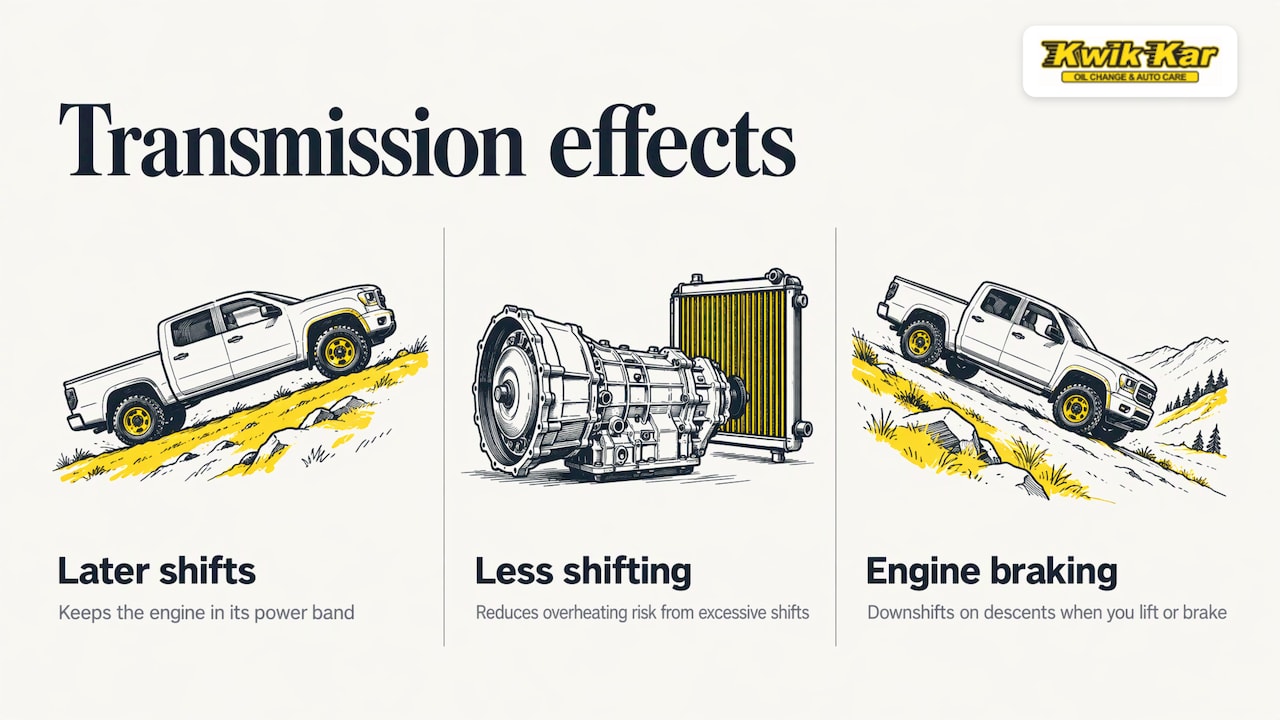
Later upshifts keep the engine in its power band
A normal automatic shifts up early to save fuel. With a trailer behind you, that early shift drops the engine into a gear where it has to strain, so the transmission shifts back down, then up again. GM’s service manual says tow/haul raises the upshift points at light to medium throttle so the vehicle can use more engine power. The result is that the engine stays in the rpm range where it pulls best.
Less gear hunting means less heat
Every shift generates heat in the transmission, and heat is what wears out clutches and fluid. The shift-cycling you feel on a grade, where the truck keeps bouncing between two gears, is exactly what the mode is built to prevent. Think of it as the engine working harder than the truck is moving, then the transmission trying to fix it again and again. Tow/haul settles on one gear and stays there. Capital One’s explainer notes it reduces shift cycling to keep transmission temperatures in a safe range, and that some applications lock out the top gears.
Stronger engine braking on the way down
When you lift off the gas, the truck downshifts sooner so the engine helps slow the load. Ford’s owner’s manual describes engine braking in all forward gears to help on descents, and says the truck may downshift to control speed on a hill without you touching the accelerator. That takes work off your brake pads and rotors, which matters when you are stopping several thousand extra pounds.
The exact behavior differs by manufacturer and model. Some trucks also change torque converter lockup or throttle response. Your owner’s manual is the final word on what your own truck does.
When should you turn tow/haul mode on?
The simple rule: use it when the vehicle is working harder than usual and the transmission is shifting a lot because of it.
Good times to switch it on:
- Towing a large trailer. A travel trailer, a car hauler, an equipment trailer or a boat that is a real load for your truck.
- Carrying a heavy payload. A bed full of gravel, a load of lumber, a slide-in camper.
- Driving hills with a load. Ram’s manual says to activate it in hilly areas, while towing or with a heavy load, when frequent shifting occurs.
- Stop-and-go traffic with a trailer. GM’s 2005 Sierra owner’s manual says the mode helps through rolling terrain, in stop-and-go traffic and in busy parking lots where better low-speed control is wanted, as described in that manual.
- Long-distance towing. RV Miles recommends it for RV or trailer towing, heavy cargo and long hauls, and for hilly terrain even with lighter loads.
You can press the button at any time while driving, so you do not need to decide in the driveway. If you hit a long grade and feel the transmission hunting, turn it on.
How heavy is heavy enough?
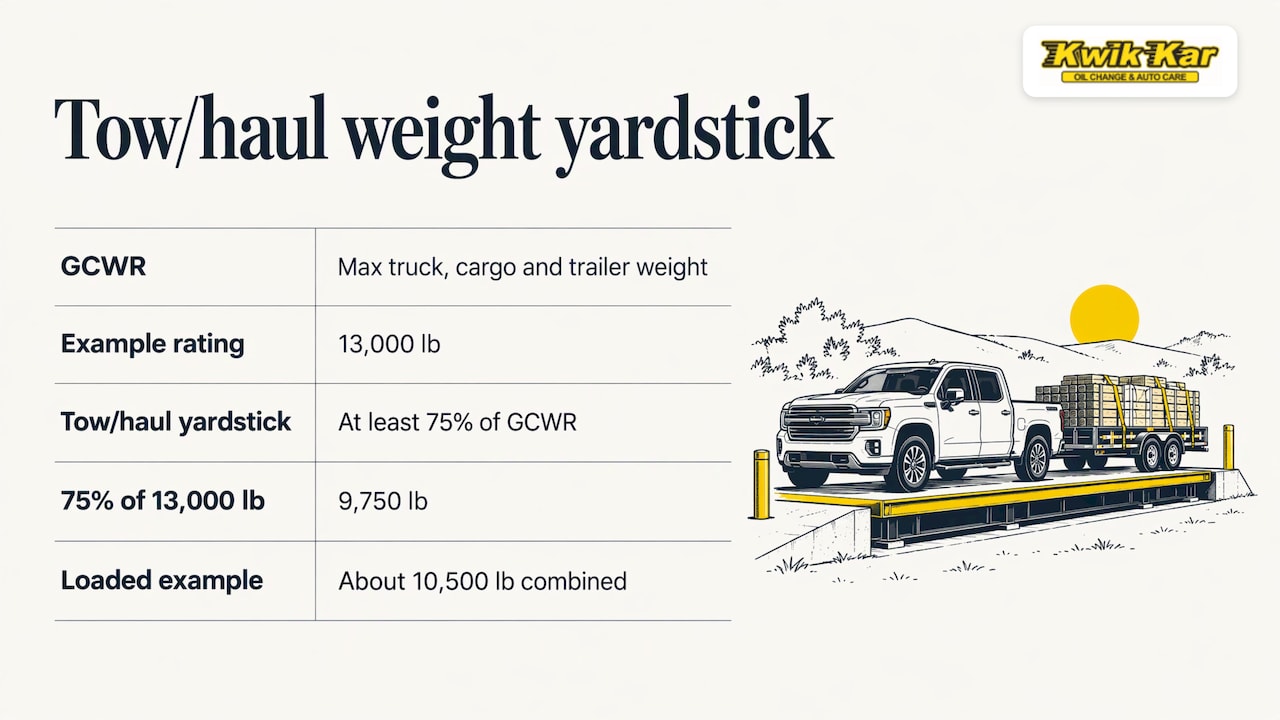
There is no single number that applies to every truck, but GM gives a useful yardstick. Its service manual says tow/haul is designed to be most effective when the combined weight of vehicle and trailer is at least 75 percent of the gross combined weight rating, or GCWR. The GCWR is the maximum the manufacturer allows for the truck, its cargo and the trailer all together. You will find it in your owner’s manual or on the towing section of the manufacturer’s specs.
A worked example: say your truck has a 13,000 lb GCWR. Seventy-five percent is 9,750 lb. If the truck, passengers, gear and trailer add up to about 10,500 lb, you are above that line and the mode is doing real work. If you are pulling a small 1,500 lb utility trailer with a lightly loaded truck, you are well under it and the mode has little to offer.
For reference, the 2005 GMC Sierra manual lists a 12,000 lb GCWR for one V8 configuration and 13,000 lb for another, which shows how much the figure changes from truck to truck. Always use the rating for your own model, year, engine and axle ratio.
Is it okay to leave tow/haul on all the time?
For most drivers the answer is simple: use it for loads, then turn it off.
GM’s service manual says that running it in a lightly loaded or empty vehicle will not cause damage, but it gives no benefit and may cause firm shifts, unpleasant engine and transmission characteristics and lower fuel economy. Capital One makes the same trade-off: the mode keeps the engine in its power band and reduces shifting at the expense of some fuel economy.
That matters on a commute. Fort Worth traffic on I-30, Loop 820 and White Settlement Road is a lot of stop-and-go, and an empty truck in tow/haul will feel jumpy and use more fuel for no gain.
One feature worth knowing: on many vehicles the mode resets on its own. Ford’s manual says it deactivates when the vehicle is powered down, though some newer vehicles behave differently, so look at your dash for the indicator light rather than assuming.
How do you turn tow/haul mode off?
The method depends on the truck:
- Button on the gearshift or dash. Press it once to activate and look for the TOW/HAUL light in the instrument cluster. On the Ford manual’s description, a second press deactivates it on trucks with a button near the gearshift lever.
- Drive-mode selector. On some late-model Fords, tow/haul is a drive mode. Select it to turn it on and select a different drive mode to turn it off, according to Ford’s second owner’s manual page.
- Restart. Many vehicles cancel it at power-down. Confirm the dash light is out after you restart.
If the light will not turn off, or the button does nothing, that is worth having looked at, since it can point to a switch or transmission control problem.
When should you avoid tow/haul mode?
The main caution is slippery pavement. Increased engine braking is applied to the drive wheels, and on a rear-wheel-drive truck that can break rear traction on ice. Capital One says some manufacturers advise against using the mode in icy or slippery conditions, and RV Miles says to avoid it on ice while noting it is generally fine in normal rain. Ford’s published guidance also warns against using it on slippery road surfaces.
North Texas does get the occasional ice storm, and a heavy truck on glazed pavement needs good tires as much as the right drive mode. This winter tires guide explains how tire choice affects grip on cold, low-traction roads. Check your tread too: our tire tread depth safety guide shows how to measure it.
Also, tow/haul is only for automatic transmissions. If you drive a manual, you choose the gear yourself.
Fort Worth driving: what the mode means for West Side trucks
Most local trailer use is a weekend run: a boat to Lake Worth or Benbrook Lake, a camper out of town on I-30 or I-20, a utility or equipment trailer for a job around River Oaks, Westover Hills or Westworth Village. Terrain around here is gentler than mountain country, so the benefit comes from weight and from stop-and-go traffic, not steep grades. Summer heat adds to the load on the transmission, because towing already raises fluid temperature, and hot afternoon traffic compounds it.
Two habits help:
- Turn tow/haul on before you leave with a heavy trailer, not halfway through the first hill.
- Turn it off once the trailer is unhooked and the bed is empty.
Looking after the transmission that does the work
Tow/haul reduces the strain, but towing and hauling still put extra load on the transmission, the cooling system, the brakes and the tires. A few things deserve attention if you use your truck this way:
- Transmission fluid. Fluid carries heat away from the clutches. Our guide on the benefits of changing transmission fluid explains what fresh fluid does. Follow the schedule in your owner’s manual, and check whether it has a separate severe-duty or trailer-towing schedule.
- Warning signs. Slipping, harsh shifts or a pause when you move the shifter into drive are worth checking early. Our article on delayed transmission engagement covers common causes.
- Brakes. Engine braking helps, but the pads and rotors still do the final stop. Have them inspected before a long haul.
- Tires and alignment. Trailer tongue weight and heavy payloads wear tires differently. Check pressures, tread and rotation.
- Cooling and batteries. Heat and electrical load go up when towing, so the radiator, hoses and battery should be in good shape before summer trips.
How Kwik Kar can help your truck or SUV
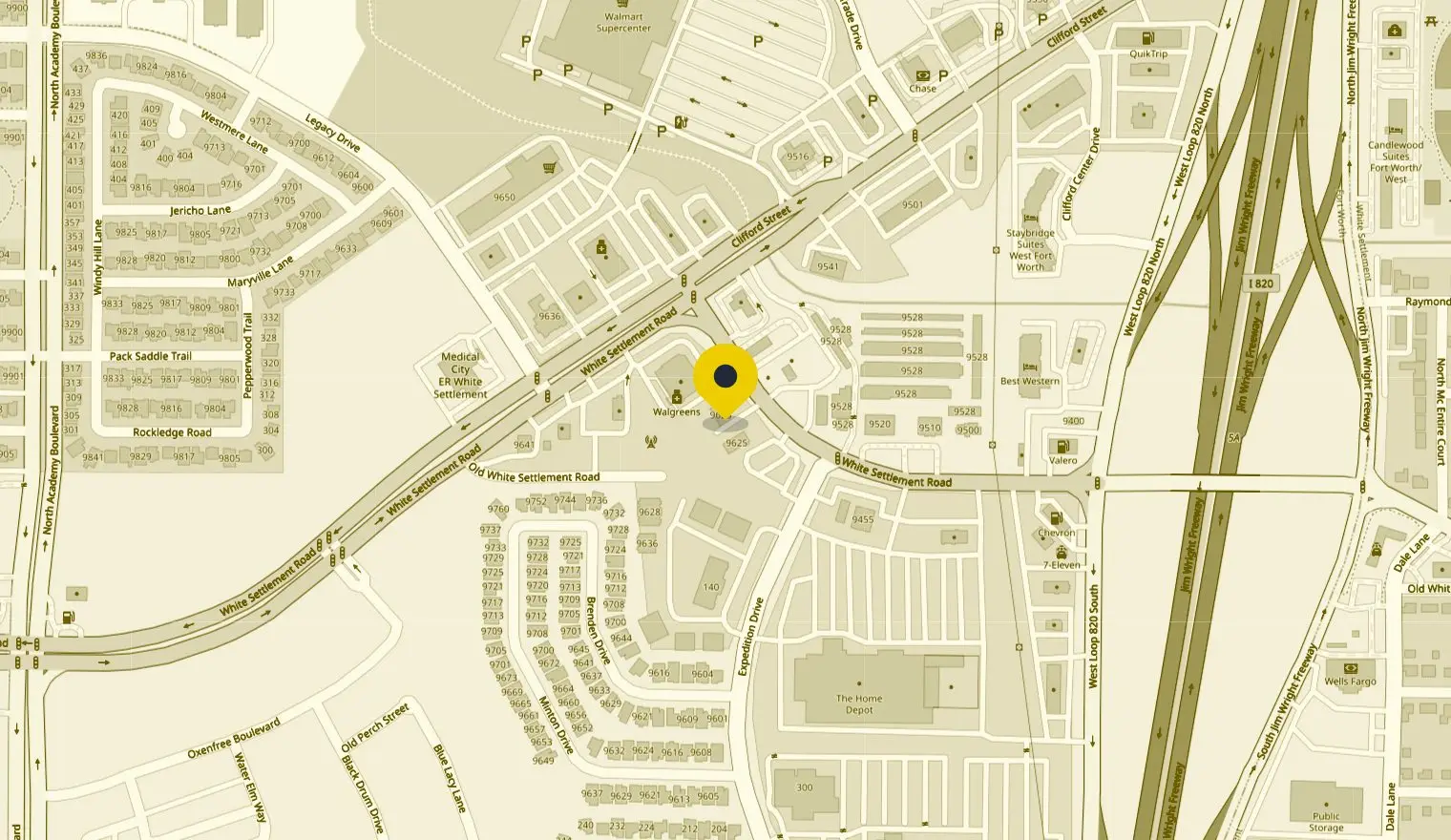
We are at 9613 White Settlement Rd, Fort Worth, TX 76108, and we handle the full range of work a towing vehicle needs: transmission service and repair, brake pad and rotor replacement, engine diagnostics, cooling and A/C work, battery testing and replacement, alternators and starters, tires and wheel alignment, plus preventive maintenance such as fluid exchanges and filter replacement. Our technicians are ASE-certified, and we are RepairPal certified. Digital vehicle inspections let you see the condition of your truck, and qualifying repairs carry a 24-month/24,000-mile warranty.
Fleet and work truck owners can have multiple vehicles looked after with consolidated billing. If you tow regularly, a pre-trip inspection before a long haul is a sensible habit.
See everything we offer on our auto repair and maintenance services page, or visit Kwik Kar to plan your visit.
Our perspective on towing and transmission care
We see tow/haul mode as the easiest transmission protection a truck owner already has. It costs nothing to switch on, and it does its job best when you pair it with a transmission that is in good shape.
The mode manages shifts, but it cannot fix worn fluid, a weak cooling system or tired brakes. That is why we look at the whole vehicle. Our ASE-certified technicians use professional diagnostic equipment, and our digital vehicle inspections show you what we find, so you can decide what to do about it with the facts in front of you.
For West Side drivers who tow to Lake Worth, Benbrook or farther, we think the best preparation is a thorough check before the trip: transmission fluid, brakes, tires, cooling and battery. Done on a regular schedule, that is how a truck stays dependable for the long run, and our repairs that qualify carry a 24-month/24,000-mile warranty.
Kwik Kar
FAQ
What does tow/haul mode do?
It changes the transmission’s shift pattern so it upshifts later, downshifts sooner and shifts less often. That keeps the engine in its power band, adds engine braking on descents and reduces heat in the transmission under heavy loads.
When should I use tow/haul mode?
Use it when towing a large trailer, hauling a heavy load or driving hills where the transmission keeps shifting. GM says it is most effective when truck and trailer reach at least 75 percent of the gross combined weight rating.
Is it bad to drive in tow/haul mode all the time?
GM’s service manual says running it lightly loaded will not cause damage, but it offers no benefit and can bring firm shifts and lower fuel economy. Most drivers switch it on for loads and off afterward.
Can I use tow/haul mode in rain or snow?
Normal rain is generally fine. On ice or very slippery roads, some manufacturers, including Ford, advise against it, because stronger engine braking can cause the drive wheels to lose traction.
Does tow/haul mode make my truck stronger?
No. It does not change engine output or your truck’s towing rating. It changes shift timing and engine braking so the powertrain you already have works more efficiently under load.
Sources
- Ram 2022 owner’s manual: When To Use TOW/HAUL Mode
- GM service manual: Tow/Haul Mode
- Ford owner’s manual: Transmission – Tow/Haul
- Ford owner’s manual: Tow/Haul drive mode
- GMC 2005 Sierra owner’s manual
- Capital One: How Tow/Haul Mode Changes Your Truck
- RV Miles: Tow Haul Mode Explained
- Ultimate Winter Tires Guide