




There is no single number that fits every car. Manufacturers set the timing belt replacement interval by engine, and published figures commonly land between 60,000 and 105,000 miles, often paired with a time limit of 6 to 10 years, whichever comes first. The only interval that counts for your vehicle is the one in your owner’s manual or maintenance guide. If you can’t find it, or you bought the car used with no records, the safe move is to have the belt inspected and, in most cases, replaced.
We are Kwik Kar Oil Change & Auto Care at 9613 White Settlement Rd, Fort Worth, TX 76108, and we handle timing belt replacement for drivers across White Settlement, West Fort Worth, Westworth Village, Westover Hills, River Oaks, Lake Worth and Benbrook. This guide explains how intervals work, how to check whether your engine even has a belt, and what to do when the paperwork is missing.
TL;DR
- Typical belt intervals run from about 60,000 to 105,000 miles, or 7 to 10 years, but some engines differ: Ford lists 100,000 miles or 6 years for one engine and 150,000 miles for another.
- Mileage and age both matter. Rubber ages even when the car sits, so whichever limit arrives first sets the date.
- Many modern engines use a timing chain instead of a belt. Check your engine, not just the badge.
- If you don’t know when the belt was last replaced, treat it as due and have it inspected.
- Replacing the belt together with the tensioner, pulleys and, where it is belt-driven, the water pump is a common approach, since the labor overlaps.
Table of Contents
- What a timing belt does and why the interval matters
- What is the normal timing belt replacement interval?
- How do I find the interval for my vehicle?
- Does my car have a timing belt or a timing chain?
- Why age counts as much as miles
- What if I don’t know the belt’s history?
- Signs the belt may be wearing out
- What else gets replaced with the belt?
- What happens if you wait too long?
- Our perspective
- Keep the belt job on your maintenance calendar
- Book a timing belt check in West Fort Worth
- A note on Texas inspections
- FAQ
- Sources
What a timing belt does and why the interval matters
The timing belt links the crankshaft to the camshaft(s), so the valves open and close in step with the pistons. It is a reinforced rubber belt with teeth, and like all rubber it wears, hardens and cracks over time.
The reason shops stress the interval is that a belt is hard to judge by eye. ALLDATA, a repair-information provider, recommends replacing the belt at the manufacturer’s suggested interval regardless of how it looks, and suggests having it inspected about every 10,000 miles. It also explains that belts have a limited life and need proactive replacement because wear is difficult to examine.
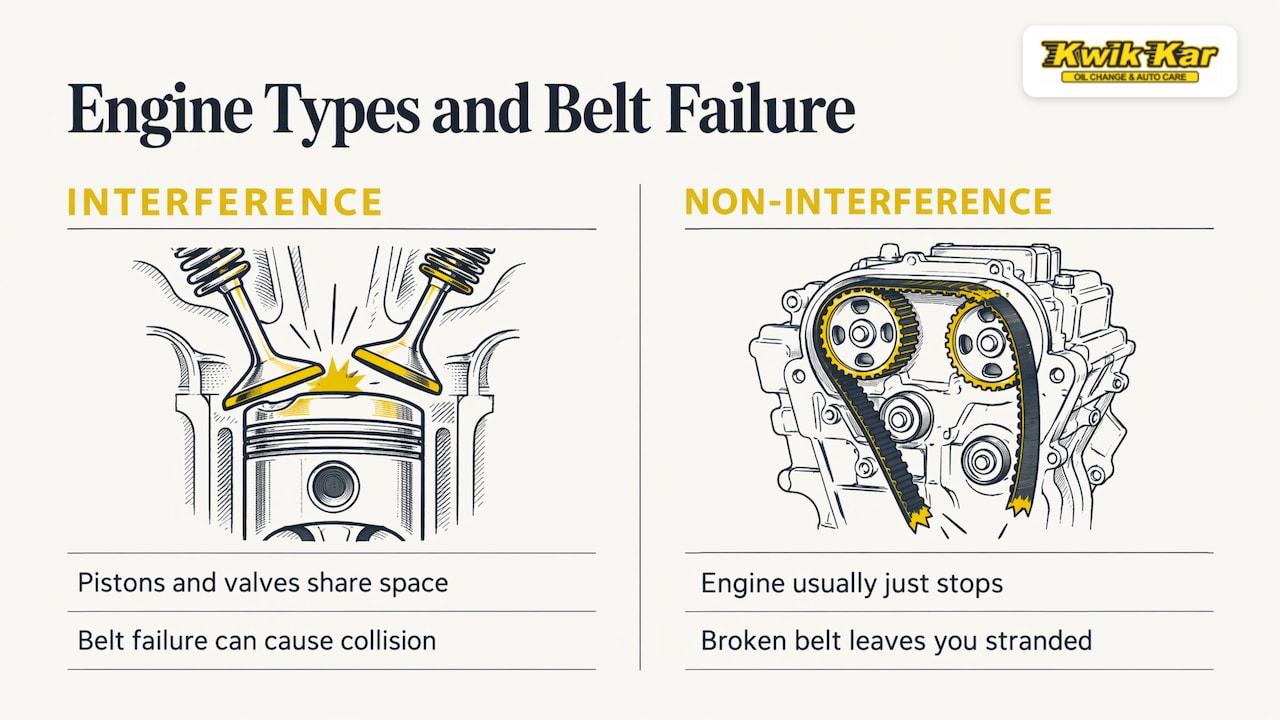
The stakes depend on the engine. On an interference engine, the pistons and valves occupy the same space at different moments. If the belt breaks or skips, they can collide. On a non-interference design the engine usually just stops. Your owner’s manual or a technician can tell you which type you have, and either way a broken belt leaves you stranded.
What is the normal timing belt replacement interval?
The honest answer is a range. Here is what published sources say:
| Source | Stated interval |
|---|---|
| Ford US maintenance guide | 1.0L engine: every 100,000 miles or 6 years, whichever comes first. 1.6L engine: every 150,000 miles |
| AutoZone | Usually somewhere between 70,000 and 90,000 miles |
| O’Reilly Auto Parts | Usually 60,000 to 100,000 miles, depending on make and model |
Two patterns show up across all of them. First, older belt designs tended to call for earlier changes, while newer belts often allow longer intervals. Second, many manufacturers add a time limit to the mileage limit. That is why a car with modest miles can still be due.
Treat the table as context, not as your answer. A 60,000-mile figure on one engine and a 150,000-mile figure on another can both be correct for their own vehicles.
How do I find the interval for my vehicle?
Work down this list until you have a firm answer:
- Owner’s manual or maintenance guide. Look in the scheduled maintenance section for “timing belt” under the engine you have. Many makers also post these guides online by model year.
- Your exact engine. The same model can offer a belt-driven engine and a chain-driven one. The engine size, such as 3.3L V6 versus 2.4L four-cylinder, is what decides.
- Service records. Look for receipts or invoices showing a previous belt replacement and its mileage and date.
- A technician with your VIN. We can look at the vehicle, confirm the engine and help you work out what is due. You can schedule an appointment and ask for a timing belt check.
For a broader view of how makers arrive at these numbers, see our explainer on how auto service intervals are determined. If you run a business fleet, the same logic applies to your service planning. Understanding how diesel service intervals are set from OEM specs shows why checking the manufacturer’s own schedule matters for every vehicle class.
Does my car have a timing belt or a timing chain?
Only belts have a replacement interval in the usual sense. Chains are designed to last much longer, though they are not maintenance-free, and we cover that in our timing chain replacement guide. Our article on timing belt or timing chain explains the difference in more detail.
What matters here: the answer depends on the engine, and it can change between generations of the same model. Two Toyota examples show how this works. According to MotorBiscuit’s engine chart, the 2001 to 2007 Highlander V6 uses a timing belt, while the 2008 to 2019 V6 uses a chain. The same chart lists belts on the 2000 to 2004 Tundra V6 and the 2000 to 2009 4.7L V8, and chains on the later 5.7L V8.
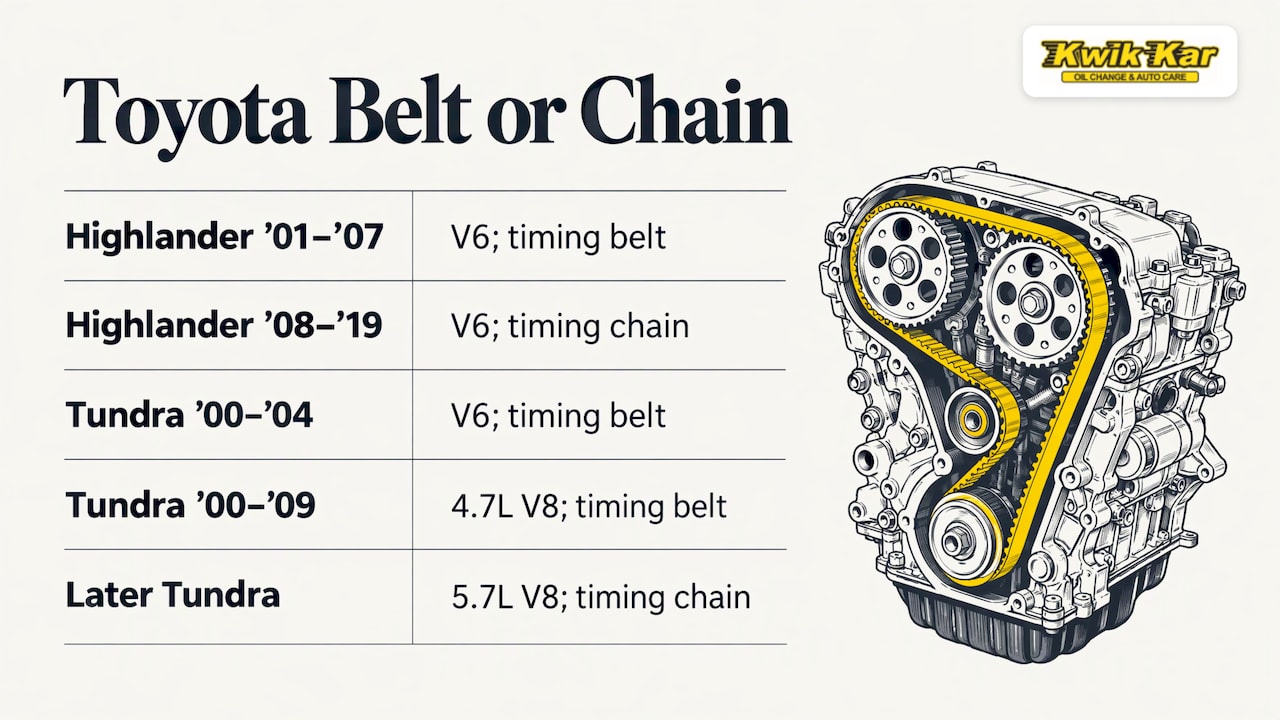
That is a big deal for truck and SUV owners in West Fort Worth. An older Tundra or Highlander that still has plenty of life in it may be carrying a belt that has aged out. If you drive one, confirm your engine before assuming you are covered by a chain.
Quick ways to confirm
- Look up the engine code and model year in the owner’s manual.
- Check whether the manual’s maintenance schedule mentions a timing belt at all.
- Ask a technician to confirm by VIN and engine.
Why age counts as much as miles
Many drivers in Fort Worth put on highway miles commuting along I-30 and Loop 820, so mileage climbs quickly. Others barely drive. Both can reach the belt’s limit.
AutoZone notes that miles are only a general indicator and that older, low-mileage vehicles should still be considered for a belt change, because time degrades rubber even without driving. Its example is a 2001 vehicle with 40,000 miles and no evidence of a belt replacement.
Heat and stop-and-go traffic add stress to everything under the hood, and Texas summers are hard on rubber parts. We would not put a number on how much sooner that shortens a belt’s life, and no honest shop should. The practical takeaway is simpler: follow the maker’s time limit as firmly as the mileage limit, and have the belt looked at during routine service if you are close to either.
What if I don’t know the belt’s history?
This is the most common situation we see with used vehicles. You bought the car, the previous owner is long gone, and no receipt mentions a belt.
AutoZone’s advice is that when in doubt, change the belt. It also suggests asking about belt service when you buy a used car, looking for receipts or invoices, and calling the dealer for service records.
Here is a sensible path:
- Look up the interval for your engine in the manual.
- Compare it with your odometer and the car’s age.
- Search the glovebox, any old paperwork and the dealer’s records for proof of a past replacement.
- If the car is near or past the interval with no proof, plan the replacement instead of waiting for symptoms.
If you are still shopping, our pre-purchase vehicle inspections can help you see what a used car needs before you sign.
Signs the belt may be wearing out
A belt often gives little warning, which is why the schedule matters more than symptoms. Still, some signs justify a prompt visit:
- Ticking or unusual noise from the front of the engine
- Misfires or rough running
- Reduced power
- Oil leaking near the timing cover
- Visible cracking, fraying or glazing if the cover is open during service
Autodiagly, an automotive information site, describes how a worn belt may run poorly with noise, misfires and reduced power, while a broken or jumped belt stops the engine, and further cranking can make internal damage worse. If the engine dies while driving and you suspect the belt, stop in a safe spot, do not keep trying to restart it, and have it towed.
If a check engine light comes on with any of these symptoms, our guide to the service engine light explains what a diagnostic scan can and cannot tell you.
What else gets replaced with the belt?
The belt sits behind covers, and getting to it takes real labor. That is why shops usually recommend replacing related parts at the same time:
- Tensioner and idler pulleys. They keep the belt at the right tension and wear along with it.
- Water pump, if the belt drives it. Replacing it during the job avoids opening the engine again later.
- Seals, if they show leaks.
Autodiagly makes the same point: the tensioner and idlers wear at about the same rate as the belt, and the labor overlaps. Your technician should tell you which parts apply to your engine and why. We use digital vehicle inspections to document what we find, so you can see it for yourself before approving work.
What happens if you wait too long?
On an interference engine, a broken belt can bend valves and damage pistons or the cylinder head. Autodiagly puts the damage from a few jumped teeth at $2,000 or more, though real costs vary by engine and repair path. On a non-interference engine the damage is usually smaller, but you are still looking at a tow and a dead car.
A study by the UK’s Motor Ombudsman found that 79% of respondents delayed timing belt replacement, so delaying is common. It is a UK survey, but it shows how easy it is to put off a repair that doesn’t feel urgent.
Our perspective
We see timing belts as a maintenance job, not a repair. Done on schedule, it is a planned visit. Done after a failure, it becomes an engine repair that nobody budgeted for.
That is why we start with your manufacturer’s schedule, not a rule of thumb. We confirm the engine, check the interval for mileage and age, and look at the condition of the belt and related parts. Our ASE-certified technicians use professional diagnostic equipment, and our digital vehicle inspections let you see what we see.
We are also a RepairPal certified shop, and we aim to price work fairly and explain it plainly. Qualifying repairs are backed by a 24-month/24,000-mile warranty. Ask us what applies to your specific job when you book.
Kwik Kar
Keep the belt job on your maintenance calendar
The belt is one line in a longer schedule. Brakes, fluids, filters, the battery and tires all have their own timing. Our guides on car maintenance by mileage and on understanding your maintenance schedule can help you map out what is coming.
A few local considerations:
- Road trips. Before a long drive out of town, confirm that the belt is not near its limit.
- Pickup trucks and SUVs. Towing and hauling add load, so check the manual’s severe-use schedule if it applies to you.
- Fleet and rideshare vehicles. High mileage reaches intervals fast. We offer fleet maintenance and repair with consolidated billing for business accounts.
Book a timing belt check in West Fort Worth
If your vehicle is near its interval, or you can’t prove when the belt was last changed, we can confirm your engine type, review the schedule and inspect the belt and related parts. We work on everything from routine preventative maintenance to engine and transmission repairs, so one shop can handle the whole picture.

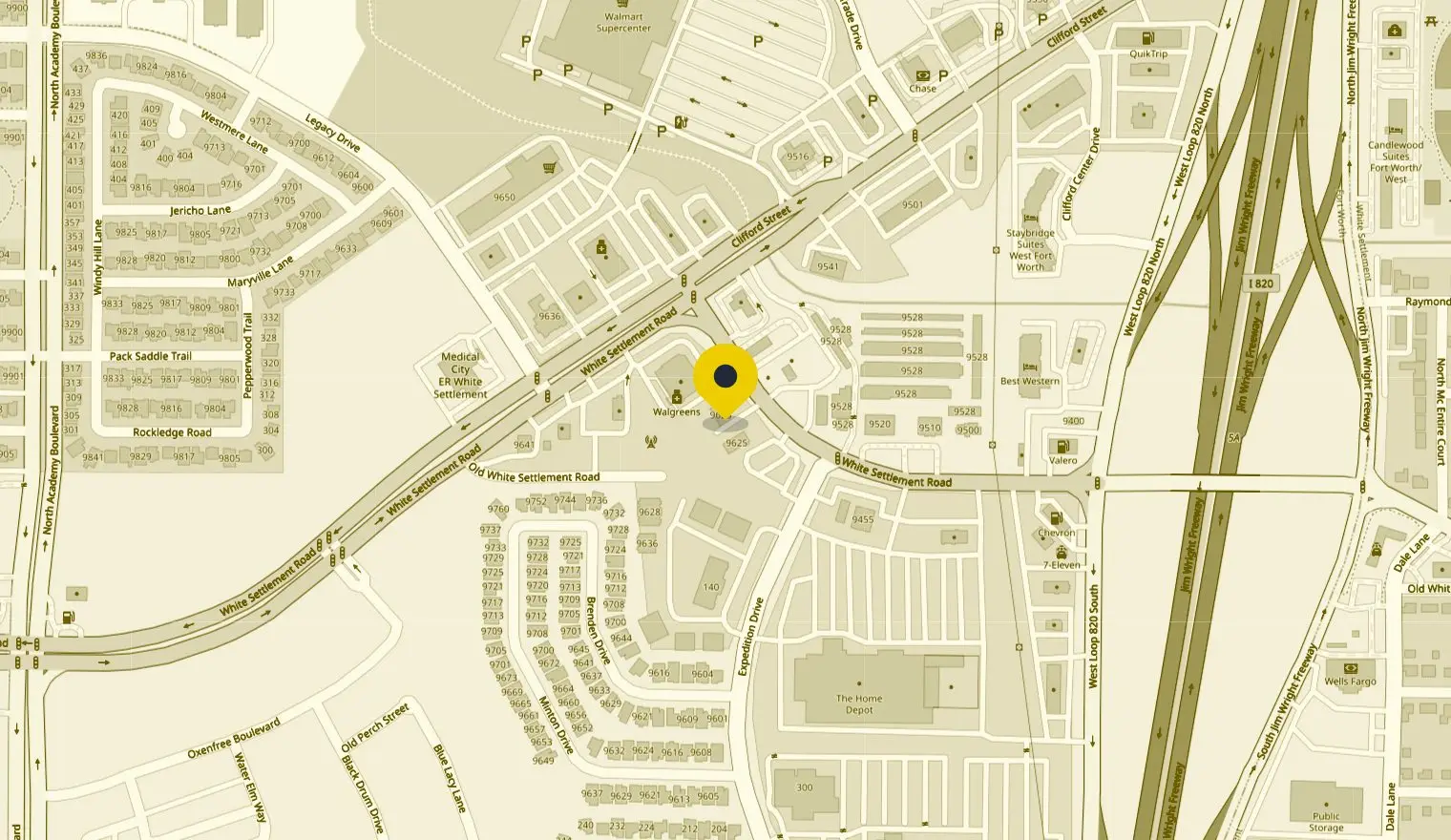
Find us at 9613 White Settlement Rd, Fort Worth, TX 76108, or visit our website to see all services. We have one location, serving drivers from White Settlement, Westworth Village, Westover Hills, River Oaks, Lake Worth, Benbrook and the rest of West Fort Worth. We don’t publish prices for belt jobs because they depend on the engine, so contact us for a quote.
A note on Texas inspections
Inspection rules changed recently, and some drivers think that affects maintenance. It does not change the belt schedule. According to the Texas DPS, since January 1, 2025, non-commercial vehicles no longer need a safety inspection before registration, under House Bill 3297. Vehicles registered in emissions counties still need emissions tests, which are separate from safety inspections. Tarrant County is among the counties with emissions requirements for eligible vehicles. Commercial vehicles in all counties still need a passing safety inspection. DPS also reminds drivers to service their vehicles regularly, and that is what a belt change does.
FAQ
How often should a timing belt be changed?
Use the interval in your owner’s manual. Published figures commonly fall between 60,000 and 105,000 miles, often with a 6 to 10 year limit, whichever comes first. Some engines differ, such as the Ford 1.6L engine at 150,000 miles.
Can I drive with a bad timing belt?
We don’t recommend it. A worn belt can cause misfires, noise and power loss, and a failed belt stops the engine. On an interference engine it can also damage valves and pistons. Have it inspected as soon as you notice symptoms.
Does my 2006 Toyota Highlander have a timing belt?
It depends on the engine. The 3.3L V6 uses a belt, and the 4-cylinder is generally listed with a chain. Confirm your engine in the owner’s manual, and bring the vehicle in if you want us to verify it.
Is there a timing belt change schedule for a Toyota Tundra?
Early Tundras with the 4.7L V8 and the 3.4L V6 use belts, while later V6 and 5.7L V8 engines use chains, per MotorBiscuit’s chart. Check your manual for the exact interval for your year and engine.
What if I bought a used car and there is no record of a belt change?
Compare the car’s age and mileage with the maker’s interval. If it is near or past it with no proof, plan to replace the belt. A technician can inspect it and advise on related parts.
Sources
- Ford US scheduled maintenance guide
- AutoZone: Timing belt replacement costs and when to replace
- O’Reilly Auto Parts: Timing belt failure symptoms and diagnosis
- ALLDATA: Facts about timing belts
- MotorBiscuit: Toyota timing belt or chain chart
- Autodiagly: Symptoms of a worn timing belt
- The Motor Ombudsman: most delayed areas of car maintenance
- Texas DPS: Vehicle safety inspection program changes