



The most common coolant leak symptoms are a sweet smell from the engine bay, colored puddles under the car, a coolant level that keeps dropping, and a temperature gauge that climbs higher than normal. Any one of them is worth checking. Two or more together mean you should stop driving it hard until the cooling system has been inspected.
This guide explains each warning sign, what usually causes it, why some leaks only show up when the engine is hot, and what to do if the car starts to overheat. We wrote it from the service bay at Kwik Kar Oil Change & Auto Care, 9613 White Settlement Rd, Fort Worth, TX 76108, where West Fort Worth drivers bring in cooling-system problems every summer.
TL;DR
- A sweet, syrupy smell, green, orange or pink spots under the car, and a low coolant level are the classic signs of a leak.
- A rising temperature gauge, steam under the hood, or a low-coolant warning means pull over and shut the engine off. Do not keep driving.
- Coolant can disappear without a puddle: it can burn off on hot engine parts, leak inside the cabin, or, in worse cases, enter the engine through a failed head gasket.
- Never open the radiator cap or hood on a hot engine. Wait until it is fully cool.
- A pressure test and a visual inspection find most leaks quickly. Early repairs are usually far smaller than overheating repairs.
Table of Contents
- What does a coolant leak look and smell like?
- Quick symptom guide: what each sign usually points to
- Where do coolant leaks usually start?
- Why does a coolant leak show up only when the engine is hot?
- Why is my car losing coolant but I can’t find a leak?
- Does a coolant leak mean a blown head gasket?
- Can you drive with a coolant leak?
- How do technicians diagnose a coolant leak?
- Repair options: from simple to major
- How can you prevent coolant leaks?
- Does Texas inspection law affect cooling system problems?
- Perspective: what we see in West Fort Worth
- Get your cooling system checked at Kwik Kar
- FAQ
- Sources
What does a coolant leak look and smell like?
Coolant, also called antifreeze, circulates through the engine, radiator, hoses and heater core to carry heat away. When any part of that loop lets go, you get clues you can see, smell and feel. Here are the main ones.
A sweet smell from the engine or vents
Coolant has a distinctive sweet odor. Car and Driver notes that a sweet smell after you shut the engine off can point to an antifreeze leak, and that a smell without an obvious puddle can still mean a leak. Small drips that land on a hot exhaust manifold or engine block evaporate fast, so the odor may be all you get.
If the smell is stronger inside the car than outside, think heater core. The same source says damp carpet or windows that fog up easily can signal a leaking heater core. If you are chasing a cabin odor and are not sure it is coolant, this guide to tracing a car odor to its source helps you sort one smell from another. Musty air from the vents with no sweetness is a different problem, and our page on why a car AC smells bad covers it.
Colored spots under the car
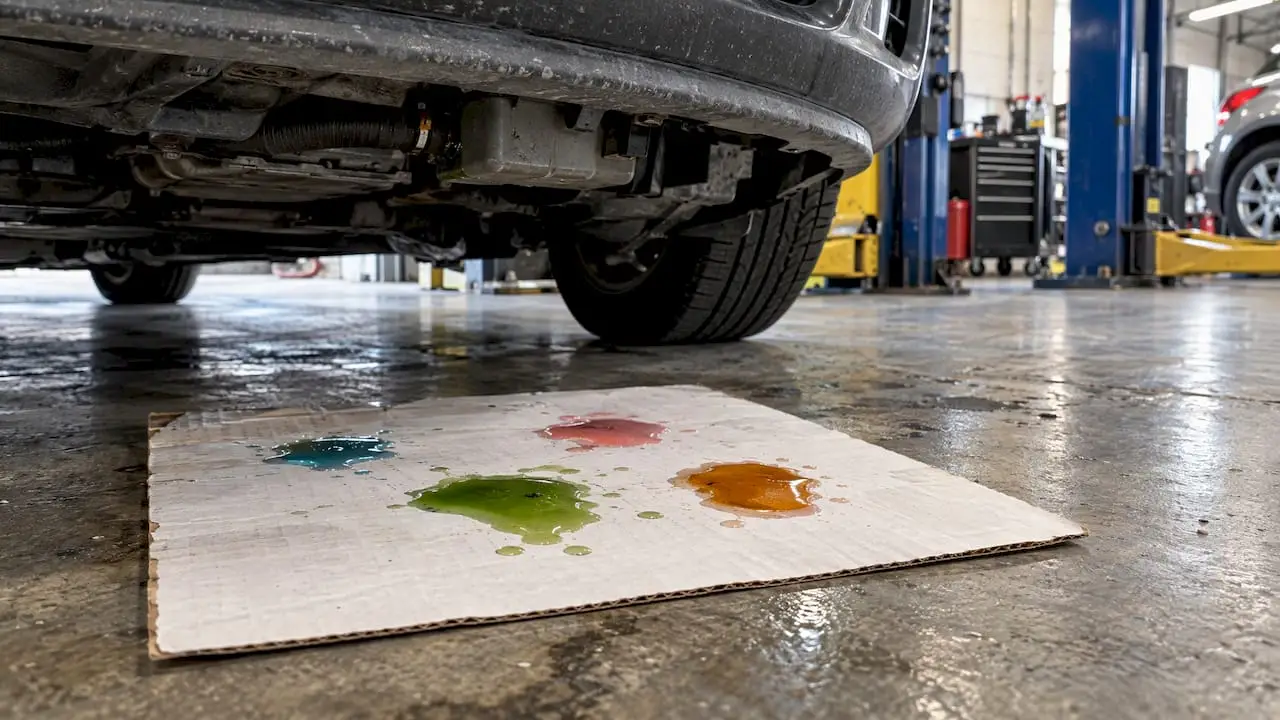
Coolant is dyed so you can recognize it. Green, orange, pink or blue stains under the front half of the car are the usual giveaway, and the fluid feels slightly slick. Put a piece of white cardboard under the engine overnight. If the spots are oily and brown or black, you are looking at an oil leak. If they are reddish and thin, it may be transmission fluid, which is a separate repair. Our guide to identifying fluid leaking from a car walks through the colors.
Low coolant or a warning light
If you have to top off the reservoir more than occasionally, the coolant is going somewhere. Kia’s owner guidance says that serious coolant loss indicates a leak in the cooling system. Many vehicles also have a low-coolant indicator on the dash. If yours lights up, treat it as a real warning and do not clear it by simply adding water and moving on.
Temperature gauge climbing, steam, or stalling
AutoZone lists a rising or persistently high temperature gauge, steam under the hood, stalling, and a low-coolant indicator as signs that can accompany a leak. These are the late symptoms. By the time the gauge moves, the engine is already struggling to shed heat. For a deeper look at this stage, read why a car overheats.
Weak heater output
The heater uses hot coolant. If the cabin blows cold air on a cool morning and the coolant is low, the leak may be big enough that the heater core is starved of fluid. Our heater diagnosis checklist shows how to tell low coolant apart from a bad blend door or thermostat.
Quick symptom guide: what each sign usually points to
| What you notice | Likely area | How urgent |
|---|---|---|
| Sweet smell outside, puddle at the front | Radiator, hose, water pump | Check soon, avoid long drives |
| Sweet smell inside, damp carpet, foggy glass | Heater core | Have it inspected promptly |
| Coolant level drops, no visible drip | Small external seep, cap, or internal leak | Inspect within days |
| Gauge rising or steam | Significant loss or failed component | Stop now |
| White exhaust smoke, milky oil | Head gasket or related internal leak | Stop driving, inspect |
| Low-coolant light | Low level in the system | Do not ignore |
Where do coolant leaks usually start?
The cooling system has a handful of weak spots, and most leaks come from one of them.
- Hoses and clamps. Rubber ages. Heat cycles make hoses soft, cracked or swollen, and clamps loosen. Consumer Reports notes that experts recommend replacing all hoses at least every four years or when one fails. Your owner’s manual may say something different, so check it first.
- Radiator. Corrosion, plastic end tanks that crack with age, and damage from road debris all cause leaks. On highway-heavy commutes along I-30 and Loop 820, the radiator face takes constant abuse.
- Radiator cap and reservoir. A worn cap cannot hold pressure, so coolant escapes as steam or spills from the overflow. Cracked reservoirs seep slowly.
- Water pump. Look for dried coolant crust near the pump or a wet area at its weep hole. A failing pump may also whine.
- Heater core. Hidden behind the dash, so symptoms show up inside the cabin.
- Thermostat housing and gaskets. Common on many engines, especially with plastic housings.
- Head gasket or engine block. The most serious category, covered below.
Some leaks are model-specific. For example, a federal service document describes a warranty extension for engine-block coolant seepage on certain 2006 to 2009 Honda Civics, and a 2022 to 2023 Volkswagen recall (NHTSA 22V707) addressed loose radiators that could damage coolant hoses. If your car is a few years old, it is worth searching your VIN for open recalls before paying for a repair.
Why does a coolant leak show up only when the engine is hot?
This is one of the most common frustrations: the driveway is dry in the morning, but the level is low by the weekend. There are a few ordinary reasons.
- Pressure. A running cooling system is pressurized, and it gets more so as it heats. A hose clamp, seam or gasket that holds when cold can weep once the system is at full temperature and pressure. Hoses also feel firmer when hot, which can open a crack that is closed when cool.
- Evaporation on hot parts. Coolant that drips onto a hot engine or exhaust part vaporizes before it reaches the ground. You get the smell and the falling level, but no puddle.
- Expansion and contraction. Metal and plastic parts move as they warm. A hairline crack in a radiator tank may open only at operating temperature.
- Load. Towing, climbing a grade, or sitting in Fort Worth summer traffic with the A/C running puts more heat in the system, which exposes weak parts.
That last point matters here. Stop-and-go traffic on White Settlement Road and Camp Bowie means long periods with little airflow through the radiator. A system that is marginal on a mild day can show its leak in July. We do not tie this to any specific temperature, but the more heat load the system sees, the faster a small leak becomes a visible one.
Why is my car losing coolant but I can’t find a leak?
Before assuming something is hidden, rule out the simple explanations.
- An overfilled reservoir. A federal technical service bulletin notes that overfilling the coolant reservoir can cause coolant to be pushed out. If you topped it off while the engine was hot, the level may drop on its own once it settles. Fill to the marked line when cold.
- Air pockets after a repair. Air trapped in the system can burp out and lower the level after service.
- A slow external seep. Dried residue, often a crusty white, pink or green film around hose ends, the cap, or the pump, shows where a slow leak has been evaporating. Car and Driver suggests that, once the engine is cool, you check the reservoir and look for light-colored residue around the cap, hoses and radiator.
- An internal leak. Coolant can leak into the cabin through the heater core or into the engine itself.
If the reservoir keeps falling and you cannot find anything, a shop can pressure-test the system and check for exhaust gases in the coolant. Our guide to cars with no coolant covers the checks in more detail.
Does a coolant leak mean a blown head gasket?
No. Most coolant leaks come from hoses, the radiator, the water pump, or the cap, and they are far cheaper to fix than an engine-internal problem. A head gasket is a possibility only when the symptoms point inward.
CRC Industries lists the key signs of a blown head gasket as engine overheating, white smoke from the exhaust, contaminated oil, and coolant loss without visible leaks. Look for these together:
- Thick white exhaust smoke with a sweet smell that continues after warm-up
- Oil on the dipstick or under the oil cap that looks milky or like a light-brown milkshake
- Repeated overheating, even after the radiator and hoses check out
- Bubbling in the coolant reservoir while the engine runs
One of these alone is not a verdict. A technician can confirm with a combustion leak test and a cooling-system pressure test before anyone talks about a head gasket job. The longer an engine runs hot, the greater the chance that a minor leak becomes that kind of failure, which is why catching it early matters.

Can you drive with a coolant leak?
Only in very limited circumstances, and not when the gauge is climbing. A tiny weep with a full reservoir and a normal gauge might get you to a shop a few miles away. Anything bigger puts the engine at risk. Kia’s guidance says that coolant leaking under the vehicle or steam from beneath the hood means you should stop the engine.
What to do if the engine overheats
- Pull over somewhere safe as soon as you can and turn the engine off.
- Call for help. Farmers Insurance advises pulling over immediately, turning off the engine, and calling for help.
- Do not open the hood or radiator cap while the engine is hot. Escaping steam and pressurized fluid can burn you.
- If towing is not available, the same source says to wait at least 30 minutes before checking coolant. The engine should be completely cool before you add any.
- Have the car towed or driven the shortest distance possible to a shop. Continued driving while overheating risks serious engine damage.
Keep a gallon of the coolant type your owner’s manual specifies and a flashlight in the truck. Mixing the wrong coolant type can cause its own problems, so match what the manual calls for.
How do technicians diagnose a coolant leak?
A good diagnosis does not start with guessing and replacing parts. At our shop it follows a clear order.
- Questions. When does the smell appear? Do you see puddles? Has the level changed? Does it happen in traffic or on the highway?
- Visual inspection. With the engine cool, we check hoses, clamps, the radiator, the cap, the reservoir, the water pump area and the ground below. Our digital vehicle inspection lets us send you photos of what we find, so you see the same thing the technician sees.
- Pressure test. Pressurizing the system with professional equipment makes slow leaks show themselves without the engine running.
- Cap test. The cap is tested separately, since a weak one can mimic a leak.
- Dye or chemical tests. UV dye traces hidden seeps, and a combustion leak test checks for exhaust gas in the coolant when an internal leak is suspected.
- Interior checks. Damp carpet, fogging glass and a sweet cabin smell point to the heater core.
You can do the first part yourself. Our DIY coolant leak checking guide lists safe steps for a cool engine. If you want a broader approach to symptoms, how to diagnose problems with a car is a good companion.
Repair options: from simple to major
The repair depends on the source, and a proper diagnosis keeps you from paying for parts you do not need.
| Source | Typical repair | Notes |
|---|---|---|
| Loose clamp or worn hose | Tighten or replace hose and clamp | Often the simplest fix |
| Radiator cap | Replace cap | Inexpensive, but test it first |
| Radiator | Repair or replace | Cracked tanks usually call for replacement |
| Water pump | Replace pump, often with gaskets and coolant | On some engines it is driven by the timing belt, so related parts may be done together |
| Heater core | Replace core | Labor-heavy because of dash access |
| Head gasket | Inspect, machine work, replace gasket | Needs a full diagnosis first |
We do not publish set prices for these repairs because cost depends on the vehicle, the part, and how much labor access takes. We give you the estimate after the inspection and before we start. Many repairs that qualify are covered by our 24-month/24,000-mile warranty, and our technicians are ASE-certified. The shop is also RepairPal certified and CARFAX Top-Rated, which matters if you want a second opinion before a larger repair.
Because timing belts and water pumps are often neighbors on the same engine, ask whether it makes sense to replace both when one is due. That is a question for your specific engine, not a rule for every car.
How can you prevent coolant leaks?
Cooling systems do not fail without warning very often. They tell you first. A few habits help.
- Check the level when the engine is cold. Look at the reservoir marks monthly and before road trips.
- Look at hoses. Squeeze them when the engine is cool. Spongy, bulging or cracked hoses need attention. Consumer Reports adds that most vehicles built after 1993 use ECD-resistant hoses, which fail from the inside, so a hose can look fine and still be weak.
- Follow your manufacturer’s schedule. Coolant breaks down and loses its corrosion protection. Intervals vary widely by vehicle, so use your owner’s manual. Our post on coolant flush intervals explains how to read yours.
- Do a preventive inspection before summer. Fort Worth heat and long idling in traffic are hard on cooling parts, and trucks that tow are harder still. Pickup and SUV owners should include the transmission cooler lines in the check. See our page on transmission cooling lines leaking if you tow.
- Use the right coolant. Do not mix types without confirming compatibility.
Our preventative maintenance services include fluid exchanges, filter replacement and tune-ups, and a cooling-system check fits naturally alongside an oil change visit.
Does Texas inspection law affect cooling system problems?
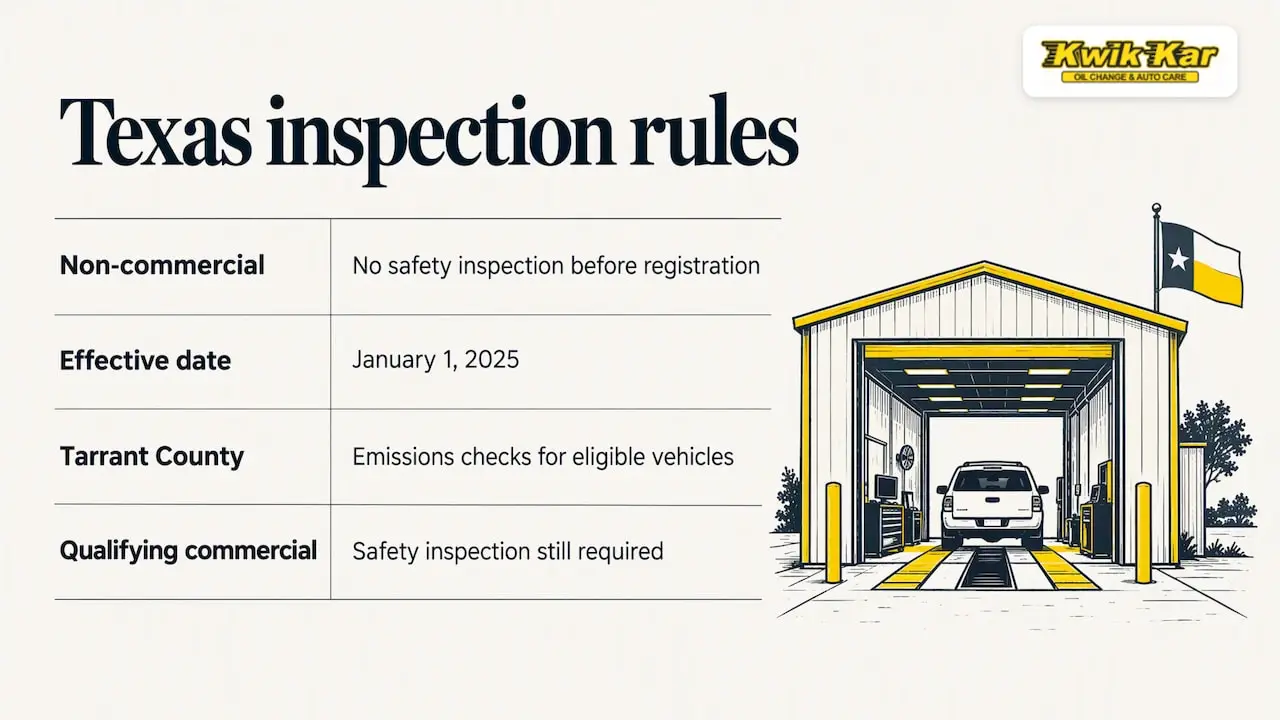
It is worth clearing up, because many drivers still ask. Since January 1, 2025, Texas no longer requires a safety inspection before registration for non-commercial vehicles. The Texas DMV says House Bill 3297 abolished the safety inspection program for non-commercial vehicles. The same notice lists Tarrant County among the counties that still require emissions inspections before registration for eligible vehicles. Qualifying commercial vehicles remain subject to safety inspection requirements. Check the official Texas DMV or DPS pages for your vehicle’s current status.
The practical result is that no inspection sticker will catch a failing hose for you. A leaking or overheating engine can also cause trouble with the emissions side, so a cooling issue is better handled sooner. If you manage a fleet, see how we support fleet maintenance for multi-vehicle accounts.
Perspective: what we see in West Fort Worth
Most cooling-system repairs we see could have been small. A seeping hose or a weak cap turns into an overheated engine when the driver waits for the gauge to settle things. We would rather you come in at the first sweet smell than after a tow. Coolant leaks are also the kind of problem where honesty about the diagnosis matters: we show you the finding in a digital inspection, explain what is urgent and what can wait, and let you decide.
We serve drivers from White Settlement and the west side of Fort Worth, and customers come in from Westworth Village, Westover Hills, River Oaks, Lake Worth and Benbrook. We have one shop, at 9613 White Settlement Rd.
— Kwik Kar
Get your cooling system checked at Kwik Kar
Kwik Kar Oil Change & Auto Care is a full-service repair and maintenance center, not just an oil change stop. If you notice a sweet smell, a falling coolant level, or a gauge that runs hot, schedule an appointment and we will inspect the system, explain what we find, and give you an estimate before work begins. You can see everything we do on our services page, or start at kwikkarwhitesettlement.com. If your car is already overheating, do not drive it in: pull over and call for a tow.
FAQ
Can I drive with a coolant leak?
Only if the leak is tiny, the reservoir is full, and the gauge stays normal, and then only to a nearby shop. If the gauge rises, steam appears, or coolant is dripping steadily, stop and turn the engine off. Driving while overheating risks serious engine damage.
Why does my car smell like syrup but I see no leak?
Coolant can drip onto hot engine parts and evaporate before it reaches the ground. If the smell is strongest inside, the heater core may be leaking. Either way, have the system pressure-tested.
Is a coolant leak expensive to fix?
It depends entirely on the source. A hose or clamp is usually a modest repair, while a heater core, water pump or head gasket involves more labor. We estimate after inspection and before any work starts.
Can I just add coolant and keep going?
Adding coolant when the engine is fully cool can buy you time, but it does not fix the leak. Use the type your owner’s manual specifies, and get the leak found before the next long drive.
Sources
- How to Recognize and Locate an Antifreeze Leak, Car and Driver
- How To Find and Fix Coolant Leaks, AutoZone
- Kia owner’s manual: If the engine overheats
- What To Do When Your Engine Overheats, Farmers Insurance
- How to Inspect Car Belts and Hoses, Consumer Reports
- NHTSA service bulletin on coolant reservoir overfilling
- NHTSA Honda Civic coolant seepage warranty extension
- NHTSA Volkswagen recall 22V707
- Spotting Blown Head Gasket Symptoms, CRC Industries
- Texas vehicle inspection changes, Texas DMV