


Most manufacturers call for a brake fluid change every two to three years, though some allow up to a few years or base it on condition. The reason is simple: brake fluid absorbs moisture over time, and that moisture lowers its boiling point, which can lead to a soft pedal or brake fade right when you need to stop hardest. Your owner’s manual is the final word on timing. If you tow, track your car, or drive in a humid climate, consider a shorter service interval.
TL;DR:
- Brake fluid should be tested regularly with moisture and boiling-point tests, especially if driving in humid conditions or using the vehicle for towing or track days.
- A brake fluid flush involves replacing old, moisture-laden fluid with DOT-rated fluid from sealed bottles, not just topping off from opened containers.
- Visual inspection alone cannot reliably determine brake fluid safety; objective tests are essential to detect moisture content and boiling point reduction.
- Vehicles in high-stress conditions or harsh environments should have fluid changed more frequently, regardless of manufacturer recommendations.
- Routine brake fluid maintenance saves money by preventing costly corrosion and component failure caused by moisture buildup.
Table of Contents
- Recommended Brake Fluid Change Interval by Vehicle Type
- Why Brake Fluid Breaks Down Over Time
- Signs Your Brake Fluid Needs Changing Now
- What a Brake Fluid Flush Includes and What to Expect
- How Kwik Kar Approaches Brake Fluid Service
- A Practical Note From Kwik Kar
- Book a Brake Fluid Check With Kwik Kar
- Sources
- FAQ
Recommended Brake Fluid Change Interval by Vehicle Type
The brake fluid replacement schedule varies more than most drivers expect. Honda, for example, calls for a recommended interval on many models, while other manufacturers allow longer intervals, and a handful of modern vehicles allow up to four years or 48,000 miles under normal driving. Some scheduled maintenance guides split the difference: annual fluid checks paired with replacement every 48 months on select models, which reflects a condition-based approach rather than a flat calendar rule.
Certain driving patterns wear through that safety margin faster than the manual assumes:
- Performance and sports cars that see frequent hard braking or track days
- Trucks and SUVs used for heavy or frequent towing
- Fleet and commercial vehicles racking up stop-and-go miles daily
- Vehicles driven in coastal, humid, or high-altitude mountain regions
If your vehicle falls into any of those categories, high-performance and fleet use cases justify shortening the interval even when the manual technically allows longer service gaps. The safest move is straightforward: open the owner’s manual, find the brake fluid service interval listed for your model, and if your driving falls outside “normal,” consider using the shorter interval rather than the longer one.
Why Brake Fluid Breaks Down Over Time
Brake fluid does something most drivers never think about: it pulls moisture straight out of the air. Standard glycol-based fluid is hygroscopic, meaning it absorbs water gradually through normal use, even in a sealed system. That moisture enters mainly through the reservoir vent, the small opening that lets air in and out as brake pads wear and fluid levels shift. It sounds like a minor design detail, but it is the primary pathway contaminants use to reach your brake lines.
Here’s what that moisture actually does once it’s in the system:
- It lowers the fluid’s boiling point, so heat from hard or repeated braking can turn it to vapor
- Vapor compresses instead of transferring force, producing brake fade or a soft, spongy pedal
- Standing water inside the lines corrodes the master cylinder, ABS modulator, and calipers from the inside out
Cost vs. risk callout: A professional brake fluid flush typically runs at an affordable cost (https://www.jdpower.com/cars/shopping-guides/how-often-do-i-need-to-change-my-brake-fluid), while replacing a corroded master cylinder or ABS modulator costs many times that. Skipping a routine flush to save money is a bet that rarely pays off. Understanding what brake fluid actually does inside the hydraulic system makes it easier to see why that small maintenance bill beats the alternative.
Signs Your Brake Fluid Needs Changing Now
Some warning signs mean you shouldn’t wait for your next scheduled interval. Watch for these:
- A soft or spongy pedal that sinks lower than usual before the brakes engage
- Pedal sink under sustained pressure, where holding the brake at a stop causes it to slowly drop
- Longer stopping distances than what feels normal for your vehicle
- Dark, cloudy, or gritty fluid visible in the reservoir instead of the clear to light amber color fresh fluid should have
A soft pedal deserves immediate attention. If you’re noticing that symptom, our guide to the 30 to 60 second hold test for a soft brake pedal walks through a simple check you can do in your own driveway.
Visual inspection alone won’t tell you the whole story, though. Fluid can look reasonably clear while its moisture content and boiling point have already dropped into unsafe territory, since pedal feel and appearance can stay normal even as performance quietly declines. That’s why shops use two objective brake fluid testing guidelines: a moisture-percentage tester, which reads water content directly, and a boiling-point tester, which measures how much heat the fluid can handle before it vaporizes. Both are common equipment at full-service shops.
Pro Tip: If your brakes feel completely normal but it’s been more than two years since your last flush, ask for a moisture test anyway. It takes a few minutes and catches problems before they show up as a pedal you can feel.
What a Brake Fluid Flush Includes and What to Expect
A full brake fluid flush is a complete exchange, not a partial refill. A technician bleeds each brake circuit, pushing out the old, moisture-laden fluid and replacing it with fresh, DOT-spec fluid poured from a sealed, previously unopened container.
That sealed-container detail matters more than most drivers realize. Once a bottle of brake fluid is opened, it starts absorbing moisture from the surrounding air almost immediately, so topping off a reservoir with fluid from an old, half-used bottle can introduce contamination on day one. That’s a key reason “topping off” is discouraged as a substitute for a real flush.
A handful of things to expect when you book this service:
- The correct DOT-rated fluid for your specific make and model, never a generic substitute
- A pedal that feels firmer and more consistent immediately after the service
- A reasonable time investment, since bleeding all four circuits properly takes longer than a quick top-off
Many shops bundle a fluid flush with a broader brake inspection, checking pads, rotors, and lines at the same visit. You can see what that combined visit typically covers in our breakdown of what brake service includes.
How Kwik Kar Approaches Brake Fluid Service
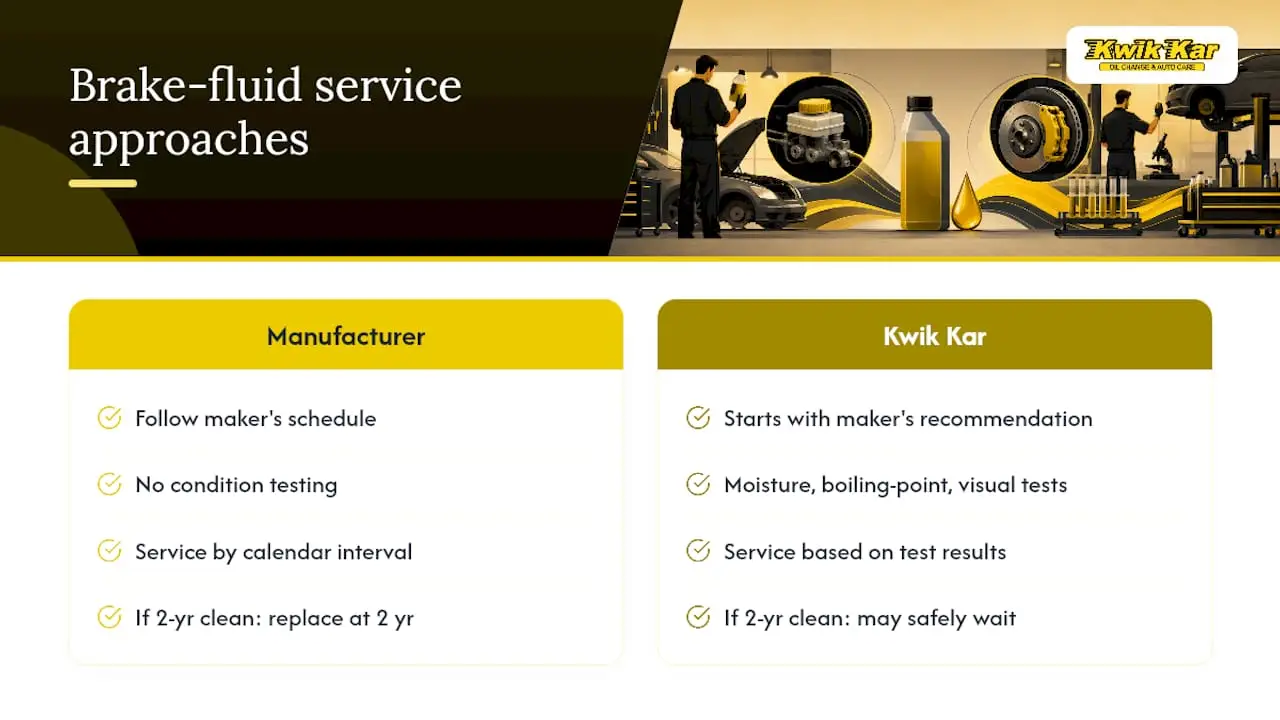
Kwik Kar Oil Change & Auto Care is RepairPal certified, which means our certified technicians follow documented, quality-controlled repair standards rather than guesswork. When a vehicle comes in for brake work, our routine checks include moisture and boiling-point testing alongside a visual inspection, because pedal feel alone doesn’t tell the full story.
We start with what your manufacturer recommends, since that’s the baseline every vehicle should follow. From there, we adjust based on what the testing actually shows. A vehicle at the two-year mark with clean test results might not need service that day. One at eighteen months with elevated moisture readings might. That’s condition-based judgment, not a calendar guess, and it’s how we decide whether your car needs service now or can safely wait.
A Practical Note From Kwik Kar
Start with your owner’s manual. It’s the baseline every vehicle should follow, and no online guide should override it. If you tow trailers, spend weekends at the track, or live somewhere humid, shift to a two-year rhythm regardless of what the manual technically allows.
When you book service, ask three things: what the moisture percentage test showed, which DOT-spec fluid will be used, and whether it’s coming from a sealed bottle. Those answers tell you whether the job was done right.
— Kwik Kar
Book a Brake Fluid Check With Kwik Kar
Our shop gives Fort Worth drivers a straightforward way to know exactly where their brake fluid stands, instead of guessing based on how the pedal feels. Our certified technicians run objective moisture and boiling-point testing before recommending a flush, so you’re never paying for service your fluid doesn’t actually need yet, and never skipping service it does.
A full flush uses correct DOT-spec fluid poured fresh from sealed containers, and we’re upfront about pricing before any work begins. If you’re also due for routine upkeep, take a look at our guide to preventive car maintenance to see how brake fluid service fits into your broader maintenance schedule. Ready to find out where your brakes actually stand? Schedule a visit or bring in a coupon from our Ladies Day offer and ask our team for a moisture test at your next appointment.
Sources
For deeper reading on brake fluid chemistry and manufacturer guidance, see CARFAX on brake fluid intervals, HELLA Tech World on brake fluid changes, and J.D. Power’s brake fluid cost guide. Always confirm the exact interval against your own owner’s manual first.
- How often should you change your brake fluid? | CARFAX
- Changing the brake fluid | HELLA Tech World
- Brake fluid service: is changing it every two years necessary? | High Speed Magazine
FAQ
How often does brake fluid really need to be changed?
Most manufacturers recommend every two to three years, though some models allow up to four years based on condition. Your owner’s manual sets the exact number for your vehicle.
Is it necessary to change brake fluid every two years?
For many vehicles, yes. Two years is a widely used, conservative safety interval since moisture absorption is gradual and often invisible until it affects pedal performance.
What happens if I don’t change brake fluid?
Moisture buildup lowers the fluid’s boiling point, which can cause brake fade or a soft pedal under hard braking, and it corrodes hydraulic components like the master cylinder and ABS modulator from the inside.
Can brake fluid last five years?
Some manufacturers allow intervals close to that on specific models, but it depends heavily on driving conditions and requires testing to confirm the fluid is still safe. We recommend a moisture or boiling-point test rather than assuming fluid is fine based on age alone.