




A soft or spongy brake pedal usually points to air trapped in the hydraulic lines, moisture-contaminated fluid, or a failing master cylinder. If the pedal sinks toward the floor or the softness appeared suddenly, stop driving and arrange a tow. If braking still works but feels mushy, drive gently and get it inspected within a day or two.
TL;DR:
- Trapped air in the brake lines is the most common cause of a spongy pedal and often results from recent brake work or a loose bleeder screw.
- Moisture contamination in brake fluid lowers its boiling point and can vaporize during braking, creating compressible gas that softens the pedal.
- Internal master cylinder seal bypass and deteriorated hoses are hidden issues that mechanical tests and visual inspections can help diagnose accurately.
- Drive cautiously or arrange a tow immediately if the pedal sinks close to the floor or appears suddenly soft, especially if braking performance deteriorates sharply.
- Regular brake fluid replacement every two years and routine inspections of hoses and seals are key preventative measures against a soft pedal.
Table of Contents
- What Causes a Soft Brake Pedal?
- How Do You Diagnose Brake Pedal Softness?
- What Fixes a Soft or Spongy Brake Pedal?
- Is It Safe to Drive With a Soft Brake Pedal?
- How Do You Prevent a Soft Brake Pedal?
- How Kwik Kar Diagnoses a Soft Brake Pedal
- Does a Failing Brake Booster Change Pedal Feel?
- Do Drum Brakes and Disc Brakes Behave Differently When the Pedal Goes Soft?
- Can Temperature Changes Make the Pedal Feel Different?
- What Advanced Diagnostics Catch That a Pump Test Won’t?
- Why Kwik Kar Treats Every Soft Pedal as a Safety Call First
- Get Your Brake Pedal Checked at Kwik Kar
- Sources
- FAQ
What Causes a Soft Brake Pedal?
Every cause of a spongy brake pedal traces back to one thing: something is compressing inside a hydraulic system that’s supposed to be solid and incompressible. Brake fluid doesn’t squeeze down under pressure. Air does. Vaporized moisture does. And a worn seal lets fluid slip past instead of pushing it where it needs to go.
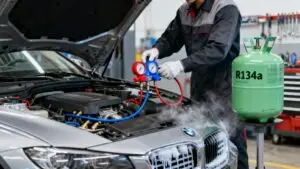
- Air trapped in the brake lines. This is the most common culprit behind a spongy pedal, and it usually gets in through a recent brake job, a loose bleeder screw, or a line that ran dry, according to Wagner Brake’s technical guidance. Air compresses under pedal pressure the way fluid never does, so the pedal feels squishy instead of solid.
- Moisture-contaminated brake fluid. Brake fluid is hygroscopic, meaning it absorbs water from the air over time. As moisture content climbs, the fluid’s boiling point drops, and heavy or repeated braking can vaporize that water into compressible gas, according to RepairPal. The reservoir can look completely full while the fluid inside is already compromised.
- External leaks and a low reservoir. A leaking caliper, wheel cylinder, or line lets fluid escape and lets air take its place.
- Internal master cylinder seal bypass. Worn seals let fluid slip past internally, so pressure fails to build even with a full reservoir and no visible leak anywhere.
- Deteriorated rubber brake hoses. Aging hoses can balloon outward under pressure or collapse internally, according to PowerStop, softening the pedal without a drop of fluid ever hitting the ground.
- Sticking calipers, wheel cylinders, or ABS modulator faults. A stuck piston or a malfunctioning ABS valve can throw off how pressure distributes across the system, which shows up at the pedal as inconsistent firmness.
How Do You Diagnose Brake Pedal Softness?
Two quick tests, done in your own driveway, tell you most of what a technician needs to know before you even call the shop.
- Pump test. With the engine off, pump the brake pedal several times. If it firms up temporarily, that firming pattern is a classic air signature, according to Wagner Brake’s technical tips. Air compresses and then gets pushed toward the caliper with each stroke, which is why the pedal feels better for a moment and then goes soft again on the next drive.
- Static pressure (creep) test. Push the pedal down firmly and hold it for 30 to 60 seconds without letting go. If the pedal slowly sinks toward the floor even though you’re holding steady pressure, that’s a strong sign of internal master cylinder seal bypass, even when there’s no fluid on the garage floor to see.
- Reservoir and visual leak check. Pop the hood and check the fluid level against the “full” and “low” marks, then look under the car and at each wheel for wet spots or drips.
- Hose and wheel inspection. Look for hoses that look swollen, cracked, or soft to the touch, and check whether one wheel feels like it’s dragging or its pad is wearing faster than the others.
Pro Tip: Write down exactly what each test showed, including how many pump strokes it took to firm up or how far the pedal sank during the hold. That detail saves diagnostic time and often saves you money once a technician takes over.
Keep in mind that some ABS-equipped vehicles trap air inside the ABS module itself, and conventional bleeding at the wheel won’t remove it. Those systems often need a scan tool to run a proper bleed sequence, according to KBB.
What Fixes a Soft or Spongy Brake Pedal?
The repair always follows the diagnosis, and the sequence matters. Most shops start with the simplest, least invasive fix and only move to parts replacement once that’s ruled out.
- Bleeding or flushing the brake fluid. This is the first-line fix when air or moisture is suspected, and it’s often enough to solve the problem on its own, according to EngineerWala. A full flush replaces old, moisture-laden fluid throughout the system rather than just topping off the reservoir.
- Replacing a hose, line, caliper, or wheel cylinder. Whichever component failed gets swapped, then the system is bled and pressure tested to confirm the pedal holds firm under the static test.
- Replacing the master cylinder. When the creep test confirms internal bypass, no amount of bleeding fixes it. The cylinder gets replaced, often bench bled before installation, then the full system is bled again.
- ABS or hydraulic control unit service. If the ABS module is trapping air, dealer-level procedures or scan-tool-guided bleed sequences may be required, since pedal pumping alone can’t reach that air.
The underlying cause is still sitting there, and it tends to get worse, not better, the longer it’s ignored.
If your last brake service happened a while back, it’s worth reviewing your brake pad wear and rotor condition at the same time, since worn components sometimes contribute to fluid level changes that mask a separate hydraulic problem.
Is It Safe to Drive With a Soft Brake Pedal?
The answer depends entirely on how far the pedal travels and how it got that way.
- Stop driving immediately if the pedal sinks close to the floor or the softness appeared suddenly, and arrange a tow rather than risk a drive with unreliable stopping power.
- Drive cautiously to a shop if the pedal is only slightly soft and brakes still respond, but skip the highway and avoid hard stops until it’s inspected.
- Tell the shop everything you found: how the pedal felt, what the pump test showed, how far it sank during the hold test, and whether you saw any leaks.
- Assume the vehicle is unsafe to operate normally once you’ve confirmed sinking under steady pressure. That’s not a symptom to schedule around next week.
How Do You Prevent a Soft Brake Pedal?
Most spongy-pedal emergencies are preventable with a maintenance habit most drivers skip entirely: watching the fluid, not just the pads.
- Change your brake fluid on schedule, or at minimum every two years, since manufacturers commonly recommend that interval to limit moisture buildup, according to All Clutch & Brake. Fluid is hygroscopic no matter how carefully you maintain the rest of the car.
- Have hoses, lines, and wheel seals inspected during routine brake service rather than waiting for a symptom to force the issue.
- Always bleed the system after any hydraulic work, and keep a record of who performed it and when.
- Use the correct DOT-spec fluid for your vehicle, and make sure the reservoir cap’s vent seal is intact so moisture isn’t sneaking in that way.
Understanding what brake fluid actually does and why it needs regular changing makes it a lot easier to stick to that two-year window instead of letting it slide.
How Kwik Kar Diagnoses a Soft Brake Pedal
Kwik Kar Oil Change & Auto Care’s certified technicians run the static hold test and check fluid condition before touching a single part, because guessing at a brake repair wastes your time and money. That diagnostic discipline, paired with quality parts, is backed by our RepairPal certification.
- Static hold and pump tests to separate air issues from internal master cylinder bypass.
- Fluid moisture and condition checks, since a full reservoir can still hide a compromised fluid problem.
- Bench bleeding and pressure testing whenever a master cylinder is replaced.
- Scan-tool ABS bleeding when the module itself needs a controlled purge sequence.
- A written inspection summary with a transparent estimate before any repair begins.
Does a Failing Brake Booster Change Pedal Feel?
A failing brake booster or vacuum leak produces a different symptom pattern than air or fluid problems, and it’s worth ruling out separately. The booster amplifies your leg’s force using engine vacuum, so when it fails, the pedal typically feels hard and requires much more effort to push, not soft and sinking.
That said, a booster problem can complicate diagnosis when it happens alongside a genuine hydraulic issue. If you press the pedal with the engine off, then start the engine while holding pressure, a properly working booster lets the pedal drop slightly as vacuum kicks in. If nothing changes, the booster or its check valve may be the problem rather than the hydraulic system.
Vacuum leaks from a cracked hose or a failing check valve starve the booster of the assist it needs, and that shows up as a pedal that feels stiff and requires more stomp than usual, sometimes right alongside a hissing sound under the dash. That’s a distinct complaint from the sinking or spongy feel caused by air or master cylinder bypass, which is exactly why technicians ask specific questions about pedal effort versus pedal travel before assuming they know the cause.
If your pedal feels unusually hard rather than soft, that’s a booster or vacuum system conversation, not the hydraulic issues covered above. Either way, it belongs in front of a technician rather than guessed at in the driveway.
Do Drum Brakes and Disc Brakes Behave Differently When the Pedal Goes Soft?
Drum brakes and disc brakes respond to hydraulic problems in noticeably different ways, and that difference matters when you’re troubleshooting a mixed setup, which many trucks and older sedans still run.
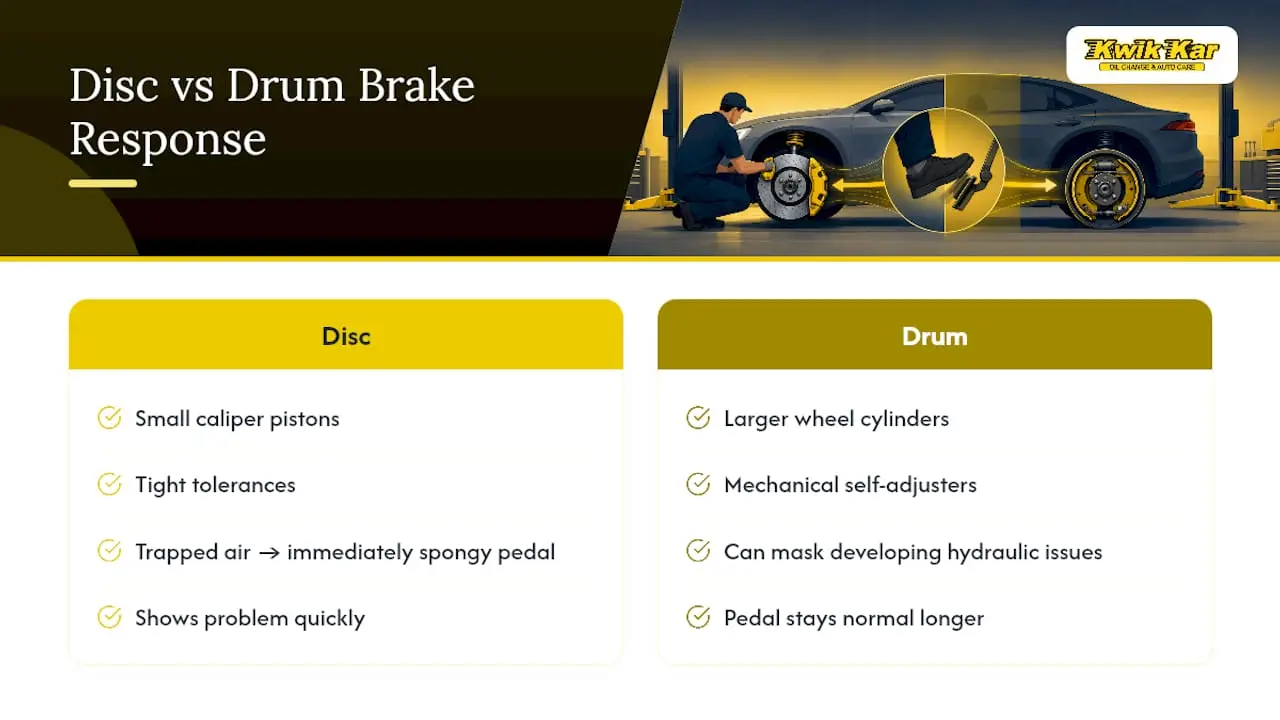
Disc brake calipers use relatively small pistons and tight tolerances, so a small amount of trapped air produces a pedal that feels immediately spongy. Drum brakes use wheel cylinders with more built-in mechanical adjustment, and self-adjusting mechanisms can sometimes mask a developing hydraulic problem for longer before the pedal feels obviously different.
That’s part of why a vehicle with rear drums and front discs can show a softer pedal that’s harder to pin down without a proper bleed sequence at all four corners. Bleeding order also differs by design. Most disc/drum combination systems require bleeding in a specific sequence, typically starting with the wheel farthest from the master cylinder, to fully clear air from both types of hydraulic circuits. Skipping a wheel or bleeding out of sequence is a common reason a pedal stays soft even after a shop “already bled the brakes.”
If you’re not sure which setup your vehicle uses, that’s a fair question to ask when you book service, since it changes both the diagnostic approach and the time the repair takes.
Can Temperature Changes Make the Pedal Feel Different?
Brake pedal feel shifts with temperature more than most drivers expect, and that shift can either mask or expose an existing problem.
Cold weather thickens brake fluid slightly and can make rubber components in the system a little stiffer, which sometimes makes a marginal pedal feel temporarily firmer during a cold start. As the system warms up during a drive, especially with hard or repeated braking, any moisture in the fluid becomes far more likely to vaporize, which is when a marginal spongy-pedal problem often reveals itself on a highway descent or after several stop-and-go stretches.
That’s the mechanism behind vapor lock: heat plus moisture equals compressible gas in a system that’s supposed to be solid fluid all the way through, a pattern confirmed by RepairPal’s explanation of how spongy brakes develop. Drivers sometimes report a pedal that felt fine on the way to work and went soft on the way home after a few hours of summer heat and traffic. That’s not the brakes getting worse throughout the day. It’s the same underlying moisture problem finally showing itself once the fluid got hot enough.
If you’ve noticed your pedal only goes soft after extended driving or in hot weather specifically, mention that pattern to your technician. It’s a strong pointer toward fluid contamination rather than a mechanical part failure, and it usually means a flush solves it without any parts replacement at all.
What Advanced Diagnostics Catch That a Pump Test Won’t?
The pump test and static hold test catch most soft-pedal problems, but a handful of causes only show up with shop equipment.
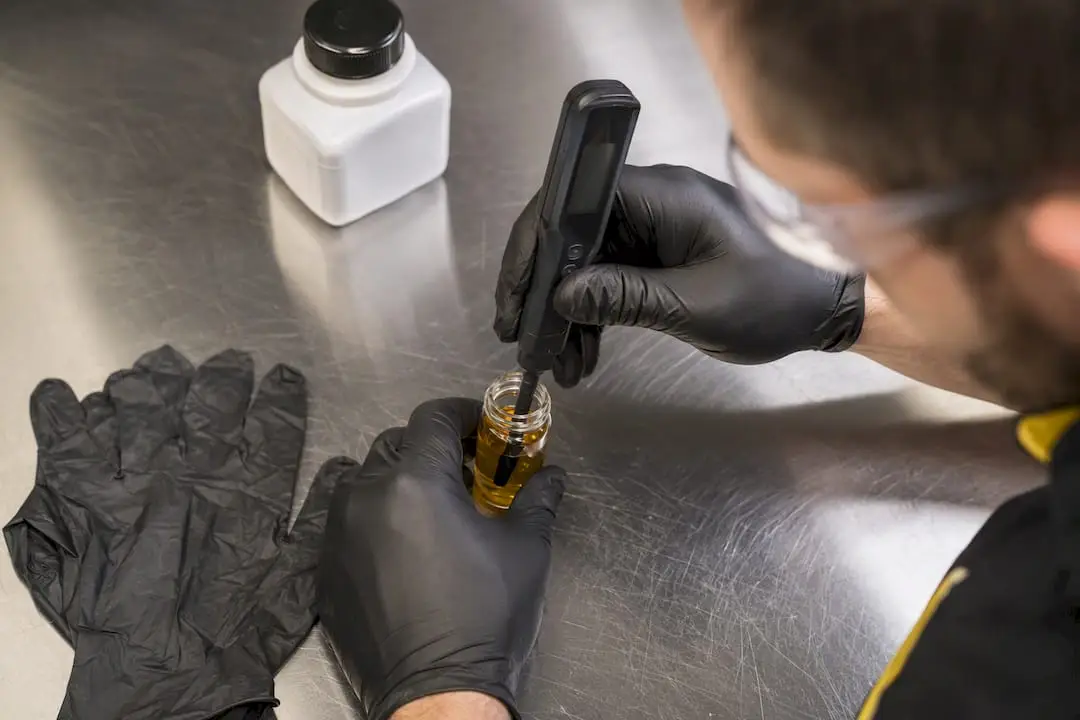
A brake fluid moisture test uses a small tester to measure water content in the fluid directly, catching contamination before it’s severe enough to vapor lock on a hot day. That test alone often settles the debate over whether a flush is really necessary or whether the fluid still has useful life left.
ABS-equipped vehicles present the biggest diagnostic gap for driveway testing. Without that scan-tool-guided sequence, air can stay trapped in the module indefinitely, and the pedal stays soft no matter how many times a wheel gets bled conventionally.
A scan tool also pulls stored ABS fault codes that point directly at a failing wheel speed sensor or a malfunctioning modulator valve, cutting out a lot of guesswork. Pressure gauges attached at each caliper or wheel cylinder confirm that hydraulic pressure is actually reaching every corner evenly, which matters most on vehicles with a mix of drum and disc brakes where uneven pressure is easy to miss by feel alone.
Why Kwik Kar Treats Every Soft Pedal as a Safety Call First
We’d rather a customer call us with a hunch than wait until the pedal sinks all the way to the floor on a highway on ramp. Every soft brake pedal gets the same static hold and fluid checks our certified technicians run on every vehicle that comes through the bay, with a clear written estimate before any work starts. If you’re not sure whether to drive in or call for a tow, call us first. We’ll walk you through it.
— Kwik Kar
Get Your Brake Pedal Checked at Kwik Kar
A spongy pedal doesn’t fix itself, and guessing at the cause usually costs more than catching it early. Certified technicians run the same static hold and pump tests covered above, then match the repair to what those tests actually show instead of replacing parts by default.

Our brake services cover the full range this article walks through: brake fluid flushes, hose and line replacement, master cylinder replacement, and ABS diagnostics using a scan tool when the module needs it. Every estimate is transparent before we touch the car, and every repair uses quality parts backed by our RepairPal and ASE certifications. If your pedal feels soft, sinks under steady pressure, or just doesn’t feel right anymore, book an inspection with Kwik Kar Oil Change & Auto Care in Fort Worth and let a certified technician run the tests properly instead of hoping the problem goes away on its own.
Sources
- Why are my brakes spongy? — Wagner Brake technical tips
- How spongy brakes can absorb your stopping power — RepairPal
- How To Diagnose a Spongy or Soft Brake Pedal — PowerStop Brakes
- Soft or spongy brake pedal? A guide — All Clutch & Brake
FAQ
How do you fix a soft brake pedal?
Most cases are fixed by bleeding or flushing the brake fluid to remove trapped air or moisture. If the pedal still sinks after a proper bleed, the fix shifts to replacing the failing part, usually a hose, caliper, or the master cylinder.
What does it mean if the brake pedal is soft?
A soft or spongy pedal almost always means something compressible, air or vaporized moisture, has gotten into a hydraulic system that’s supposed to be solid fluid throughout. A pedal that sinks under steady pressure specifically points to a master cylinder that’s leaking internally.
Is it safe to drive with a soft brake pedal?
If the pedal sinks toward the floor or the softness came on suddenly, don’t drive. Arrange a tow. If it’s only slightly soft and the brakes still hold, drive gently to a shop and avoid highways until it’s inspected.
How much does it cost to fix a soft brake pedal?
Cost depends entirely on the cause, since a simple fluid flush is a far smaller job than a master cylinder or ABS module repair. Kwik Kar Oil Change & Auto Care provides a written estimate after diagnosis so you know the exact scope before any work begins.