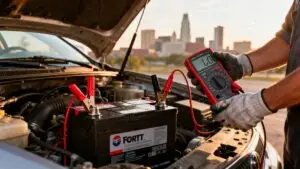





A dead battery always seems to happen at the worst possible time. It can feel like a huge deal, but honestly, it’s usually just a small hiccup if you're prepared. Having the right gear tucked away in your trunk is what turns a tow-truck call into a quick, five-minute fix.
What You Need Before Jumping a Battery
Staring at a dashboard with no lights is a frustrating feeling, but the fix begins with a simple emergency kit. Jumping a battery isn't just about finding a friendly stranger with another car; it's about having the right tools to protect both yourself and your vehicle's sensitive electronics. This is where people often go wrong—rushing the process or using cheap, flimsy equipment can turn a simple problem into an expensive one.
Before you even think about connecting a cable, your first priority has to be safety and ensuring a clean, solid connection. These aren't just suggestions; they're non-negotiable steps for a successful jump.
Your Essential Jump Start Toolkit
The single most important piece of gear you can own is a quality set of jumper cables. I can't stress this enough: not all cables are made equal, and this is one area where spending a little extra pays off big time. Look for a set that’s at least 12-16 feet long. That length gives you much-needed flexibility when you can't park the two cars perfectly nose-to-nose.
The thickness of the cable, known as its gauge, is also crucial. A lower gauge number means a thicker, more robust wire that can handle the electrical current needed to start your engine.
- Cable Gauge: You want a gauge of 6 or lower. For bigger vehicles like trucks and SUVs, a beefier 4-gauge set is even better.
- Cable Material: Make sure you're getting 100% copper cables, not the cheaper copper-coated aluminum ones. Copper is a much better conductor and will get the job done right.
Beyond the cables themselves, there are a couple of other things you’ll be glad you have.
Having the right tools on hand transforms a roadside emergency from a crisis into a mere inconvenience. It's the preparation that dictates whether you spend five minutes or five hours dealing with a dead battery.
Safety Gear and Cleaning Supplies
Don't ever overlook personal safety. A car battery contains corrosive sulfuric acid and can release flammable hydrogen gas, so a few simple precautions are a must. Your kit should always include:
- Safety Glasses: A non-negotiable item to protect your eyes from sparks or any potential battery acid splash.
- Gloves: A good pair of insulated gloves will protect your hands from grime, sharp edges, and any accidental electrical contact.
Finally, one of the most common reasons a jump-start fails is a bad connection. Over time, battery terminals can get covered in a crusty, white or bluish powder—that's corrosion. It acts as an insulator, preventing the jumper cable clamps from making a solid connection. A simple wire brush is the perfect tool for scrubbing it off. Getting a clean, metal-to-metal contact is key.
Keeping these small tools in your kit can be a real lifesaver. This kind of forethought is all part of a solid vehicle maintenance routine, similar to the habits we cover in our pre-trip vehicle inspection checklist.
Essential Jump Start Safety Checklist
Before connecting any cables, run through this quick checklist. It only takes a minute and ensures you're setting yourself up for a safe and successful jump.
| Item/Check | Purpose and Importance | Status |
|---|---|---|
| Both Vehicles Off | Prevents electrical surges that could damage sensitive electronics in either car. | ☐ |
| Parking Brakes On | Ensures neither vehicle can roll or move unexpectedly during the jump-start process. | ☐ |
| Inspect Jumper Cables | Look for any frayed wires or damaged clamps that could be a safety hazard. | ☐ |
| Identify Battery Terminals | Correctly find the positive (+) and negative (-) posts on both batteries. They're usually marked. | ☐ |
| Check for Battery Damage | If the dead battery is cracked, leaking, or bulging, do not attempt to jump it. Call a pro. | ☐ |
| Wear Safety Gear | Put on your safety glasses and gloves before you touch anything under the hood. | ☐ |
Taking a moment for these checks separates a smooth process from a potentially dangerous mistake. Once you've ticked these boxes, you're ready to proceed with confidence.
The Correct Jumper Cable Connection Sequence
This is where the rubber meets the road, but connecting jumper cables is about more than just matching red to red and black to black. The specific order you follow is a critical safety protocol, designed to protect both you and the sensitive electronics in modern vehicles. One wrong move, like creating a spark near a battery that’s venting flammable gas, can turn a simple jump-start into a really bad day.
So, why the specific sequence? It's all about preventing an accidental spark in the worst possible place. By making that final connection on a bare metal surface away from the dead battery, you complete the circuit safely and minimize any risk. Think of it as a carefully choreographed dance where every step has a purpose.
This quick infographic breaks down the essential prep work before you even touch a cable clamp.

As you can see, grabbing the right cables, wearing some gloves, and making sure the terminals are clean sets you up for a smooth and successful jump.
The Step-by-Step Connection Process
Alright, with both cars turned off and parked close enough for the cables to reach (but not touching each other!), it's time to get started. Uncoil your jumper cables and make sure the red and black clamps aren’t touching each other or any metal surfaces.
Red to Dead: First, take one of the red (positive) clamps and connect it securely to the positive (+) terminal of the dead battery. You may need to give it a little wiggle to make sure it bites through any surface grime for a solid connection.
Red to Good: Now, walk the other red (positive) clamp over to the donor car and attach it to the positive (+) terminal of the working battery.
Black to Good: Next, take a black (negative) clamp and connect it to the negative (-) terminal of that same good battery.
You're almost there. Three of the four clamps are connected. This last connection is the most important one for your safety.
This final step is the one most people get wrong, but it’s the most important for preventing a dangerous situation. Never connect the last clamp to the dead battery’s negative terminal.
Making the Final Ground Connection
That last clamp is what completes the electrical circuit. If you were to connect it directly to the dead battery's negative post, you could create a spark right where the battery might be venting flammable hydrogen gas—a natural byproduct of a battery in distress.
- Black to Bare Metal: Instead, take that final black (negative) clamp and attach it to an unpainted, heavy piece of metal on the dead car’s engine block or frame. A hefty bolt head or a clean metal bracket works perfectly. This grounds the circuit safely away from the battery.
Once all four clamps are secure, go ahead and start the working car. Let it run for a few minutes to send a bit of a charge over to the dead battery. Then, hop in the dead car and try to start it. If it fires up, congratulations—you just successfully jumped a battery.
How to Disconnect Everything Safely
With both cars running, don't just yank the cables off. The disconnection process is just as important, and you’ll do it in the exact reverse order you used for the connection.
- Start by removing the black clamp from the bare metal ground spot on the car you just jumped.
- Next, remove the black clamp from the donor car's battery.
- Then, remove the red clamp from the donor car's battery.
- Finally, take the red clamp off the newly started car's battery.
This reverse-order removal breaks the circuit with the same level of safety you used to create it. And remember to be careful not to let the metal clamps touch each other while any of them are still connected to a battery.
Now, don't shut the car off right away. Let the newly revived car run for at least 20 minutes—taking it for a drive is the best way to do this. This gives the alternator enough time to start recharging that drained battery.
Troubleshooting a Jump Start That Isn't Working
So, you’ve followed the steps perfectly. The clamps are on tight, you get back in the driver's seat, turn the key, and… nothing. Or maybe just that dreaded, sad little clicking sound. When a jump-start doesn’t work, it’s definitely frustrating, but it’s also a clue. Your car is trying to tell you what’s really going on under the hood.
The first thing to do is listen. Seriously. The sound your car makes—or doesn't make—is one of your best diagnostic tools. A fast, rapid-fire clicking often means there's a little bit of juice left in the battery, just not nearly enough to crank the engine. On the other hand, a single, solid click or total silence could point to a completely dead battery or another problem entirely, like a bad starter or ignition switch.

Check Your Connections First
Before you start thinking the worst, go back to the basics: the connections. This is, by far, the most common reason a jump start fails. A weak connection simply won't let enough electricity flow from the good car to the dead one. Go ahead and disconnect the cables (in the proper reverse order, of course) and take another look.
- Corrosion: See any of that white or crusty blue-green powder on the battery terminals? Even a thin layer of that stuff will stop a current dead in its tracks. Grab a wire brush and scrub the battery posts and the inside of the cable clamps until you’re looking at shiny, bare metal.
- Clamp Grip: Are the clamps really biting down on the terminals? Give them a little wiggle. You want them to have a solid, firm grip, not just be resting loosely on top.
Sometimes, a battery can be so drained that it essentially acts as a block, preventing the jump-start current from getting where it needs to go. This is a common issue with older batteries that have died a few times.
Once you’ve cleaned everything and re-secured the clamps, give it another shot. This time, let the donor car run for a good 5-10 minutes before you try starting the dead vehicle. This extra time can give a deeply discharged battery the little surface charge it needs to wake up.
When the Battery Might Be Too Far Gone
If you’ve double-checked your connections, let the other car run for a while, and you're still getting nothing, the battery itself is likely the problem. A battery that’s been sitting dead for weeks or has simply reached the end of its typical 3-5 year lifespan might not be able to accept a charge at all.
This is usually where a simple jump-start attempt ends and real diagnostics begin. It could be a sign of a much bigger problem with the car’s charging system. If you want to get a better idea of what's going on, it helps to learn how to diagnose common problems with your car and see if the symptoms point toward a bad alternator or something else.
If repeated jumps fail, it's time to stop. Forcing it can risk damaging the sensitive electronics in either car. At this point, getting a professional opinion is your safest and smartest move.
When to Avoid a Jump Start and Call a Pro
Knowing how to jump-start a car is a great skill to have, but the real mark of experience is knowing when not to. Sometimes, hooking up the jumper cables is the wrong move, and pushing ahead can put you, your car, and the good Samaritan helping you in real danger.
Before you even think about connecting a clamp, take a moment to look at and smell the battery. Seriously. Your eyes and nose are your best tools for spotting a bad situation before it gets worse. Ignoring the warning signs just isn't worth the risk.
Clear Signs of a Damaged Battery
If you see any of the following, stop immediately. These are all signs of a serious internal battery failure, and adding electricity to the mix is a recipe for disaster. Do not proceed if you notice:
- A Cracked or Leaking Case: Any visible crack or fluid seeping out means the battery's structure is shot.
- A Bulging or Swollen Shape: If the battery case looks puffed up or bloated, it’s likely been damaged by overcharging or freezing.
- A Rotten Egg Smell: That unmistakable sulfur smell is a dead giveaway that the battery is venting flammable and dangerous hydrogen sulfide gas.
If you run into any of these red flags, the only safe option is to call a professional. Trying to force a jump could lead to nasty acid burns or, worst-case scenario, a battery explosion.
A dead battery is an inconvenience; an exploding battery is a disaster. If your gut tells you something looks or smells wrong, listen to it. The risk is never worth it.
Other Scenarios Requiring a Professional
Physical damage isn't the only reason to back away from a jump start. A few other situations make it either dangerous or just plain pointless.
A frozen battery is one of the most hazardous scenarios. If you're in a cold climate and the car has been sitting for a while, check the battery first. If you can see ice on it or the casing feels like a solid block, don't even think about hooking up cables. Applying current to a frozen battery can cause it to rupture or explode.
Another big clue is when the battery doesn't seem to be the problem at all. Let's say your dashboard lights up, the radio works, and the headlights are bright, but the engine won't even try to crank. This usually points to something else, like a bad starter, alternator, or ignition switch. A jump-start won't do a thing for those kinds of mechanical or electrical failures.
In these cases, your best bet is to get a proper diagnosis. Knowing how to find a trustworthy mechanic is key when your car's problems go beyond a simple dead battery.
Proactive Care for Your Battery and Alternator
A successful jump gets you back on the road, but it’s really just a temporary fix for a much bigger problem. If you don't figure out why the battery died in the first place, you'll be pulling out those jumper cables again sooner rather than later. The real goal is to prevent the next dead battery before it even has a chance to happen. That means taking a look at your vehicle’s charging system.

Think of your battery and alternator as a team. The battery provides that initial burst of power to crank the engine, but once the car is running, the alternator takes over. It generates all the electricity needed to run your car's systems and—most importantly—recharge your battery for the next start. If one part of this duo starts to fail, the other is sure to follow.
Is It the Battery or the Alternator?
A battery that dies once could just be a simple mistake, like leaving your headlights on. But a battery that dies repeatedly? That often points to a failing alternator that just can't keep up anymore. Keep an eye out for these classic signs of alternator trouble:
- Dimming Lights: If your headlights or dashboard lights seem to flicker or dim, especially when you turn on the radio or A/C, your alternator is probably struggling to produce consistent power.
- Warning Lights: A "BATT," "ALT," or a little battery-shaped icon on your dash is your car's way of screaming for help. It’s a direct signal that the charging system needs immediate attention.
- Strange Noises: Hear a grinding or whining sound coming from under the hood? That could be the bearings inside the alternator wearing out—a sure sign it's on its last legs.
If you notice any of these symptoms right after a jump-start, the alternator is almost certainly the culprit. Ignoring it will only lead to another dead battery and, eventually, a full breakdown that leaves you stranded.
A dead battery is the symptom, but a failing alternator is often the disease. A professional charging system test is the only way to get an accurate diagnosis and prevent a cycle of jump-starts.
Smart Habits to Extend Battery Life
You can get a lot more life out of your battery with just a few simple, proactive habits. First off, keep those battery terminals clean. That crusty, white or blue buildup you sometimes see actually acts as an insulator, weakening the connection and making it harder for the battery to charge. A quick scrub with a wire brush every few months makes a world of difference.
Also, think about your driving patterns. If you’re constantly taking short trips of less than 20 minutes, you're not giving the alternator enough time to fully replenish the battery's charge. Over time, this slowly drains it. Make an effort to take a longer drive at least once a week to let it get a good, solid recharge.
For those curious about the future of vehicle power systems, this guide on Battery And Charging Technologies offers some interesting insights. But at the end of the day, the best prevention is getting a professional opinion. Here at Kwik Kar, we can perform a complete charging system check to test both your battery's health and your alternator's output, letting us spot hidden issues before they leave you stranded.
Common Questions About Jumping a Car Battery
Even with the right steps in hand, things can feel a little fuzzy when you’re standing in a parking lot with a dead car. Getting clear answers to those last-minute questions is the key to turning a stressful moment into a quick, manageable fix.
Let's clear up some of the most common uncertainties people have when they're faced with jumper cables and a car that just won't start.
How Long Should the Cables Stay Connected?
One of the most common mistakes is yanking the cables off the second the dead car sputters to life. Hold on. After the engine turns over, you need to leave both cars running with the cables still attached for another 3-5 minutes. This gives the good car's alternator a chance to pump a solid initial charge into the weak battery.
Once that's done and you've safely disconnected everything, your job isn't over. You'll want to drive the car you just jumped for at least 20-30 minutes. Cruising at a steady speed is best, as it gives your own alternator enough time to really start recharging the battery properly.
Are Portable Jump Starters a Good Alternative?
Absolutely. In fact, for most people, they're a much better and safer option these days. Modern lithium-ion portable jump starters are small enough to fit in your glovebox but powerful enough to get you going without needing a second vehicle. They’re a total game-changer.
They also come with built-in safety features that prevent sparks and won't let you hook them up backward—a huge advantage over old-school jumper cables.
The rise of lithium-ion technology has made portable jump starters a game-changer for roadside emergencies. They are projected to dominate the market due to their convenience, safety features, and compact, powerful designs.
These little power packs can hold their charge for months, so you can just stick one in the trunk and have peace of mind knowing you can handle a dead battery all by yourself.
What if My Car Dies Again Right After a Jump?
You get the car started, drive a few blocks, and then… it dies again. This is a classic sign that the jump-start was just a band-aid on a bigger problem. When this happens, it almost always points to one of two things:
- A Failed Battery: The battery is just too old or worn out to hold a charge anymore.
- A Faulty Alternator: The alternator isn't doing its job of recharging the battery while you drive, so it drains right away.
In this situation, trying to jump it again and again is a waste of time. Your car’s charging system needs a professional look. A technician can test everything properly to see if you need a new battery, a new alternator, or something else entirely. It’s the only way to make sure you don't get stranded for good.
If your vehicle's charging system is acting up, don't wait for another dead battery. The certified technicians at Kwik Kar Oil Change and Auto Care can perform a comprehensive inspection to diagnose the root cause and get you back on the road with confidence. Visit us online to schedule your appointment.