



Transparent auto pricing means the advertised price of a vehicle includes every mandatory fee a buyer must pay, so the number you see in an ad matches the number on the final contract. The only legitimate exceptions are government charges like sales tax and registration. No surprise dealer fees added at the desk. No price that only applies if you finance through the dealership. Just a clear, honest total from the start.
This approach, sometimes called “all-in pricing” or “out-the-door pricing” in the industry, gives you the ability to compare vehicles across dealerships on equal footing. When one dealer buries a $1,200 documentation fee in the fine print and another folds it into the advertised price, you cannot make a fair comparison without transparency. The Federal Trade Commission (FTC) has made closing that gap a top enforcement priority in 2026.
- The advertised price must reflect all required dealer fees
- Government taxes and registration fees are the only permitted exclusions
- Pricing cannot be conditioned on using dealer financing
- Discounts advertised must be available to all buyers, not just select groups
Why the FTC cracked down on auto dealer pricing in 2026
The FTC’s enforcement push did not come out of nowhere. Deceptive pricing in auto sales had been a documented problem for years, and in March 2026, the agency acted decisively. The FTC sent warning letters to 97 dealership groups nationwide, demanding that advertised prices reflect the total amount consumers would actually pay.
The letters cited six specific illegal pricing practices under Section 5 of the FTC Act:
- Advertising a price that omits required fees
- Advertising discounts not available to all consumers
- Failing to account for a required additional down payment
- Conditioning the advertised price on dealer financing
- Requiring add-ons not reflected in the advertised price
- Advertising vehicles that are unavailable or do not exist
The FTC’s stated rationale goes beyond consumer protection alone. When buyers cannot see the true price, honest dealers who do advertise fully are put at a competitive disadvantage. The agency framed transparent pricing as a market efficiency issue, not just a fairness one.
What the FTC guidelines actually require from dealers
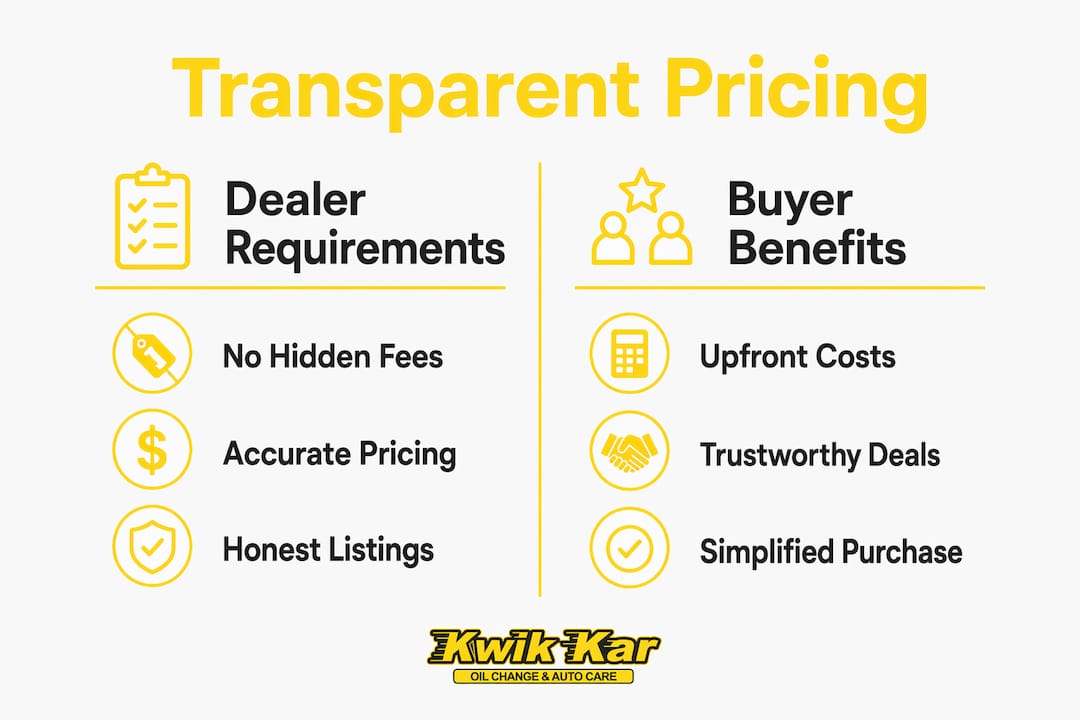
The FTC’s framework is direct. Every price a dealer advertises must represent what a buyer will pay at the point of sale, with no additions except government-mandated charges.
Upfront, all-in pricing
Dealers must fold all mandatory fees, including documentation fees, dealer prep charges, and any required add-ons, into the advertised price. A fee that every buyer pays is not optional, so it cannot be hidden until the finance office.
No financing conditions
A dealer cannot advertise a lower price that only applies when the buyer finances through the dealership. The price is the price, regardless of how you pay.
Honest inventory listings
Advertising a vehicle that is not actually available, or listing a price that applies to a trim level the lot does not carry, violates the FTC’s standards. Every listing must reflect real, purchasable inventory.
Elimination of junk fees
Charges like “dealer prep,” “market adjustment,” or “vehicle procurement” that are not disclosed upfront fall squarely in the FTC’s crosshairs. Consumer Reports notes that documentation fees typically run 1–3% of the vehicle’s cost but are often inflated well beyond that.
Pro Tip: Before you sign anything, ask the dealer for a complete itemized breakdown of every fee on the contract. Compare it line by line against the advertised price. Any fee that was not in the original listing is worth challenging.
How transparent pricing changes the way dealerships operate
Transparency regulations force real operational changes, and not every dealership has welcomed them. Industry analysts note that dealers who resist transparency tend to experience more “deal friction,” meaning more negotiations that collapse, more customers who walk out, and longer time-to-close on each sale.

The shift toward no-haggle or one-price models is one direct response. Under this model, a dealer posts a fixed price for each vehicle, and every buyer pays the same amount. No-haggle pricing reduces buyer stress and shortens the sales process, though it does not guarantee the lowest possible price.
Digital pricing tools have become central to compliance. TrueCar, for example, revised its dealer agreements in 2026 to fold mandatory dealer fees directly into advertised prices, creating what it calls “All-in Pricing.” The goal is a single, unified figure that buyers see before they ever set foot in a showroom.
- Dealers must audit every advertising channel, including social media posts, which the FTC now treats as advertising
- Pricing software must be updated to reflect all-in totals, not base prices
- Finance and insurance (F&I) departments face tighter limits on undisclosed add-ons
What transparent auto pricing means for you as a car buyer
The most direct benefit is simple: the price you research online is the price you pay. That eliminates the disorienting experience of negotiating one number for an hour, then watching the total climb by thousands in the finance office.

Transparent pricing also makes comparison shopping genuinely useful. When every dealer in your area lists an all-in price, you can evaluate three vehicles side by side without mentally adjusting for hidden fees. Consumer advocates consistently recommend focusing on the total out-the-door price rather than monthly payments, which can disguise inflated loan terms or interest rates.
A few practical strategies sharpen your position further:
- Request the out-the-door price in writing before visiting the dealership
- Keep vehicle price, trade-in, and financing as three separate conversations
- Do not reveal your maximum budget or monthly payment target before the vehicle price is locked in, since disclosing payment capacity early gives dealers room to manipulate financing terms
- Verify that every fee on the final contract appeared in the original advertised price
Understanding overpriced auto repairs follows the same logic: knowing what a fair price looks like before you agree to anything is the single most effective protection you have.
How transparent auto pricing developed in the US
The push for pricing transparency in auto sales did not begin in 2026. It built over decades as consumer frustration with hidden fees became a documented pattern.
The no-haggle model appeared in the early 1990s when a handful of dealership chains began posting fixed, non-negotiable prices. The idea was partly a response to consumer surveys showing that the negotiation process was the most disliked part of buying a car. Fixed-price selling reduced that friction, though it did not address the separate problem of fees added after the price was agreed.
Online car shopping accelerated the transparency pressure significantly. Once buyers could research prices across dozens of dealers from a single screen, the gap between an advertised price and a final invoice became harder to hide and easier to compare. Third-party pricing platforms emerged to aggregate listings and give buyers a reference point.
State-level regulations began requiring fee disclosures in advertising well before the FTC’s 2026 initiative. Several states mandated that dealers include documentation fees in advertised prices, creating a patchwork of rules that the FTC’s national standard is now working to unify.
Tools and platforms that put transparent pricing into practice
Several pricing platforms now build transparency directly into how they display vehicles. TrueCar’s All-in Pricing standard, announced in 2026, folds dealer documentation fees and preparation charges into the listed price so buyers see a single, complete figure rather than a base price with asterisks.
Edmunds and similar platforms display “True Market Value” data, which shows what buyers in a specific region are actually paying for a given vehicle. That figure, based on real transaction data, gives you a concrete anchor for any negotiation. Tools like CarEdge provide similar regional transaction data at no cost.
Consumer Reports publishes average transaction prices by model and trim level, which the publication recommends using as a negotiating floor rather than the dealer invoice price. The invoice price has become a less reliable benchmark because manufacturer holdback payments mean dealers can sell at invoice and still profit.
For auto glass and other repair services, the same transparency principles apply. Understanding why glass repair costs vary by region and shop helps you evaluate whether a quoted price is reasonable before you commit.
Challenges and criticisms of transparent auto pricing
Transparent pricing is not without friction. Dealers argue that all-in pricing makes it harder to advertise competitive base prices, since folding fees into the headline number produces a higher figure than a competitor who still separates them. That creates a perception problem even when the total cost is identical.
Documentation fees are a particular sticking point. Unlike taxes or registration, documentation fees are largely arbitrary and vary widely by state and dealer. Transparency makes them visible, which is the point, but it also invites negotiation on a fee that some dealers treat as non-negotiable.
Critics of no-haggle models point out that a fixed price is not always the best price. A buyer with strong negotiating skills and competing quotes may do better at a traditional dealership. Transparency and the lowest possible price are related but not the same thing.
The FTC’s warning letters, while significant, did not carry immediate fines. Some industry observers question whether letters alone will produce lasting change, or whether the agency will need to pursue formal enforcement actions to shift behavior at scale.
How to verify transparent pricing and protect yourself
You do not have to take a dealer’s word for it. A few concrete steps let you confirm that the pricing you are seeing is genuinely transparent.
Request the out-the-door price by email before you visit. A dealer who is practicing transparent pricing will give you a complete figure without hesitation. One who deflects or insists you come in first is a signal worth noting.
Cross-reference the advertised price against the final contract line by line. Every fee that appears at signing should have been disclosed in the original listing. Fees that were not, including dealer prep, market adjustment, or “administrative” charges, are contestable. Consumer Reports recommends checking your state’s Department of Motor Vehicles website to verify what registration actually costs, so you can spot any padding on that line.
Understanding common auto repair scams builds the same instinct: when you know what a legitimate charge looks like, inflated or invented fees become obvious.
If a dealer’s pricing does not match what was advertised, you can file a complaint directly with the FTC at ftc.gov/complaint. The agency has stated it will continue monitoring the market and take further action as warranted.
At Kwik Kar Oil Change & Auto Care in Fort Worth, transparent pricing is not a regulatory checkbox. Every service quote includes a clear breakdown of parts and labor before any work begins, so you know exactly what you are paying and why. That same standard applies whether you are in for a routine oil change or a more involved repair.
Key Takeaways
Transparent auto pricing requires that every advertised vehicle price include all mandatory dealer fees, with no hidden charges added at the point of sale, as enforced by the FTC’s 2026 initiative targeting 97 dealership groups.
| Point | Details |
|---|---|
| FTC enforcement scope | The FTC sent warning letters to 97 dealership groups in march 2026 demanding all-in advertised prices. |
| Six illegal practices | Omitting fees, unavailable discounts, financing conditions, required add-ons, and fake listings all violate the FTC Act. |
| All-in pricing standard | Platforms like TrueCar now fold mandatory dealer fees into the listed price to align with FTC standards. |
| Buyer protection strategy | Always negotiate the out-the-door price and keep vehicle price, trade-in, and financing as separate discussions. |
| Documentation fees | These fees are often arbitrary and negotiable; transparency makes them visible and contestable. |
FAQ
What does transparent pricing mean in auto sales?
Transparent auto pricing means the advertised price includes all mandatory dealer fees, so the number you see matches what you actually pay. The only permitted exclusions are government charges like sales tax and registration.
What should you never reveal to a dealer when negotiating?
Avoid disclosing your maximum budget, monthly payment target, or trade-in plans before the vehicle price is finalized. Revealing payment capacity early allows dealers to manipulate financing terms to their advantage.
How much does a car salesman typically make on a vehicle sale?
Dealer profit structures vary and are not publicly standardized, but manufacturer holdback payments mean dealers can profit even when selling at invoice price. Focusing on the out-the-door price rather than invoice keeps the negotiation grounded in what you actually pay.
What is the best way to verify a dealer is using transparent pricing?
Request the complete out-the-door price in writing by email before visiting. Then compare every line item on the final contract against the original advertised price. Any fee that was not disclosed upfront is worth challenging.