


A multi-vehicle service account is a specialized program that consolidates maintenance, repair, and billing for multiple vehicles under one centralized contract. These accounts replace the chaos of managing separate invoices, vendors, and service histories for each vehicle in a fleet. Providers like S&S Tire, LBC Fleet, Amerit, and Corcentric have built programs around this model, and what multi-vehicle service accounts offer goes well beyond simple convenience. Fleet managers and car owners with multiple vehicles gain standardized service quality, dedicated account management, and technology-driven visibility across every vehicle and location.
What multi-vehicle service accounts offer for billing and admin
The most immediate benefit of a fleet service account is billing consolidation. Consolidated billing across locations means one monthly invoice covers every vehicle, every repair, and every service center in your network. That single document replaces a stack of vendor invoices that would otherwise require individual review, approval, and payment.
LBC Fleet and S&S Tire both structure their programs around a dedicated Fleet Account Manager. This person handles estimate reviews, approves or rejects vendor invoices, and audits line items against flat-rate standards. The practical result is that your accounts payable team stops chasing down repair justifications from multiple shops.
- Single monthly invoice covering all vehicles and service locations
- Dedicated account manager who reviews estimates and approves vendor charges
- Centralized billing portal with real-time invoice status, as used by Corcentric
- Invoice line-item audits that reject unapproved scope before charges post
- Reduced AP workload by eliminating manual reconciliation across vendors
Consolidated vendor billing into a single platform also creates consistency that benefits both technicians and accounts payable teams. When pricing is standardized nationally, there is no ambiguity about what a repair should cost at different locations.
Pro Tip: Ask your account manager to send a weekly invoice summary by vehicle ID. That one habit catches billing errors before they compound into a monthly reconciliation problem.

How service standardization protects your fleet quality
Consistent service quality across multiple locations is harder to achieve than most fleet managers expect. A multi-vehicle account solves this by requiring all participating shops to follow the same procedures and employ technicians who meet defined certification standards.
S&S Tire requires TIA-certified technicians and standardized maintenance procedures at every service location in its network. TIA stands for Tire Industry Association, and that certification signals a technician has met nationally recognized competency standards. When every shop in your account follows the same playbook, the quality of a tire rotation in Dallas matches the quality of one in Denver.
LBC Fleet applies flat-rate estimate reviews to every repair order. This means a technician cannot bill 4 hours for a job the flat-rate guide prices at 2.5 hours without a documented justification. That single control prevents cost creep across a large fleet.
- Require TIA or ASE certification from every technician who touches fleet vehicles.
- Apply flat-rate guides to all repair estimates before approval.
- Standardize preventive maintenance intervals across vehicle types and locations.
- Integrate a Dealer Management System (DMS) to track service history by vehicle.
- Audit repair orders quarterly to identify shops with recurring billing anomalies.
“The core value of a dedicated fleet account manager is cost control by reviewing repair estimates against flat-rate standards and limiting unjustified charges.” — LBC Fleet
Technology platforms like Decisiv’s Service Request Management (SRM) and Karmak Fusion DMS support this standardization by creating a shared data layer across locations. When every shop logs work the same way, comparing performance across your network becomes straightforward.
Proactive and reactive maintenance in a single account
A well-structured fleet account does not wait for vehicles to break down. Preventive maintenance scheduling is built into the program, with service intervals tied to mileage, engine hours, or calendar dates depending on the vehicle type. This is the difference between a reactive repair bill and a predictable maintenance budget.
Providers like Kooner Fleet Maintenance Services combine preventive and mobile repair services with emergency response under one contract. S&S Tire advertises 24/7 emergency dispatch, which means a driver stranded at 2 a.m. has a direct line to coordinated support without the fleet manager making calls. Understanding the difference between preventive and reactive maintenance helps you set realistic expectations for what your account should include.
- Scheduled preventive maintenance tied to mileage or time intervals
- 24/7 emergency dispatch for roadside and priority break-fix situations
- Mobile repair services that bring technicians to the vehicle when possible
- Priority response windows for fleet vehicles versus standard retail customers
- EV-specific maintenance including battery health checks and charging equipment service
Pro Tip: Build a preventive maintenance calendar by vehicle ID at the start of each quarter. Accounts that schedule proactively see fewer emergency dispatches, which are always more expensive than planned service.
How technology and data management support fleet accounts
The operational backbone of a modern fleet service account is its technology stack. Without integrated software, a multi-location account is just a billing arrangement. With it, you get real-time visibility into every vehicle’s repair status, service history, and cost.
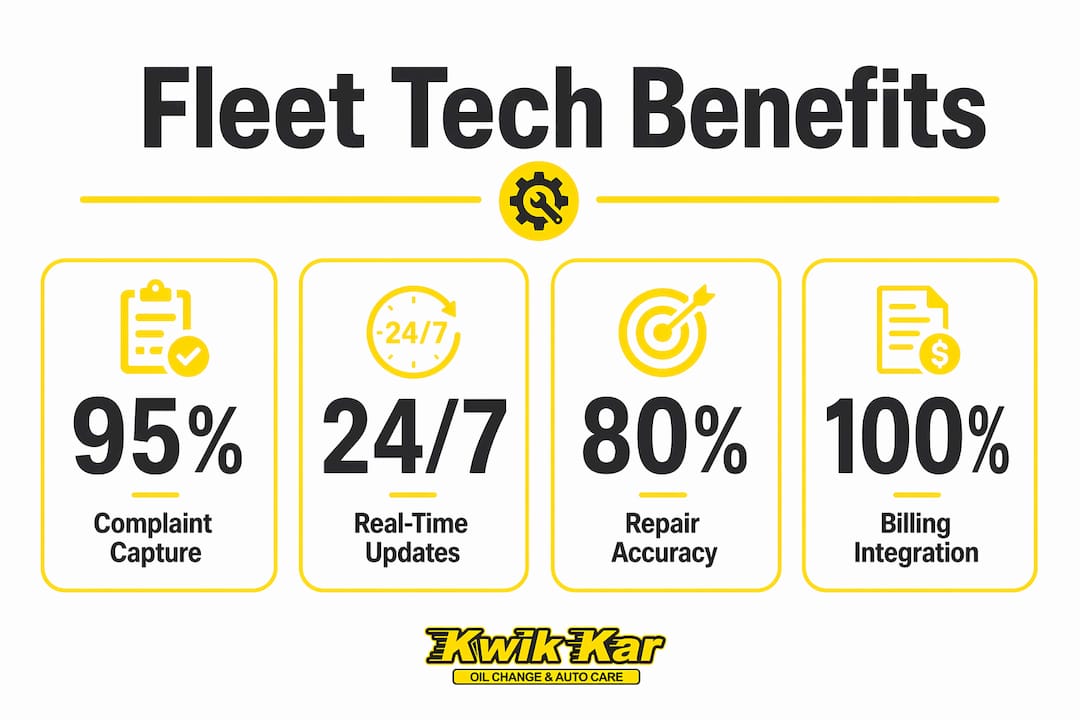
Nextran Truck Centers use Decisiv SRM for complaint capture and case creation across their locations. When a driver reports a problem, the system logs the complaint, creates a service case, and routes it to the appropriate shop. Integration with Karmak Fusion then generates a repair order and manages billing automatically. That data flow eliminates the phone calls and spreadsheets that typically fill the gaps between a vehicle problem and a completed repair.
| Technology | Function | Fleet Benefit |
|---|---|---|
| Decisiv SRM | Captures complaints, creates service cases | Reduces coordination gaps between driver and shop |
| Karmak Fusion DMS | Generates repair orders, manages billing | Automates invoice creation and cost tracking |
| Centralized billing portal | Consolidates vendor invoices | Single view of all charges across locations |
| Telematics integration | Tracks vehicle location and diagnostics | Triggers maintenance alerts before failures occur |
Real-time repair status updates also reduce the most common fleet manager frustration: not knowing when a vehicle will be back on the road. When your account includes a technology platform, you check a dashboard instead of calling the shop. Fleet managers who use dashcam cloud storage alongside their service accounts gain an additional layer of vehicle data that supports both safety and maintenance decisions.
Coverage scope and specialized services: what does a multi-vehicle account include?
Multi-vehicle accounts vary widely in geographic reach and vehicle type support. The best programs cover multiple states and handle everything from light commercial vans to heavy-duty trucks and electric vehicles under one contract.
S&S Tire operates across four states, giving regional fleets a consistent service network without managing separate vendor relationships in each market. Amerit Fleet Solutions takes this further by covering EV fleet vehicles and charging station maintenance under a single contract. That matters because EV charger failures and vehicle battery issues often require different technicians, and coordinating two separate vendors doubles your downtime risk.
| Vehicle or Asset Type | Covered Under Multi-Vehicle Account? | Notes |
|---|---|---|
| Light commercial vehicles | Yes | Standard in most programs |
| Medium-duty trucks | Yes | Requires certified diesel technicians |
| Heavy-duty trucks | Yes | Often includes DOT compliance checks |
| Electric vehicles | Yes (select providers) | Amerit specializes in EV fleet service |
| EV charging infrastructure | Yes (select providers) | Amerit combines EV and charger maintenance |
Maintaining both electric vehicles and EV charging infrastructure under one account eliminates coordination gaps and reduces downtime. Amerit’s combined approach enables single-visit EV service for both the vehicle and its charger, which is a meaningful operational advantage as fleets transition away from internal combustion engines. A solid fleet vehicle maintenance program accounts for this transition from the start.
Key Takeaways
Multi-vehicle service accounts deliver the most value when billing consolidation, certified technicians, and integrated technology work together under one contract.
| Point | Details |
|---|---|
| Consolidated billing | One monthly invoice covers all vehicles and locations, cutting AP workload significantly. |
| Dedicated account manager | A single contact reviews estimates and audits invoices against flat-rate standards. |
| Standardized technician quality | TIA or ASE certification requirements keep service quality consistent across all shops. |
| Proactive maintenance planning | Scheduled service intervals and 24/7 emergency dispatch reduce unplanned downtime. |
| Technology integration | SRM and DMS platforms create real-time repair visibility and automate billing across locations. |
What fleet managers often get wrong about these accounts
At Kwik Kar Oil Change & Auto Care, we see a consistent pattern with fleet operators who set up multi-vehicle accounts and then underuse them. The account gets created, the billing consolidates, and then the manager assumes the hard work is done. It is not.
The approval workflow is where most programs quietly fail. Estimate approvals and invoice audits are not administrative formalities. They are the mechanism that prevents a shop from billing for work that was never authorized. Skipping that step, even once, creates a precedent that costs real money over a full fleet cycle.
The second mistake is treating the technology platform as optional. Fleets that skip SRM or DMS integration end up managing their “consolidated” account through email threads and phone calls. That is not consolidation. It is just a different kind of chaos.
My honest advice: before you sign any multi-vehicle service contract, ask the provider to walk you through their estimate approval process step by step. If they cannot describe it clearly, their billing consolidation will create more problems than it solves. The providers who handle this well, like LBC Fleet and Corcentric, have defined workflows that protect you from the moment a repair is requested through the moment the invoice posts.
— Kwik Kar
Multi-vehicle maintenance support at Kwik Kar Oil Change & Auto Care
Kwik Kar Oil Change & Auto Care serves Fort Worth vehicle owners and fleet operators who need dependable, transparent maintenance without the runaround. Whether you manage two vehicles or twenty, the certified technicians at Kwik Kar Oil Change & Auto Care handle everything from routine oil changes to complex repairs with RepairPal-certified quality and upfront pricing.
Fleet managers can review the full range of affordable maintenance services available for multi-vehicle needs, and owners who want flexible payment options can learn about auto repair financing that fits a fleet budget. Contact Kwik Kar Oil Change & Auto Care directly to discuss a customized service plan for your vehicles.
FAQ
What does a multi-vehicle service account include?
A multi-vehicle service account includes consolidated billing, a dedicated account manager, standardized maintenance procedures, and often 24/7 emergency dispatch support. Coverage typically spans preventive service, break-fix repairs, and in some programs, electric vehicle and charger maintenance.
How do fleet account managers control repair costs?
Fleet account managers review every repair estimate against flat-rate guides and reject charges for unapproved scope before invoices post. This process, used by providers like LBC Fleet, prevents billing inflation across multiple service locations.
Can a multi-vehicle account cover electric vehicles?
Yes. Providers like Amerit Fleet Solutions cover both EV fleet vehicles and charging infrastructure under a single contract. Combining both under one account eliminates the coordination delays that come from managing separate vendors.
What technology platforms support multi-vehicle fleet accounts?
Decisiv SRM and Karmak Fusion DMS are two platforms that integrate complaint capture, repair order creation, and billing management across fleet locations. Nextran Truck Centers use this combination to maintain real-time repair visibility across their network.
How do I choose the right multi-vehicle service provider?
Evaluate providers based on their geographic coverage, technician certification requirements, and the clarity of their estimate approval workflow. A provider that cannot explain their invoice audit process in plain terms is a billing risk, not a billing solution.