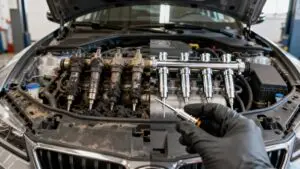





Your car is your business. For rideshare and delivery drivers, understanding what vehicle reliability means for gig income is not a bonus consideration. It is the foundation your earnings are built on. Most gig workers focus on how many hours they log or which platform pays best, but the real gap between a good month and a terrible one often lives in the engine bay. A breakdown does not just cost you a repair bill. It costs you every fare, every delivery, and every hour you are not on the road.
Table of Contents
- Key takeaways
- What vehicle reliability really means for gig drivers
- The real financial impact on your earnings
- Choosing the right vehicle for gig work
- Maintenance practices that protect your income
- Financial planning around your vehicle
- My take on reliability and gig income
- Keep your vehicle working as hard as you do
- FAQ
Key takeaways
| Point | Details |
|---|---|
| Reliability goes beyond age | A dependable vehicle means predictable costs, low repair frequency, and strong parts availability. |
| Downtime destroys income | Even one unplanned breakdown can erase days of earnings through lost revenue and emergency repair costs. |
| Total cost beats purchase price | A cheaper vehicle often costs more over time through repairs, depreciation, and lower fuel economy. |
| Maintenance prevents emergencies | Following scheduled service intervals cuts unplanned breakdowns by as much as 25%. |
| Tax strategy matters | Tracking mileage at the 2026 IRS rate of 72.5 cents per mile directly improves your net income. |
What vehicle reliability really means for gig drivers
Most drivers hear “reliable vehicle” and picture a car that simply starts in the morning. That is too narrow a definition, and it costs people money. For gig workers, vehicle reliability is a complex mix of dependability, maintenance frequency, parts availability, predictable ownership costs, and how the vehicle holds up under high-mileage commercial use.
Think about it this way: if your car needs a water pump replaced every 60,000 miles and that part costs $85 at any auto parts store, you can budget for it. If a newer vehicle needs a proprietary sensor that requires dealer-only programming and costs $900, your budget just took a hit you did not see coming. Predictability is the core of reliability for gig work.
Here is what reliability actually breaks down into for rideshare and delivery drivers:
- Dependability under high mileage: Gig vehicles often accumulate 30,000 to 50,000 miles per year. A vehicle needs to tolerate that pace without accelerating its failure timeline.
- Service interval manageability: Reliable vehicles have straightforward, affordable service schedules you can actually follow.
- Parts availability: Common makes and models have widely available parts, which means faster repairs and lower labor costs.
- Resale value retention: Vehicles with strong reliability track records hold their value, which matters when it is time to switch to your next gig car.
- Fuel economy consistency: Efficiency does not just save money at the pump. It reduces the gross-to-net income gap that quietly erodes your hourly rate.
Consumer Reports and J.D. Power measure reliability differently. Consumer Reports tracks owner-reported problems over time, giving you a long-term picture. J.D. Power’s Initial Quality Study focuses on the first 90 days of ownership. For gig workers who plan to drive a vehicle for three to five years under heavy use, Consumer Reports data is generally more useful. Both sources are worth consulting before you commit to a purchase.
The real financial impact on your earnings
Here is where the numbers get sobering. Maintenance costs surged 36.2% between 2019 and 2024, putting serious pressure on gig drivers who already operate on thin margins. That increase is not something you can outrun by working longer hours.
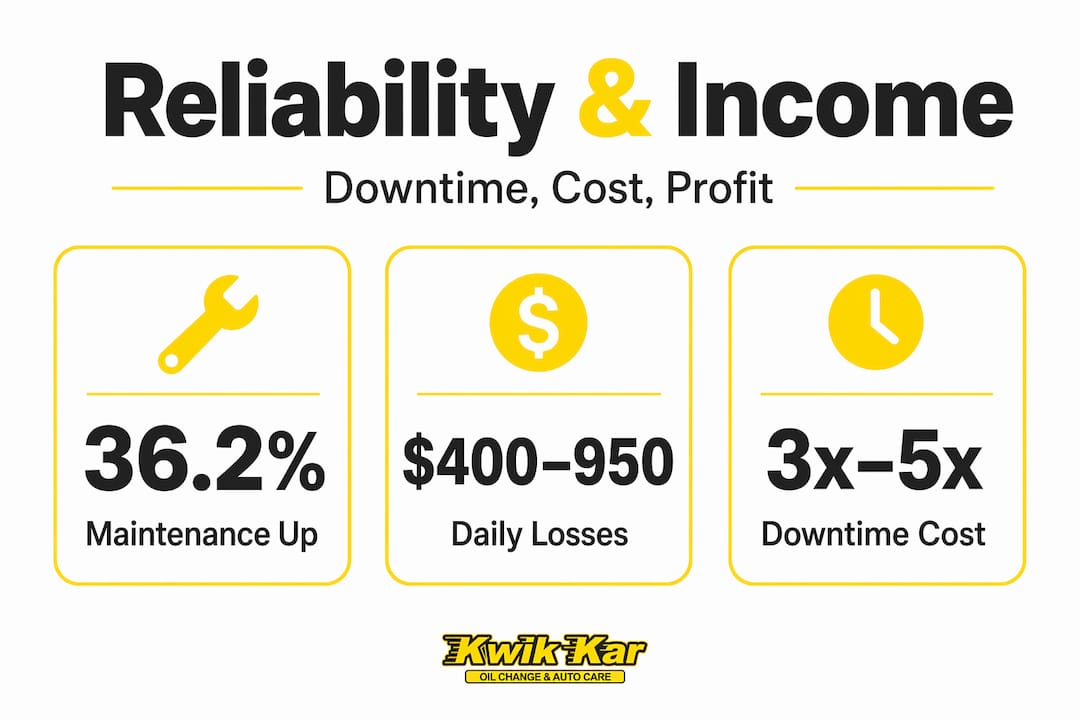
When your vehicle goes down unexpectedly, the vehicle reliability impact on income becomes immediate. Fleet downtime costs for light commercial vehicles run between $400 and $550 per day, and that figure can climb past $950 once you factor in overhead, emergency labor, and towing. Emergency towing alone runs between $350 and $1,800. Rush labor premiums add 25% to 60% on top of standard repair rates. One unplanned breakdown on a Friday night is not a minor inconvenience. It is potentially a week of net income gone.
Many gig drivers also fall into what financial experts call a gross versus net illusion. You see $1,200 on your weekly earnings summary and feel good. Then you subtract fuel, accelerated depreciation, insurance, and that transmission flush you put off for three months. The actual take-home number looks very different.
| Cost Category | Planned Maintenance | Unplanned Repair |
|---|---|---|
| Oil change | $60–$90 | N/A |
| Brake service | $150–$300 | $300–$600+ |
| Transmission service | $150–$250 | $1,500–$3,500+ |
| Towing | $0 | $350–$1,800 |
| Lost income (per day) | $0 | $400–$950+ |
The pattern is clear. Unplanned downtime costs three to five times more than scheduled maintenance. That ratio should shape every decision you make about your vehicle.
Accelerated depreciation compounds the problem. High-mileage gig use puts your vehicle’s value on a steeper decline than typical personal use. If you are not accounting for that in your income model, you are spending down an asset without realizing it.
Choosing the right vehicle for gig work
The best vehicles for gig economy use are rarely the flashiest or the most technologically advanced. The Toyota Camry Hybrid LE is a widely cited example for good reason. Drivers have reported 50 mpg efficiency with 240,000 miles logged without major mechanical issues. That kind of track record matters more than a premium sound system or a large touchscreen.
Modern high-tech components and complex systems increase the potential for expensive failures once a warranty expires. A vehicle loaded with advanced driver assistance systems and proprietary electronics can be impressive on a test drive. It becomes a liability when a sensor fails at 90,000 miles and the dealer is the only place that can fix it.
Choosing the right car based on total cost of ownership, not sticker price, is one of the highest-leverage decisions a gig driver can make. A vehicle that costs $4,000 more upfront but saves you $1,500 per year in repairs and fuel pays for itself in under three years, while you also benefit from higher resale value.
Here is a comparison of commonly recommended vehicles for gig drivers:
| Vehicle | Est. Annual Maintenance | Avg. Fuel Economy | Reliability Rating | Notes |
|---|---|---|---|---|
| Toyota Camry Hybrid | $500–$700 | 50 mpg | Excellent | Top pick for rideshare longevity |
| Honda Accord | $550–$800 | 32–38 mpg | Excellent | Strong parts availability |
| Toyota Corolla | $400–$650 | 32–38 mpg | Excellent | Lower purchase price |
| Hyundai Elantra | $500–$750 | 33–41 mpg | Good | Solid warranty coverage |
| Ford Fusion (used) | $700–$1,100 | 26–34 mpg | Fair | Watch for transmission history |
Pro Tip: Before buying a used vehicle for gig work, pull a full maintenance history report and have an independent mechanic do a pre-purchase inspection. A $150 inspection fee can save you from a $3,000 surprise within the first year.
When evaluating used vehicles, watch for deferred maintenance, high-mileage transmission wear, and models with known problematic components. A vehicle sold at a significant discount often carries a hidden cost that shows up at the worst possible time.
Maintenance practices that protect your income
Gig work income and vehicle performance are directly linked through one habit: consistent, scheduled maintenance. The Federal Highway Administration ties improved vehicle longevity to following service intervals, and the average American vehicle now reaches 12.6 years of age precisely because owners are more diligent about upkeep than in previous decades.
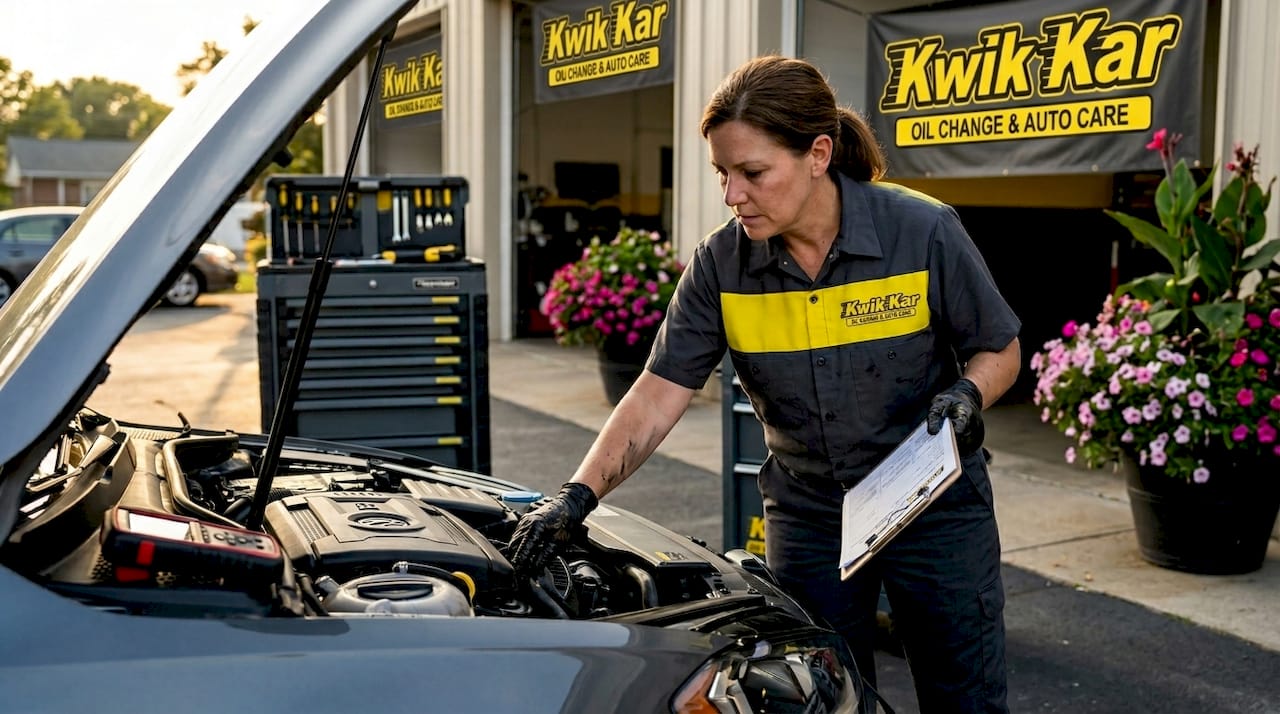
Preventive maintenance programs reduce unplanned breakdowns by 18% to 25%. For a gig driver, that is not an abstract statistic. That is potentially 18 to 25 fewer days per year when your car is out of commission.
Follow these steps to build a maintenance routine that protects your earnings:
- Track mileage precisely. Use your platform app or a dedicated mileage tracker. Tie service intervals to actual miles driven, not calendar months. Gig vehicles hit service thresholds much faster than typical personal vehicles.
- Prioritize oil changes. This is the single highest-return maintenance task. Review oil change basics to understand what the right interval looks like for your specific vehicle and driving conditions.
- Rotate tires on schedule. Uneven tire wear leads to premature replacement and can mask alignment issues that stress other components.
- Service brakes proactively. Replacing pads before rotors are scored costs roughly half what rotor replacement adds to the bill.
- Check transmission fluid regularly. Transmission failure is one of the most expensive repairs a gig driver can face. Fluid condition is your early warning system.
- Follow your maintenance by mileage schedule. High-mileage gig use means you hit service intervals faster than the calendar suggests.
Pro Tip: Find one trusted mechanic and stick with them. A shop that knows your vehicle’s history can spot developing problems before they become expensive emergencies. Use this guide to finding trustworthy mechanics to vet your options.
Preventive maintenance compliance combined with a trusted service relationship is one of the most effective ways to maintain vehicle uptime and protect income stability.
Financial planning around your vehicle
Smart gig workers treat their vehicle like a small business asset, not a personal expense. That mindset shift changes how you track, budget, and plan. Here are the financial disciplines that separate drivers who build consistent income from those who constantly feel squeezed:
- Use the IRS mileage rate correctly. The 2026 standard mileage rate is 72.5 cents per mile. That deduction is significant. Track every business mile without exception.
- Build a vehicle reserve fund. Set aside a fixed dollar amount per week specifically for maintenance and repairs. Even $30 to $50 per week creates a buffer that prevents one repair bill from derailing your finances.
- Evaluate insurance for commercial use. Personal auto insurance often does not cover commercial gig work. A lapse in coverage during a claim can be financially devastating.
- Separate financing costs from earnings. If you are making payments on your vehicle, those payments come out of your gross income. Factor them into your actual hourly rate calculation.
- Reassess total cost of ownership annually. As your vehicle ages and repair frequency increases, your cost model changes. Running the numbers once a year keeps your decision-making current.
44% of gig drivers cite maintenance costs as their top obstacle to profitability. That is not a coincidence. It reflects how many drivers are still reacting to vehicle problems rather than planning around them.
My take on reliability and gig income
I have seen this pattern more times than I can count. A driver comes in frustrated, having put off an oil change for two months because things were going well and they did not want to spend the time or money. Three weeks later, they are back with an engine issue that costs ten times what the oil change would have.
In my experience, the drivers who treat vehicle maintenance as a non-negotiable business expense are the ones who stay on the road longer, earn more consistently, and report far less financial stress. The ones who cut corners on maintenance are constantly in reactive mode. They are not driving their business forward. They are just trying to stop it from falling apart.
What most people miss is the psychological toll. Vehicle unreliability does not just cost money. It creates chronic uncertainty that affects how you work, how you plan, and how you feel about gig work in general. A car you can count on is not just a financial tool. It is peace of mind on four wheels.
My recommendation is simple: treat your vehicle like it pays your salary, because it does.
— Kwik Kar
Keep your vehicle working as hard as you do
At Kwik Kar Oil Change & Auto Care in Fort Worth, we work with gig drivers who need fast, thorough, and honest service without the runaround. We know your vehicle is your income, and we treat it accordingly.
Whether you need a quick oil change or tire rotation, a full inspection before a high-mileage season, or help understanding what your vehicle actually needs right now, our certified technicians give you straight answers and transparent pricing. Check out our guide on signs your car needs an oil change to stay ahead of the most common and costly oversight gig drivers make. Protecting your income starts with keeping your car on the road. We make that straightforward.
FAQ
What does vehicle reliability mean for gig income?
Vehicle reliability means how consistently your car performs without unexpected breakdowns or costly repairs. For gig workers, it directly determines how many paid hours you can work and how much of your gross income you actually keep.
How much income can a gig driver lose from vehicle downtime?
Daily downtime costs for light commercial vehicles range from $400 to $950 or more when lost revenue and emergency repair costs are combined. Even a single unplanned breakdown can erase several days of net earnings.
What are the best vehicles for gig economy drivers?
The Toyota Camry Hybrid, Honda Accord, and Toyota Corolla consistently rank as top choices due to their proven longevity, affordable maintenance costs, and strong fuel efficiency under high-mileage gig use.
How often should gig drivers service their vehicles?
Because gig vehicles accumulate miles much faster than personal vehicles, you should tie service intervals to mileage rather than calendar months. Oil changes, tire rotations, and brake inspections should be checked at every manufacturer-recommended mileage interval without delay.
Can vehicle maintenance costs be deducted from gig income taxes?
Yes. You can either deduct actual vehicle expenses or use the 2026 IRS standard mileage rate of 72.5 cents per mile. Tracking every business mile accurately is one of the most effective ways to reduce your tax liability as a gig worker.