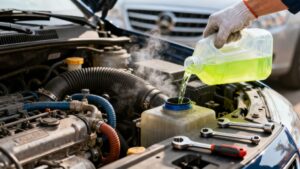
In the simplest terms, oil viscosity is just a measure of its thickness—or, more technically, its resistance to flow. The easiest way to picture it is to think about pouring water versus pouring honey. That difference in how they pour? That’s viscosity in action, and it's one of the most important properties protecting your engine from wearing out.
Your Quick Guide to Oil Viscosity
At its heart, oil viscosity is all about creating a protective cushion. Your engine is full of fast-moving metal parts, like pistons and bearings, that are constantly trying to grind against each other. The right oil creates a resilient film between them, preventing that from happening. Without this crucial lubricating barrier, your engine would quickly fall victim to friction, overheating, and catastrophic failure.
So, viscosity is just a number that tells you how thick or thin your motor oil is at different temperatures. A high-viscosity oil is thick and flows slowly, like honey, which gives it a strong, protective film. A low-viscosity oil is thin and flows fast, like water, which is better for fuel economy in a lot of modern engines. If you're curious about the industrial side of this, you can dig deeper into market trends with the High-Viscosity Lubricating Oil Market Report.
Protection in All Conditions
The real trick is finding an oil that’s thin enough to get everywhere it needs to go when your engine is cold, but stays thick enough to protect it once things heat up.
- Cold Starts: On a chilly morning, you need a thinner oil (lower viscosity). This allows it to circulate instantly and lubricate vital parts the second you turn the key.
- High Temperatures: When the engine is running hot, you need a thicker oil (higher viscosity). This ensures the protective film doesn’t thin out and break down under all that heat and pressure.
The right viscosity gives your engine the exact protection it needs, whether you're firing it up on a frosty morning or stuck in traffic on a hot summer day. It's the secret to both immediate performance and long-term engine health.
To give you a clearer picture, here’s a quick breakdown of how viscosity works for your engine.
Oil Viscosity at a Glance
| Viscosity Type | Flow Characteristic | Primary Benefit |
|---|---|---|
| Low Viscosity | Flows quickly, like water | Excellent for cold starts and fuel efficiency |
| High Viscosity | Flows slowly, like honey | Provides a thick, durable film under high heat |
Getting this balance right is the first step in picking the perfect product for your car. Different engines and climates have different needs, which is why you see so many options on the shelf. It’s also why understanding the different oil change types is so helpful, as viscosity plays a key role in every service. This foundation is exactly why those numbers on the oil bottle matter so much.
Decoding the Numbers on Your Oil Bottle
Ever stood in the auto parts aisle, staring at a wall of oil bottles and wondering what all those numbers—like 5W-30 or 10W-40—actually mean? It might look like a secret code, but it’s really a straightforward language developed by the Society of Automotive Engineers (SAE) to tell you exactly how an oil will protect your engine. Once you understand it, you'll know exactly what you're looking at.
Let’s break it down. The first number, the one with the 'W' next to it, is all about cold starts. A lot of people think the 'W' stands for 'Weight,' but it actually stands for Winter. This number tells you how well the oil flows on a frosty morning. A lower 'W' number, like the 5W in 5W-30, means the oil is thinner and moves more easily when it’s cold. This is critical for getting lubrication to vital engine parts right when you turn the key.
This quick-glance concept map shows the relationship between an oil's flow and its protective qualities.
As the infographic shows, thinner oil flows easily, while thicker oil creates a more durable film to protect engine components.
The Second Number Is All About Heat
Now for the second number in the pair—the '30' in 5W-30. This number tells you how the oil behaves once your engine is fully warmed up and running at its normal operating temperature, which can easily climb over 200°F. A higher number here means the oil will stay thicker and create a more robust, protective film under the intense heat and pressure of a running engine, which is exactly what you need to prevent metal parts from grinding against each other.
This is the genius behind modern multi-grade oils. They’re engineered with special additives that allow them to change their behavior with temperature. They act thin when the engine is cold for quick circulation and thick when the engine is hot for maximum protection. You get the best of both worlds in a single bottle.
A multi-grade oil like 5W-30 behaves like a 5-weight oil in winter conditions for easy startups and a 30-weight oil once the engine is hot, ensuring continuous protection. This adaptability is what keeps modern engines running smoothly in all seasons.
Think of it this way: a daily driver in a moderate climate might be perfectly happy with 5W-30. But if you have a truck that’s constantly towing heavy loads through a hot Texas summer, you might need a beefier oil like 10W-40 to handle that extra heat. The oil doesn't just lubricate; it adapts. Understanding what both numbers mean is one of the most important things you can do for your engine’s long-term health.
How Temperature Affects Your Oil's Performance

Think about motor oil’s job on a freezing winter morning versus a blistering summer day. Temperature is the single biggest thing that changes how your oil behaves inside the engine.
All conventional oils get thinner as they heat up and thicker as they get cold—it’s just their nature. The problem is, your engine needs the complete opposite. For a smooth, low-friction startup, you want thinner oil that flows easily. But once the engine is running at over 200°F, you need a thicker oil to create a strong, protective film. This is where modern oil science really shines.
The Role of the Viscosity Index
This is where we talk about the Viscosity Index (VI). It’s a simple number that tells you how much an oil’s thickness changes when the temperature swings. Think of it as a measure of stability. An oil with a high VI holds its ground, refusing to get too thin when hot or too thick when cold.
That stability is non-negotiable for engine health. If your oil thins out too much under high heat, its protective film can shear apart, allowing metal parts to grind against each other. That friction leads to rapid wear, damaged components, and in the worst cases, total engine failure.
A high Viscosity Index (VI) is your engine’s best friend. It signals that the oil will maintain a consistent, protective thickness, ensuring reliable lubrication whether you’re starting up in freezing cold or driving hard in intense heat.
So, how do oil manufacturers get an oil to perform so consistently? The magic is in the additives.
Unlocking Stability with Viscosity Index Improvers
To create the multi-grade oils we rely on today, engineers add something called Viscosity Index Improvers. These are sophisticated polymer additives that expand as the oil gets hotter, perfectly counteracting its natural tendency to thin out.
When the oil is cold, these polymers stay coiled up and don’t do much, letting the oil flow freely for cold starts. As your engine heats up, they uncoil and expand, which boosts the oil’s viscosity right when you need it most. This clever technology is what allows a 5W-30 oil to act like a thin 5-weight oil in the winter but a tough 30-weight oil under heat.
This technology is a pretty big deal. The global market for these improvers is expected to grow from USD 243.79 million in 2026 to USD 421.39 million by 2035, all because modern engines need to be more efficient and durable. This is especially true in areas with wild temperature swings, where an engine can easily top 250°F. You can learn more about the market for these powerful additives and see just how vital they are. This stability is the key to balancing protection with another critical factor: fuel economy.
Finding the Balance Between Protection and Efficiency
Choosing the right motor oil is a careful balancing act. Think of it as finding that sweet spot between bulletproof engine protection and getting the best possible fuel efficiency. The right oil viscosity creates a strong, slick film that cushions all those moving parts, preventing metal-on-metal grinding and helping your engine live a long, healthy life.
But there’s a catch. Modern engines are built for efficiency, often with incredibly tight tolerances between internal components. These newer engines are specifically designed to use thinner, lower-viscosity oils, like a 0W-20 or 5W-20. A thinner oil flows more easily, which reduces internal drag and frees up power that would otherwise be wasted just pushing thick lubricant around.
The Risk of Using the Wrong Viscosity
This is where picking the right oil gets really important. Using an oil that’s too thin for your engine’s design is a recipe for trouble. If the oil doesn’t have enough thickness, its protective film can break down under heat and pressure, leading to rapid wear. This is a big risk for older or high-mileage engines, which often have larger gaps between parts from normal use.
On the other hand, pouring in an oil that’s too thick brings its own set of headaches.
- Reduced Fuel Economy: A thicker-than-needed oil creates more friction, making your engine work harder. That extra effort shows up as lower miles per gallon (MPG).
- Sluggish Performance: Your car might feel less responsive, especially on cold mornings when thick oil struggles to get flowing.
- Increased Engine Strain: In a worst-case scenario, an overly thick oil can starve critical parts of lubrication right after you start the car, causing premature wear over time.
To get a clearer picture, it helps to see how these choices directly affect your engine.
Viscosity's Impact on Engine Performance
| Viscosity Choice | Engine Protection | Fuel Economy | Best For |
|---|---|---|---|
| Correct Viscosity | Excellent; creates a strong, stable film for your engine's design. | Optimal; balances protection with minimal internal drag. | The specific engine it was designed for; check your owner's manual. |
| Too-Low Viscosity | Poor; film can break down under heat, causing metal-on-metal wear. | Slightly higher; less drag, but at a high cost to engine health. | No engine; this leads to premature wear and potential failure. |
| Too-High Viscosity | Good, but can starve parts at startup; may not flow into tight spaces. | Lower; increased friction forces the engine to work harder. | Certain high-performance or older, high-mileage engines with specific needs. |
As you can see, the manufacturer's recommendation isn't just a suggestion—it's a critical part of your engine's engineering.
The goal is to match the oil’s properties to your engine’s specific needs. A thinner oil boosts efficiency in a modern engine, while a slightly thicker oil provides the robust protection an older or harder-working engine demands.
Aligning Oil with Engine Design
Ultimately, the viscosity your car's manufacturer recommends is an integral part of the engine’s design. Automakers spend millions on research to pinpoint the exact oil that gives their engines the perfect blend of protection and performance.
While upgrading to a high-quality synthetic oil can offer huge benefits, the viscosity grade always comes first. You can learn more about how a synthetic oil change service can improve your car’s performance, but you have to start with the right numbers. Matching the oil to your engine ensures you get the best of both worlds: a well-protected engine that runs as efficiently as the day it left the factory.
How to Choose the Right Oil Viscosity for Your Car
Alright, now that we've broken down what oil viscosity is, let's get practical. Choosing the right oil isn't just a random guess—it’s one of the most important decisions you can make for your engine’s health and performance. The good news is, it's a pretty straightforward process.
Your first and most important stop should always be your vehicle's owner's manual. Car manufacturers invest a ton of time and money to pinpoint the exact oil viscosity that gives your specific engine the best balance of protection and fuel efficiency. This recommendation is the golden rule.
Always Start with Your Owner’s Manual
Inside that manual, you'll find the recommended grade, like 5W-30. Sometimes, it might give you a couple of approved options. Following this advice is the best way to make sure your engine gets the lubrication it was engineered for, which also helps protect your warranty and prevent extra wear and tear.
Think of the owner's manual as the official prescription for a long and healthy engine life. But the manufacturer's word is just the baseline. A few other factors can help you zero in on the perfect choice, especially if you have a range of viscosities to choose from.
The single most important step is to check your owner's manual. The manufacturer’s recommended oil viscosity is engineered for your specific engine and provides the best starting point for protection and performance.
Consider Your Climate and Driving Style
Where you live and how you drive have a huge impact on how your oil performs. The viscosity you pick should match what your car actually goes through day-to-day.
- Climate: If you’re dealing with frigid winters, a lower "W" number (like 0W-20 or 5W-20) is your best friend. It helps the engine turn over easily on cold mornings. On the flip side, if you live somewhere with blistering heat, a slightly thicker oil at operating temperature (say, a 10W-30 over a 5W-20, if both are approved) can offer a more durable layer of protection.
- Driving Habits: Are most of your drives short, stop-and-go trips around town? That’s actually tough on an engine because the oil might not get hot enough to do its job properly. On the other hand, heavy towing or performance driving creates a ton of heat. If you push your vehicle hard, a slightly thicker oil (within the approved range) can give you an extra cushion of defense.
Adjusting for High-Mileage Engines
Once an engine rolls past the 75,000-mile mark, some natural wear and tear is expected. Tiny gaps can start to form between internal parts, like the piston rings and cylinder walls. When this happens, the standard, thinner oil might not be enough to create a strong, protective film.
This is exactly why high-mileage oils are often a bit thicker. An oil like a 10W-30 instead of a 5W-30 can do a better job of filling in those gaps. This simple switch can help reduce oil burning, slow down minor leaks, and even restore a bit of lost compression.
We dive deeper into this topic in our guide to the best oil for high mileage engines.
Spotting the Warning Signs of Incorrect Oil Viscosity
Using the wrong oil viscosity is more than a simple mix-up—it can trigger some pretty obvious performance problems and, if left unchecked, lead to some seriously expensive engine damage. The good news is your car will usually give you a heads-up when its lubricant isn’t up to the task. If you know what to listen and look for, you can catch the issue long before it turns into a major repair bill.
So, what happens when the oil is just not the right thickness for the job? Well, if it’s too thin, it just can't create that tough, protective film your engine's moving parts rely on. This is where you’ll start to see some clear warning signs.
Signs Your Oil Is Too Thin
When oil doesn't have enough viscosity, it thins out even more under heat and pressure, essentially leaving your engine’s metal components exposed. You might start to notice a few things:
- Engine Knocking or Ticking Noises: Without that crucial cushion of oil, you’ll start to hear that dreaded metal-on-metal sound. It often shows up as a distinct tapping or knocking from components like lifters and rods.
- Increased Oil Consumption: Thin oil is slippery stuff, and it can more easily sneak past your piston rings and get burned up with the fuel. If you find yourself topping off your oil more often than usual, this could be the reason.
- Low Oil Pressure Warning: That little oil light on your dash might start to flicker, especially once the engine is fully warmed up. This is a classic sign the oil is too thin to maintain the pressure your engine needs.
On the flip side, running an oil that’s too thick brings its own set of headaches.
One of the first things you'll often notice with the wrong oil is a change in engine noise. If you suddenly hear new ticking, knocking, or just a louder mechanical hum, it’s a good sign the oil film isn't doing its job.
Signs Your Oil Is Too Thick
An oil that’s too heavy is like molasses in winter—it struggles to get flowing. This can deprive critical parts of lubrication, especially during those crucial first few moments after you start the car. Be on the lookout for these symptoms:
- Difficult Cold Starts: On a chilly morning, your engine might crank over really slowly or feel like it’s fighting to start. That’s because the starter motor is battling the drag from the thick, cold oil.
- Reduced Fuel Economy: Your engine has to work a lot harder just to pump that heavy oil through its narrow passages. All that extra work burns more fuel, causing your gas mileage to take a hit.
- Sluggish Performance: The car might feel unresponsive or just plain lazy. That increased internal friction from the thick oil robs your engine of power, making it feel sluggish.
If any of these signs sound familiar, don’t just brush them off. While there are legitimate reasons to switch viscosity for your climate or a high-mileage engine, it’s never a good idea to guess. When you’re not 100% sure, your best bet is to get some professional advice from a trusted technician at your local oil change shop.
Frequently Asked Questions About Oil Viscosity
Even after we've broken down the science, you might still have a few questions floating around about what oil viscosity really means for your car. That's perfectly normal. Let's clear up some of the most common points of confusion to help you feel confident when it's time for an oil change.
Can I Use an Oil Viscosity Not Listed in My Manual?
The simple answer is that it's a bad idea. Your car’s manufacturer spent millions on research and development to pinpoint the perfect oil viscosity for your specific engine. When you stray from their recommendation, you risk everything from poor lubrication and lower fuel economy to long-term engine wear.
That said, many owner's manuals will give you a small range of approved viscosities, like 5W-20 or 5W-30. If that's the case, you have some flexibility based on your driving conditions. You might opt for the lower "W" number for easier cold starts in winter or the higher number for extra protection in extreme heat, as long as both are manufacturer-approved.
When in doubt, always treat your owner’s manual as the final authority on oil. Sticking to what the manufacturer recommends is the surest way to keep your engine running just as it was designed to.
What Happens if I Accidentally Mix Different Oil Weights?
Mixing different oil weights isn't the end of the world, but you'll want to correct it. It’s definitely not a catastrophe if it’s just for a short time. For instance, if you top off a 5W-30 engine with a quart of 5W-20, you’ve basically created a new, custom blend with a slightly thinner viscosity than recommended.
While this won't cause your engine to seize up overnight, the new, altered viscosity just can't provide the precise level of protection your engine needs. The best thing to do is schedule a full oil change with the correct viscosity as soon as you can. This will restore the proper lubrication and get things back to normal.
Do High-Mileage Cars Really Need Thicker Oil?
In many cases, yes. Once an engine ticks past the 75,000-mile mark, the constant friction can create tiny, microscopic gaps between parts like the piston rings and cylinder walls. A slightly thicker oil, maybe a 10W-30 instead of a 5W-20, does a much better job of filling those gaps.
This simple switch helps in a few important ways:
- It cuts down on oil consumption, since thicker oil is less likely to slip past the rings and burn off.
- It improves compression, which can restore a little bit of that lost engine performance.
- It helps minimize small leaks from older, hardening seals and gaskets.
Moving to a high-mileage formula with a slightly higher viscosity is a common and effective trick of the trade to help an older engine run stronger for longer.
If you're still on the fence about which oil is right for your car, don't just guess. The certified technicians at Kwik Kar Oil Change and Auto Care can look at your vehicle, consider your driving habits, and help you choose the perfect oil for your engine's needs. Stop by our Fort Worth shop or schedule your appointment online for expert service you can trust.