




European oil standards are performance rules written by European carmakers and their trade group, ACEA, and they work differently from the API ratings you see on most American oil bottles. If you drive a BMW, Mercedes-Benz, Audi, Volkswagen or Volvo, the right oil is the one that meets the approval named in your owner’s manual. Matching the viscosity number alone is not enough.
This guide explains how to read ACEA codes, what BMW Longlife-01 means, and what to check before you buy oil labeled “Euro.” We service European vehicles at Kwik Kar Oil Change & Auto Care at 9613 White Settlement Rd, Fort Worth, TX 76108, so these are questions we hear at the counter.
TL;DR
- ACEA sets European minimum performance sequences, and carmakers add their own approvals (BMW Longlife, VW, Mercedes-Benz and others) on top of them.
- API ratings and ACEA ratings are different systems. Neither one replaces the approval your manual calls for.
- BMW Longlife-01 is a long-established BMW approval for gasoline engines. Longlife-04 is a different oil built for diesel particulate filters.
- Viscosity (like 5W-30 or 0W-40) is only one line on the requirements list. The approval or ACEA class matters just as much.
- Your owner’s manual is the final word. If a label is vague, ask before the oil goes in.
Table of Contents
- What are European engine oil standards?
- How do ACEA standards differ from API standards?
- How do you read an ACEA code?
- What does BMW Longlife-01 mean?
- Can you use European-spec oil in a U.S.-spec vehicle?
- Why approval beats viscosity
- What this means for Fort Worth driving
- Our perspective on European oil
- What a proper oil service on a European car includes
- Book your European car in for an oil service
- A quick checklist before you buy oil
- FAQ
- Sources
What are European engine oil standards?
There are two layers. The first is the ACEA oil sequences, published by the European Automobile Manufacturers’ Association. The second is the individual approvals each carmaker issues for its own engines.
ACEA’s sequences define the minimum quality level of an oil, and the association leaves specific applications to the vehicle manufacturer. In other words, ACEA says what a category of oil must do. Your carmaker says which category your engine needs.
One detail surprises many owners: ACEA does not certify oils. Marketers self-declare that their products conform under a voluntary European quality management system, and there is no central public registry of compliant oils. A carmaker approval is a stricter thing. The oil is tested to that manufacturer’s protocol, and if it passes, the manufacturer issues an approval. That is a different achievement from simply meeting an ACEA sequence.
How do ACEA standards differ from API standards?
API ratings are the ones most American drivers know: SP for newer gasoline engines, CK-4 for modern diesel. Industry reporting describes API SP as recommended for vehicles built after 2020 and CK-4 for vehicles built after 2017.
ACEA specifications come from the carmakers themselves. The same report says they are more specific and detailed than API specifications, put more weight on emissions and fuel economy, and tend to be updated more often. European engines also tend to run tighter tolerances, turbochargers and long drain intervals, which is why those oils are written around them.
| API (U.S.) | ACEA (Europe) | |
|---|---|---|
| Who writes it | Industry standards program | European vehicle manufacturers’ association |
| Typical label | API SP, API CK-4 | A3/B4, C3, E-series |
| Focus | Broad coverage across many engine types | Engine type, emissions systems, fuel economy |
| Update pace | Periodic | Generally more frequent |
| Carmaker approval needed on top? | Sometimes | Often, for European brands |
A bottle can carry both an API rating and an ACEA claim. That is common on oils sold in the U.S. for European cars.
How do you read an ACEA code?
An ACEA code is a letter plus a number. The letter identifies the class, and the number identifies the category inside that class.
- A/B: gasoline and light-duty diesel engines. You will see them paired, such as A3/B4.
- C: oils for engines with exhaust aftertreatment, such as diesel particulate filters, and some gasoline engines with catalysts.
- E: heavy-duty diesel engines. These matter to commercial trucks, not to passenger cars.
The categories are not interchangeable. According to one oil manufacturer’s technical page, the classes are not backward-compatible, and industry guidance has stopped A/B specifications from being advertised alongside C specifications because the formulations differ so much. If your manual calls for a C-class oil, an A3/B4 oil is not a stand-in.
What is the difference between ACEA C1 and C3?
This is one of the most-asked questions on the topic. C1 is a low-ash category, and C3 is a mid-ash category. Both are designed for engines with exhaust aftertreatment systems. The C1 to C6 range is tailored around the sulfated ash, phosphorus and sulfur levels (often called SAPS) that a particulate filter or catalyst can tolerate.
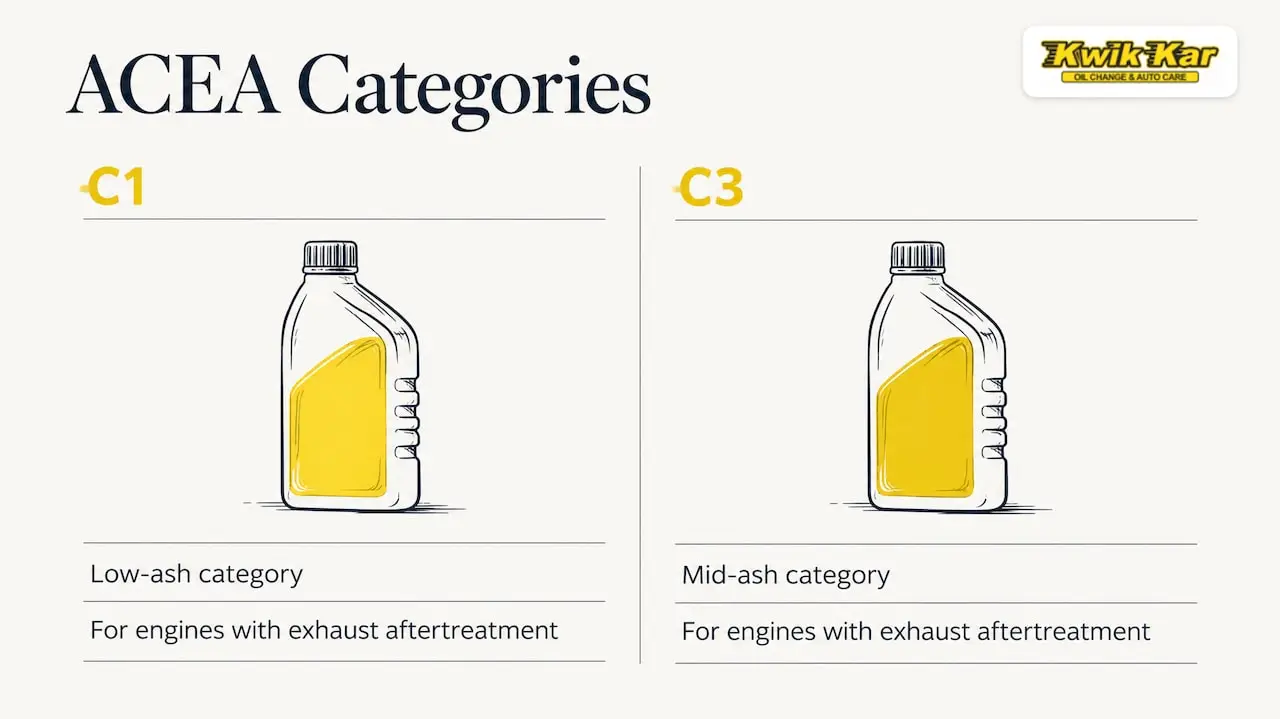
The practical point: ash left behind when oil burns can clog a particulate filter over time. That is why a carmaker picks one category and sticks with it. If your manual says C3, buy C3. Do not move to C1 or an A/B oil because the price is better.
What does BMW Longlife-01 mean?
BMW Longlife-01 is a BMW engine oil approval, usually written LL-01. It is the answer most people are after when they search for it. BMW’s technical guidance says LL-01 oils are comparable in quality to Longlife-04 and Longlife-01 FE oils and can be used in most BMW engines. It is a gasoline-engine approval first and foremost.
A few points to keep straight:
- LL-01 is not LL-04. Longlife-04 was developed to protect diesel particulate filters and is stipulated for all diesel engines with one. The same BMW document says LL-04 oils must not be used in BMW spark-ignition engines outside Europe, which includes the United States.
- Newer cars may call for something else. For 2026 model year BMWs in the U.S., BMW tells owners to refer to the owner’s manual for the recommended oil, since the cars leave the factory with BMW-approved fully synthetic oil. Newer approvals exist, so do not assume LL-01 fits a recent car.
- Viscosity is not the whole story. BMW says its longlife oils are tested for use anywhere in the world regardless of ambient temperature, so viscosity generally does not need to be checked, with one narrow exception for certain older engines in extreme cold. The approval is the thing to match.
If you drive a BMW and want to know what an oil service looks like here, our BMW oil change guide for Fort Worth walks through it.
Can you use European-spec oil in a U.S.-spec vehicle?
Sometimes, yes, but the word “Euro” on a label does not settle it. Treat it as a question with a checklist, not a yes or no.
The oil has to satisfy what your manual lists for your exact engine. For most American-market cars, that means the API rating and viscosity. For many European brands sold here, it also means a carmaker approval. An oil sold as a “European formula” may carry the approval you need, or it may only carry an ACEA claim that nobody has independently verified.
Before you buy, check four things:
- The owner’s manual. Find the oil section and write down the viscosity, the API rating and any named approval (for example BMW Longlife-01, VW 504 00, or MB-Approval 229.5).
- The bottle’s back label. Look for that exact approval name. “Suitable for” or “meets the requirements of” wording is a description. A listed approval is a statement that the oil was approved.
- The engine type. Gasoline, diesel and diesel with a particulate filter call for different categories. A diesel-filter oil in a gasoline engine can be wrong even when the brand is premium.
- The market. Clearance oil labeled for another region may be built to that region’s rules. If the label is unclear, skip it.
Our general guide, What Oil Do I Put in My Car?, covers how to read the manual and the oil cap.

Why approval beats viscosity
A 5W-30 from one maker and a 5W-30 from another can behave quite differently under the hood. Viscosity tells you how thick the oil is at cold and hot temperatures. It says nothing about detergent package, ash level or how the oil holds up in a turbocharged direct-injection engine.
The approval process is where those differences get tested. The Lubrizol white paper above notes that OEM approval means an oil formulation was tested to the maker’s own protocol at independent labs. That is why we treat viscosity as step one and approval as step two.
This matters for the way European engines are built. Many run oil that has to protect turbochargers, variable valve timing and emissions hardware at the same time. The wrong formulation may not show a problem the same week. It can show up later as sludge, a clogged filter or extra wear.
What this means for Fort Worth driving
Fort Worth gives oil a real workout. Long summer afternoons, heavy stop-and-go traffic on I-30 and Loop 820, and highway runs out toward Weatherford, Benbrook or Lake Worth all put heat into the engine. Short trips around White Settlement, Westover Hills and River Oaks add a different stress: the engine does not always get hot enough to burn moisture and fuel out of the oil.
None of that changes the oil your manual calls for. It does change how seriously you should take your maintenance schedule. If your driving looks like heavy stop-and-go, lots of short hops, towing or long road trips, check whether your manual lists a “severe” or “special operating conditions” schedule and follow it. We do not publish one universal interval, because the right one depends on your vehicle and your manufacturer’s guidance.
If you also want to know how filters fit in, our guide to oil filter types and fitment explains why the filter matters as much as the oil on European engines.
Our perspective on European oil
We see the same mix-up every week: a driver picks an oil by viscosity and brand loyalty, and the engine actually wanted a specific approval.
Our approach is simple. We start with your manufacturer’s requirement, not with whatever is on the shelf. Our ASE-certified technicians check the manual’s oil specification for your exact engine, and we use professional diagnostic equipment and digital vehicle inspections so you can see what we see.
European vehicles reward careful work. Oil, filters, coolant and the right tools all matter together, which is why we put them in the same conversation. We are a full-service repair center, not only an oil change stop. If an oil service turns up something bigger, we can handle that under the same roof, and qualifying repairs carry our 24-month/24,000-mile warranty.
Kwik Kar is RepairPal certified and CARFAX Top-Rated, and we say so because that standard is the one we hold ourselves to on every vehicle.
Kwik Kar
What a proper oil service on a European car includes
When you bring in a BMW, Audi, Volkswagen, Mercedes-Benz or Volvo, a thorough service goes beyond draining and refilling. Here is what we look at:
- Confirming the specification. We match the oil to the manual and the approval it names.
- The right filter. Filter fitment varies a lot across European models, and a poor fit can mean leaks or poor filtration.
- Oil level and condition. Some European engines consume a little oil between changes. Our Audi oil consumption guide explains when that is worth investigating.
- A visual inspection. A digital vehicle inspection covers fluids, belts, hoses, brakes and tires, with photos you can review.
- Coolant check. European cars use specific coolant types, and mixing them is a bad idea. See our European coolant types guide.
There is also the tooling side. Many European cars need brand-specific tools and software for resets and diagnostics, which we cover in why European vehicles need specialized tools.
Book your European car in for an oil service
We service European and domestic vehicles at 9613 White Settlement Rd in Fort Worth, serving drivers across White Settlement, West Fort Worth, Westworth Village, Westover Hills, River Oaks, Lake Worth and Benbrook. We have one location, on White Settlement Road.
Bring your owner’s manual if you have it, or tell us the year and model and we will look up the requirement. You can see everything we do on our services page, including preventative maintenance such as filter replacement and fluid exchanges, or schedule a visit online.
Prices are not published on our site, so ask for an estimate when you book and we will explain what is included.
A quick checklist before you buy oil
Use this when you are standing in the aisle or comparing options online:
- Read the manual’s oil section and write down viscosity, API rating and any named approval.
- Find that approval name on the bottle. If it is not listed, the oil is not shown to carry it.
- Confirm gasoline versus diesel, and whether a particulate filter is involved.
- Be cautious about clearance or imported oil with unclear labeling.
- Keep the receipt and note the date and mileage, so your service record is clean.
If any step leaves you unsure, a quick call or visit is cheaper than a wrong fill. We would rather answer a question than see an engine run on the wrong oil.
FAQ
What does ACEA stand for, and does it certify oil?
ACEA is the European Automobile Manufacturers’ Association. It publishes performance sequences that define minimum oil quality, but it does not certify or stamp individual oils. Marketers declare their own conformity, so a carmaker approval on the label is the stronger signal.
Is BMW Longlife-01 the same as Longlife-04?
No. Longlife-01 is a general approval used in most BMW gasoline engines. Longlife-04 was developed for diesel engines with particulate filters, and BMW says it must not be used in its spark-ignition engines outside Europe. Always follow your manual.
Can I use an oil that meets only ACEA A3/B4 if my manual says C3?
No. ACEA classes are not backward-compatible, and C-class oils are formulated for exhaust aftertreatment systems with specific ash limits. Use the category your manual names.
Is oil labeled “Euro” safe for my U.S. car?
It can be, but only if it matches the viscosity, API rating and any carmaker approval in your manual. The word “Euro” alone does not tell you that. Check the back label for the exact approval name.
Sources
- ACEA Oil Sequences, General Requirements
- The Important Differences in Oil Specifications: European Versus Domestic (MOTOR)
- The Importance of Testing and OEM Approval (Lubrizol)
- Classifications and Specifications (LIQUI MOLY)
- BMW Oil Specs and Recommendations
- BMW Model Year 2026 Maintenance (BMW USA)