



Most modern cars use a full-flow filter, either a spin-on canister or a cartridge insert, and that choice comes down to your engine’s design, not personal preference. Magnetic and centrifugal filters serve specialized or heavy-duty roles. For daily driving, check your owner’s manual for the correct fit first, then match media and micron rating to your oil type and driving habits.
TL;DR:
- Proper fitment according to your owner’s manual remains the most critical factor when selecting an oil filter, regardless of media quality.
- Combining a quality full-flow filter with a bypass filter can significantly reduce engine wear and extend oil life, especially in demanding conditions.
- Synthetic and microglass media filters offer higher efficiency and dust-holding capacity, ideal for extended oil change intervals and dusty environments.
- Regular replacement at every oil change, along with proper disposal, is essential to prevent environmental contamination and maintain engine protection.
- Professional service ensures correct filter fitment, proper disposal, and is recommended for complex engine designs or when warranty conditions apply.
Table of Contents
- 1. Types of oil filters and what each does
- 2. How oil filters actually work
- 3. Full-flow vs bypass filtration and why the combination matters
- 4. Filter materials and construction quality
- 5. How to choose the right oil filter for your car
- 6. Maintenance, replacement intervals, and disposal
- 7. When professional filter service makes sense
- Book your next oil change and filter service with Kwik Kar
- Sources
- FAQ
1. Types of oil filters and what each does
Every oil filter aims to catch contaminants before they scratch bearings or clog oil passages, but the designs differ enough that swapping one type for another isn’t always straightforward.
Spin-on filters are the one-piece canister most drivers picture when they think of an oil filter. The filter media, seals, and housing come as a single sealed unit, so replacement means unscrewing the old can and threading on a new one. They dominate the passenger car market because they’re quick to install and rarely leak if hand-tightened correctly.
Cartridge filters trade the metal can for a plastic or steel housing that’s permanently mounted on the engine. You only replace the filter element inside, along with its O-ring seals. Many newer vehicle designs and several European models use cartridges partly because they produce less waste metal and partly for packaging reasons under the hood.
Magnetic filters add a magnet to the housing or a magnetic drain plug that attracts ferrous metal particles, which is useful on engines already showing above-normal wear or metal contamination in the oil.
Centrifugal filters spin the oil at high speed to fling out heavier particles, a method more common in heavy-duty diesel and specialty industrial systems than in everyday passenger cars.
High-efficiency or premium variants exist within both the spin-on and cartridge categories. They use finer media and hold more debris before clogging, which can matter if you’re planning extended oil change intervals.
- Spin-on: single-unit canister, fast to swap, standard on most gasoline engines.
- Cartridge: replaceable element only, common on newer and European designs.
- Magnetic: adds ferrous-particle capture, useful for engines with known wear issues.
- Centrifugal: spins out heavier contaminants, typically found in heavy-duty applications.
2. How oil filters actually work
Oil filters rely on mechanical trapping: oil pushes through a pleated media, and particles larger than the media’s openings get caught while clean oil passes through. Surface filtration catches debris on the media’s outer layer, while depth filtration traps particles throughout the material’s thickness, which generally holds more dirt before it needs changing.
Micron rating describes the smallest particle size the filter can reliably catch, but a lower number alone doesn’t make a filter better. Efficiency (what percentage of particles at that size actually get captured) and dust-holding capacity (how much debris the filter can hold before oil flow suffers) matter just as much.
Common media includes cellulose (paper), synthetic fibers, and microglass blends, each behaving differently under heat and pressure. Anti-drainback valves keep oil in the filter when the engine shuts off, preventing a dry start, while a built-in bypass valve lets oil flow around a clogged filter rather than starving the engine.
3. Full-flow vs bypass filtration and why the combination matters
Full-flow filtration means every drop of oil the pump moves passes through the filter before reaching the engine’s bearings, which is why full-flow filters use a coarser media that won’t restrict flow or starve oil pressure. Bypass, or secondary, filtration diverts a smaller portion of oil through a much finer filter that polishes out soot and fine particles a full-flow filter would let through.
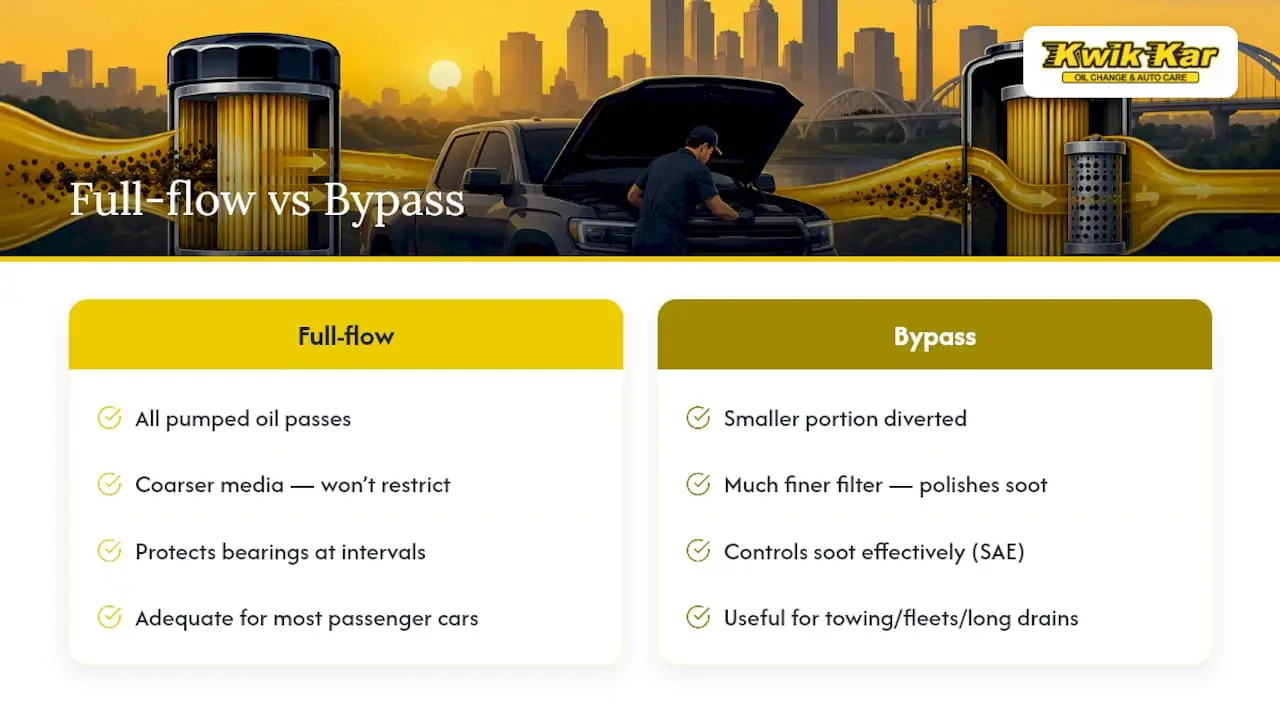
Research from SAE found that bypass filters are particularly effective at controlling soot, one of the main factors that limits how long oil stays usable. A separate SAE study found that pairing a quality full-flow filter with an effective bypass filter reduced engine wear and extended oil and filter life compared to full-flow filtration alone in the tested configurations.
For most passenger vehicles, a properly sized full-flow filter provides adequate protection on manufacturer-recommended intervals. Bypass systems tend to make more sense for heavy towing, fleet vehicles, or drivers deliberately extending drain intervals.
4. Filter materials and construction quality
Cellulose, or paper, media is the traditional standard: it’s affordable and does the job for typical oil change intervals. Synthetic and microglass media cost more but offer higher efficiency and greater dust-holding capacity, which pays off when you’re running synthetic oil on a longer drain schedule or driving in dusty, stop-and-go conditions.
Beyond the media itself, construction details decide whether a filter holds up. Seal quality, a functioning anti-drainback valve, a properly calibrated bypass valve, and a sturdy canister or cap all affect reliability over the filter’s service life. If you’re already choosing a full synthetic oil for extended intervals, pairing it with a higher-efficiency filter makes that extra mileage worth trusting.
5. How to choose the right oil filter for your car
Fit comes before everything else. A filter that’s technically “better” but doesn’t match your engine’s thread size, gasket dimensions, or built-in bypass pressure setting can cause leaks or oil starvation.
- Start with your owner’s manual to confirm the exact filter specification your manufacturer requires.
- Match thread size, gasket, and bypass valve settings before comparing anything else.
- Choose a reputable brand or OEM-equivalent filter once fitment is confirmed.
- Compare micron rating and efficiency only after the first three boxes are checked.
- Factor in your driving conditions: frequent towing, short city trips, or dusty roads all favor higher-efficiency media or shorter intervals.
Standard OEM-equivalent filters are perfectly adequate for typical commuting on manufacturer-recommended intervals. Premium, higher-efficiency filters earn their price when you’re running synthetic oil on extended intervals, towing regularly, or driving in harsh conditions where contamination builds faster. For a deeper look at how oil type interacts with filter choice, our guide to oil for high mileage engines walks through that pairing in more detail.
Pro Tip: Keep your old filter’s part number handy. It’s the fastest way to confirm you’re buying an exact match instead of guessing from a generic fitment chart.
6. Maintenance, replacement intervals, and disposal
Most vehicles need a new filter at every oil change, though your owner’s manual sets the official interval. If you handle it yourself, our DIY oil and filter change guide walks through using the correct wrench, draining trapped oil fully, and hand-tightening the new filter to the torque your manufacturer specifies rather than over-tightening.
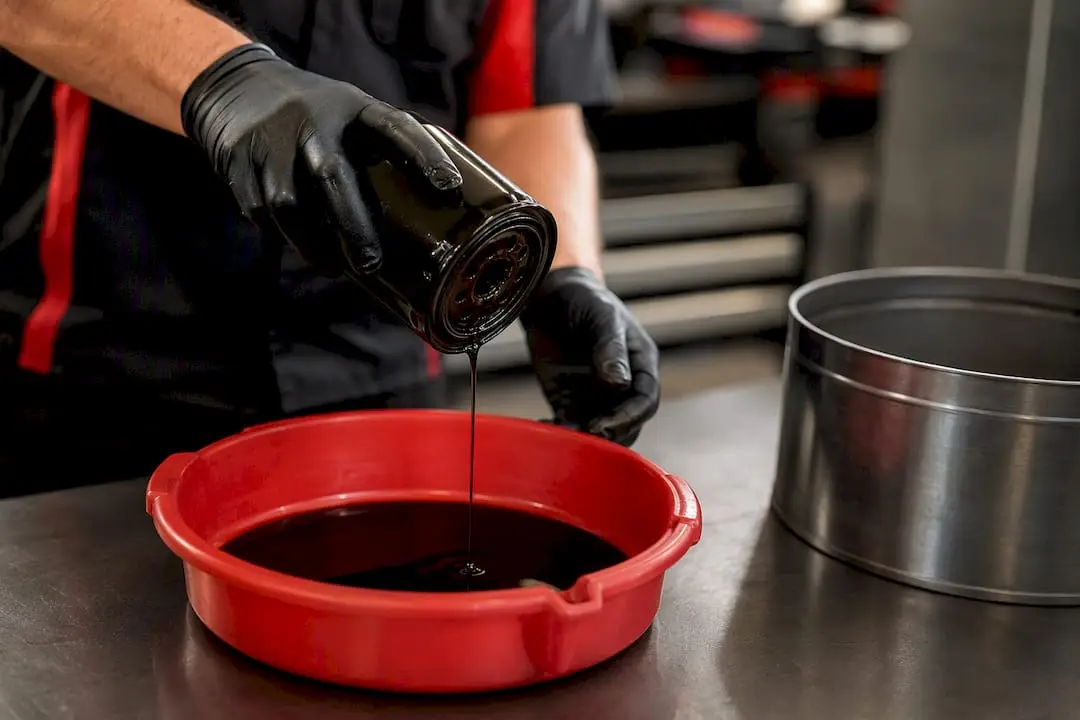
Used oil is a genuine environmental hazard. The EPA notes that a single quart of used oil can contaminate up to one million gallons of fresh water, which is why proper draining and recycling matter. EPA consumer guidance recommends puncturing the filter’s dome or anti-drainback valve and draining it for up to 12 hours at warm temperatures before recycling, since that recovers oil that would otherwise sit trapped inside. Many auto parts stores and local recycling centers accept both used oil and drained filters at no charge.
7. When professional filter service makes sense
Some jobs are worth handing off: tight engine bay access, an unfamiliar cartridge design, warranty conditions tied to documented service, or simply wanting the used oil and filter recycled responsibly. Certified technicians handle filter fitment correctly the first time, price the work transparently, and include a full vehicle inspection with every oil change.
If you’d rather leave the wrench work to someone who does it daily, booking a professional service takes the guesswork out of fitment and disposal alike.
— Kwik Kar
Book your next oil change and filter service with Kwik Kar
Skip the fitment guesswork. Certified technicians match the correct oil filter to your exact vehicle, back it with transparent pricing, and include a full inspection with every visit. Fort Worth drivers can schedule online through our services page or browse current oil change offers before booking.
- Certified technicians handle spin-on and cartridge filter service on most makes and models.
- Every oil change includes a full vehicle inspection at transparent, upfront pricing.
- Appointments are available through our oil change types guide and services page.
Sources
Technical claims here draw on EPA used oil guidance, SAE filtration research, and API oil category standards.
- Optimizing lubricating oil filtration systems for diesel engines — SAE
- Managing, reusing, and recycling used oil — EPA
- Collecting Used Oil for Recycling/Reuse: Tips for Consumers Who Change Their Own Motor Oil and Oil Filters — EPA
FAQ
What are the four types of filters?
The four common oil filter types are spin-on, cartridge, magnetic, and centrifugal. Spin-on and cartridge cover most passenger vehicles as full-flow filters, while magnetic and centrifugal designs handle specialized wear or heavy-duty filtration needs.
What are the two main types of oil filter systems?
The two main system-level approaches are full-flow and bypass filtration. Full-flow filters process all the oil the pump circulates, while bypass filters polish a smaller portion at a finer micron level, and SAE research shows combining both can reduce engine wear compared to full-flow alone.
What are the five types of filters?
Adding a fifth category to the standard four, some guides separate high-efficiency or premium variants as their own class, since they use finer synthetic or microglass media within the spin-on or cartridge design. Definitions vary by source, but fit and manufacturer specification always take priority over the specific media grade.
What are the top oil filter options for most drivers?
There’s no universal “best” filter since the right choice depends entirely on your engine’s design and manufacturer specification. For most drivers, a properly fitted OEM-equivalent spin-on or cartridge filter matched to your owner’s manual covers standard maintenance needs, with higher-efficiency media worth considering for synthetic oil or extended drain intervals.
How do I know when my oil filter needs replacing?
Most manufacturers specify replacing the oil filter at every oil change, so following that interval is the simplest way to stay protected. Signs of a failing filter can include dropping oil pressure, unusual engine noise, or visible metal debris in used oil, all of which warrant prompt inspection.