





For most drivers who prioritize long-term durability, a conventional torque-converter automatic has historically shown more consistently long life, provided it receives proper service. A CVT can match or exceed that record when it’s used in the right application and maintained exactly as the manufacturer requires. The reasons come down to mechanical design and fluid sensitivity, both covered below along with the maintenance steps that protect either transmission.
TL;DR:
- Correct fluid type and regular maintenance are critical for CVT longevity, especially avoiding cross-contamination with automatic transmission fluid.
- CVTs rely on precisely formulated fluid for friction control, making fluid chemistry and condition vital for preventing belt and pulley wear.
- Automated and CVT transmissions can have similar fluid stress levels if the fluid and maintenance protocols are properly followed.
- Heavy towing, aggressive driving, and neglecting warm-up procedures can significantly accelerate wear in both transmission types.
- Professional inspections include fluid testing, leak checks, and diagnostic scans to catch issues early and prevent costly repairs.
Table of Contents
- How CVTs work and why that affects reliability
- How automatic transmissions work and why they’re often durable
- What reliability data and testing actually show
- Fluid rules and service intervals that prevent early failure
- Warning signs and what repairs tend to cost
- Driving habits that help either transmission last longer
- What a professional transmission inspection actually checks
- Schedule a transmission check with Kwik Kar
- Sources
- FAQ
How CVTs work and why that affects reliability
A continuously variable transmission uses a metal or composite belt riding between two variable-diameter pulleys, called a variator, instead of fixed gears. As the pulleys widen or narrow, the belt changes its effective radius and the transmission shifts through an unbroken range of ratios rather than snapping between set gears. That design gives smooth acceleration, but it also puts constant friction and clamping pressure on the belt and pulley surfaces.
That friction is managed by the fluid. CVT fluid is formulated with a lower viscosity and specific friction modifiers to keep the belt gripping the pulleys without slipping or shuddering, according to SAE research on CVT fluid development. Change that chemistry, even slightly, and the whole system behaves differently.
- The variator’s belt and pulleys rely on precise clamping force, not gear teeth, to transmit power.
- CVT fluid is engineered for friction control first, not just lubrication.
- Many CVTs are built as sealed systems, and manufacturers specify their own fluid rather than a generic type.
How automatic transmissions work and why they’re often durable
A conventional automatic pairs a torque converter with a set of planetary gears and clutch packs. The torque converter uses fluid coupling to transfer engine power smoothly, while the planetary gears shift through fixed ratios using hydraulically actuated clutches. Automatic transmission fluid, or ATF, does double duty here: it lubricates moving parts and also acts as the hydraulic medium that engages the clutch packs at the right moment.
This design has been refined for decades, and ATF chemistry is well established. Consumer Reports has noted that proven platforms like six-speed automatics tended to hold stronger reliability records compared to newer transmission technology introduced around the same period, according to its reliability findings on transmission technology.
- Torque converters and planetary gearsets have fewer continuously variable wear points than a belt-and-pulley system.
- ATF formulation has a long service history across many vehicle platforms.
- Drivers rarely see the mechanical complexity of a CVT variator, which can mask how sensitive it is to fluid condition.
What reliability data and testing actually show
The honest answer is that reliability depends heavily on execution, not just transmission type. Consumer Reports found that some newly introduced transmission technologies, including certain CVTs and high-gear-count automatics, generated more early reliability complaints, with rough shifting and slipping among the leading issues reported by owners of specific models, according to its coverage of reliability and new technology. Established six-speed automatics tended to hold up better simply because the design had years of refinement behind it.
CVT and automatic fluid stresses can be comparable. An SAE comparative study of CVT and four-speed automatic fluid stress found that fluid stress in a push-belt CVT can resemble what occurs in a conventional automatic, meaning the deciding factor is often fluid engineering and testing quality rather than the transmission architecture itself.
That points to a practical truth: the biggest drivers of longevity are not fixed by transmission type alone. They include:
- How the vehicle is used, since towing or heavy loads stress a CVT variator differently than a planetary gearset.
- Whether the owner follows the maintenance schedule, since both fluid types degrade and lose their protective properties over time.
- How diligently the manufacturer engineered wear points, since coated pulley sheaves and improved bearing materials can reduce CVT wear according to SAE materials research on clutch sheave wear.
Some hybrid platforms have paired CVTs with electric motors in ways that reduce strain on the belt during acceleration, and those applications tend to report fewer complaints than CVTs used in heavier, non-hybrid vehicles. The pattern holds across both transmission types: a well-maintained unit in the application it was designed for tends to outlast one pushed beyond its intended use.
Fluid rules and service intervals that prevent early failure
Fluid choice is not a place to improvise, especially with a CVT. Honda’s own owner documentation specifies its HCF-2 CVT fluid by name and explicitly warns against mixing it with other fluid types, noting that using an incorrect fluid can damage the transmission in ways not covered by warranty, according to Honda’s transmission fluid guidance. That is not a suggestion. It reflects how tightly CVT fluid chemistry is tied to how the belt and pulleys behave under load.
Service intervals vary by vehicle and manufacturer, and Consumer Reports notes that transmission fluid change intervals can range roughly from 30,000 to over 100,000 miles, with many CVTs falling under an “inspect or service” recommendation rather than a fill-for-life label, according to its transmission maintenance guidance. The only reliable way to know your interval is to check your owner’s manual and keep dated service records, which also help at resale or during a warranty claim.
- Confirm the exact fluid type your manufacturer specifies before any fluid service, since ATF and CVT fluid are not interchangeable.
- Have a shop check fluid level and condition at every scheduled interval rather than waiting for a symptom to appear.
- Ask for a written note in your service record any time fluid is checked or changed, so you have documentation for future claims.
- If you tow, haul heavy loads, or drive in stop-and-go traffic frequently, schedule an inspection sooner than the standard interval.
Pro Tip: Never let a shop “top off” a CVT with a generic ATF in a pinch. If the correct fluid isn’t in stock, wait rather than mixing types.
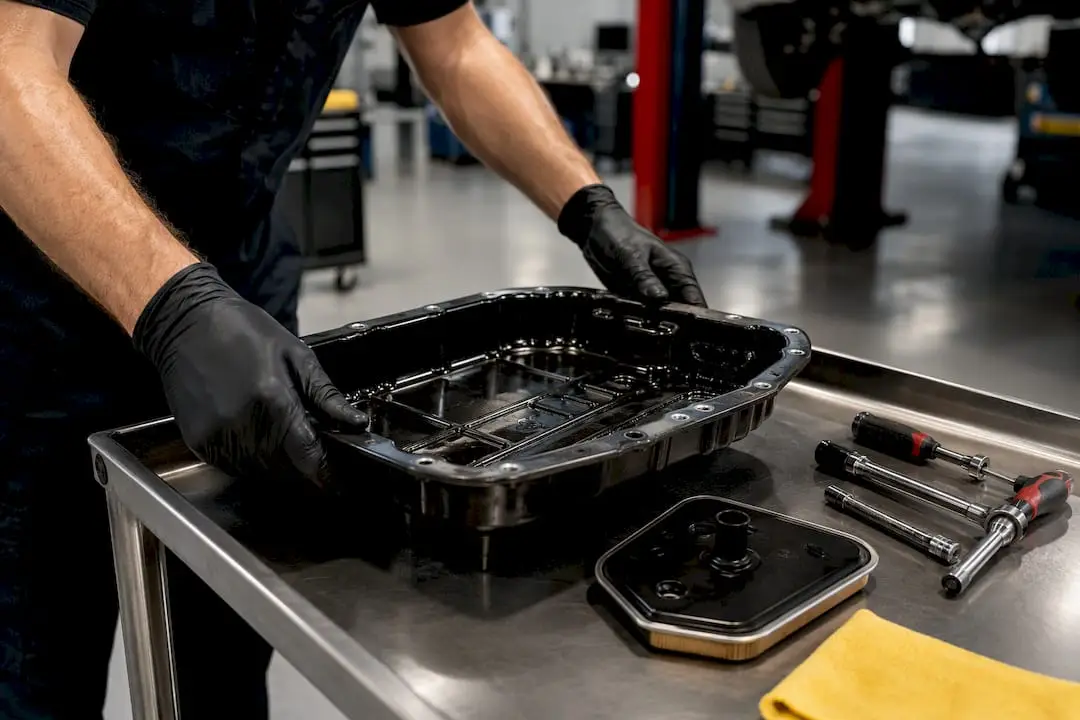
For more on what a proper service includes, see what a transmission service covers and general cautions around transmission fluid and filter changes.
Warning signs and what repairs tend to cost
CVT problems and automatic transmission problems tend to announce themselves differently, and catching them early keeps repair bills smaller.
- A CVT that shudders at low speed, whines under acceleration, or seems to hesitate before power delivery often points to belt or pulley wear.
- Overheating in a CVT can accelerate fluid breakdown, which compounds the original wear problem.
- A conventional automatic that shifts harshly, slips between gears, or delays engagement often signals worn clutch packs or contaminated fluid.
- Torque converter shudder in an automatic can feel like driving over rumble strips, a sign worth having checked promptly.
Repair costs depend on labor hours, parts availability, and whether the transmission can be rebuilt or needs full replacement. Waiting until a transmission fails completely almost always costs more than catching a warning sign early, since a small wear issue can spread to other components once fluid contamination or overheating sets in. For a fuller symptom list, see signs of transmission problems.
Driving habits that help either transmission last longer
Small habits make a real difference in how long a transmission holds up, regardless of type.
- Avoid heavy lugging at low RPM, which stresses both CVT belts and automatic clutch packs.
- Stay within your vehicle’s rated towing capacity, since sustained heavy loads generate excess heat.
- Let the engine and transmission warm up briefly before demanding full power, especially in cold weather.
- Keep the transmission cooling system in good condition, since overheated fluid loses its protective properties faster in either design.
Pro Tip: If your check engine light or a transmission warning appears after towing or a long highway trip, get a diagnostic scan before your next drive rather than waiting for the next scheduled service.
What a professional transmission inspection actually checks
A thorough shop inspection verifies fluid type and level against manufacturer specifications, checks for leaks and abnormal pressure, runs a diagnostic scan for stored codes, and includes a drivability test before any written estimate is given. ASE and RepairPal certified technicians follow documented procedures rather than guesswork, and a paper trail of service records protects both your warranty standing and your vehicle’s resale value.
— Kwik Kar
Schedule a transmission check with Kwik Kar
You don’t need to diagnose a CVT shudder or an automatic’s rough shift yourself. A professional auto care shop in Fort Worth checks fluid type and condition against manufacturer specs, tests for leaks, and provides a written estimate before any work begins, so you know exactly what you’re paying for and why.

A typical transmission appointment includes:
- A fluid level and condition check matched to your specific manufacturer’s fluid spec.
- A diagnostic scan to catch stored codes before they turn into bigger repairs.
- A written estimate with no surprise charges once the inspection is complete.
Keeping a dated record of every fluid check pays off later, whether that’s a warranty claim or a stronger resale price. Visit our preventative maintenance and tune-up services page or explore our full service lineup to book an inspection today.
Sources
For manufacturer fluid specs, see Honda’s owner documentation. For reliability data, see Consumer Reports.
- Car reliability is hurt by some new technologies – Consumer Reports
- Development of continuously variable transmission fluid for fuel economy – SAE
- Transmission Fluid | CR-V 2024 | Honda Owners Manual
FAQ
Which lasts longer, a CVT or automatic transmission?
A well-maintained conventional automatic has historically shown a more consistent longevity record, largely because the technology is more established. A CVT can last just as long when it receives the exact fluid and service intervals its manufacturer specifies, as outlined in Consumer Reports’ transmission maintenance guidance.
Why avoid CVT transmission?
Some drivers avoid CVTs because early versions of the technology generated more reliability complaints, including rough shifting and slipping, compared to established automatics, according to Consumer Reports’ findings on newer transmission technology. That gap narrows significantly when the CVT receives its specified fluid and regular inspections.
Is it better to have CVT or automatic transmission?
Neither is universally better. A conventional automatic tends to suit heavier use and towing more comfortably, while a CVT can deliver smooth, efficient performance in the lighter-duty applications it was designed for, provided the fluid and service schedule match manufacturer requirements.
Can a CVT transmission last 300,000 miles?
A CVT can reach very high mileage when it receives its specified fluid at the intervals the manufacturer recommends and isn’t subjected to towing or loads beyond its design. Skipping fluid service or using the wrong fluid type is one of the fastest ways to shorten a CVT’s lifespan, as Honda’s own fluid guidance makes clear.